


What is the Cost Method to Value Inventory
The cost method is a way to value inventory at what you paid for it. Reviewed November 2026.
The method ignores the price the goods will sell for. Cost covers the buy price. It adds freight in, duties and prep.
Stock stays on the balance sheet at that cost until sold. Once sold, the cost moves to cost of goods sold (COGS). COGS is the expense for items you sold.
Book a callWhat Is the Cost Method to Value Inventory?
The cost method to value inventory is simple.
The business records each item at what it paid to get it ready to sell. A pallet that cost $500 sits on the books at $500. The shelf price does not change that.
Cost is more than the invoice. Freight in, duties and receiving labor all count.
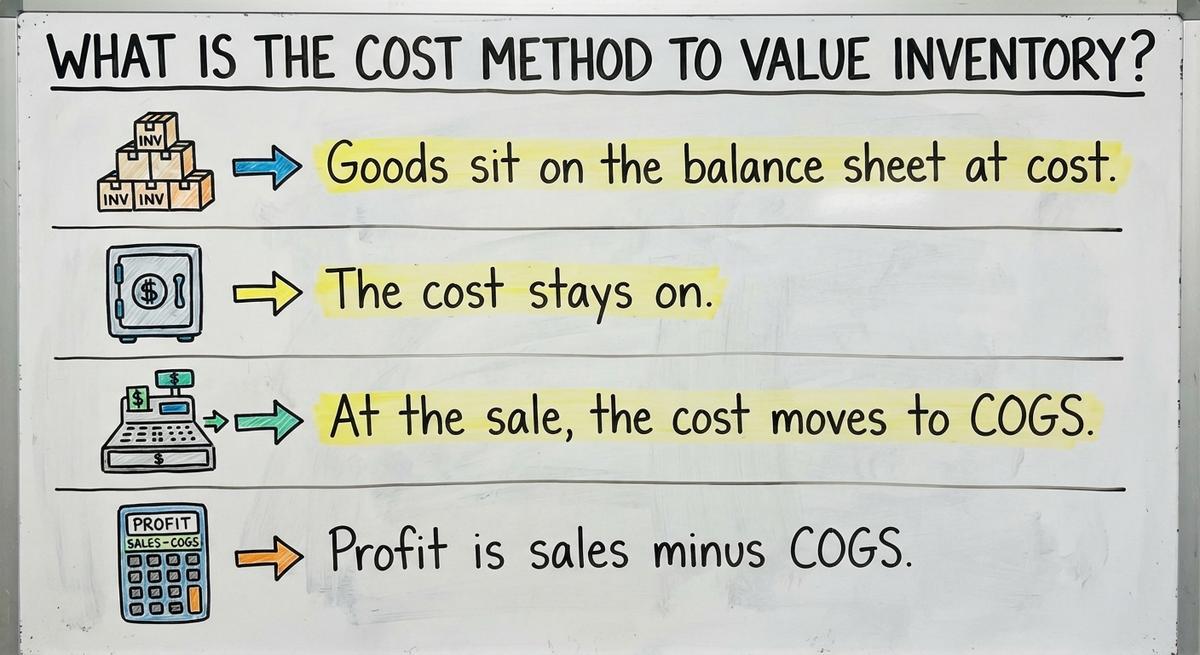
- Goods sit on the balance sheet at cost. The balance sheet is the report of what you own and owe.
- The cost stays on that report until the goods leave your building in a sale.
- At the sale, the cost moves to COGS. COGS is the expense line for goods sold.
- Profit is sales minus COGS. A cost error changes profit by the same amount.
Every inventory valuation method below starts from one rule. Count what you paid, not what you hope to get.
We build it for your operation, and the first look is free
If you would rather not compare products, describe how your operation already works and we build the system around it.
No build cost. You see it running on your own process first, and the monthly subscription starts only once it is live.
Book a callWhy the Cost Method Matters for Wholesalers and Warehouses
Inventory is a major asset for wholesalers.
The US Census Bureau tracks national wholesale inventories and sales each month. You can find them on its Monthly Wholesale Trade page. Stock is big money for the whole sector.
A wrong value hurts in 3 places:
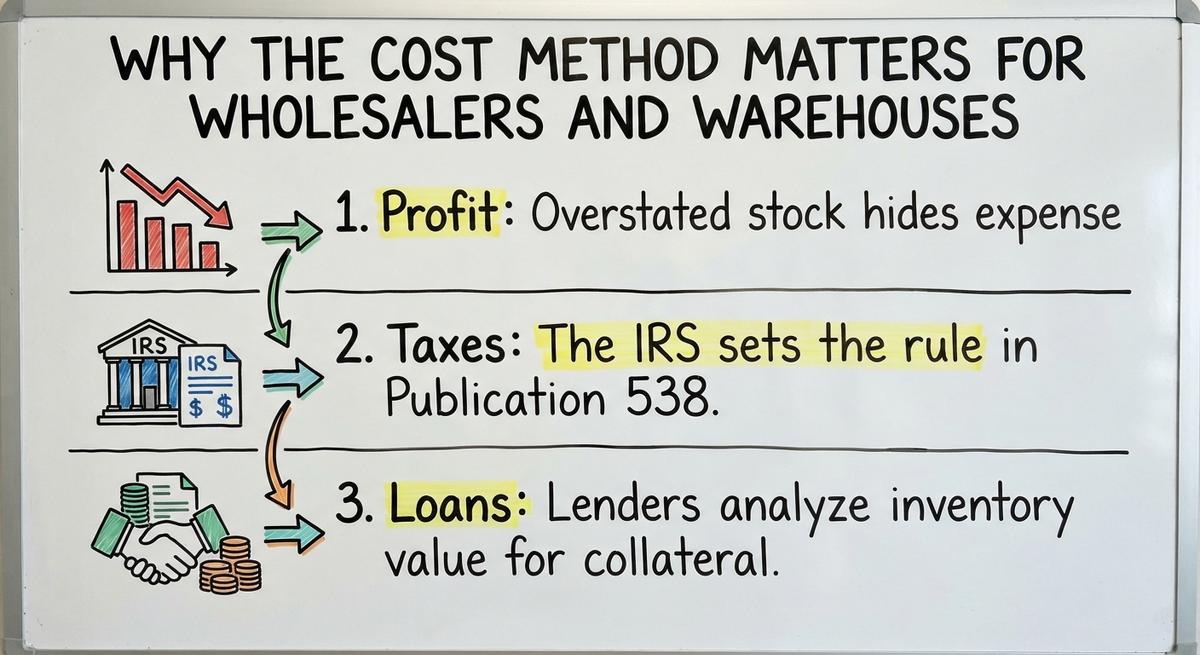
- Profit: Overstated stock hides expense. Profit then looks higher than it really is.
- Taxes: The IRS sets the rule in Publication 538. It states, "you must value your inventory at the beginning and end of each tax year."
- Loans: A lender reads your stock value when it sets your credit line for the year.
GS1 publishes the barcode standards. A scan then ties each unit to one item record. A clean item record is where a clean cost starts.
Right cost also sets right prices and margins.
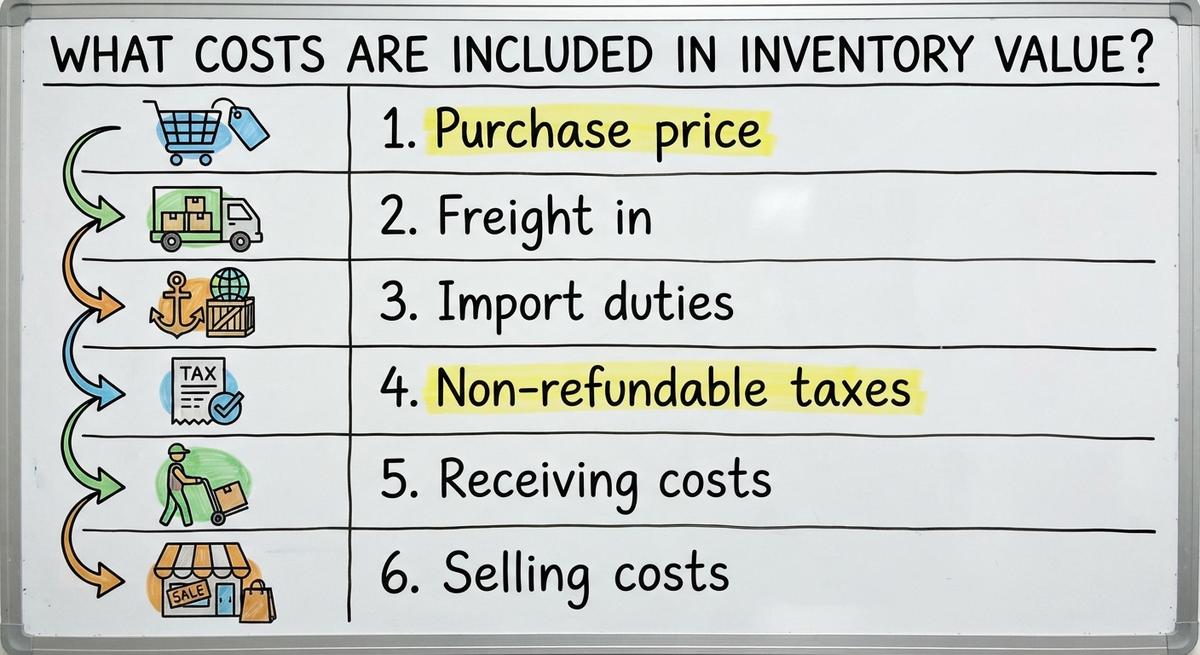
What Costs Are Included in Inventory Value?
Inventory value has 5 cost parts.
The value is the buy price plus every cost to bring goods to your dock and make them ready to sell. Net out discounts and returns.
- Buy price: The amount on the vendor invoice is the base number for each unit you buy.
- Freight in: The cost to ship goods to your warehouse is part of the item cost.
- Import duties: Customs fees paid to bring goods across the border add to the cost of each unit.
- Non-refundable taxes: Taxes you cannot claim back are part of what you paid for the goods.
- Receiving costs: Labor to unload, inspect and tag goods so they are ready for sale counts too.
Ask your accountant how to treat your case. Rules differ by item and by tax status.
Cost is what you paid to make goods sale-ready, and nothing more.
Landed Cost in Numbers
Landed cost is the full per-unit cost.
It is the cost of goods once they reach your dock. Say you buy 200 cases at $8 each. That is $1,600.
Add $150 for freight in. Add $50 in duties. Add $40 for receiving labor. The total is $1,840. Divide by 200 cases to get $9.20 a case.
A freight quote tool states that "LTL shipments can range from 1 - 6 non-stackable standard sized pallets". LTL means less than truckload. Small loads still carry freight cost. That cost belongs in each case.
If you book inventory at $8 a case, you understate cost by $1.20 on every case.
Costs to Leave Out
Three costs stay out of inventory value.
They hit expense in the month you pay them. Keeping them out keeps your cost clean.
- Selling costs: A 5% sales commission on a $2,000 order is $100 of expense and not stock cost.
- Storage after goods are ready: Rent of $60 a month on a shelf is expense in most cases.
- Admin overhead: Office pay, software and the owner's phone bill stay out of stock cost.
Discounts and returns work the other way. A 2% discount on $1,600 saves $32. Returning 10 cases at $8 removes $80.
Subtract both from cost. Stock value holds only what you paid to get goods ready, net of what you got back.
Not sure this is the right shape for your operation
Describe how the work runs today. We map it on a call and show you what it would look like built around that, before you spend anything.
Book a callHow Often Should You Count Stock Before You Value It?
The cost method needs a unit count. Cost times units gives value. A count that is off by 50 units at $12 each is off by $600.
Count stock once a year at minimum.
Do it at year end. The IRS wants value at the start and end of each tax year. Many firms also count a slice every week.
The NIST Manufacturing Extension Partnership offers vendor-neutral guidance on supply chain and inventory process. Start there to design a count routine.
A good count on December 31 sets a clean base for January 1.
Value is only as good as the count behind it.
The Main Cost Flow Methods
Cost flow methods are rules for matching costs.
They match costs to sales when buy prices change over time. Say you bought the same item at 3 prices. Which price goes with each sale?
There are 3 common answers. They are FIFO, LIFO and weighted average cost. A fourth, specific spotting, tracks each unit.
Each gives a different profit from the same facts.
The Running Example
The example uses 3 buys and 1 sale.
A small distributor buys the same item 3 times in a month. Every method below uses these numbers.
- Buy 1: The distributor buys 100 units at $10 each for a total of $1,000.
- Buy 2: The distributor buys 100 units at $12 each for a total of $1,200.
- Buy 3: The distributor buys 100 units at $14 each for a total of $1,400.
- Sale: The distributor sells 150 units at $20 each for a total of $3,000.
Total cost of all 300 units is $3,600.
The only question is how much of that $3,600 is COGS. The rest stays in stock.
FIFO: First In, First Out
FIFO means first in first out.
FIFO sells the oldest costs first. It leaves the newest costs in stock. Most warehouses move goods this way on the shelf.
In the example, the 150 units sold use these costs:
- The first 100 units cost $10 each and add up to $1,000 of COGS.
- The next 50 units cost $12 each and add up to $600 of COGS.
- Total COGS under FIFO comes to $1,600 for the 150 units sold.
The 150 units left cost 50 at $12 plus 100 at $14. That is $600 plus $1,400. Stock left is $2,000.
Profit is $3,000 minus $1,600. That is $1,400.
When prices rise, FIFO shows the highest stock value and the highest profit.
LIFO: Last In, First Out
LIFO sells the newest costs first.
It leaves the oldest costs in stock. The US allows LIFO for tax and GAAP. IFRS does not. IFRS is the rule set used in many other countries.
In the example, 150 units sold use 100 at $14 and 50 at $12. COGS is $1,400 plus $600. That is $2,000.
Stock left is $1,600. Profit is $1,000. Taxable profit is $400 lower than under FIFO.
LIFO needs closer records. Confirm the tax rules with a CPA before you pick it.
Weighted Average Cost
Weighted average cost is total cost over units.
It gives one average cost per unit. Bulk goods and items that look alike fit this method well.
In the example, $3,600 divided by 300 units is $12 a unit.
- COGS is 150 units at $12 each. That comes to $1,800.
- Stock left is 150 units at $12 each. That also comes to $1,800.
- Profit is $3,000 minus $1,800. That leaves $1,200 of profit.
The average smooths out price swings. Profit lands between FIFO and LIFO.
Specific Identification
A serial number or lot tag links each unit to its invoice. The method fits items that are one of a kind. Machines and custom goods are examples.
Specific spotting tracks each unit's real cost.
Say you sell the 150 units that cost $14 each. COGS is $2,100. Cost follows the exact unit that left.
Tracking each unit takes real effort. Use this method for high-value items only.
Here is how the 3 other methods split the same sale of 150 units:
- FIFO: COGS is $1,600 and stock left is $2,000 after the sale of 150 units.
- LIFO: COGS is $2,000 and stock left is $1,600 after the sale of 150 units.
- Weighted average: COGS is $1,800 and stock left is $1,800 after the sale of 150 units.
The same $3,600 of cost splits 3 ways. The split sets your profit.
The comparison is easier when one option is built for you
Off-the-shelf means fitting your process to the software. We do it the other way round, and the first look costs nothing.
Book a call
How to Choose the Right Cost Method
The right cost method fits your business.
It fits how stock moves and how fast prices change. It also fits what your CPA and lender expect. Pick one and stay with it.
Use these rules of thumb:
- Fast, dated goods: Pick FIFO when old stock ships first and expiry dates matter to your buyers.
- Rising prices and tax focus: Ask a CPA about LIFO if cost climbs and you want lower taxable profit.
- Bulk, same-looking goods: Pick weighted average when units are hard to tell apart on the shelf.
- High-value single units: Pick specific spotting when each unit has its own tag and its own price.
Talk to a CPA before you commit. The choice can follow you for years.
Which Cost Method Is Best for a Small Wholesaler?
Most small wholesalers do best with 2 methods.
Those are FIFO and weighted average. Both are simple to run. Both match how goods move.
A team of 5 to 100 staff rarely has time to track LIFO layers. FIFO matches the shelf. Weighted average needs one number per item.
Pick FIFO for perishable or dated goods. Pick weighted average for bulk goods or items bought in many small buys.
Your CPA can run both on last year's data. That shows the gap between them. Simple wins for small teams when the books are kept by hand.
Can a Business Change Its Inventory Cost Method?
A business can change its cost method.
A switch needs a documented reason. It may need IRS approval. Do not change to chase one good quarter.
- Write down why the new method fits the business better than the old one.
- Ask your CPA if the change needs a formal request to the IRS.
- Apply the new method to all items of the same kind and not just some.
- Tell your lender. Using LIFO for tax means using LIFO on lender reports too.
Consistency lets you compare year to year. A method that jumps around hides real trends.

What Happens to Inventory Cost When Goods Are Sold?
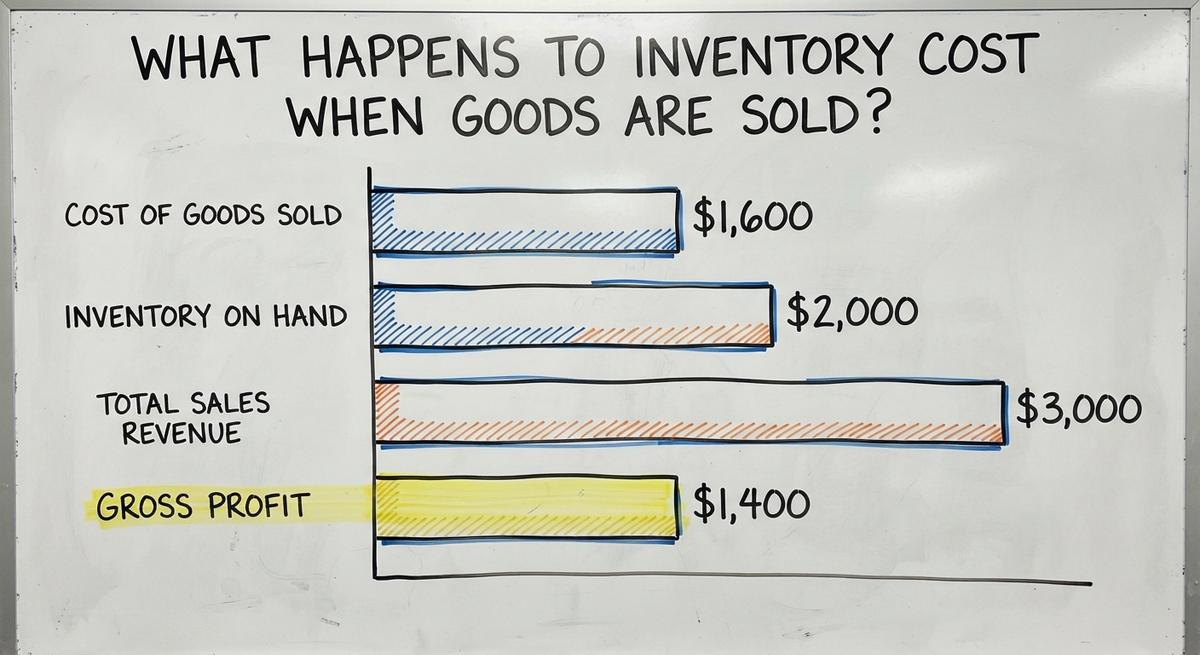
Take the FIFO example. Before the sale, stock is $3,600. After the sale, $1,600 moves to COGS. The other $2,000 stays on hand.
Sold goods move from stock to COGS.
Their cost leaves inventory. Stock on the balance sheet drops. The expense line on the income statement rises by the same amount.
Sales of $3,000 less COGS of $1,600 gives gross profit of $1,400. Gross profit is what is left after the cost of goods.
The cost leaves the shelf the day the sale posts. Late posting shifts profit from one month to the next.

What If Inventory Is Worth Less Than It Cost?
Inventory is written down to net realizable value.
The rule is lower of cost or net realizable value. Net realizable value is the expected sale price minus the cost to sell.
Say a unit cost $12. Damage cuts its sale price to $9. You spend $1 to sell it. Net realizable value is $8.
- Write-down per unit is $12 minus $8. That is $4 for each unit.
- On 50 damaged units, the write-down is $200 in total.
- The $200 hits expense in the period you find the loss.
Do not hold dead stock at full cost. Scrap, damaged and out-of-date goods inflate profit until you write them down.
Cost has a floor. That floor is what the goods will really fetch.

What Mistakes Do Businesses Make When They Value Inventory at Cost?
There are 5 common valuation mistakes.
The most common is leaving out landed cost. Stock then looks cheaper than it is. Other mistakes come from loose data and loose counts.
- Missing freight and duties: Booking only the invoice price understates cost per unit and overstates profit.
- Manual cost edits: Typing new costs into a spreadsheet by hand misses changes when a vendor raises a price.
- Count gaps: Units on the shelf and units on the books drift apart if no one checks them.
- No write-downs: Damaged and obsolete goods stay at full cost long after they lose their value.
- Wrong cost flow: Mixing FIFO on some items and LIFO on others breaks the books for the year.
A fix for each one is below. Small errors repeat on every sale. They grow fast.
One Source of Truth for Cost Data
One source of truth is one cost record.
Cost data lives in many places. An accounting package holds some. A spreadsheet holds more. A paper receiving sheet holds the rest. The 3 disagree. Nobody knows which one is right.
One source of truth means one place where each item's cost is stored and changed. Other tools read from it. They do not keep their own copy.
Pick that place. It can be the accounting package or a cloud system. Then retire the other copies.
If a vendor raises a price on Monday, one edit should fix every report. A cost that exists in 3 places is wrong in at least 2.
Counts That Do Not Match the Books
A count mismatch is a stock gap.
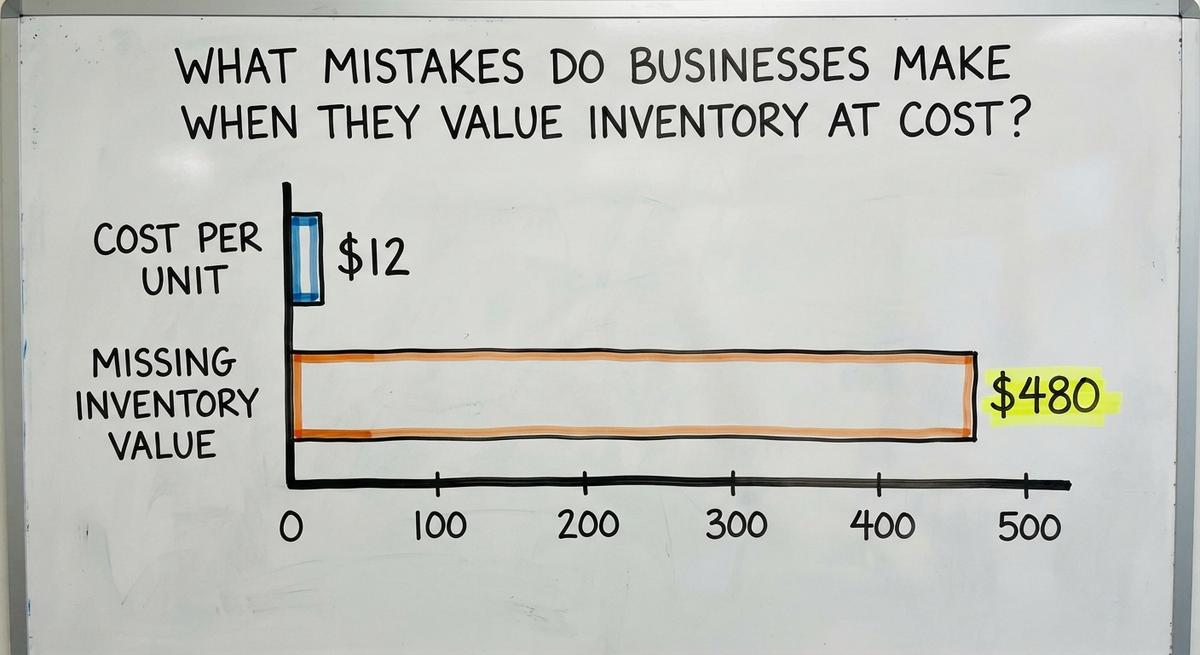
The shelf and the system show different units. At $12 a unit, 40 missing units is $480 of value that is not there.
An accurate count also protects promises to buyers. The US Federal Trade Commission holds sellers to ship when they said they would. You cannot ship stock you do not have.
- Scan on receipt so each unit joins the record on the day it arrives at your dock.
- Count a small slice of items each week and fix any gaps you find fast.
- Post returns and scrap on the same day they happen so the books stay current.
A count that matches the books is the cheapest way to protect your cost.
See it running on your own process first
No build cost. The subscription starts once it is live and doing the job, not before.
Book a call
How Cost Data Links to Holding, Ordering, and Stock Out Costs
Inventory cost is 1 of several costs.
Inventory cost on the balance sheet is only one cost that shapes a warehouse. Others sit outside the cost method. They use the same data.
Three related topics are worth a read:
- The topic of what is holding cost in inventory management covers the price of keeping stock on your shelves.
- The topic of what is ordering cost in inventory management covers the price of placing each buy.
- The topic of what is stock out cost in inventory management covers the lost sales when shelves run empty.
Two more questions come next for growing firms. One is the cost of inventory management software. The other is what is the best warehouse inventory management system?
A clean cost method makes both choices easier.

Next Steps
The cost method comes down to 4 steps.
Write them down this week.
- Add freight in, duties and receiving cost to each item's buy price before you book it.
- Pick FIFO, LIFO, weighted average or specific spotting and write down why you chose it.
- Keep cost data in one place and retire any stray copies of it.
- Review your CPA's view before year end and write down any damaged stock.
If your cost sits in 3 tools today, start with step 3.
A clean record makes every later step cheaper.



Frequently asked questions
What is the cost method to value inventory?
The cost method values stock at what you paid, including freight in and duties, not at its sale price. Goods stay on the balance sheet at that cost until you sell them.
What costs are included in inventory value?
Inventory value holds the vendor price, freight in, import duties, taxes you cannot reclaim, and receiving labor. Selling costs and office overhead stay out, and discounts or returns reduce the total.
What is the difference between FIFO, LIFO, and weighted average?
FIFO sells the oldest cost first, LIFO sells the newest cost first, and weighted average uses one blended cost per unit. When prices rise, FIFO shows the highest profit and LIFO the lowest.
Which cost method is best for a small wholesaler?
FIFO or weighted average suits most small wholesalers. Both are easy to track by hand. Pick FIFO for dated goods and weighted average for bulk items, then check the choice with your CPA.
Can a business change its inventory cost method?
Yes, but not on a whim. Keep a written reason, and ask a CPA if the IRS must approve the switch. Lenders also expect steady methods from year to year.
What happens to inventory cost when goods are sold?
The cost of each sold unit leaves stock and lands in COGS. Stock value drops and expense rises by the same amount, so gross profit equals sales minus that cost.
What if inventory is worth less than it cost?
Write it down to net realizable value, which is the expected sale price minus selling costs. Booking the loss now keeps profit honest. A $4 drop on 50 units is a $200 expense.
Start with a free first look
A 30 minute call, your operation mapped, and a clear picture of what we would build. No obligation and nothing to install.
Book a callRelated guides
More on the same work.
Guides
- Moving Average Method Inventory
- Cost of Inventory Management Software
- Costing Inventory
- Inventory Management Software Costs
- Total Cost of Inventory Formula
- Cost of Carrying Inventory
- Warehouse Management Costs
- Warehouse Management Cost
- Inventory Audit Checklist
- Inventory Management Best Practices
- Inventory Shrinkage Accounting Entry
- Inventory Shrinkage is Recorded When
- Calculate Inventory Shrinkage
- Inventory Process Flow
- Warehouse Inventory Management Software
- Warehouse Inventory Tracking Software
- Warehouse Inventory Management Systems
Common questions
- What is Cycle Counting in Inventory Management
- How to Calculate Cost of Goods Sold Without Ending Inventory
- How Much Does Inventory Management Software Cost
- What is Stock Out Cost in Inventory Management
- What is Holding Cost in Inventory Management
- What is Ordering Cost in Inventory Management
- How to Record Inventory Shrinkage