


Moving Average Method Inventory
The moving average method is a way to cost stock after each buy. Every unit on the shelf then carries the same average cost.
Reviewed November 2026.
Sales use that average to set cost of goods sold (COGS), the cost of what you sold. The rest is your ending inventory value.
Some call it perpetual weighted average cost. It covers the formula, a wholesale example, tax notes, and common slips. The method suits items that look alike and sit mixed together.
Book a callWhat Is the Moving Average Method for Inventory?
The moving average method is one of three common inventory valuation methods.
It is a perpetual inventory system. The average updates each time stock arrives. Staff never track separate price layers.
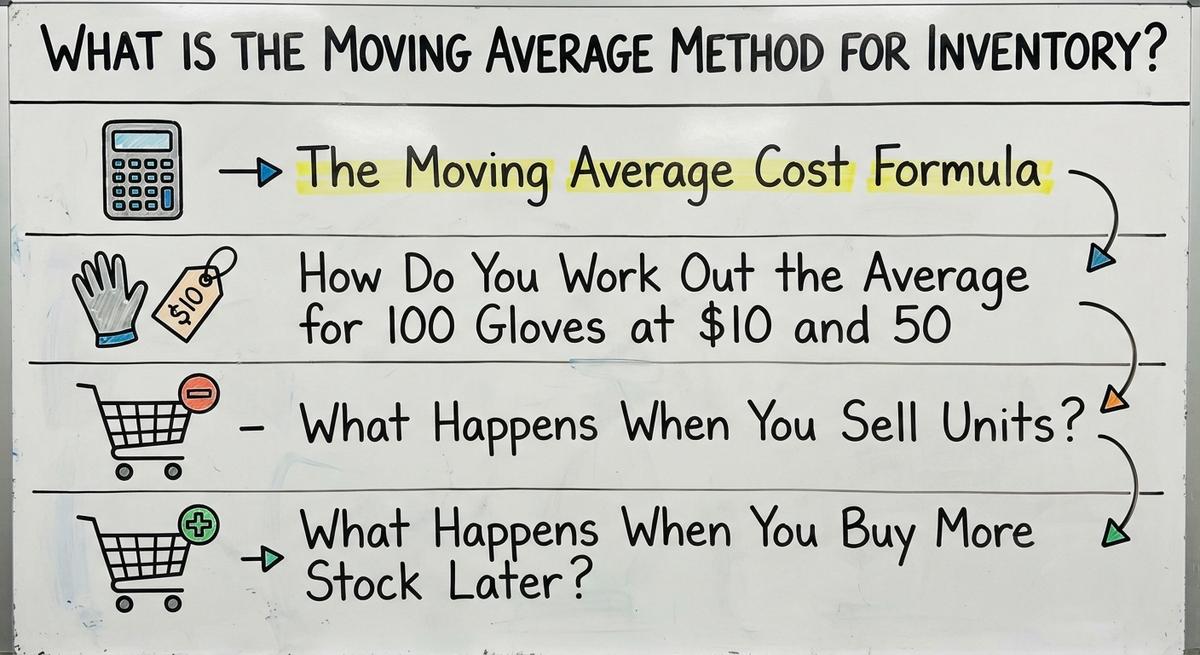
The Moving Average Cost Formula
The moving average cost formula uses two totals from your shelf. Recalculate only when new stock arrives.
New average = total cost on hand ÷ total units on hand
Sales do not change the average. They only remove units at the current average.
Scan-based counts rely on the GS1 barcode standards. Every receipt then matches the right item.
How Do You Work Out the Average for 100 Gloves at $10 and 50 at $13?
The average is $11 per case.
Start with 100 cases of work gloves at $10. That costs $1,000. Buy 50 more at $13. That adds $650.
- Total cost is $1,000 plus $650, or $1,650 for all the stock.
- Total units are 100 plus 50, or 150 cases on the shelf.
- Divide $1,650 by 150 units to get $11 per case.
Every case now carries $11, whichever delivery it came from.
What Happens When You Sell Units?
A sale removes units at the current average and leaves that average alone.
The cost per unit of what remains does not change. No recalculation is needed. Say you sell 60 cases from 150 cases carried at $11.
- Cost of goods sold is 60 cases times $11, or $660.
- Ending inventory value is 90 cases times $11, or $990.
The average stays at $11 until the next delivery lands. Only a new buy moves it. Sales change the count, never the average.
We build it for your operation, and the first look is free
If you would rather not compare products, describe how your operation already works and we build the system around it.
No build cost. You see it running on your own process first, and the monthly subscription starts only once it is live.
Book a callWhat Happens When You Buy More Stock Later?
Buy 60 more cases at $14. That costs $840.
A new buy joins the remaining stock value, and you divide by the new unit total.
Add $990 and $840 for $1,830. Divide by 150 units. The new average is $12.20.
The average rose $1.20, from $11 to $12.20. It shifts a little with each delivery. That drift is why the method is called moving.
Why Do Wholesale Teams Use Moving Average Costing?
Wholesale inventory teams use moving average costing for goods that are alike and mixed on shelves.
One average beats tracking every buy layer. It also smooths supplier price swings. Margins on quotes stay steady.
Benefits
The method is easy to teach and light on record keeping. It fits small teams and businesses with many identical items. Four gains stand out:
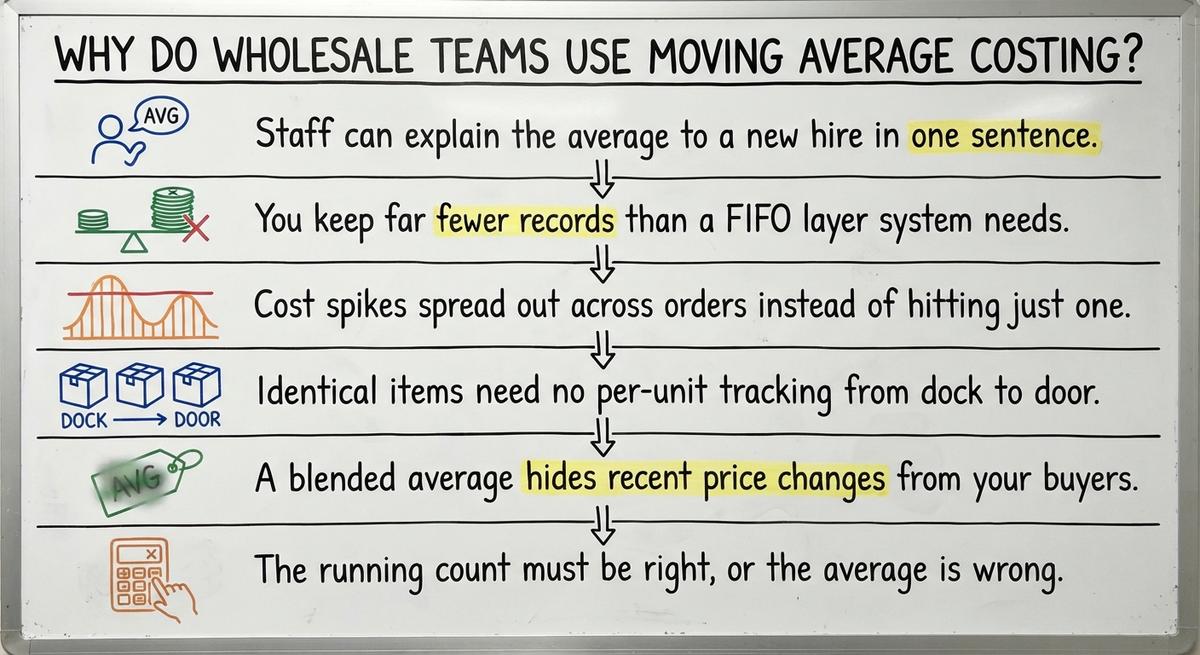
- Staff can explain the average to a new hire in one sentence.
- You keep far fewer records than a FIFO layer system needs.
- Cost spikes spread out across orders instead of hitting just one.
- Identical items need no per-unit tracking from dock to door.
Together, these gains cut training time and bookkeeping. Cost figures stay steadier from order to order.
Drawbacks
The method has four limits. Fix them before you rely on it.
- A blended average hides recent price changes from your buyers.
- The running count must be right, or the average is wrong.
- Serialized or one-of-a-kind items need their own cost records.
- Late bills and landed costs, meaning freight and duties, throw the average off.
The method is only as good as your counts and receipts.
Not sure this is the right shape for your operation
Describe how the work runs today. We map it on a call and show you what it would look like built around that, before you spend anything.
Book a callHow Is Moving Average Different From FIFO and Other Methods?
FIFO (first in, first out) is a method that sells the oldest cost first. Moving average blends all costs.

In rising prices, FIFO shows a higher profit. Moving average lands in the middle. That gap is the heart of FIFO vs moving average.
| Method | Cost it uses on a sale |
|---|---|
| FIFO | Oldest buy cost |
| Moving average | Blended average cost |
Take the glove example. FIFO would cost the first 60 cases at $10, or $600. Moving average costs them at $11, or $660.
LIFO and Periodic Weighted Average
Two other methods get confused with moving average. Here is how each one differs.
LIFO (last in, first out) is a method that sells the newest cost first. IFRS does not allow it. US tax rules apply, so ask an accountant before choosing it.
Periodic weighted average cost is a method figured once at period end across all buys in that period. Moving average updates after each buy. The cost stays current.

Is the Moving Average Method Allowed for Taxes?
Average cost is a commonly accepted method under US GAAP.
Use the same method each year. A change can need IRS approval. Confirm with a CPA first.
The law does need you to value stock. IRS Publication 538 says, "To figure taxable income, you must value your inventory at the beginning and end of each tax year."

What Costs Go Into the Average Cost per Unit?
The average cost per unit is the buy price plus costs tied to that buy. Pick a rule and keep it.
- The buy price of the goods you bought from the supplier.
- Freight in, duties, and handling tied to that same buy.
- Discounts and returns lower the cost of the goods.
Add freight for one supplier and you add it for all. Steady rules give steady numbers for COGS average inventory work.
The comparison is easier when one option is built for you
Off-the-shelf means fitting your process to the software. We do it the other way round, and the first look costs nothing.
Book a call
Common Mistakes That Skew Your Average Cost
Five mistakes wreck the average. Most come from data entry, not the math.
- Staff enter receipts days late, so sales use a stale average.
- A case gets logged as an each, inflating the unit count.
- Selling before receiving creates negative inventory and a bad average.
- Someone adjusts stock without a note, and no one can trace it.
- Teams skip cycle counts, so errors pile up unseen.
An accurate count also helps you ship on time. The FTC mail order rule holds sellers to the ship date they promised. NIST offers supply chain guidance on tightening these steps.
Can Accounting Software or Spreadsheets Handle Moving Average Costing?
Some accounting packages use FIFO only. Others offer average costing.
Check the current records for your edition before you rely on its inventory costing. Many small distributors keep their books in accounting software. Costing drifts when stock data lives in other sheets.
Why Do Spreadsheets Struggle With Moving Average?
Spreadsheets break in five ways.
- One sort or deleted row breaks the formula chain, and the error hides.
- Each buy must apply in order, so one broken link carries forward.
- Several people edit several copies, so no file holds the true numbers.
- Printed pick sheets and emailed orders lag behind the latest counts.
- Cost by location or lot is hard to see in one sheet.
When a Custom Tool Makes Sense
No big ERP. No long move. It works at small scale, and our team is local to Columbus, Ohio.
A custom tool makes sense when receiving, picking, and costing live in one place.
We build it around how your team already works. You keep your accounting software for the books. We replace only the manual steps that feed it.
Compare it with warehouse inventory management software and the best inventory software before you choose.
A Quick Checklist Before You Choose
Five questions guide the pick. Talk through them with your team before you commit to a method:
- Are your items identical or unique?
- How often do supplier prices change?
- How accurate are your counts today?
- Who reviews the numbers each month?
- What does your accountant advise?
Your answers point to a method, or to the manual step to fix first.
Next Steps
Recalculate on each buy and keep counts clean. The average is only as reliable as the data behind it.
Then map how stock is received and costed today, from the delivery dock to the ledger. Mark each manual step along the way.
We can talk through where those steps cause errors, with no pressure.
Frequently asked questions
What is the moving average cost method and how is it used to value inventory?
The moving average cost method finds a new average cost per unit after every buy. Total cost on hand is divided by total units on hand. Sales remove units at that average. The result sets cost of goods sold and the value of ending inventory.
Does the average cost change when you sell items?
No. A sale removes units at the current average, so the average stays the same. It changes only when new stock arrives at a different price. Sales lower the unit count and the total value, but the cost per unit holds.
Is moving average the same as weighted average cost?
They are close cousins. Moving average updates after every buy. Periodic weighted average is figured once at period end. Both blend costs. Moving average needs a live count, so it fits a perpetual inventory system.
Which inventory costing method is best?
No single method is best. The choice depends on four things: whether items are identical, how often supplier prices change, how accurate your counts are, and what your tax rules allow. Ask your accountant before you pick.
Can you switch costing methods?
Yes, but a change may need IRS approval. Pick one method and use it the same way each year. Talk to a CPA before you switch, since the change can affect taxes and past records.
Does moving average work for perishable goods?
It can work for goods that look alike. Perishables often need first-in, first-out handling on the shelf, so the oldest stock ships first. Costing and shelf rotation are separate choices. Check both with your accountant.
Start with a free first look
A 30 minute call, your operation mapped, and a clear picture of what we would build. No obligation and nothing to install.
Book a callRelated guides
More on the same work.
Guides
- Average Days to Sell Inventory Formula
- Cogs Average Inventory
- Inventory Audit Checklist
- Inventory Management Best Practices
- Inventory Shrinkage Accounting Entry
- Warehouse Inventory Management Software
- Warehouse Inventory Tracking Software
- Warehouse Inventory Management Systems
- Best Inventory Software
- Quickbooks Inventory Management Software
- Warehouse Inventory Systems
- Classification of Inventory
- Inventory and Warehouse Management Software
- Custom Inventory Management Software
- Excess Inventory
- Closed for Inventory
- Warehouse Inventory Management System
- Retail Inventory Management
- Multi Location Inventory Management Software
- Ms Excel Inventory Template
- Warehouse Inventory Software Programs