


Inventory Management Best Practices
Inventory management best practices are repeatable habits that keep stock counts true and stock levels right. Updated November 2026, it ends with a 30-day plan.
Good habits put the right item in the right place, in the right amount, at the right time. You will find small worked examples with simple numbers throughout.
The steps work without a big ERP, a system that runs a whole company. Most run on QuickBooks, a few labels and a clear routine.
Book a callWhat Are Inventory Management Best Practices?
Inventory management best practices are the habits that make your stock records match your shelves. Four goals drive them: the right item, the right place, the right amount and the right time.
Labels help people find the item. Counts prove the amount. Reorder rules fix the timing. You can run all of it on plain tools. Habits come first and software comes second.
We build it for your operation, and the first look is free
If you would rather not compare products, describe how your operation already works and we build the system around it.
No build cost. You see it running on your own process first, and the monthly subscription starts only once it is live.
Book a callWhy Inventory Management Best Practices Matter
Poor inventory control costs money in 3 ways. Slow stock ties up cash. A stockout, which means an item is gone when a customer wants it, loses a sale. Hunting for items wastes labor.
Take 3 people who lose 6 hours a week each to searching, at $22 an hour. That is $20,592 a year (3 x 6 x 22 x 52). The US Bureau of Labor Statistics posts pay for shipping, receiving and inventory clerks if you want your own rate.
How Do You Know Your Inventory Process Is Breaking Down?
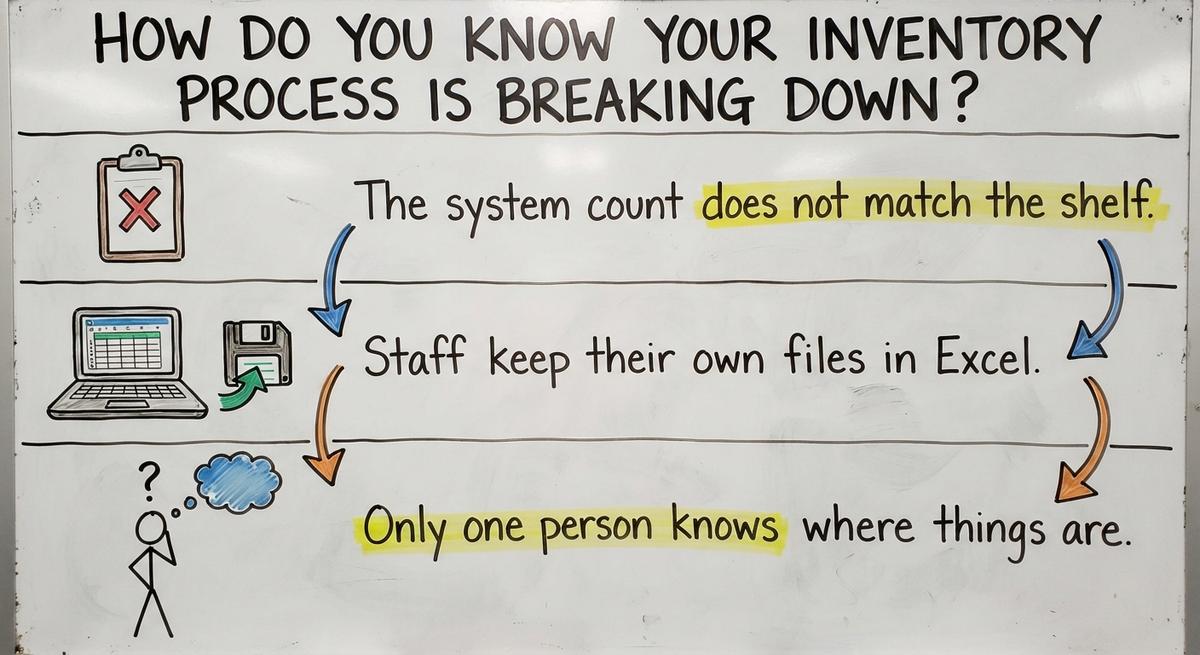
Your process is breaking down when 3 warning signs show up. Each one points to a habit that no longer fits your size.
- The system count does not match the shelf. Missed entries, unrecorded returns and picking errors cause the gap. Small gaps grow, and each one hides the next.
- Staff keep their own files in Excel, Access, printed sheets and email. Four versions of the truth give you four chances for error.
- Only one person knows where things are. When that person is out, work stalls. New hires take weeks to learn the floor.
Seeing even one sign means manual habits no longer fit your size.
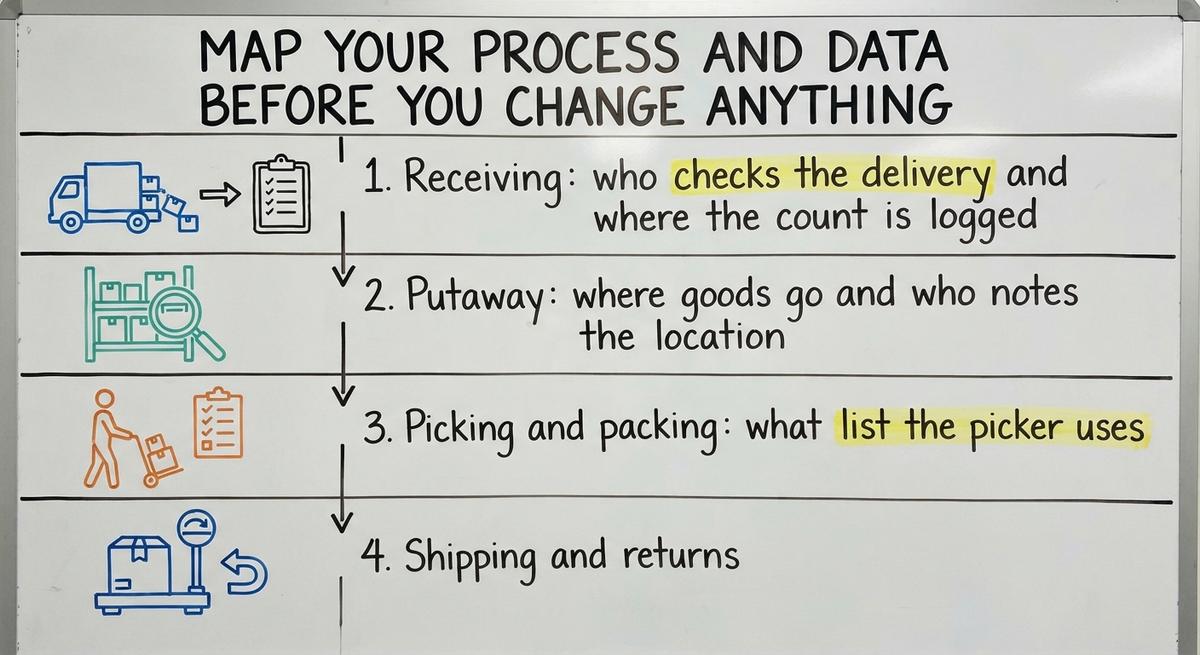
Map Your Process and Data Before You Change Anything
A map of your current process takes 1 to 2 days, and you cannot fix what you have not mapped. Walk the floor with a notepad. Write down each step and who records it.
- Receiving: who checks the delivery and where the count is logged.
- Putaway: where goods go and who notes the location.
- Picking and packing: what list the picker uses.
- Shipping and returns: who updates the count after the truck leaves or the box comes back.
Next, list every place inventory data lives: QuickBooks, Excel, Access, paper and email. Mark each one as trusted or a guess. Then pick the top 1 or 2 pain points. Set one measure, such as count accuracy, and track it from day one.
Not sure this is the right shape for your operation
Describe how the work runs today. We map it on a call and show you what it would look like built around that, before you spend anything.
IRS Publication 538 puts it plainly: “To figure taxable income, you must value your inventory at the beginning and end of each tax year.”
Book a callWarehouse Organization That Keeps Stock Findable
Warehouse organization comes before software. A tidy floor gives accurate data, and a messy floor ruins it. Three rules cover most of the work.
- Give every item one SKU and one name. A SKU is a stock keeping unit, the unique code for one item. Use a fixed pattern such as BOLT-HEX-050-ZN. Merge duplicates and drop vague names like "misc bolts."
- Set the unit of measure. Decide if you track cases or eaches, then store the case size on the item.
- Label bin locations. A bin location is the exact spot for an item. Use a code like A-03-2-B for aisle, rack, shelf and bin. Use durable labels people can read from 6 feet away. Record the location with each item.
Slot fast movers, the items that ship most, close to shipping. Walking time drops and picking mistakes fall. Good labels and good slots do more for accuracy than any new screen.

Record Every Stock Movement at the Time It Happens
The core rule is simple: if stock moves, you record it right then. Delay is the main cause of bad counts. Apply the rule at 5 points:
- Receive goods against a buy order. Check quantity and condition at the dock. Flag shortages and damage the same day.
- Put stock away at once and log the location. Piles of unlogged stock are how items vanish.
- Pick from one pick list tied to the order. Confirm quantities before the box closes.
- Pack and ship from that same order source, so the count drops when the truck leaves.
- Hold returns and damaged goods in a separate area with status codes. Decide to restock, repair or write off.
Barcodes speed this up, but a simple paper log beats no log. Inventory tracking only works when the record happens at the shelf.
Inventory Control Through Cycle Counting
Inventory control is the work of keeping records true and levels right. Counting proves the numbers. A cycle count beats the once-a-year shutdown, and it lifts inventory accuracy all year.

What Is a Cycle Count and How Often Should You Count?
A cycle count is a small count of a few items or areas on a set schedule. Count a few areas each week. You disrupt less work and catch errors fast.
Use the ABC idea. A items are your top-value and fastest items. B items sit in the middle. C items are slow and cheap.
- A items: count every week.
- B items: count every month.
- C items: count every quarter.
Count the items that matter most most often.
Find the Cause of Every Count Difference
A count difference is a clue, not a number to erase. Do not just adjust the record. Ask what went wrong: a missed receipt, a wrong pick or a return nobody logged.
Track the pattern by item, person and process step. If 3 misses hit the same shelf, fix the shelf. Inventory accuracy is counted stock that matches recorded stock, shown as a percent.
Set Reorder Points and Safety Stock
A good reorder rule stops both stockouts and overstock. Base it on real sales and real supplier timing. The NIST Manufacturing Extension Partnership offers vendor-neutral guidance on supply chain process.

Share forecasts with key vendors on a regular check-in. Get lead times and minimum orders in writing. Agree on backorder and substitution rules, tell customers early and record each decision on the order.
How Do You Calculate a Reorder Point?
A reorder point is the stock level that triggers a new order. The formula is daily use times lead time, plus a buffer. Lead time is the days from order to arrival.
Track the actual number for each supplier, not the promise. Say you sell 20 units a day and the lead time is 7 days. That is 140 units. Add a 40-unit buffer and you reorder at 180 units.
The comparison is easier when one option is built for you
Off-the-shelf means fitting your process to the software. We do it the other way round, and the first look costs nothing.
Book a callHow Much Safety Stock Do You Need?
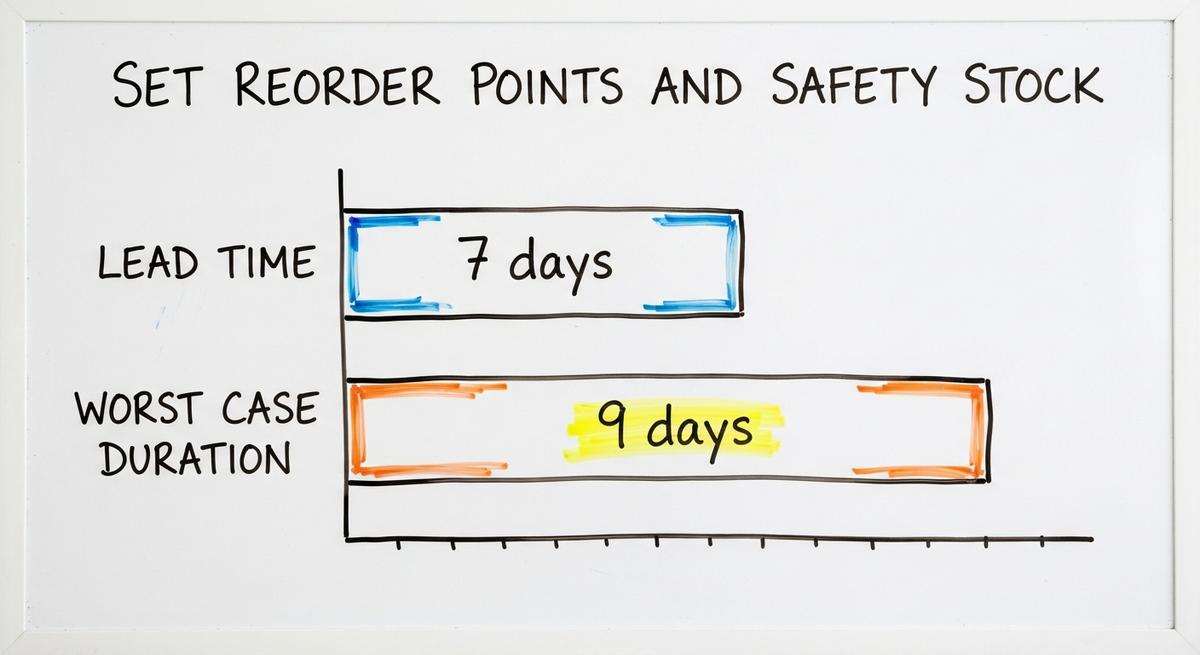
Safety stock is extra inventory held for late shipments and demand spikes. Size it from your worst case. Subtract average use over average lead time from worst-case use over worst-case lead time.
Say the worst case is 25 a day for 9 days. That is 225. The average is 140. The gap is 85 units of safety stock. Skip buffers on slow items unless you have a reason.

Manage Slow and Dead Stock
Dead stock is inventory that has not sold in a long time. It traps cash on shelves and takes up bin locations that fast movers need.
Run a simple report from sales history every month. Flag items with no sales in 90 days, or the window you choose. Then decide for each item:
- Discount it to move it fast.
- Bundle it with a popular item.
- Return it to the supplier if terms allow.
- Write it off and clear the space.
Stop reordering what does not sell. Each month you wait costs you shelf space and cash.

Choose the Right Valuation and Costing Method
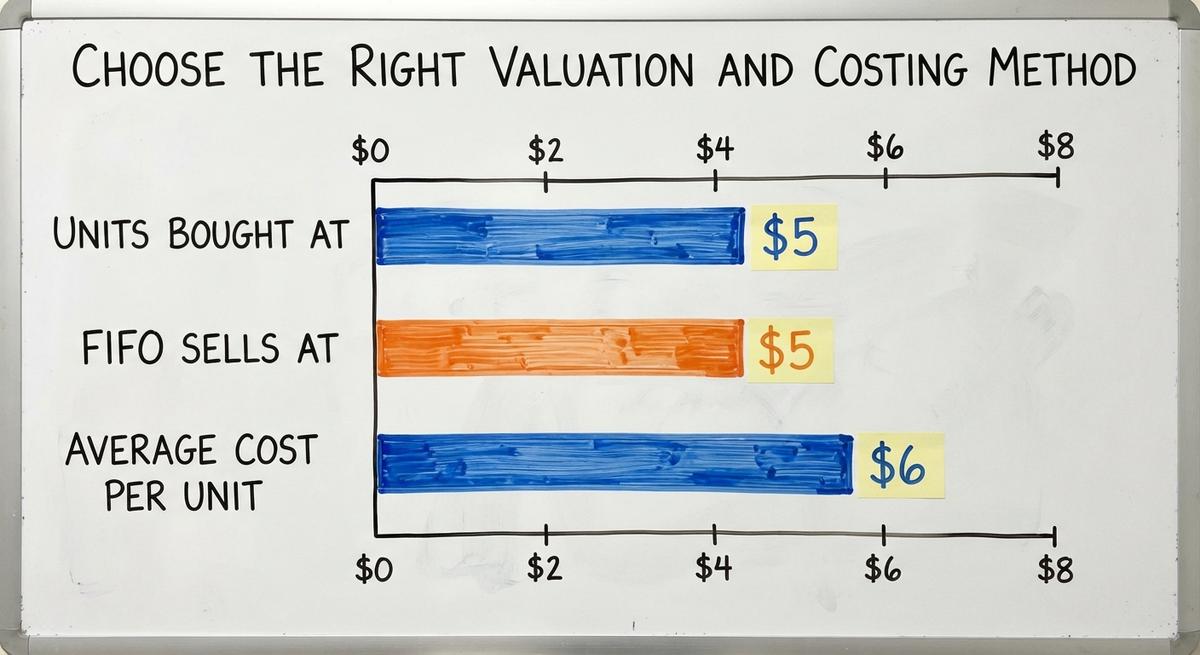
FIFO means first in, first out: you sell the oldest cost first. Average cost adds up total cost and divides by units. LIFO sells the newest cost first.
Take 10 units bought at $5 and 10 bought at $7. FIFO sells at $5 first. Average cost is $6 for every unit.
Talk to your accountant and match the method your QuickBooks file uses. Perishable or dated goods favor FIFO, or FEFO, which means first expired, first out. Pick one method and keep it.

Train Your Team and Name an Owner
Best practices fail without habits. Write a one-page procedure for each task: receiving, picking, counting and returns. Add photos and a checklist so a new hire can follow it on day one.
Then name one owner for inventory accuracy. That person reviews a few key numbers each week. One accountable person turns a good plan into a routine.

Track the Right Inventory Numbers
A short list of numbers beats a big dashboard. Track these 3 and review them weekly.
- Inventory accuracy: counted stock that matches the record, as a percent. If 190 of 200 counts match, accuracy is 95%.
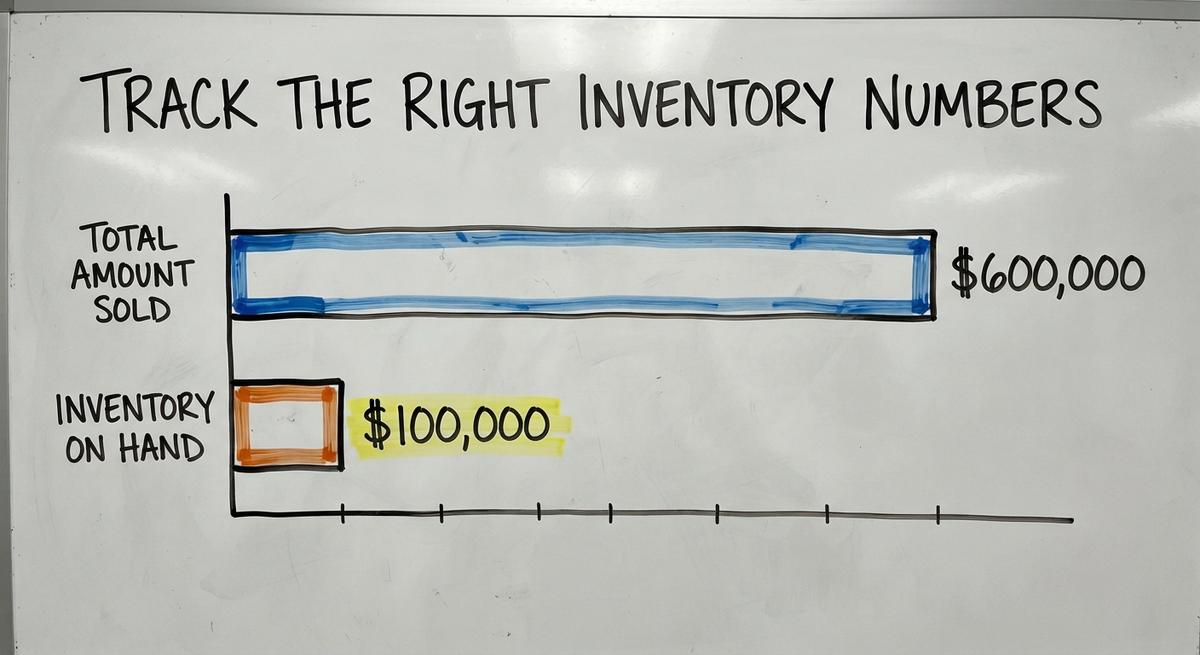
- Inventory turnover: cost of goods sold divided by average inventory. With $600,000 sold and $100,000 on hand, you turn stock 6 times. Days on hand is 365 divided by 6, about 61.
- Fill rate: orders shipped complete and on time, divided by all orders. Stockout rate is the share of requests you could not fill.
The US Census Bureau publishes wholesale inventories and sales each month, so you can compare your own ratio. A rising fill rate shows customers can trust your promises.
See it running on your own process first
No build cost. The subscription starts once it is live and doing the job, not before.
Book a call
Know When Spreadsheets and Paper Stop Working
Spreadsheets work at first. They stop working when more people touch the data and more items move each day. Wholesale distribution inventory brings lots, bins and fast picking.
Can QuickBooks Handle Inventory Management on Its Own?
QuickBooks inventory handles accounting well. It is weaker at bin locations, lot tracking, pick lists and many users updating at once. Excel and Access have the same limits.
Point-of-sale tools help at the register. Forbes notes a POS system can "track inventory" for retail, as its guide to small business POS systems explains. Retail inventory management differs from warehouse work. Re-keying the same data by hand is where errors start.
Can You Keep QuickBooks and Replace Only the Manual Parts?
You have 3 routes. Off-the-shelf warehouse inventory management software fits standard workflows. A full ERP fits large, complex firms. Custom inventory management software fits you when your workflow is unusual. The Software Society, a Columbus, Ohio team, builds custom tools around your current workflow. QuickBooks stays for accounting. Receiving, picking, counts and reorder alerts get fixed first.
Yes. Most small operations do not need a full ERP. They need the manual parts fixed, without a long and costly rollout.

A Simple 30-Day Plan to Put These Practices to Work
A 30-day plan fits one change into each week. Follow this order:
- Week 1: map your process and list every data source.
- Week 2: clean up SKUs and label every bin location.
- Week 3: start cycle counts and the rules for recording each move.
- Week 4: set reorder points and pick 3 numbers to track.
Small steps in a fixed order stick better than one big change.

Common Inventory Management Mistakes to Avoid
Five mistakes cause most inventory trouble:
- Counting once a year, so errors pile up for 12 months.
- Adjusting numbers without finding the cause.
- Buying on gut feel instead of lead times and sales.
- Keeping the same data in too many tools.
- Changing everything at once.
Fix one habit at a time and prove it works before you add the next.
Next Steps for Your Operation
If you want to talk through your workflow, The Software Society can review where manual steps cost you time. Bring your map from the 30-day plan, and we will work out which parts to fix first.
Start with the habits that pay first: record each move, count a little each week and set reorder points from real lead times.
Frequently asked questions
What is the role of inventory control in management?
Inventory control tells managers what stock they own, where it sits and when to reorder. It protects cash, keeps promises to customers and gives owners numbers they can trust for buying and pricing.
What are some effective inventory management practices?
Use clear SKUs and bin labels. Record each move as it happens. Run weekly cycle counts. Set reorder points from real lead times. Review slow stock monthly. Track accuracy, turnover and fill rate. Name one owner for the numbers.
Start with a free first look
A 30 minute call, your operation mapped, and a clear picture of what we would build. No obligation and nothing to install.
Book a callRelated guides
More on the same work.
Guides
- Warehouse Inventory Management Software
- Warehouse Inventory Management Systems
- Quickbooks Inventory Management Software
- Inventory and Warehouse Management Software
- Custom Inventory Management Software
- Warehouse Inventory Management System
- Retail Inventory Management
- Multi Location Inventory Management Software
- Inventory Management for Multiple Locations
- Manufacturing Inventory Management Software
- Cost of Inventory Management Software
- Manufacturing Inventory Management
- Retail Inventory Management Systems
- Inventory Management Software Freeware
- Inventory Management Small Businesses
Common questions
- What is Inventory Management Practices
- Why is Warehousing and Inventory Management Important
- What is the Difference Between Aggregate and Item Inventory Management
- How to Manage Inventory in a Warehouse
- What is the Best Warehouse Inventory Management System?
- What is the Difference Between Warehousing and Inventory Management
- What is B Type of Inventory in Warehouse Management
- What is Warehousing and Inventory Management
- What is Jit Inventory Management