


Inventory Audit
An inventory audit is a check that compares your records with what sits on your shelves. One side is the system or spreadsheet count. The other side is the shelf count. Reviewed November 2026.
Book a callWhat Is an Inventory Audit and Why Does It Matter?
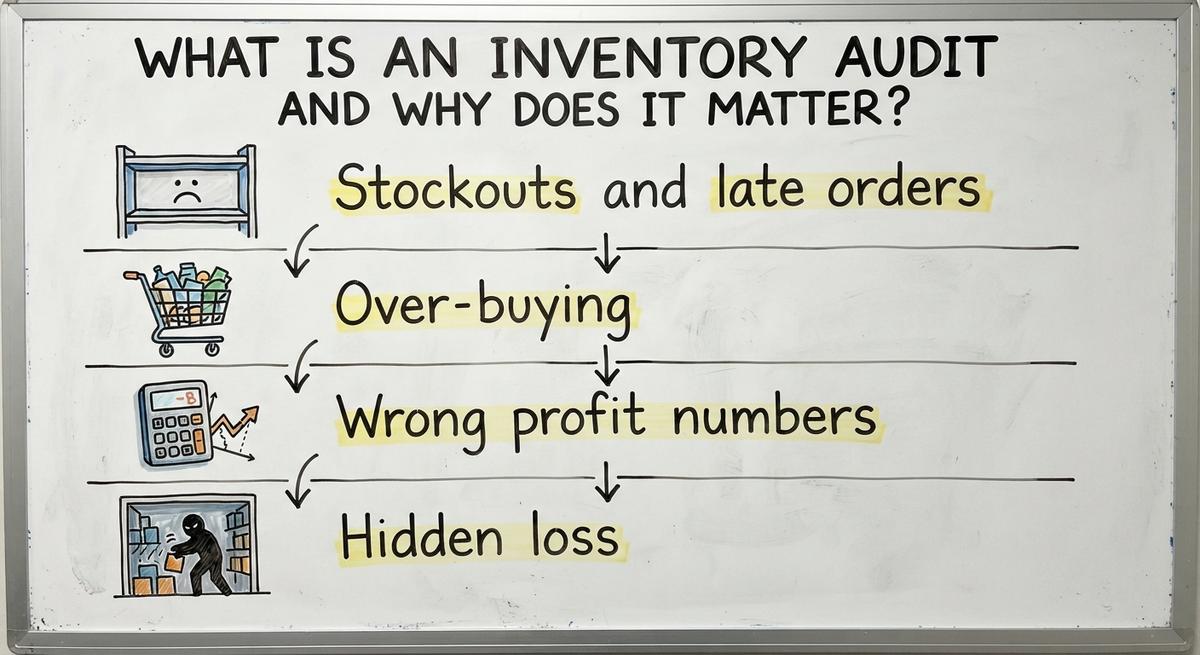
Inventory audits are tests of two things: your counts and the process that keeps them right. Wrong counts hurt in plain ways.
- Stockouts and late orders: Records that show stock you do not have lead to promises you cannot keep.
- Over-buying: Records that hide stock on the shelf lead to cash tied up in extra product.
- Wrong profit numbers: Books that miss the shelf give a wrong cost of goods sold.
- Hidden loss: An audit finds theft, damage and mistakes before they grow.
The IRS says in Publication 538 that "you must value your inventory at the beginning and end of each tax year." Lenders and insurers also ask for stock values. Barcodes help here. GS1 publishes the standards behind scan-based counts. A true count backs every one of these requests.
We build it for your operation, and the first look is free
If you would rather not compare products, describe how your operation already works and we build the system around it.
No build cost. You see it running on your own process first, and the monthly subscription starts only once it is live.
Book a call
Inventory Audit vs. Stocktake vs. Cycle Count: What Is the Difference?
An audit is a check of accuracy and the process behind it. A stocktake or physical inventory count only records quantities. People use the terms loosely, so they overlap.
A cycle count is a small, rolling count of part of the stock. You can count one aisle today and another next week. Over time you cover everything.
The audit asks a bigger question. It asks why the numbers were wrong and what to change. A count gives you data. An audit gives you answers.
Types of Inventory Audits
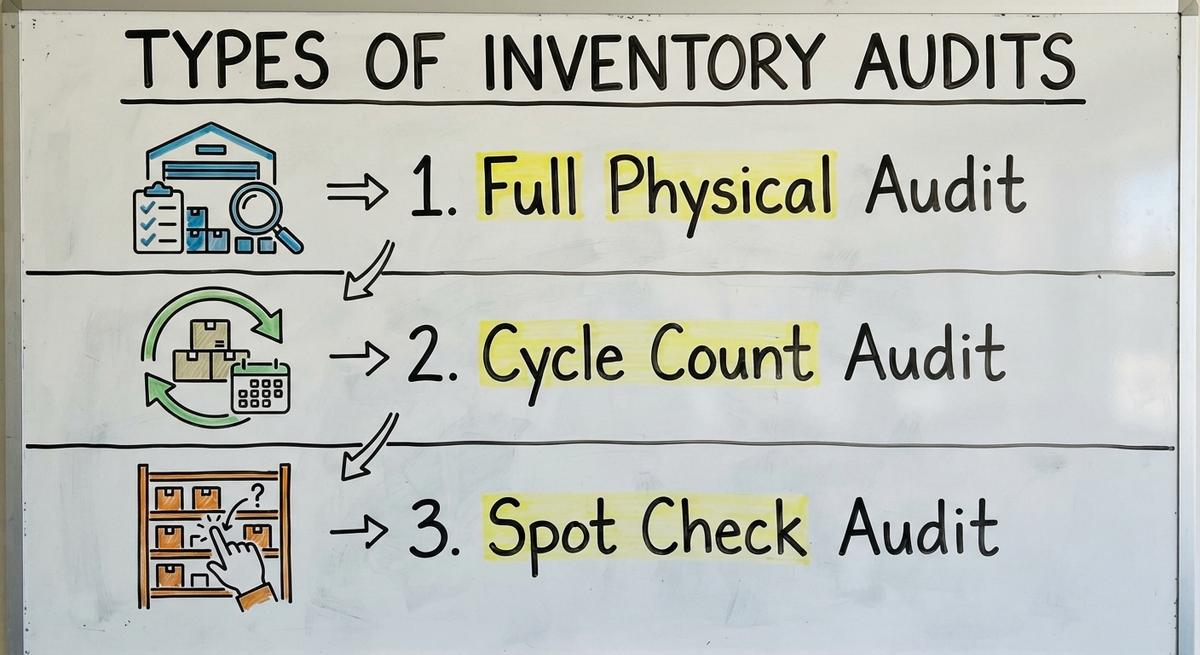
3 types fit most small warehouses: the full physical audit, the cycle count audit and the spot check. Each suits a different need.
Full Physical Audit
A full physical audit is a count of every item at one time, such as at year end. The upside is a complete picture. The downside is that shipping needs a pause and the count takes many hands. This type fits a smaller warehouse with a limited number of SKUs. A SKU (stock keeping unit) is a unique item number.
Cycle Count Audit
A cycle count audit is a small count of your stock each day or week. Over time, all stock gets covered. Every item is checked on a regular rotation instead of in one big push. You need no shutdown, and orders keep going out while counters work. Errors surface sooner. A gap is caught within days, not at the end of the year. Start with high-value or fast-moving items, as mistakes there cost the most.
Spot Check Audit
A spot check audit is a look at a few items picked at random. You can also use it when something seems off. Run one after a big receiving day, a returns surge or a customer complaint. Errors creep in at those times. Count the chosen items by hand and compare them to your records. A spot check is a quick test of how far you can trust your records. It takes far less time than a full count.

How to Do an Inventory Audit Step by Step
8 steps take you from scope to review. Preparation comes first.
Before the count, do these four things:
- Label bins and group like items so counters find stock fast.
- Clear trash and returns piles from the floor.
- Finish open receiving and shipping, or note what is in motion.
- Export the current stock list from your accounting software or spreadsheet, and set a date.
Then run the audit:
- Set the scope: pick the area or items to count.
- Freeze movement so stock stays put.
- Count each item by hand.
- Record the count on a sheet.
- Compare the sheet to your records.
- Investigate each gap.
- Adjust the records.
- Review what went wrong.
Have one person count and a second person verify high-value items. Tell your team and customers if shipping will slow.
Not sure this is the right shape for your operation
Describe how the work runs today. We map it on a call and show you what it would look like built around that, before you spend anything.
Book a callDo You Have to Stop Shipping During an Inventory Audit?
Pauses are needed only for full counts. Cycle counts and spot checks run as orders go out. The FTC expects you to ship when you said you would. Plan any pause with care.
Who Should Perform the Warehouse Inventory Audit?
The best auditors are people who do not receive or pick in the area they count. A fresh pair of eyes removes bias. Nobody wants to find their own mistake.
Small teams can swap areas. The picker for aisle A counts aisle B. If the team is stretched, hire outside help for the count day.
Independence is what makes the count trustworthy.
What Errors Does an Inventory Audit Find?
5 errors show up again and again. Each one creates inventory discrepancies, the gaps between records and shelf.

- Wrong unit of measure: Staff log cases as each, or each as cases.
- Wrong bin: Items sit in another location than the record says.
- Receiving errors: A receipt is never entered, or a shipment is entered twice.
- Unadjusted damage: Broken goods and returns stay on the books.
- Unexplained loss: Theft shows up as stock that simply vanishes.
Most gaps trace back to one of these five.
Why Counts Drift When Data Lives in Many Places
Drift is what happens when accounting software, spreadsheet files, printed pick sheets and email each hold part of the truth. Staff re-type numbers between them. Each small slip adds up over a season.
The root cause is often process, not people. Good staff make errors when the system asks them to copy the same number 3 times. Fewer hand-offs mean fewer leaks.
How to Find the Cause of a Count Mismatch
A recount is the first step in finding the cause. Most first counts that look wrong turn out to be miscounts.
- Check the last receipts and shipments for that item.
- Look in nearby bins and at similar item numbers.
- Check the unit of measure and any recent adjustments.
- Record a reason code so patterns show up.
After 3 audits, the reason codes show where your process leaks.
The comparison is easier when one option is built for you
Off-the-shelf means fitting your process to the software. We do it the other way round, and the first look costs nothing.
Book a callHow to Fix Your Inventory Records After an Audit
Fixing records is a two-part job: change the numbers and change the cause. Do both.
- Make each adjustment with a date, a reason and a name.
- Send large gaps to a manager for sign-off.
- Keep the count sheets as a paper trail.
- Change the step that caused the error.
Fixing only the number guarantees the same gap next time.

How Often Should You Run an Inventory Audit?
1 full inventory audit a year is the minimum. Add a cycle count weekly or monthly for fast movers and high-value items.
Count more often after growth, a new location or a system change. Let past error rates set the schedule. A bin that is wrong twice gets checked more.
Measuring Inventory Accuracy
Inventory accuracy is the share of items whose records matched the shelf. The formula is items that matched, divided by items counted, times 100. If 470 of 500 items match, accuracy is 94%.
- Track accuracy by item and by location.
- Track dollar variance as well as unit variance.
- Watch the trend from one audit to the next.
A rising trend proves the fixes work.
Inventory Audit Checklist and Ways to Make the Next One Easier
3 phases make up the inventory audit checklist: before, during and after.
- Before: set a date, clean the space and print the stock list.
- During: freeze movement, count, and verify high-value items.
- After: compare, find causes, adjust and update the process.
To shorten the next audit, label every bin and shelf. Log receipts the day they arrive. Cut the places where staff type stock data by hand.
Manual tracking stops working when audits keep finding the same gaps. Ask any software provider how it handles counts, adjustments and one shared record of stock.
Pick one area this week and run a spot check. The gaps you find show you where to start.
Frequently asked questions
What is an inventory audit?
An inventory audit is a check that compares your stock records with the items physically on hand. It finds gaps and shows which process step caused them.
How long does an inventory audit take?
A spot check takes under an hour. A full count of a small warehouse takes 1 to 3 days, depending on SKU count, crew size and how tidy the space is.
Do you have to stop shipping during an inventory audit?
Only for a full physical count. Cycle counts and spot checks run beside normal orders. If you pause, tell customers the dates early.
What is a good inventory accuracy rate?
Many small teams aim for 95% or higher by item count. Set your own target from past audits, then raise it as your process improves.
Can I run an audit from a spreadsheet?
Yes. A spreadsheet works for a small number of SKUs. Lock the stock list before counting and log every change with a date and name.
What should I do with items I cannot find?
Recount, search nearby bins, then check recent receipts and shipments. If still missing, adjust the record with a reason code and manager sign-off.
Start with a free first look
A 30 minute call, your operation mapped, and a clear picture of what we would build. No obligation and nothing to install.
Book a callRelated guides
More on the same work.
Guides
- Inventory Audit Checklist
- Cycle Counting Inventory
- Inventory Management Best Practices
- Moving Average Method Inventory
- Inventory Shrinkage Accounting Entry
- Inventory Shrinkage is Recorded When
- Calculate Inventory Shrinkage
- Inventory Process Flow
- Warehouse Inventory Management Software
- Warehouse Inventory Tracking Software
- Warehouse Inventory Management Systems
- Best Inventory Software
- Quickbooks Inventory Management Software
- Warehouse Inventory Systems
- Classification of Inventory
- Inventory and Warehouse Management Software
- Custom Inventory Management Software
- Excess Inventory