


Inventory Audit Checklist
An inventory audit checklist is a step list that proves your shelves match your records. Use it before, during, and after each count. It fits small warehouses and distributors that run on spreadsheets, accounting software, and paper.
Book a callWhat Is an Inventory Audit Checklist?
An inventory audit is a check that the stock on your shelves matches the stock in your records. A good audit does more than count boxes. It finds each gap and explains the gap.
A physical inventory count is one tool inside the audit. The audit also tests your records and your process.
The checklist below puts those steps in order. In June 2025, we kept every step short enough to print on one page.
We build it for your operation, and the first look is free
If you would rather not compare products, describe how your operation already works and we build the system around it.
No build cost. You see it running on your own process first, and the monthly subscription starts only once it is live.
Book a callWhy Do Inventory Audits Matter for Small Warehouses?
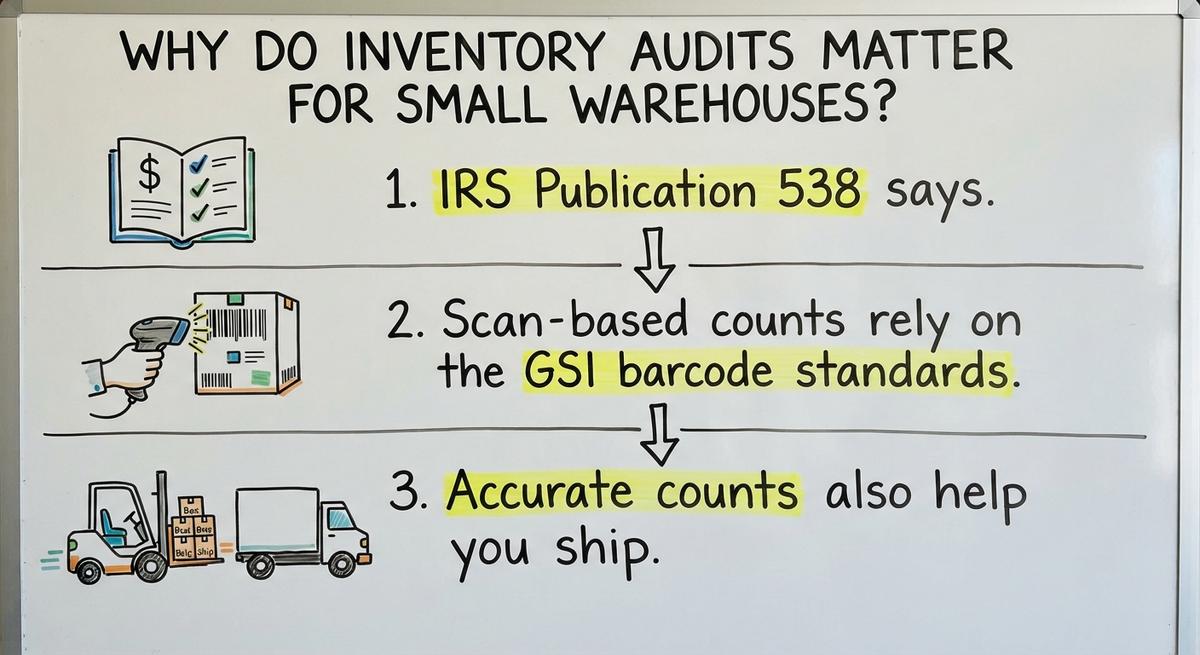
Wrong counts cause missed orders, extra buying, and bad financial numbers. Teams of 5 to 100 people have no spare staff to chase errors. An audit catches small problems before they grow.
AccountingTools notes, "If your company records its inventory as an asset and it undergoes an annual audit, then the auditors will be conducting an audit of your inventory."
Rules also ask for counts:
A regular audit costs less than a surprise at year end.
What Is the Difference Between an Inventory Audit, a Cycle Count, and a Physical Inventory?
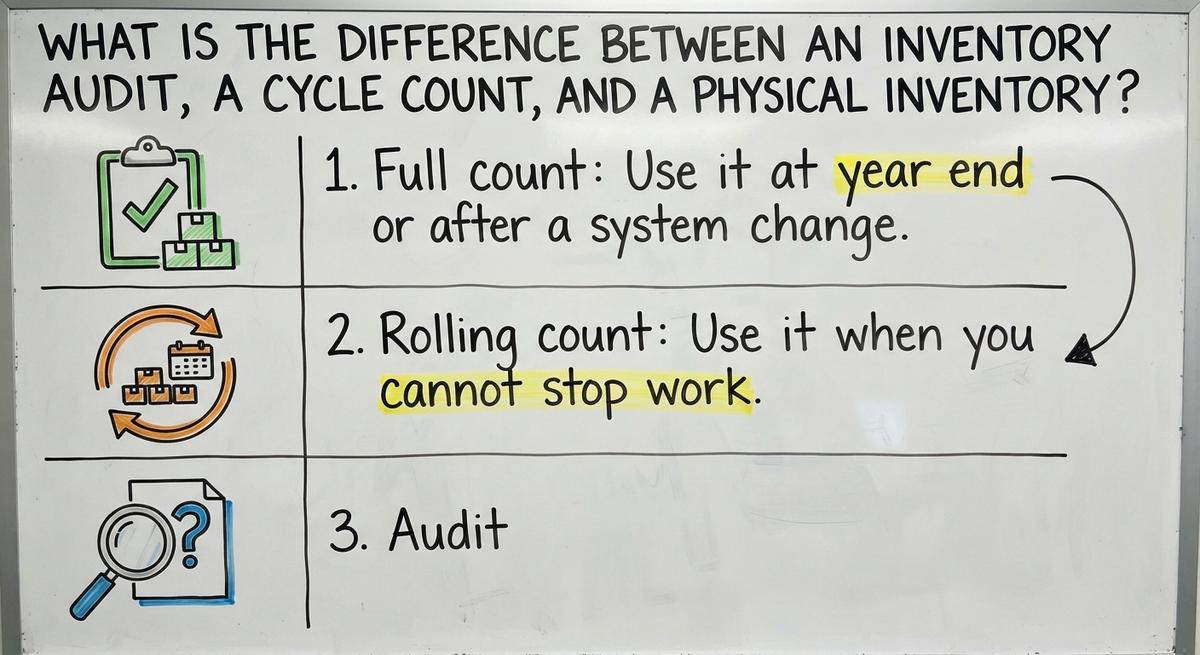
A physical inventory is a full count of every item. Cycle counting is a small count of a few items on a rolling schedule. An audit checks counts, records, and process together.
- Full count: Use it at year end or after a system change. Operations stop for a day or more.
- Rolling count: Use it when you cannot stop work. Staff count a few bins each week and log the results.
- Audit: Use it to learn why the shelf counts and the book records differ from each other.
Most teams mix one yearly full count with weekly cycle counts.
What Should Be on an Inventory Audit Checklist?
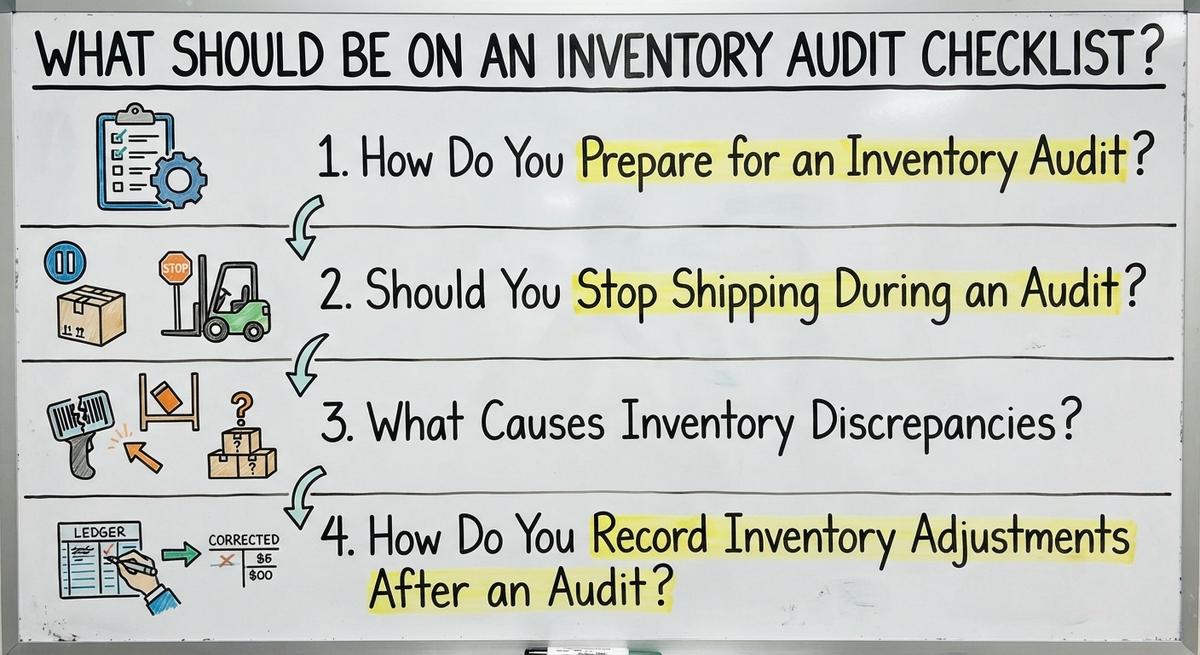
A warehouse audit has 3 phases. Each phase holds a short list of jobs.
- Before: Set the goal, clean records, ready the floor, and assign people.
- During: Hold stock still and count by location.
- After: Compare counts, find causes, and post inventory adjustments.
Each phase below has its own steps.
How Do You Prepare for an Inventory Audit?
Preparation takes more time than the count itself. Finish these 4 jobs first:
- Set scope: Pick all stock, one zone, or high-value items. Choose the date and write a target, such as 98% accuracy.
- Clean records: Export item lists from your accounting package. Remove duplicate SKUs, fix unit names, and close open receipts, transfers, and pick tickets.
- Ready the floor: Label each bin and tidy the aisles. Set aside damaged and returned goods. Gather scanners, count sheets, pens, and tags.
- Assign people: Name a lead, counters, and a checker for each zone. Use two-person teams where one person counts and one records.
A team that knows the plan makes fewer mistakes on count day.
Not sure this is the right shape for your operation
Describe how the work runs today. We map it on a call and show you what it would look like built around that, before you spend anything.
Book a callShould You Stop Shipping During an Audit?
Yes, pause shipping and receiving during the count if you can. Stock that moves mid-count creates false variances. A box picked after you count its bin looks like a miss.
If you cannot stop, log every move with the time and quantity. Then adjust the count for those moves.
Follow these rules on the floor:
- Count by location in a set order so that no bin is skipped or counted twice.
- Check the item number, lot or serial number, unit of measure, and condition of the goods.
- Tag each counted bin with a sticker so a second team can see the bin is done.
- Recount any large mismatch at once, before the counters leave that zone.
A still warehouse gives you a count you can trust.
What Causes Inventory Discrepancies?
Say the system shows 120 units and you count 112. At $5 each, the gap is 8 units, or $40. Flag any item above your set tolerance.
Inventory discrepancies come from a short list of causes. Compare the counts to your records first. Find each inventory variance by item, in units and in dollars.
Then trace the paper trail. Common causes:
- Receiving errors happen when a driver or clerk logs the wrong quantity at the dock door.
- Wrong picks send the wrong item to a buyer and leave the record out of line.
- Unrecorded returns put goods back on the shelf with no entry in the system.
- Damage or theft removes stock. Business Insider reported in June 2019 that Walmart uses computer vision to monitor checkouts and deter theft in more than 1,000 stores.
- Bad unit conversions turn a case into a single unit, or the other way around.
Group the causes to see patterns. A pattern points to a process to fix. A one-off points to a person to blame, and blame fixes nothing.
How Do You Record Inventory Adjustments After an Audit?
Each adjustment needs a reason code and an approver. The code says why the count changed. The approver stops quiet edits.
Keep the signed count sheets and a one-page summary. Tell your accountant how the changes affect stock value in your accounting software. A year later, the file should show who changed what and why.
Signed paper turns a fix into proof.
How Often Should You Audit Inventory?
Most small warehouses run 1 full count a year plus regular cycle counts. Count fast-moving and high-value items more often. A simple split by item class helps. Count your top items monthly and slow items twice a year.
Let your error rate set the pace. More gaps call for more checks. Fewer gaps let you count less. A full audit takes 1 to 3 days for most small sites. Time depends on item count and team size.
The comparison is easier when one option is built for you
Off-the-shelf means fitting your process to the software. We do it the other way round, and the first look costs nothing.
Book a call
What Mistakes Ruin an Inventory Audit?
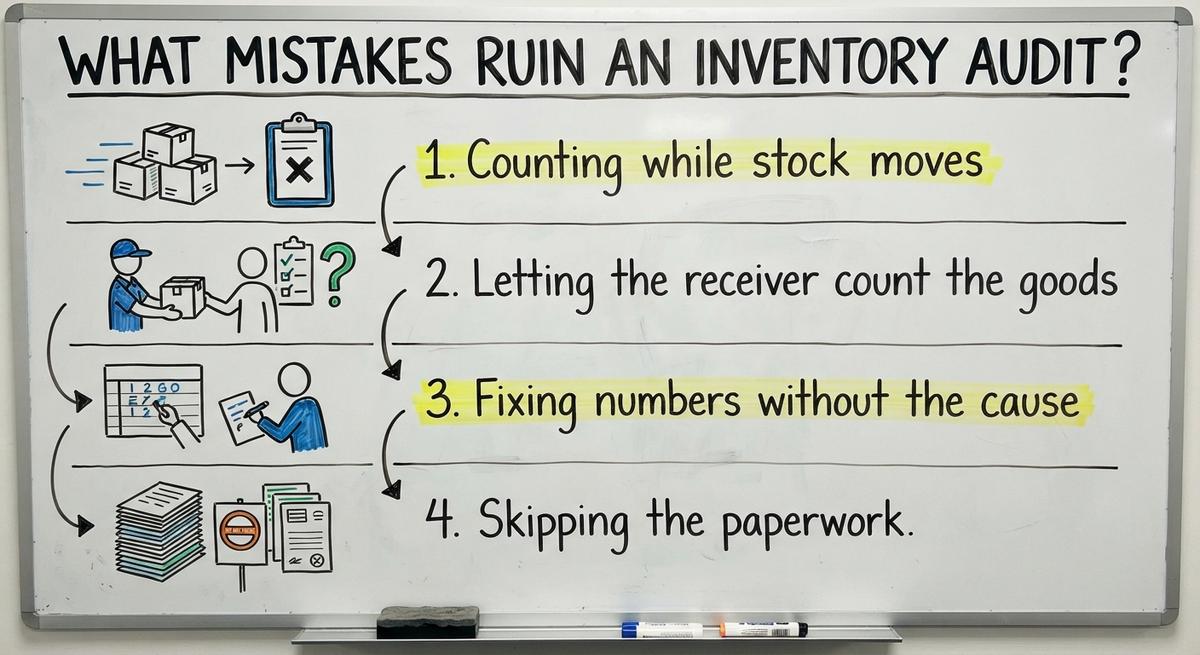
Four mistakes ruin most audits. Avoid them:
- Counting while stock moves: Pause the floor or log every move, or the totals will drift from the shelf.
- Letting the receiver count the goods: Use a second person to check, so one person never grades their own work.
- Fixing numbers without the cause: The same gap returns next quarter and costs you more time.
- Skipping the paperwork: No one can trust a change that has no record behind it.
A clean process beats a fast count.

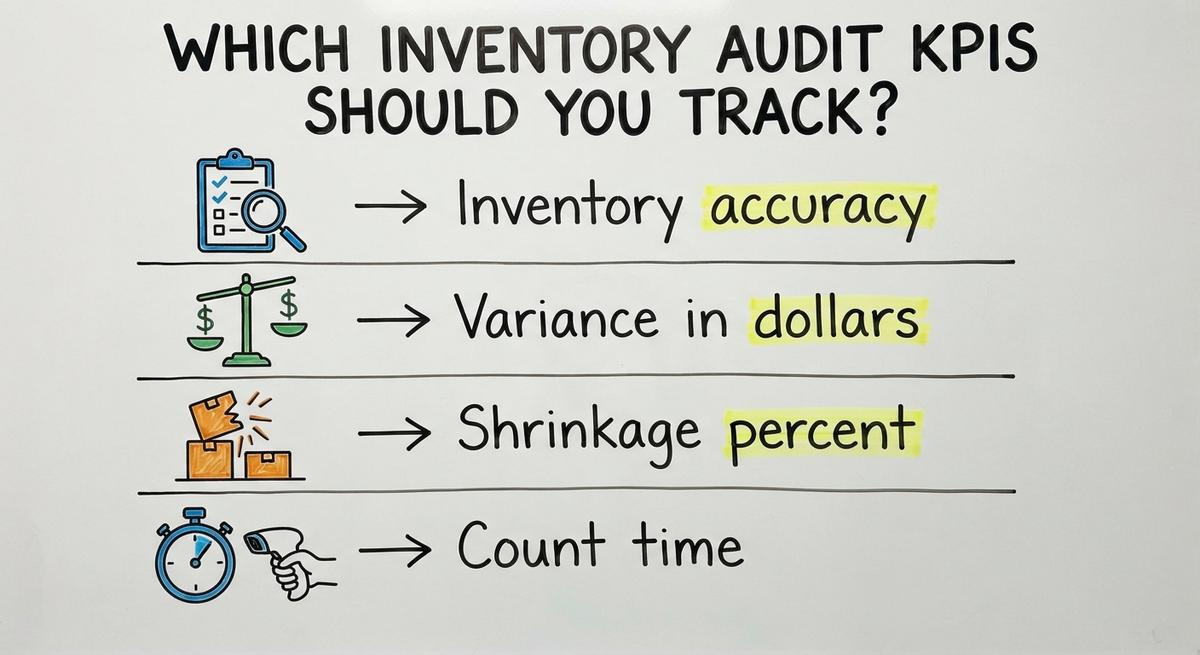
Which Inventory Audit KPIs Should You Track?
Track 4 numbers. Each one has a plain formula.
- Inventory accuracy: Items that match divided by items counted, times 100, gives your hit rate.
- Variance in dollars: Counted value minus book value shows the money gap for each audit.
- Shrinkage percent: Lost value divided by book value, times 100, shows how much stock vanished.
- Count time: Hours spent per audit show the labor cost of each count.
Compare results from one audit to the next. A rising accuracy rate shows your fixes work.
Labor adds up fast. Say 2 counters spend 10 hours at $20 an hour. That is $400 a count, or $1,600 across 4 counts a year.
When Do Spreadsheets and Paper Sheets Make Audits Harder?
Spreadsheets and paper sheets make audits harder when data lives in too many places. Typing count sheets into Excel adds new errors. Data spread across accounting software, a desktop database, email, and paper is hard to match.

Watch for 3 signs:
- Audits take days instead of hours, and staff dread the next one.
- The same variances repeat from one audit to the next.
- No one trusts the numbers on the report.
Custom software can fix the manual steps only. You keep your accounting software for what it does well. Count sheets feed records directly. Variance reports build themselves. Adjustments wait for approval.
This works at small scale, with no big ERP. Our team in Columbus, Ohio builds around how your operation already works. Other options include off-the-shelf warehouse inventory management software.
The goal is fewer hand-offs, not a new system for its own sake.

How Can You Start Your Next Audit With Less Manual Work?
Your next audit can start this week with the before phase. Clean your item list and write your accuracy target. Then run one zone as a test.
If typing and matching eat your time, talk to us. We will map your count steps and show which manual ones to replace first.


See it running on your own process first
No build cost. The subscription starts once it is live and doing the job, not before.
Book a call


Frequently asked questions
What is an inventory checklist?
An inventory checklist is a list of steps and items to check when you count stock. It names the zones, the people, the tools, and the records to compare. Teams use it so no bin is skipped and every count follows the same order.
What are the common procedures used in an inventory audit?
Common procedures are planning the scope, cleaning records, counting stock by location, and comparing counts to the system. Auditors also test a sample of receipts and shipments. Then they trace each gap to a cause and post approved adjustments with a reason code.
How long does an inventory audit take?
A small warehouse often needs 1 to 3 days for a full audit. Time depends on item count, bin labels, and team size. Prep adds more. A cycle count of a few bins takes under an hour, so the work spreads out across the year.
What is a 5S audit checklist?
A 5S audit checklist scores how well a work area follows 5 habits: sort, set in order, shine, standardize, and sustain. It is a floor tidiness check, not a stock count. A clean, labeled warehouse makes an inventory audit faster and easier.
Who should count inventory during an audit?
Use two-person teams. One person counts and one records. Do not let the person who receives or ships an item also count it. A second person checks the zone. This keeps the count honest and makes errors easier to spot.
What should you do with large inventory variances?
Recount the item at once. If the gap stays, trace receipts, pick tickets, and returns to find the cause. Flag any item above your set tolerance. Post an adjustment only after a manager approves it with a reason code.
Do you need to stop operations for an inventory audit?
Pausing shipping and receiving gives the cleanest count. If you cannot stop, log every move with a time and quantity. You can also use cycle counting, which checks a few bins at a time and keeps the warehouse running.
Start with a free first look
A 30 minute call, your operation mapped, and a clear picture of what we would build. No obligation and nothing to install.
Book a callRelated guides
More on the same work.
Guides
- Inventory Management Best Practices
- Moving Average Method Inventory
- Inventory Shrinkage Accounting Entry
- Warehouse Inventory Management Software
- Warehouse Inventory Tracking Software
- Warehouse Inventory Management Systems
- Best Inventory Software
- Quickbooks Inventory Management Software
- Warehouse Inventory Systems
- Classification of Inventory
- Inventory and Warehouse Management Software
- Custom Inventory Management Software
- Excess Inventory
- Closed for Inventory
- Warehouse Inventory Management System
- Retail Inventory Management
- Multi Location Inventory Management Software
- Ms Excel Inventory Template
- Warehouse Inventory Software Programs
- Inventory Management for Multiple Locations