

Distributor Brand
A distributor brand is a product line sold under the distributor's own name. Learn the types, risks, and the cost and stock tracking it needs.
Book a callWhat Is a Distributor Brand?
A distributor brand is a product line a distributor sells under its own name instead of the maker's name. People also call it a house brand, private label, or own brand. The distributor picks the product. The maker builds it. The distributor's name goes on the label. (Reviewed November 2026.)
We build it for your operation, and the first look is free
If you would rather not compare products, describe how your operation already works and we build the system around it.
No build cost. You see it running on your own process first, and the monthly subscription starts only once it is live.
Book a callDistributor Brand vs. Manufacturer Brand
A manufacturer brand and a distributor brand can sit on the same shelf and in the same price book. The difference is who holds the controls.
| Manufacturer brand | Distributor brand | |
|---|---|---|
| Owns the name | Maker | Distributor |
| Sets the price | Maker | Distributor |
| Handles complaints | Maker | Distributor |
Either way, stock counts. IRS Publication 538 says, "To figure taxable income, you must value your inventory at the beginning and end of each tax year."
Why Do Wholesale Distributors Create Their Own Brand?
A wholesale distributor builds its own brand for 3 business reasons: better margins, more control over supply, and repeat orders. Each one is below.
Better Margins
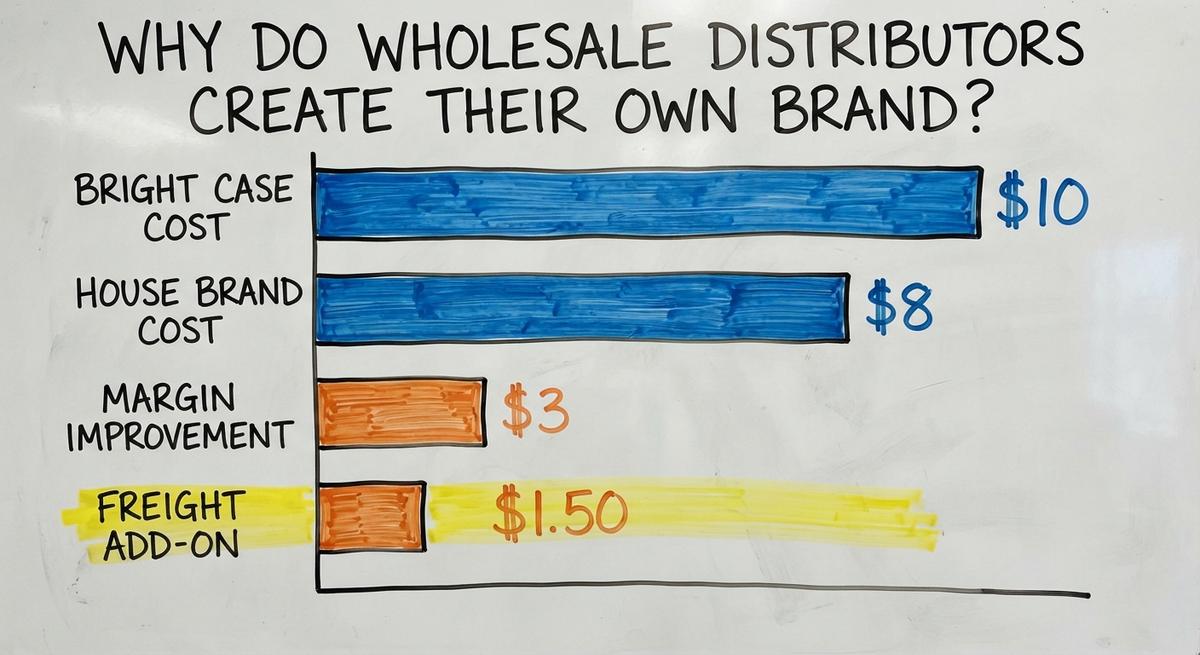
Buying direct from a maker can cost less than buying a branded item through a chain. Say a branded case costs $10 and sells for $13. A house-brand case from the maker costs $8 and sells for $12. Margin goes from $3 to $4.
That gain is real only if you track landed cost. Landed cost is the full price to get an item on your shelf: item, freight, duties, and packaging. Add $1.50 in freight and the $4 gain shrinks to $2.50.
More Control Over Supply and Specs
One rule makes this work: write the spec down. A written spec lets a new maker match the old one. Control of the spec is what makes a supplier swap invisible to the customer.
A house brand lets you choose the specs, pack sizes, and suppliers. You can switch makers and the customer sees the same label. You also face less risk when a maker drops or reshuffles a product.
Stronger Customer Loyalty
Picture a customer who buys 20 cases a month of your house-brand gloves. A wrong size once is a mistake. Twice sends that customer back to the branded line. Repeat orders depend on getting each order right.
A customer who likes your house brand can only reorder it from you. That ties repeat orders to your business. Trust comes from the same thing each time: steady quality and accurate orders.
Not sure this is the right shape for your operation
Describe how the work runs today. We map it on a call and show you what it would look like built around that, before you spend anything.
Book a callCommon Types of Distributor Brand Products
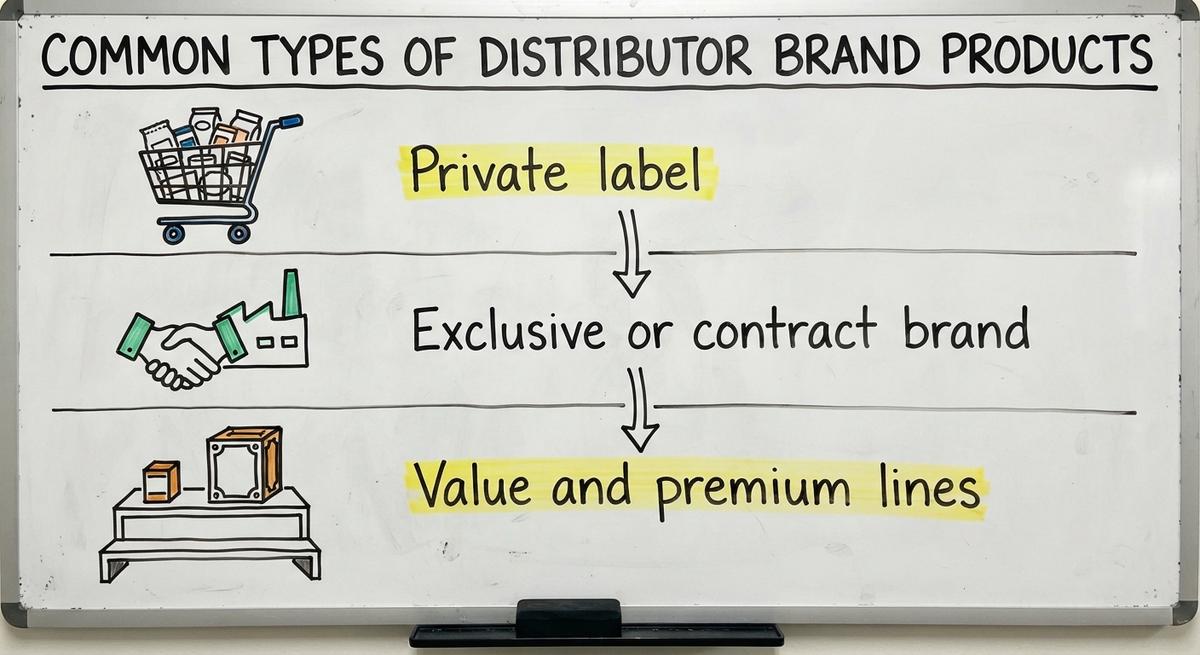
Distributor brand products fall into 3 main types.
- Private label: another company makes it and you sell it under your name. Example: a maker packs paper towels in your box.
- Exclusive or contract brand: a maker's own product that only you sell. Example: a fastener maker sells its bolt line only through you.
- Value and premium lines: a lower-priced tier and a higher-quality tier. Example: a basic work glove and a coated glove.
Pick the type that fits your buyers and your supplier ties.
What It Takes to Launch Private Label Distribution
Private label distribution follows 6 steps: pick products, find makers, set specs, order, label, and sell. Start with a few top sellers, not the whole catalog.
How Do You Pick Which Products to Put Under Your Own Name?
Pick high-volume items that customers reorder and that have simple specs. Review sales history. Look for items where buyers care little about the maker. Then check which of those have the most room for margin. A plain 20-pound bag of salt fits. A complex part with strict tolerances does not.
Find and Vet Makers
A maker is only as good as its proof. Ask each one for samples, minimum order sizes, lead times, and quality records. Get specs and terms in writing. Keep a backup supplier for each item where you can.
The NIST Manufacturing Extension Partnership offers vendor-neutral guidance on supply chain process. Strong supplier management starts before the first order.
Handle Labels, Packaging, and Compliance
Labels must carry the right product information for the product type. Rules differ by product and industry. Check the rules that apply to yours before you print. We do not give legal advice. Ask a qualified advisor or the agency that covers your product.
The Risks of a Distributor Brand
A house brand has 4 clear risks.
- Larger minimum orders tie up cash.
- Slow movers fill storage space.
- You now own quality problems and returns.
- One supplier can leave you with no stock.
Test a small run first. A house brand is a bet on your own demand, so size the bet to what you can afford to hold.
The comparison is easier when one option is built for you
Off-the-shelf means fitting your process to the software. We do it the other way round, and the first look costs nothing.
Book a call
The Operations Behind a Distributor Brand
A distributor brand adds work. You have more SKUs (one SKU is one item you stock), more buy orders, and more tracking. Customers judge the brand by one thing: do orders arrive right and on time?
Track Cost, Stock, and Supplier Details
Good inventory tracking for house-brand items covers these points:
- Landed cost per item, so margin is a fact, not a guess.
- Reorder points and lead times, so you do not run out.
- Lot or batch numbers, where recalls or quality matter.
- Each item linked to its maker and any alternate source.
With these, you see true margin by item. The US Census Bureau tracks wholesale inventories and sales. Your own ratio matters more.
When Do Spreadsheets Stop Working for House-Brand Items?
Spreadsheets stop working when specs, costs, and stock live in 3 different places. Many owners run an accounting package plus spreadsheets, database files, printed sheets, and email. Then errors show up: wrong items, stockouts, and slim margins nobody noticed.
Say 2 people spend 5 hours a week re-keying data at $22 an hour. That is $11,440 a year. The cost is real before any error.
How Custom Software Can Support a Distributor Brand
The Software Society, a local Columbus, Ohio team, builds this kind of fit. The goal is one place for cost, stock, and supplier facts.
Custom wholesale distribution software can be built around how your shop already works. No forced move. It can keep your accounting software where it helps and replace only the manual parts. It also works at small scale, not just for large firms.
A Simple Checklist Before You Start
Run through this list before the first buy order. Each item is a gate.
- Products chosen: a few high-volume, simple-spec items.
- Maker vetted: samples, lead times, and quality records on file.
- Specs written down: so another maker can match them.
- Landed cost known: freight, duties, and packaging included.
- Storage space planned: room for the larger order.
- Reorder rules set: a point and a quantity for each item.
- Return process defined: who takes the item back and who pays.
If one box stays empty, wait.

Next Steps for Your Distributor Brand
Pick a few items. Know your true cost. Keep the details in order. If you want to talk about how your operation runs today, The Software Society in Columbus, Ohio is open to a conversation. One team builds the software, the website, and the search presence.
Frequently asked questions
Is a distributor brand the same as private label?
Mostly yes. A private label is made by one company and sold under another's name. A distributor brand is a private label owned by a distributor. Some distributor brands are exclusive lines from a maker instead. Both carry the distributor's name.
Can a small distributor build its own brand?
Yes. A small wholesale distributor can start with 3 to 5 top-selling items. Choose simple products. Order small runs first. Track landed cost on each item. Grow the line only after those items sell steadily and margin holds.
How many products should I start with?
Start with 3 to 5 items. Pick high-volume, repeat-order products with simple specs. A small start limits cash risk and storage needs. It also lets you learn what your suppliers can do before you add more.
Does a distributor brand hurt relationships with manufacturers?
It can strain them if a house brand competes with a maker's line you carry. Tell makers early. Keep your branded lines in the catalog. Many distributors run both and keep good ties by being open about it.
Start with a free first look
A 30 minute call, your operation mapped, and a clear picture of what we would build. No obligation and nothing to install.
Book a callRelated guides
More on the same work.
Guides
- Business Distributors
- Is a Distributor a Wholesaler
- Distributor Example
- Distributor Examples
- Distributor Rate
- Company Distributor
- Software for Distributors
- Dealer and Distributor
- Define Wholesale Distributor
- Distributor Markets
- Distribution Management Software
- Cloud-based Purchase Order System
Common questions
- Wholesale vs Distributor
- Wholesale Distributor Meaning
- Distributor vs Wholesaler
- What is the Distributor
- Difference Between a Wholesaler and a Distributor
- Distributors vs Suppliers
- Dealer vs Distributor
- How Distributors Work
- Difference Between a Dealer and a Distributor
- Wholesale Distributors Definition
- Difference Between Wholesale and Distribution
- What is Vendor Management Inventory