


What is Vendor Management Inventory
What is vendor management inventory? Learn how vendor managed inventory (VMI) works, who uses it, the risks, and how a small distributor can start.
Book a callWhat Is Vendor Management Inventory?
Vendor managed inventory (VMI) is an arrangement where the supplier watches your stock and decides when to restock and how much to send. You share your counts. The supplier fills the gap before you run out.
People write "vendor management inventory," but the standard industry term is vendor managed inventory. Both phrases mean the same thing.
Here is a simple example. A fastener maker checks your bin counts each week. Two bins run low. The maker ships 2 boxes, and you never place an order. Reviewed November 2026.
We build it for your operation, and the first look is free
If you would rather not compare products, describe how your operation already works and we build the system around it.
No build cost. You see it running on your own process first, and the monthly subscription starts only once it is live.
Book a callHow Does Vendor Management Inventory Work?
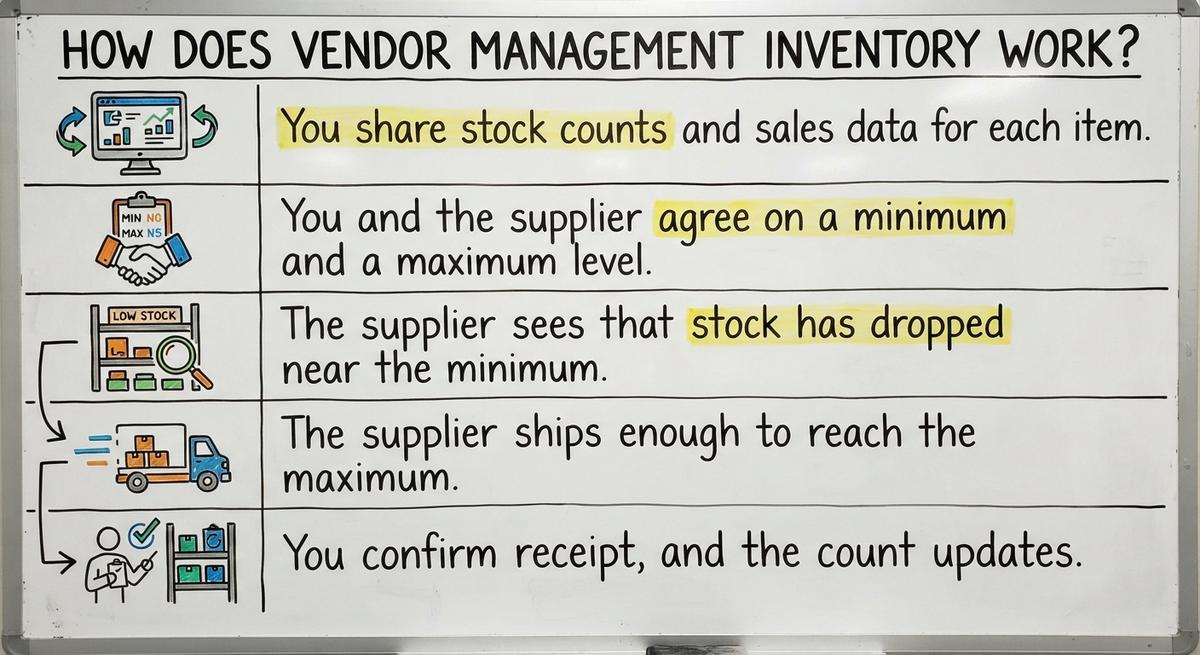
The vendor managed inventory process has 5 steps, and each one depends on shared numbers. The supplier needs a clear view of what sits on your shelves.
- You share stock counts and sales data for each item.
- You and the supplier agree on a minimum and a maximum level for each item.
- The supplier sees that stock has dropped near the minimum.
- The supplier ships enough to reach the maximum.
- You confirm receipt, and the count updates.
Data can move by a portal, a shared sheet, or an automated feed. Barcodes help keep the counts clean. GS1, the standards body behind them, calls its system "the global language of business," and you can read about its barcode standards on its site. The same scan means the same item to both sides.
The loop works when both sides see one set of numbers.
Who Uses Vendor Management Inventory?
Distributors that buy from manufacturers use VMI, and so do warehouses and fulfillment centers that hold stock for clients. The method fits fast-moving, repeat-order items best. Think fasteners, filters, packaging, and cleaning supplies.
VMI works in both directions. A distributor can be the buyer with its own supplier. The same distributor can also act as the vendor for its own customers. It watches their shelves and ships before they run dry.
Slow, custom, or one-off items do not fit. No steady demand means no pattern to follow.
Not sure this is the right shape for your operation
Describe how the work runs today. We map it on a call and show you what it would look like built around that, before you spend anything.
Book a callWhat Are the Benefits of Vendor Management Inventory?
VMI gives buyers fewer stockouts (the times an item runs out when a customer wants it). The supplier sees the drop early and ships early. That also means fewer rush orders and fewer costly freight bills.
Other gains follow:
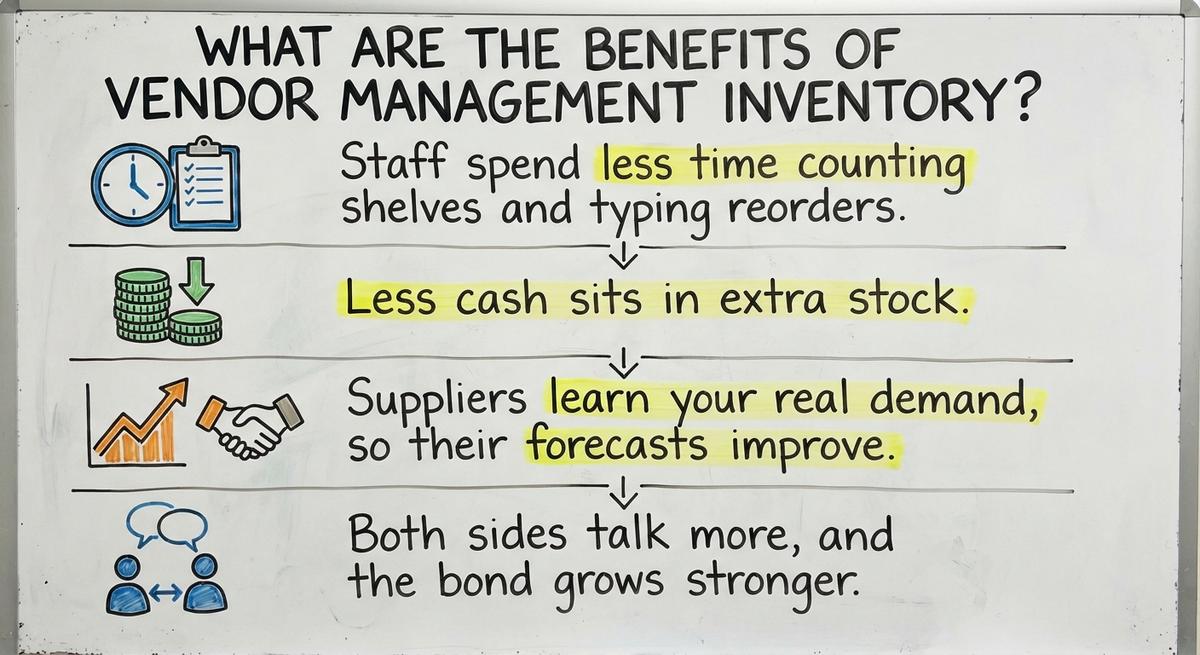
- Staff spend less time counting shelves and typing reorders by hand.
- Less cash sits in extra stock, because the supplier aims for a set maximum.
- Suppliers learn your real demand, so their forecasts improve.
- Both sides talk more, and the bond grows stronger.
Time adds up fast. Say 2 people spend 5 hours a week on reorders at $22 an hour. That is 2 x 5 x 52 x $22, or $11,440 a year. The US Bureau of Labor Statistics tracks pay for this kind of stock work, so check the rate for your own area.
VMI turns a weekly chore into a quiet background task.

What Are the Risks and Downsides?
The main risk of VMI is bad data. Wrong counts lead to wrong orders, and the supplier acts on what it sees. If your sheet says 40 and the shelf holds 4, you stock out.
Watch for these problems:
- Trust has to run both ways. You share sales data, and the supplier shares its plans.
- The supplier may overstock if the limits are vague. Write the maximum down.
- Paper sheets and email threads fall behind. The supplier then acts on old numbers.
- Ownership gets fuzzy. Who owns the stock, and who pays for slow movers?
An open question about ownership turns into a fight later. Settle it in writing before the first shipment.
What Does a Vendor Management Inventory Agreement Include?
A VMI agreement is a short contract that spells out who does what. It answers the questions that cause fights. Use this checklist:
- Levels: the minimum, the maximum, and the reorder point for each item.
- Lead times: how many days the supplier needs to ship.
- Data rules: what you share and how often counts update.
- Ownership: whether the stock is on consignment (the supplier owns it until you use it) or you own it on arrival.
- Payment terms: when the invoice is due.
- Slow movers: who pays for items that stop selling.
- Fixes: how each side reports and corrects a bad count or a wrong shipment.
A one-page VMI agreement beats a handshake every time.

What Do You Need to Run Vendor Management Inventory?
You need 3 things: accurate counts by item and location, a safe way to share them, and clear reorder rules. Without all 3, the supplier cannot act.
Counts matter for more than VMI. The IRS states, "To figure taxable income, you must value your inventory at the beginning and end of each tax year." You already owe the numbers.
Where the data hides
Many small operations split stock data across accounting software, spreadsheets, a desktop database, and printed sheets. No one file holds the full picture. That split is the real barrier to VMI. It is not a lack of costly software.
The fix starts with one shared view of stock that both sides trust.
The comparison is easier when one option is built for you
Off-the-shelf means fitting your process to the software. We do it the other way round, and the first look costs nothing.
Book a callCan a Small Distributor Use Vendor Management Inventory Without an ERP?
Yes. A small distributor can run VMI without an ERP (a large system that runs every part of a business). Start with a few top items and a simple shared view of stock.
Keep your accounting software where it works for accounting. Replace only the manual steps: the counting, the copying, and the sending.
Software built around your team
A small, custom fix beats a big system you will never finish setting up. For a wider view, see what is the best inventory management software for small business.
Custom software can match how your team already works. It can feed the supplier from your own numbers. You skip the big migration and the long rollout. The Software Society, a Columbus, Ohio team, builds this kind of software for small operations.

How Do You Get Started With Vendor Management Inventory?
You get started by picking one supplier and 10 to 20 steady items. A small pilot shows what works before you commit the whole shelf. Follow these steps:
- Choose the supplier you trust most.
- Clean up the counts for those items.
- Set a minimum and a maximum for each one.
- Run a trial of 60 to 90 days.
- Review stockouts, rush orders, and time saved.
Expand once the numbers hold up. Add items, then add suppliers. Related methods include what is jit inventory management and what is kanban system of inventory management.
A good pilot proves the plan with real numbers.
Your Next Step
VMI works when counts are right and rules are clear. Pick one supplier, list 10 items, and write down your minimum and maximum levels this week. If your data lives in too many places, talk to The Software Society about a small custom fix that keeps your accounting where it is.
Frequently asked questions
What is a vendor management inventory system?
A vendor management inventory system, properly called vendor managed inventory, is the set of tools and rules that let a supplier see your stock and restock it for you. It can be a shared sheet, a portal, or an automated feed. What matters is that the counts are current and both sides trust them.
What is an example of vendor managed inventory?
A fastener maker checks your bin counts each week. Two bins sit below the agreed minimum. The maker ships enough boxes to reach the maximum, and you confirm receipt. You never write a buy order.
What is an example of vendor management?
Vendor management is the wider job of choosing, pricing, and reviewing suppliers. An example is a yearly review that scores each supplier on price, on-time delivery, and defects. VMI is one narrow part of it, where the supplier also handles restocking.
What are the four types of inventory management?
There is no single official list of four. Common groupings include raw materials, work in process, finished goods, and supplies. Methods are a different matter. Examples include just-in-time, kanban, min and max levels, and VMI. Choose by how fast items sell and how steady the demand is.
Is vendor management inventory the same as vendor managed inventory?
Yes. Vendor managed inventory is the standard term. Many people write vendor management inventory, but both phrases describe the same arrangement.
Who owns the stock in a VMI setup?
It depends on the agreement. Under consignment, the supplier owns the stock until you use or sell it. Otherwise you own it when it arrives. Write down which model applies and who pays for slow movers.
Start with a free first look
A 30 minute call, your operation mapped, and a clear picture of what we would build. No obligation and nothing to install.
Book a callRelated guides
More on the same work.
Guides
- Distribution Inventory Management
- Warehouse Inventory Management Software
- Warehouse Inventory Management Systems
- Quickbooks Inventory Management Software
- Inventory and Warehouse Management Software
- Custom Inventory Management Software
- Warehouse Inventory Management System
- Retail Inventory Management
- Multi Location Inventory Management Software
- Inventory Management for Multiple Locations
- Manufacturing Inventory Management Software
- Cost of Inventory Management Software
- Manufacturing Inventory Management
- Retail Inventory Management Systems
- Inventory Management Software Freeware
Common questions
- What is the Distributor
- Why is Warehousing and Inventory Management Important
- What is the Difference Between Aggregate and Item Inventory Management
- How to Manage Inventory in a Warehouse
- What is the Best Warehouse Inventory Management System?
- What is the Difference Between Warehousing and Inventory Management
- What is B Type of Inventory in Warehouse Management
- What is Warehousing and Inventory Management
- What is Jit Inventory Management