


What Warehouse Management System Does Amazon Use?
Amazon uses a proprietary warehouse management system it built in-house, called Amazon WMS. It is not a commercial product and is not for sale. Amazon developed it to handle a scale and speed that no off-the-shelf platform could match. This article explains how it works, what smaller warehouses can learn from it, and what options actually exist for operations running on the accounting software. Reviewed and updated 15 September 2026.
Published 25 July 2026. Reviewed and updated 15 September 2026.
Book a callWhat Warehouse Management System Does Amazon Use?
Amazon's warehouse management system is a custom-built internal platform. No vendor sold it to them. Amazon's engineers designed it from scratch to match exactly how Amazon's fulfillment network operates.
A warehouse management system, or WMS, is software that tracks inventory from the moment it arrives at a dock door to the moment it leaves on a truck. It tells workers where to put things, where to find them, and in what order to pick them. It also records every move so the business always knows what it has and where.
Would you rather have it built around your operation?
The first look is free. If you would rather not compare products, describe how your operation already works and we build the system around it.
No build cost. You see it running on your own process first, and the monthly subscription starts only once it is live.
Book a callHow Does Amazon's WMS Operate at Scale?
Amazon's version does all of that at extraordinary scale. It manages hundreds of millions of products across more than 1,000 fulfillment sites worldwide. It connects directly to Amazon's robotics fleets, conveyor systems, and shipping software so that every part of the operation talks to the same source of truth.
As OSHA notes, "The warehousing and storage industry includes establishments operating facilities for general merchandise, refrigerated goods, and other products." Managing that variety safely and quickly is exactly the problem a WMS exists to solve, and Amazon's system was built to solve it at a scale no commercial platform was designed for.
Did Amazon Build Its Own WMS or Buy One?
Amazon built its own. Early in the company's growth, it tried using available warehouse software, but those tools were built for the operations of the time.
As order volumes grew, the limits of off-the-shelf platforms became clear. Amazon needed software that could change as fast as the business did.
Building in-house gave Amazon 3 specific advantages that buying could not:
- Speed of change: Amazon could update its own system the same week a new need appeared. A vendor's product roadmap might take 18 months to catch up.
- Tight integration: Amazon's robots, scanners, and shipping systems all speak the same internal language. There are no translation layers or API delays between them.
- Process fit: The software was shaped around Amazon's workflows, not the other way around.
This is the same logic that drives smaller businesses toward custom warehouse software today. The scale is different. The principle is identical.
Key Features Inside Amazon's Warehouse System
Amazon's WMS is not a single tool. It is a set of connected systems that handle every stage of warehouse operations. Those systems cover receiving, putaway, picking, packing, shipping, and returns.
Each stage feeds data to the next so that inventory counts stay accurate across the entire network in real time.
Returns are one of the hardest parts of warehouse operations to manage well.
Amazon's system grades returned items automatically, routes sellable goods back into inventory, and flags damaged items for disposal or liquidation. The whole process runs without a manager making individual decisions on each box.
Real-Time Inventory Tracking
Amazon tracks inventory at the item level across every site simultaneously. When a product is received, scanned, moved, picked, or shipped, the system records it in real time. There is no batch update at the end of the day. The count is always current.
This matters because Amazon sells the same item from multiple locations. The system has to know exactly where every unit sits so it can route the order to the closest fulfillment center.
Directed Putaway and Pick Path Tuning
When a worker receives a product, the system tells them exactly where to put it. This is called directed putaway. It is not random.
The system places items based on how often they sell, how heavy they are, and how close they are to the packing stations that need them most.
Pick path tuning works the same way in reverse. When an order comes in, the system sequences the picks so the worker travels the shortest possible path. Even saving 30 seconds per pick adds up fast when a facility processes 100,000 orders a day.
Robotics and Conveyor Integration
Amazon's Kiva robots, now branded Amazon Robotics, carry shelving units directly to workers rather than sending workers to walk the floor. The WMS coordinates which pods to retrieve, in what order, and where to send them next.
The conveyor system moves totes between stations automatically. The WMS is the brain that keeps all of it moving without collisions or delays.
Labor Management and Productivity Tracking
The system records how long each task takes and compares it against expected rates.
Managers can see in real time where a bottleneck is forming and shift staff before it affects shipping times. This is not about surveillance for its own sake. It is about spotting problems early enough to fix them during the shift rather than after the damage is done.
Returns Processing
Returns are one of the hardest parts of warehouse operations to manage well.
Amazon's system grades returned items automatically, routes sellable goods back into inventory, and flags damaged items for disposal or liquidation. The whole process runs without a manager making individual decisions on each box.
Is the comparison easier when one option is built for you?
Yes. Off-the-shelf means fitting your process to the software, and custom is the other way round. The first look costs nothing.
Book a callDoes Amazon Use Any Third-Party Warehouse Software?
Amazon relies almost entirely on tools it built itself. The core WMS, the robotics control layer, the labor management tools, and the shipping software are all proprietary.
Amazon does license some external technology at the edges. Barcode standards, for example, follow GS1 specifications so that products from any supplier scan correctly at any Amazon facility. That is a standards layer, not a WMS layer.
Amazon's Internal WMS Versus Fulfillment by Amazon
It is worth separating two things that get confused:
- Amazon's internal WMS runs Amazon's own fulfillment centers and is not available to anyone outside the company.
- Fulfillment by Amazon (FBA) is a service Amazon sells to third-party sellers. When a seller ships inventory to Amazon, Amazon's internal tools handle it. The seller does not get access to those tools. They use seller-facing dashboards that sit on top of Amazon's systems.
Sellers who connect their own warehouse software to Amazon's marketplace do so through Amazon's Selling Partner API. That is a data connection, not a shared WMS.

What Does Amazon's Approach Teach Smaller Warehouses?
The lesson from Amazon is not "build a billion-dollar software team." The lesson is simpler: the best warehouse software fits the operation, not the other way around.
Off-the-shelf platforms target a hypothetical average warehouse. They make assumptions about how receiving works, how orders flow, and how inventory is counted. When your operation does not match those assumptions, you spend time working around the software instead of working through your orders.
Applying That Principle Without Amazon's Budget
Amazon never accepted that trade-off. It built software that matched its process exactly. Smaller warehouses can apply the same principle without Amazon's budget.
The question is not "which big platform should we buy?" It is "what does our operation actually need, and what is the simplest system that delivers it?"
The NIST Manufacturing Extension Partnership makes a similar point in its supply chain guidance: the goal is a process that fits the business, supported by tools chosen or built to match it.
Why Can Most Small Warehouses Not Use What Amazon Uses?
Amazon's WMS is not for sale. It was built for a scale that most businesses will never reach and would not need to reach.
Running it would need the same infrastructure, the same robotics fleet, and the same engineering team that keeps it. None of that is realistic for a warehouse with 10 to 80 staff.
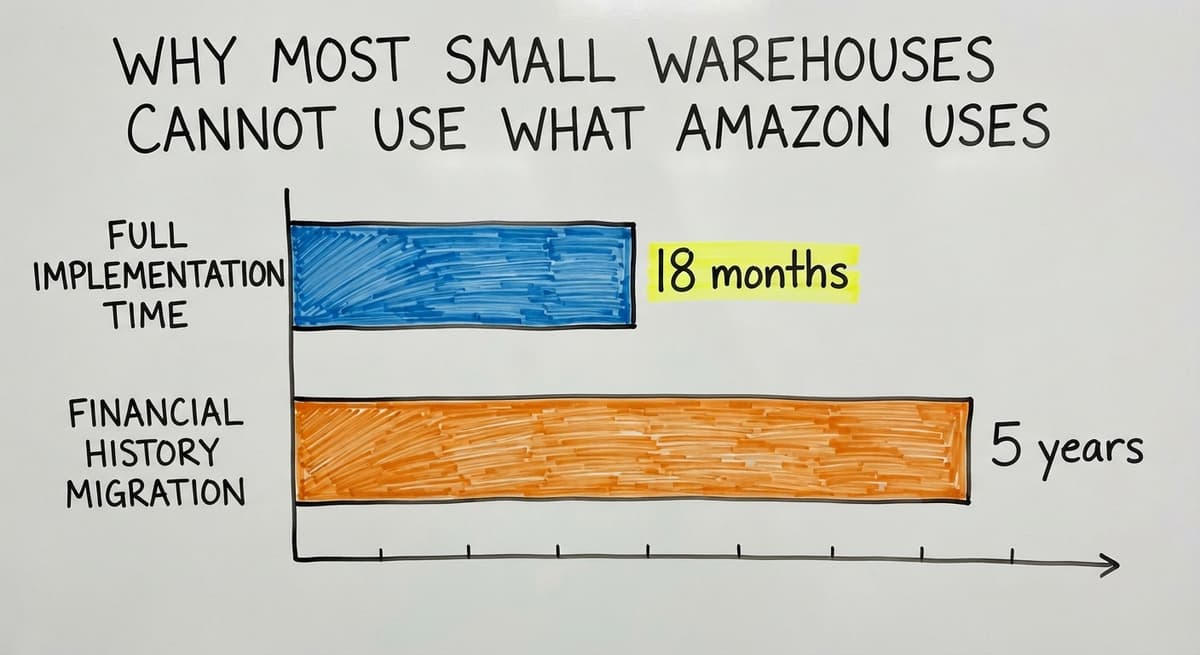
Enterprise WMS platforms do exist for mid-size operations. The enterprise warehouse suites are powerful. They are also expensive to license, slow to implement, and built around assumptions that may not match how your warehouse runs.
A full rollout can take 12 to 18 months and cost well into six figures before a single order is processed through the new system.
For operations already running on the accounting software, a full ERP migration creates a second problem: what happens to 5 years of financial history and the accounting workflows the team already knows?
What does it look like running on your own process?
The first thing you see is it running on your own process, at no build cost. The subscription starts once it is live and doing the job, not before.
Book a call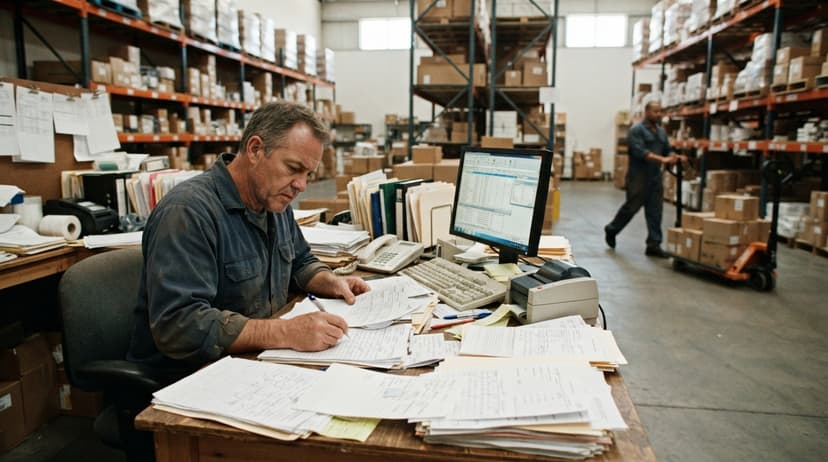
What Warehouse Management Options Exist for Smaller Operations?
Smaller warehouses have real choices. None of them is Amazon's system, but several can deliver genuine control over inventory and fulfillment at a fraction of the cost.
Here are the main categories, with an honest view of each:
- Off-the-shelf cloud WMS platforms cover the basics well and are priced for small businesses. They work best when your operation matches their assumptions. When it does not, expect workarounds.
- Mid-market ERP systems with warehouse modules give you accounting and warehouse management in one place. The trade-off is cost, complexity, and an rollout timeline that can stretch past a year.
Custom and Hybrid Warehouse Software Options
- Custom-built warehouse software follows your specific workflows. It takes longer to build than buying a subscription, but it fits exactly. For operations with unusual processes or tight the accounting software dependencies, this is the most cost-effective path over a 3-year horizon.
- Hybrid approaches keep the accounting software for accounting and add a custom layer for warehouse functions. Data flows between the two systems automatically. Nothing is entered twice. This avoids the disruption of a full migration while giving the warehouse the control it needs.
The Warehousing Education and Research Council publishes benchmark data on distribution center performance. Looking at those benchmarks before choosing a system helps you understand which gaps in your current process matter most.
When Does a Custom Warehouse System Make More Sense Than a Big Platform?
A custom system makes more sense when the standard platforms cannot match how your operation actually runs. That situation is more common than vendors admit.
Four signals that point toward a custom or hybrid approach:
- Your workflows are genuinely unusual. If you do kitting, special labeling, or staged receiving that no standard platform handles cleanly, you will spend years fighting the software.
- Your team runs on the accounting software and accounting is not broken. Replacing a working accounting system to get warehouse features is a large disruption for a partial gain. A custom layer on top of accounting integration for warehouse operations is a smaller change with a faster return.
- You cannot afford 12 months of parallel systems. A long ERP rollout means running two systems at once. For a lean team, that doubles the work during the transition period.
- You have between 5 and 100 staff. At that size, enterprise platforms are oversized and basic apps are undersized. A system built for your actual scale fits the gap.

Why Is Inventory Accuracy a Compliance Requirement, Not Just an Operations Goal?
The IRS is clear on why inventory accuracy is not optional: IRS Publication 538 states, "To figure taxable income, you must value your inventory at the beginning and end of each tax year." A system that cannot produce an accurate count is not just an operations problem. It is a compliance problem.
How Does Custom Warehouse Software Work Alongside Your Accounting Software?
The accounting software handles accounting well. Most small warehouses do not need to replace it. What they need is a layer between the warehouse floor and the books that tracks inventory in real time and passes clean data to the accounting software automatically.
Here is how that works in practice:
- A receiving clerk scans incoming goods. The warehouse system records the receipt, updates inventory counts, and creates a buy record.
- When an order ships, the system decrements inventory and generates a packing slip. The accounting software receives the sale record without anyone typing it in.
- At month end, inventory values in the accounting software match what is actually on the shelf because the two systems have been talking all month.
Not sure this is the right shape for your operation?
The call is free. Describe how the work runs today. We map it on a call and show you what it would look like built around that, before you spend anything.
Book a callThe Cost of Not Integrating Your Warehouse and Accounting Systems
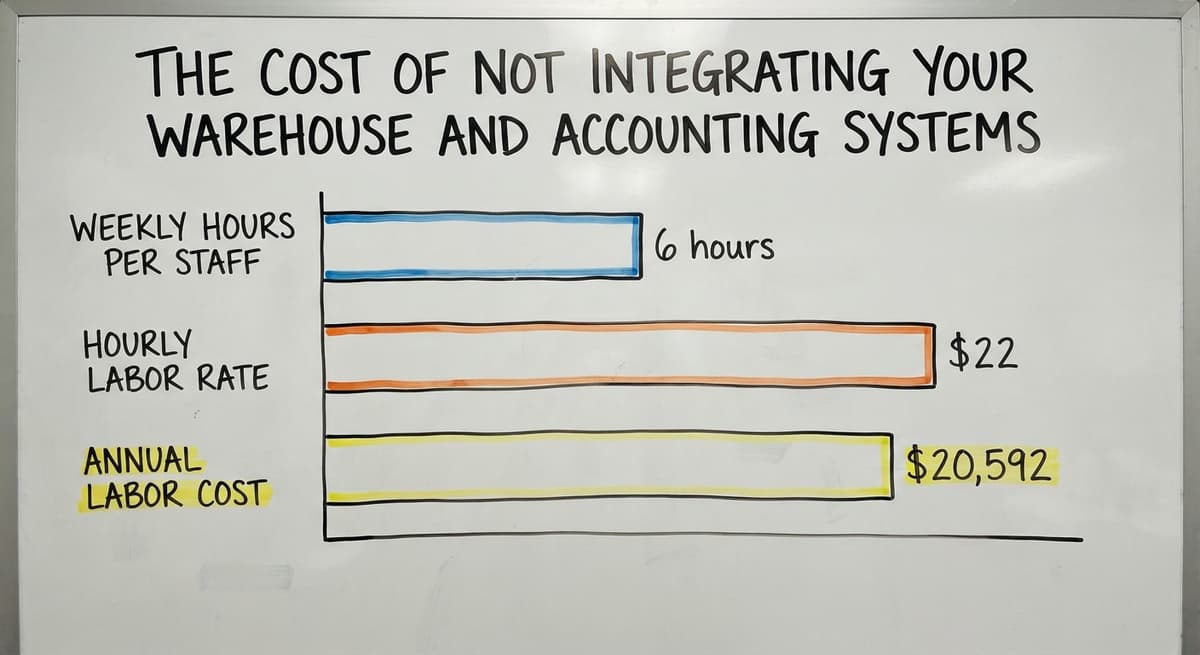
Consider the cost of not having this. If 3 staff members each spend 6 hours a week on manual data entry at $22 an hour, that is $20,592 a year in labor, before counting the errors those hours introduce. A custom integration that removes that entry pays for itself quickly.
Replacing spreadsheet and manual processes in warehouse operations does not need buying the most expensive platform on the market. It needs a system that closes the specific gaps your operation has, without breaking what already works.
Questions to Ask Before Choosing a Warehouse Management System
Choosing the wrong system is expensive. The right questions before you buy save more than the software ever could.
- Does the system fit how we already work, or will we change our process to match it? If the answer is the second one, ask whether that change is worth it.
- How long will it take to go live? Get a realistic timeline, not a sales timeline. Ask for references from businesses your size.
- What happens to our the accounting software data? If the answer involves migrating years of financial history, understand the full cost of that before you sign.
- Can the system grow with us without a full replacement? A system you outgrow in 3 years is not a solution. It is a delay.
- Who supports it when something breaks on a Tuesday at 4 PM? Support response time matters more than feature lists when orders are stacking up.
Calculating the Real Cost of Manual Warehouse Processes
The US Bureau of Labor Statistics reports median wages for stock clerks and order fillers.
Knowing what your team costs per hour makes it easier to calculate the real cost of manual processes and compare it honestly against the cost of a system that removes them.
The Bottom Line on Amazon's Warehouse Management System
Amazon uses a proprietary WMS it built itself. It is not available to other businesses. It was designed for a scale and complexity that most operations will never need.
The real takeaway is the principle behind the choice. Amazon did not buy software and then adjust its warehouses to fit. It built software that fit its warehouses. That logic applies at any scale.
Choosing the Right System for Your Warehouse
Smaller warehouses have options that follow the same principle without the same budget. Off-the-shelf platforms work well when they fit. Custom warehouse software and hybrid approaches work better when they do not.
The decision comes down to an honest look at what your operation actually does and what gaps are costing you the most.
If your warehouse runs on the accounting software and you are managing inventory in spreadsheets, the gap between where you are and where you need to be is smaller than it looks.
The right system does not have to be Amazon's system. It has to be yours.
If you want to talk through what that looks like for your specific operation, that conversation starts with a straightforward review of how your warehouse currently works and where the friction is. No pressure, no pitch deck. Just a clear picture of what fits.
Frequently asked questions
How does Amazon manage its warehouses?
Amazon manages its warehouses using a proprietary internal platform that covers receiving, storage, picking, packing, and shipping. The system connects directly to Amazon's robotics fleets, conveyor systems, and labor management tools.
Everything runs from a single source of data, updated in real time as items move through the facility. Amazon also uses directed putaway and pick path tuning to reduce travel time on the floor.
What system do Amazon warehouses use?
Amazon warehouses use a custom-built warehouse management system developed in-house by Amazon's own engineering teams. It is not a commercial product and is not available to other businesses.
The system was designed specifically for Amazon's scale and integrates with Amazon Robotics, conveyor infrastructure, and shipping software across more than 1,000 fulfillment sites.
Is an ERP the same as a WMS?
No. An ERP platform, which stands for enterprise resource planning, handles accounting, procurement, HR, and many other business functions. The large ERPs include a warehouse management module, but that is one part of a much larger system.
A standalone WMS focuses specifically on warehouse operations: receiving, inventory tracking, picking, and shipping. The two can work together, but they are not the same thing.
What is the most popular WMS?
There is no single answer. The right WMS depends on the size of the operation, the complexity of the workflows, and the existing software the business already runs. Large enterprises tend to run tier-one WMS suites.
Mid-size operations use the warehouse module inside their ERP. Small businesses start with an off-the-shelf cloud WMS. Operations running on the accounting software benefit most from a custom layer that connects warehouse functions to existing accounting rather than replacing the whole stack.
Is Amazon's warehouse management system available to other businesses?
No. Amazon's WMS is a proprietary internal tool and is not sold or licensed to other companies.
Third-party sellers who use Fulfillment by Amazon get access to seller-facing dashboards, but those are not the same as Amazon's internal warehouse management platform. Sellers connect their own systems to Amazon's marketplace through an API, not through Amazon's WMS.
What can small warehouses learn from how Amazon manages its inventory?
The core lesson is that the best warehouse software fits the operation rather than forcing the operation to change. Amazon built its system around its own workflows instead of buying a platform and adjusting its processes to match.
Smaller warehouses can apply the same principle by choosing or building tools that match how they actually work, rather than accepting workarounds built into software designed for a different kind of business.
How can a warehouse keep its accounting software and still get better inventory control?
A custom warehouse layer can sit on top of the accounting software and handle receiving, inventory tracking, picking, and shipping. Data passes between the two systems automatically so nothing is entered twice.
The accounting software keeps handling accounting, and the warehouse system handles operations. This avoids the cost and disruption of a full ERP migration while closing the gaps that spreadsheets and manual entry create.
When does a custom WMS make more sense than an off-the-shelf platform?
A custom system makes more sense when standard platforms cannot handle the operation's specific workflows, when the business runs on the accounting software and does not want to replace it, or when a long ERP rollout would disrupt daily operations. It is also a strong fit for businesses with 5 to 100 staff who need something sized for their actual scale rather than an enterprise tool with features they will never use.
What is Amazon Fulfillment Technologies?
Amazon Fulfillment Technologies is the internal group that builds and runs the software behind Amazon's fulfillment centers: the warehouse management system, the robotics control, the picking and sortation logic and the tools that tie them to the order pipeline. It is an in-house engineering organisation rather than a product, which is why what warehouse management system Amazon uses has no vendor name attached to it.
How does Amazon's warehouse robotics system work?
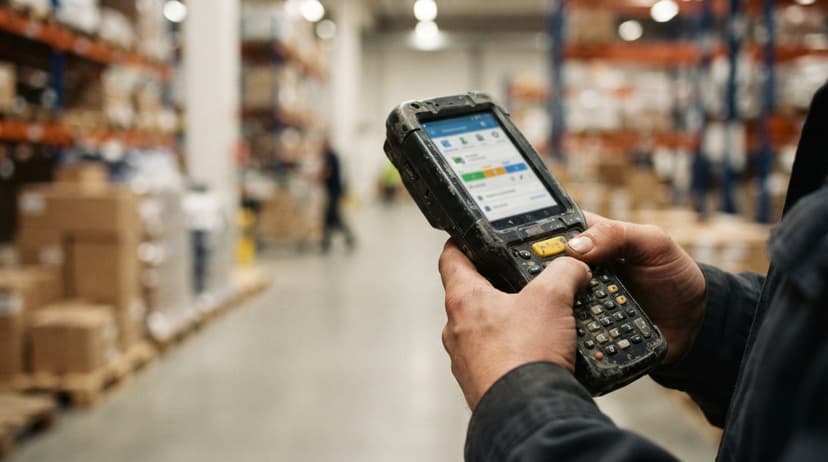
Instead of pickers walking to shelves, mobile robots carry whole shelving pods to a picking station, where a person takes the item the screen shows and confirms it with a scan.
The warehouse system decides which pod to bring, in what order, and where to store it afterwards, so the same floor holds far more stock with far less walking.
Small warehouses cannot copy the robots, but they can copy the principle: let the system decide the route and confirm every pick with a scan.
What WMS software is best for Amazon sellers?
For a seller shipping some orders through Amazon's fulfillment network and some from their own warehouse, the useful system is one that pulls orders from every channel into one queue, keeps stock levels in sync across channels, generates carrier labels, and feeds the accounting software.
Whether that is a cloud subscription or a custom build depends on how standard the seller's process is; the integration to the marketplace is the feature to test first.
How can a third-party WMS integrate with Amazon FBA?
Through the marketplace's seller APIs. A third-party WMS pulls the seller's orders and returns, pushes stock levels so listings stay accurate, and tracks inbound shipments sent to fulfillment centers as transfers rather than sales.
Ask any vendor to demonstrate the connection on your own seller account before you commit, and check how it handles the timing gap between an order and its confirmation.
What is in a free first look?
A 30 minute call, your operation mapped, and a clear picture of what we would build. No obligation and nothing to install.
Book a callRelated guides
The rest of this guide, for the parts of the job this page does not cover.
Guides
- Warehouse Inventory Management Systems
- Warehouse Management System Top 10
- Software for Warehouse Management System
- Small Business Warehouse Management System
- Warehouse Management System Types
- Warehouse Inventory Management System
- Warehouse Management System Examples
- Warehouse Management System Implementation
- Cloud Warehouse Management System
Common questions
- Which Warehouse Management System Would a Jeweler Most Likely Use
- What Does Lpn Stand for in Warehousing
- What Are the Benefits of Warehouse Management System
- What is the Point of Warehouse Management System
- What is Asn in Warehouse Management System
- What is a Warehouse Management System
- What is a Warehouse Management System Used For
- What is the Purpose of a Warehouse Management System
- What is a Warehouse Management System Pdf
- What is a Warehouse Management System Example
- What Does Receiving Mean in a Warehouse?
- How to Choose a Warehouse Management System
- How to Create a Warehouse Management System
- How to Build a Warehouse Management System
- Warehouse Management System vs Warehouse Control System