


How To Keep Track Of Cigarette Inventory
Learn how to keep track of cigarette inventory in 5 steps: one item list, one log of every move, and regular counts by pack, carton, and case.
Book a callHow Do You Keep Track of Cigarette Inventory?
To keep track of cigarette inventory, give every product a unique ID. Record every receipt, sale, and adjustment. Count on a set schedule.
Those are the 3 habits: one item list, one log of every move, and regular counts. Skip one and the numbers drift. Keep all 3 and your records stay close to the shelf.
The same steps work in a small warehouse or a large one. Only the tools change. A clipboard may do at 50 items. A scanner and shared system fit better at 500. This guide was reviewed in October 2026.
We build it for your operation, and the first look is free
If you would rather not compare products, describe how your operation already works and we build the system around it.
No build cost. You see it running on your own process first, and the monthly subscription starts only once it is live.
Book a callWhy Cigarette Inventory Is Harder to Track Than Other Stock
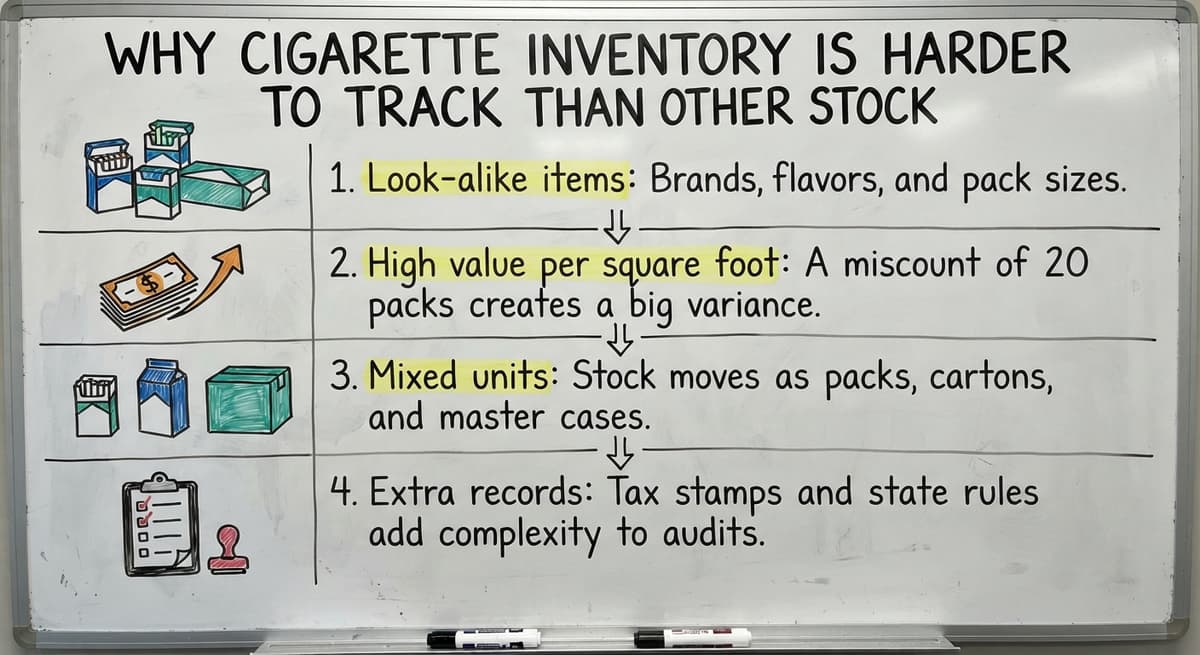
Cigarette inventory is hard to track because many items look alike, each one costs a lot, and stock moves in several units. Small slips add up fast.
- Look-alike items: Brands, flavors, and pack sizes differ by tiny label details.
- High value per square foot: A miscount of 20 cartons costs real money.
- Mixed units: Stock moves as packs, cartons, and master cases.
- Extra records: Tax stamps and state rules add paperwork. Check current state and federal rules, and ask a qualified advisor. This guide is not legal advice.
GS1 calls its barcode standards "the global language of business", and that shared language is what lets a scanner tell two look-alike cartons apart. Clear IDs fix the first problem. The rest of this guide fixes the others.
Step 1: Give Every Product One Clear Item Record
To give every product one clear item record, assign one SKU (a short code you pick for each item) per brand, style, and pack size. Then store everything about it in one place.
Each record holds the UPC (the barcode number), a plain description, and the unit sizes. Never list the same item under two names. A spreadsheet that says "Menthol King Box" and an accounting package that says "Menthol KG BX" will never agree.
Clean this list first. Every later step depends on it. One item, one name, one record is the rule that keeps all your counts honest.
Step 2: Track Packs, Cartons, and Cases Together
To track cartons and packs together, pick one base unit and convert every larger unit back to it. Most warehouses pick the pack.
The base unit is the smallest thing you count. Everything else is a multiple of it. Staff then never have to guess which unit a number means.
Count by pack, carton, and case
Say 1 carton holds 10 packs. Say 1 master case holds 50 cartons. Then 1 case is 50 x 10, or 500 packs.
Now a buyer orders 2 cases. The system shows 1,000 packs coming in. A store buys 3 cartons. The system takes off 30 packs. No one does math at the dock.
Put the conversion on the item record once. Errors drop when you buy by the case and sell by the carton, because the math lives in one spot and not in someone's head.

Step 3: Record Every Stock Movement
To record every stock movement, log each time an item enters, leaves, or changes in your building. Use one simple rule: nothing enters or leaves the warehouse without a record.
A warehouse inventory is only as good as its log. Without it, a count gap has no trail to follow.
What to log
Log each of these moves:
- Receipts from suppliers
- Sales and shipments to customers
- Returns from customers
- Transfers between locations
- Damaged packs and cartons
- Write-offs, such as stale or lost stock
What each entry needs
Every entry answers 4 questions: who, what, when, and how many. A line like "Sam, 4 cartons of item 1102, May 3, damaged in the aisle" is enough. Short notes now save hours of digging later.
The comparison is easier when one option is built for you
Off-the-shelf means fitting your process to the software. We do it the other way round, and the first look costs nothing.
Book a callStep 4: Set Up Bin Locations and Receiving Checks
To set up bin locations, label every shelf and cage so each item has one home. Then check each delivery at the dock before anyone puts it away.
A bin is just a labeled spot, such as "A-2-3" for aisle A, rack 2, shelf 3. Staff find stock fast. Counters know where to look.
Check deliveries at the dock
Open the buy order. Count what the driver unloads. Compare it to the paper. Note any gap before the driver leaves. After put-away, a mistake is nearly impossible to prove. Barcode scanning for receiving and picking makes this step faster and cuts typing errors.
Secure high-value stock
Lock the cigarette cage. Limit who holds a key. Keep a short list of approved staff. Fewer hands mean fewer gaps, and that is the cheapest loss control you can buy.
Step 5: Use Cycle Counts Instead of Only Yearly Counts
To keep an inventory count accurate, use cycle counts. A cycle count means you count a small group of items each week and not the whole building once a year.

Count fast sellers more often. They move the most and slip the most. Slow items can wait a month or two. Cycle counting best practices all share this idea: small, steady checks beat one huge one.
How often should you count cigarette inventory?
Count your top sellers weekly. Count the rest on a monthly rotation. Do a full count at least once a year, since tax rules ask you to value stock. The IRS says in Publication 538: "To figure taxable income, you must value your inventory at the beginning and end of each tax year." Weekly counts make that day easy.
How to run a count
Count the shelf. Compare it to the system. Look into every gap, even a small one. Check recent receipts, sales, and returns first. Catch problems while the trail is fresh, and most gaps turn out to be a missed log entry.
Should You Track Expiration Dates or Lot Numbers?
You should track the received date for every delivery. Track lot or batch numbers only if your records or customers need them. Freshness matters, so ship the oldest stock first.
That rule is called FIFO, short for first in, first out. Put new stock behind old stock on the shelf. Pull from the front.
A lot number is a code the maker prints on a batch. If a customer asks for it, or your rules call for it, log it at receiving. If no one will use it, skip it.
Keep it light. Track only what you will actually use, because extra fields that no one reads just slow the dock down.
Can You Track Cigarette Inventory in a Spreadsheet or an Accounting Package?
Yes, you can track cigarette inventory in a spreadsheet at very low volume. It breaks down when many people, copies, and typos enter the picture.

A spreadsheet has no lock on the cell. Two people edit two copies. Someone sorts one column and scrambles a row. Nobody notices for weeks.
An accounting package such as a popular small-business bookkeeping program tracks quantity and cost well. Many setups do not track bins, mixed units, or count sheets the way a warehouse works. Can your accounting software track cigarette inventory? Yes for totals. It often falls short on the daily floor work.
Printed sheets and email add delays and re-typing. Each re-type is a new chance for error.
You may have outgrown your tools if:
- Counts never match the system.
- Staff keep private side sheets.
- Only one person knows how the file works.
- Month-end takes days to fix.
Outgrowing a tool is a sign of growth, not a failure.
See it running on your own process first
No build cost. The subscription starts once it is live and doing the job, not before.
Book a callWhat a Custom Inventory System Can Do Without Replacing Your Accounting Software
A custom inventory system can fill the manual gaps in your warehouse and leave your accounting package alone. It is built around how your operation already works.
You do not need a forced move. Custom software that works alongside your accounting software can send totals to your books while the floor uses its own screens. Keep your accounting software's inventory where it helps with accounting. Replace only the hand-typed parts.
Here is what that can look like:
- Scan-based receiving that checks each delivery against the buy order
- Unit conversion that turns cases into cartons and packs on its own
- Count sheets that staff fill out on a handheld device
- Low-stock alerts that tell you to reorder before the shelf is bare
This works at small scale. It is not a big ERP (a large, all-in-one business system) and it does not need a long rollout. The Software Society builds custom workflows like this with human experts. You can also compare options in our look at inventory management software for wholesale distributors.

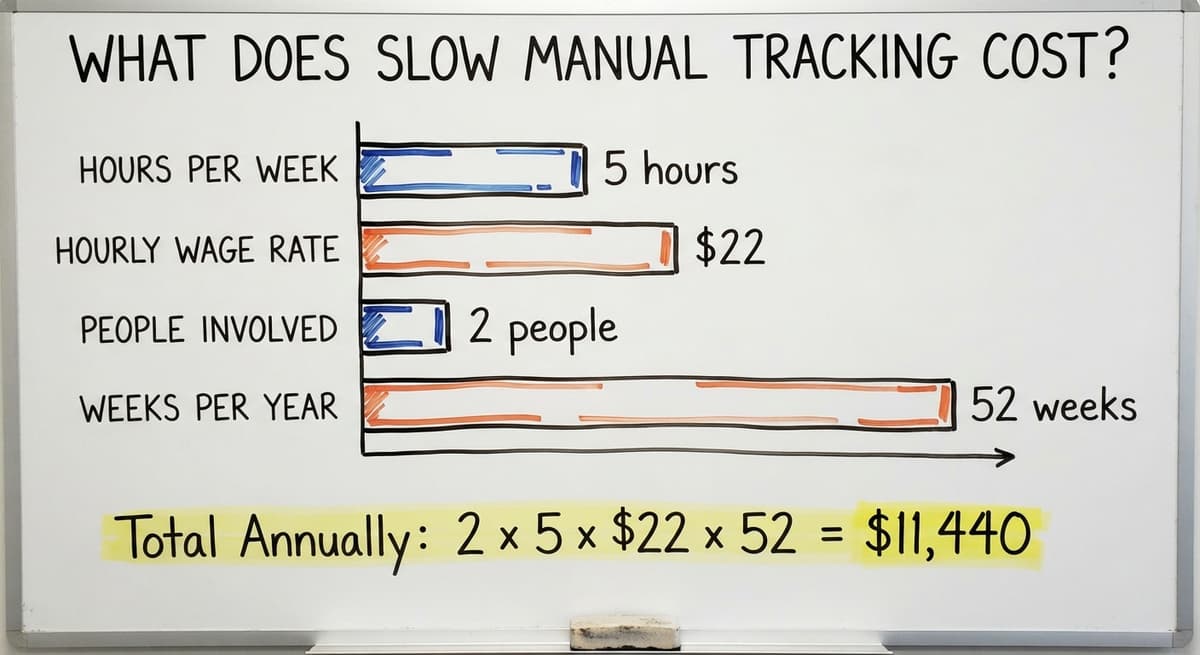
What Does Slow Manual Tracking Cost?
Manual tracking costs you in wages first. Try this math with your own numbers.
Say 2 people spend 5 hours a week fixing counts and re-typing sheets. Say they earn $22 an hour. That is 2 x 5 x $22 x 52 weeks, or $11,440 a year. For a sense of what warehouse clerks earn, see the Bureau of Labor Statistics.
Wrong counts also hurt promises. The FTC's mail, internet, or telephone order rule expects sellers to ship when they said they would. An accurate count backs that up. Late orders start with stock you thought you had. For wider process guidance, the NIST Manufacturing Extension Partnership offers vendor-neutral help.
Common Mistakes That Cause Cigarette Stock Losses
Cigarette stock goes missing mostly because of weak habits and not theft. Most losses trace back to the same 5 mistakes.
- Counting once a year. Gaps pile up for 12 months before anyone sees them.
- Letting many people edit one spreadsheet. Edits overwrite each other.
- Skipping receiving checks. Short deliveries get put away as full ones.
- Not recording damage or returns. The shelf and the system drift apart.
- Mixing units with no clear conversion. A carton gets logged as a pack.
Why does cigarette inventory go missing? Often the stock is there but the record is wrong. Fix the record habits first. Then look at security.

Do You Need Software to Track Cigarette Inventory?
No, you do not need software to start. A clean item list, a movement log, and a weekly count can run on paper.
Software helps once volume grows. Wholesale cigarette inventory moves fast and in several units. A tool that does the unit math and records each scan saves time and cuts errors.
The Census Bureau's Monthly Wholesale Trade data shows how much stock wholesale firms carry nationwide. That stock has to be counted somehow. Pick the lightest tool that stops your biggest leak.
How to Start This Week
You can start this week with 3 small jobs. None needs new software.
- Clean up your item list. Merge duplicates and give each item one name and one SKU.
- Count your top 20 items. Compare the numbers to your records and note every gap.
- Write down where your records live today: accounting package, spreadsheet, paper, or email.
That list shows where re-typing happens. If those manual steps cost you hours each week, talk to a local team about fixing just those steps. The Software Society can look at your workflow with you and build only what you need.
Frequently asked questions
What is tobacco tracking and tracing?
Tobacco tracking and tracing means marking tobacco products with unique IDs or stamps so each pack or carton can be followed through the supply chain. Rules differ by country and state. Check current rules for your area. Your own inventory log is a simple, separate version of the same idea.
How often should you count cigarette inventory?
Count fast sellers weekly and the rest on a monthly rotation. Do a full count at least once a year. Small, frequent cycle counts catch errors while the trail is still fresh.
Do you need software to track cigarette inventory?
Not at first. A clean item list, a movement log, and regular counts can run on paper. Software helps once you handle many items in packs, cartons, and cases, since it does the unit math and records each scan for you.
How to chart smoking history?
Doctors often use pack-years. Multiply packs smoked per day by years smoked. For example, 1 pack a day for 20 years is 20 pack-years. This question is about health, and not inventory. Talk to a doctor for medical use.
Is Demi Moore a cigarette smoker?
Public reports say she smoked in the past and has spoken about quitting. This site cannot confirm her current habits. Check recent, reliable news for an up-to-date answer.
What is the #1 selling cigarette?
There is no single answer. It depends on how you measure: units sold, revenue, or share. It also depends on the region and the year. For your own warehouse, your sales log shows your top seller, so count it most often.
How do you count cigarettes by pack, carton, and case?
Pick the pack as your base unit. Then convert up. If 1 carton holds 10 packs and 1 case holds 50 cartons, 1 case equals 500 packs. Store that conversion on each item record so staff never guess.
Start with a free first look
A 30 minute call, your operation mapped, and a clear picture of what we would build. No obligation and nothing to install.
Book a callRelated guides
More on the same work.
- How to Keep Track of Inventory
- How to Keep Track of Inventory on Clover
- How to Keep Track of Consignment Inventory
- How to Keep Track of Alcohol Inventory
- How to Keep Track of Ebay Inventory
- How to Keep Track of Poshmark Inventory
- How to Keep Track of Grocery Inventory
- How to Keep Track of Freezer Inventory
- How to Create an Inventory Tracking System?
- How to Keep Track of Inventory in Warehouse
- How to Keep Track of Inventory Small Business
- How to Record Inventory on Hand
- How to Manage Inventory in Rocket League
- How to Improve Inventory Management
- How to Manage Fba Inventory
- How to Manage Inventory in Stardew Valley
- How to Manage Inventory Fallout 76
- How to Manage Inventory Diablo 4
- How to Manage Pharmacy Inventory
- How to Manage Hardware Inventory
- How to Manage Food Inventory
- How to Manage Inventory Efficiently
- How to Manage Inventory Apex Legends
- How to Manage Consignment Inventory