


How To Keep Track Of Consignment Inventory
To keep track of consignment inventory, store it apart from your own stock. Log each item on arrival with its owner and location. Record every sale, return and move the same day. Count it on a set schedule. Send the owner a clear statement. Do these 6 steps in order.
Reviewed October 2026 for small wholesalers and warehouses that run on an accounting package and spreadsheets.
Book a callWhat Is Consignment Inventory?
Consignment inventory is stock that one party holds but another party owns until it sells. The owner is the consignor. The holder is the consignee. The holder sells the goods and pays the owner after each sale. Unsold goods go back.
This stock is hard to track for a plain reason. The goods sit in your building, or in someone else's. The ownership is not yours, or not theirs. Your shelves show one thing. Your books must show another.
The terms consignor and consignee matter in every record you keep. Each line should say who owns the item today.
We build it for your operation, and the first look is free
If you would rather not compare products, describe how your operation already works and we build the system around it.
No build cost. You see it running on your own process first, and the monthly subscription starts only once it is live.
Book a callWhy Is Consignment Inventory Tracking Hard?
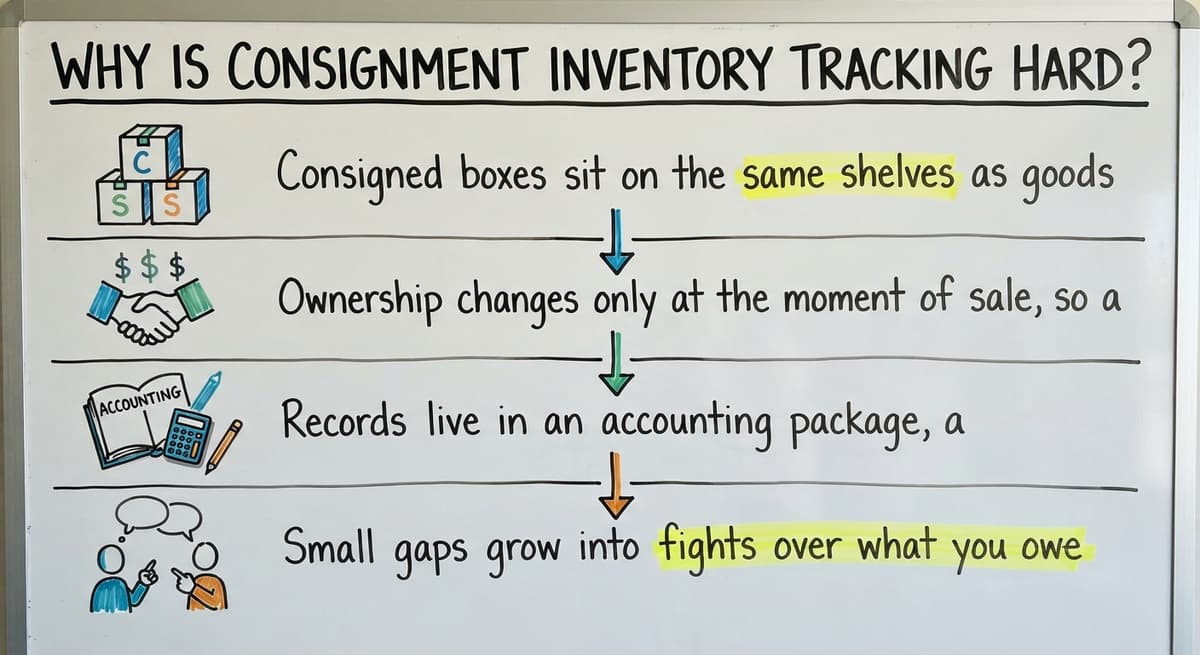
Consignment inventory tracking fails when ownership and location blur together. Four things cause most of the trouble:
- Consigned boxes sit on the same shelves as goods you own, so no one can tell them apart.
- Ownership changes only at the moment of sale, so a late entry leaves the books wrong.
- Records live in an accounting package, a spreadsheet, printed sheets and email.
- Small gaps grow into fights over what you owe.
Scan-based counts help here. GS1 describes its barcode standards as a way to "identify, capture and share" product information, and you can read more at GS1 barcode standards.
A clean record starts with one place where each item is written down once.
Step 1: How Do You Keep Consigned Stock Separate From Your Own?
You keep consigned stock separate by giving it its own zone and its own item codes. Do this before anything else. Mixed shelves ruin every later step.
- Use a dedicated shelf, bin or floor zone. If space is tight, use a separate location in your records.
- Put a label or tag on each box that shows the owner's name.
- Never give a consigned item the same code as an item you own.
The last rule protects your numbers. Owned stock has a value on your books. Consigned stock does not. One shared code mixes the two, and your counts and values go wrong together.
Separate space plus separate codes keeps owned-stock value and counts clean.
Step 2: Record Every Item When It Arrives
Record each consigned item the day it arrives, because memory fades fast. Good receiving habits matter here. Your normal warehouse receiving process can carry this step with a few added fields.
Log these facts for every delivery:
- The owner's name
- The item and the quantity
- The date received
- The agreed price
- The condition of the goods
- Any agreed return date
Give the owner a receipt. A signed copy or an emailed copy both work. Keep one record per delivery and enter it the same day.
A receipt on day one is what ends later arguments about what you were given.
The comparison is easier when one option is built for you
Off-the-shelf means fitting your process to the software. We do it the other way round, and the first look costs nothing.
Book a callStep 3: Track Who Owns What and Where It Sits
Track two facts on every consigned item: the owner and the location. With both fields, you can see on-hand quantity for each owner at any time. Without them, you guess.

A simple table works at small scale if one person is accountable for it:
| Owner | Item | Location | On hand |
|---|---|---|---|
| Owner A | Ceramic mugs | Zone C, bin 4 | 120 |
| Owner B | Canvas totes | Customer site | 60 |
Stock held in your warehouse
Give each zone or bin a name. Write that name in the location field. Then a picker can find any owner's goods in minutes.
Stock held at a customer's site
Some goods sit at a shop or job site. Treat that site as a location too. You still own the duty to count it and report it.
One owner field and one location field turn a pile of boxes into a record you can trust.
Step 4: Log Every Sale, Return and Move
Every sale, return and move must reach your record on the day it happens. A sale moves an item from consigned to sold. It also flags the amount you owe the owner.
Follow these habits:
- Record each sale the same day, with the owner and the sale price.
- Record each return to the owner the same day.
- Record each move between zones or sites the same day.
- Note damaged or lost items and write down the reason.
Missed entries are the top cause of mismatched counts. A box leaves the shelf, no one logs it, and the record stays high. Weeks later the count is off, and no one knows why.
A same-day log is the cheapest way to keep your counts honest.
Step 5: Count Consigned Stock on a Regular Schedule
Count consigned stock every month at least. Count fast movers more often. A cycle count is a small, regular count of a few items instead of one big count of everything. Our guide to cycle counting for small warehouses shows how to set one up.

Follow this routine:
- Count the physical stock and compare it to the record.
- Write down every difference you find.
- Find the cause. A wrong number fixed with no cause will come back.
- Share the count with the owner so both sides agree.
The law also expects you to count what you hold. IRS Publication 538 says, "To figure taxable income, you must value your inventory at the beginning and end of each tax year." Read the full text at IRS Publication 538. Ask your accountant how this applies to goods you do not own.
A count that the owner has seen and agreed to ends most doubts before they start.
Step 6: Report Sales and Pay the Owner on Time
Send each owner a statement on a regular schedule. Match it to the agreed terms. A clear statement shows four things:
- What sold
- What is still on hand
- What went back
- The amount you owe
Clear statements prevent disputes and protect the relationship. Owners who see the same numbers you see have little to argue about. Keep a copy of every statement you send. If a question comes up in 6 months, you can answer it in minutes.
Pay on the date you promised. Late pay costs more trust than any counting error does.
A steady statement and an on-time payment are what make an owner send you more goods.

How Should Consignment Stock Show Up in Your Accounting Package?
Consigned goods you do not own generally should not count as your inventory asset. Rules differ, so confirm the right treatment with an accountant. This guide gives a general caution and nothing more.
An accounting package such as popular small-business bookkeeping software is good for money and the books. It is not built around owner-by-owner stock tracking. It shows what you owe. It does not easily show which owner's boxes sit in which bin.
So many teams keep a side spreadsheet. That is where errors creep in. Two people edit it, one forgets to save, and the numbers split.
Use the accounting package for the money and a separate record for the stock, and keep the two tied by clear dates.
See it running on your own process first
No build cost. The subscription starts once it is live and doing the job, not before.
Book a callWhen Do Spreadsheets Stop Working?
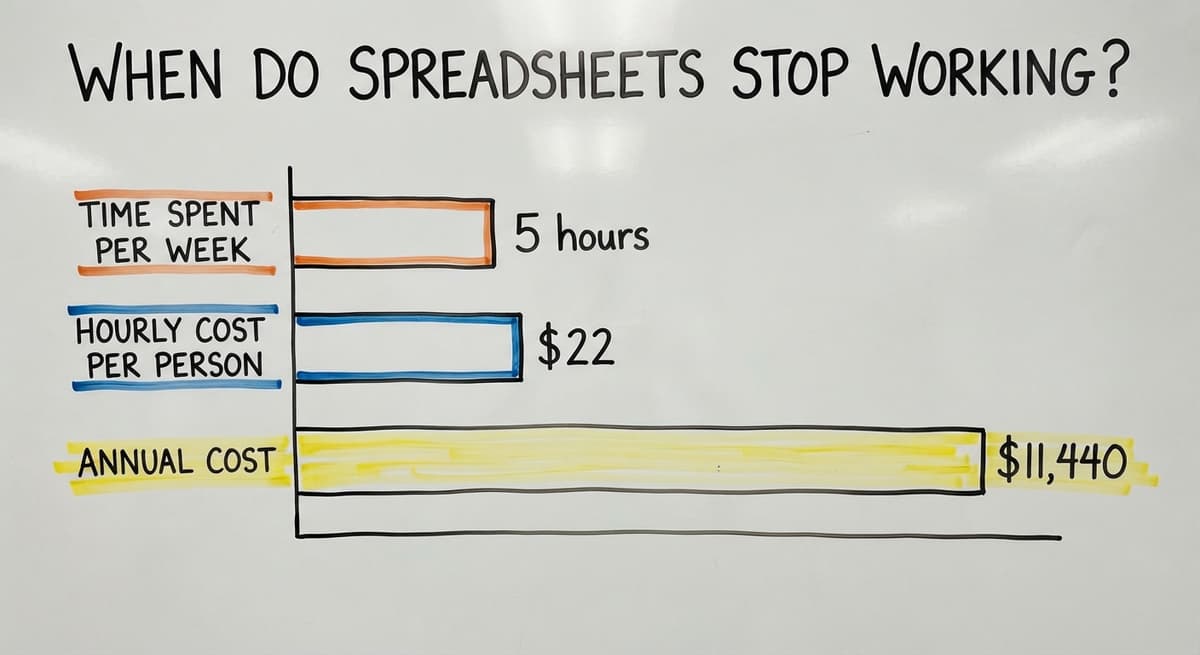
An inventory tracking spreadsheet stops working when more people, owners and places depend on it than one person can watch. Look for these signs:
- Several people edit the file at once.
- You hold goods for many owners.
- Stock sits in many locations.
- Counts often fail to match the record.
- Someone spends hours each month building statements by hand.
- Copies live in a spreadsheet, a database, on paper and in email.
Put a price on the hand work. Say 2 people spend 5 hours a week on statements and fixes at $22 an hour. That is 2 x 5 x 22 x 52, or $11,440 a year. The US Bureau of Labor Statistics publishes pay for this kind of work, so check it against your own wages.
A small custom tool can replace only the manual parts and leave the rest alone.
What Does a Simple Consignment Tracking System Look Like?
A simple consignment tracking system is a small set of tools that match how you already work. It does not force a move to a big new system. It replaces only the manual steps.

It has these parts:
- A receiving screen that logs owner, item, quantity, price and condition
- Owner and location fields on every item
- A log for sales, returns and moves
- A count tool that shows differences at once
- An owner statement built with one click
Your accounting package stays in place for the books. A tool can pass sales and amounts owed to your accounting software. Our note on working with accounting software alongside custom software explains how.
You do not need a big enterprise system or a long rollout. This works for a team of 5 as well as a team of 50. The Software Society is not the source of this advice. NIST offers vendor-neutral guidance on inventory process if you want a second view.
The right system is the smallest one that removes the hand work you repeat every week.
Common Consignment Tracking Mistakes to Avoid
Most errors come from habits, not from tools. Watch for these five:
- Mixing stock with no owner labels
- Entering sales days later
- Skipping counts when the week gets busy
- Agreeing to terms by voice with no written record
- Relying on one person's memory
The last one hurts most. If that person is out sick, no one knows what sits where. Write it down. Share it. Train a second person.
Accurate records also protect your promises to buyers. The FTC guidance on shipping orders covers the duty to ship when you said you would. A true count is how you keep that promise.
Every one of these mistakes has a written habit that prevents it.

Next Step: Fix the Manual Parts First
Start with the six steps above. They cost nothing. If your spreadsheet strains after that, look at what part eats the most hours. Wholesale firms hold large stocks nationwide, and the US Census Bureau tracks them each month. Your own stock deserves the same care.
The Software Society builds custom workflows that replace fragmented manual work with a system that fits real operations. Book a short business review and we will map your consignment steps and show which ones to automate first.
Frequently asked questions
What is a consignment order?
A consignment order is an agreement where an owner sends goods to a seller who does not buy them up front. The seller keeps the goods on hand and sells them. The owner is paid after each sale. Goods that do not sell go back to the owner. The order should state the price, the pay date and the return date in writing.
How do you keep track of inventory?
Give each item one code. Record every receipt, sale, return and move the same day. Count a few items on a set schedule and compare the count to the record. Fix the cause of any gap. A spreadsheet works for a small range. An inventory app or a custom tool helps as stock, people and places grow.
What items sell well on consignment?
There is no single answer. What decides it is price, demand, size and how fast an item sells. Goods that are easy to store, easy to value and in steady demand tend to suit consignment best. Check your own sales history and talk to the owner before you agree to hold a new line.
How to record goods on consignment?
Log the owner, item, quantity, date received, agreed price and condition. Mark the item as consigned so it does not count as your own stock. Give the owner a receipt. When it sells, record the sale and the amount you owe. Ask an accountant how your books should show these goods.
Who owns consignment inventory?
The consignor owns it until it sells. The consignee holds it and sells it. Ownership passes to the buyer at the moment of sale. Until then the goods are not an asset of the holder, so tag them with the owner's name.
How often should you count consignment stock?
Count at least once a month. Count fast movers every week or two. Share each count with the owner so both sides agree on the numbers.
How do you keep consigned stock separate from your own?
Use a dedicated shelf, bin or zone. Label each box with the owner's name. Give consigned items their own item codes so owned-stock counts and value stay clean.
When should you move beyond a spreadsheet?
Move when many people edit the file, you hold goods for many owners, stock sits in many places, or counts often fail to match. Another sign is hours spent on statements by hand. A small custom tool can replace just those manual parts.
Start with a free first look
A 30 minute call, your operation mapped, and a clear picture of what we would build. No obligation and nothing to install.
Book a callRelated guides
More on the same work.
- How to Keep Track of Inventory
- How to Keep Track of Inventory on Clover
- How to Keep Track of Alcohol Inventory
- How to Keep Track of Ebay Inventory
- How to Keep Track of Poshmark Inventory
- How to Keep Track of Grocery Inventory
- How to Keep Track of Freezer Inventory
- How to Keep Track of Cigarette Inventory
- How to Manage Consignment Inventory
- How to Create an Inventory Tracking System?
- How to Keep Track of Inventory in Warehouse
- How to Keep Track of Inventory Small Business
- How to Record Inventory on Hand
- How to Manage Inventory in Rocket League
- How to Improve Inventory Management
- How to Manage Fba Inventory
- How to Manage Inventory in Stardew Valley
- How to Manage Inventory Fallout 76
- How to Manage Inventory Diablo 4
- How to Manage Pharmacy Inventory
- How to Manage Hardware Inventory
- How to Manage Food Inventory
- How to Manage Inventory Efficiently
- How to Manage Inventory Apex Legends