


How To Keep Track Of Poshmark Inventory
Give every item a unique SKU, keep it in a set bin, and log it on one master list. Update that list the moment an item sells, ships or comes back. That is how to keep track of Poshmark inventory without losing stock or profit.
Reviewed October 2026. The steps below use plain tools and match the habits of a small warehouse.
Book a callHow Do You Keep Track of Poshmark Inventory?
You keep track of Poshmark inventory with 3 habits. Give each item a unique ID. Store it in a set spot. Record it on one master list. Then update the list the moment an item sells, ships or is returned.
This works for resellers and small resale shops that buy and sell stock in volume. It also works for a closet with 50 items. The habits stay the same as the pile grows. Only the tools change.
The next 5 steps show each habit in order.
We build it for your operation, and the first look is free
If you would rather not compare products, describe how your operation already works and we build the system around it.
No build cost. You see it running on your own process first, and the monthly subscription starts only once it is live.
Book a callWhy Tracking Poshmark Inventory Matters
You cannot sell what you cannot find. Poor records also hide your true cost, so profit becomes a guess. The tax office cares too. IRS Publication 538 says, "To figure taxable income, you must value your inventory at the beginning and end of each tax year."
Other risks add up:
- Cross-listed items can sell twice when the list is stale.
- Lost stock is cash sitting on a shelf.
- A late shipment breaks the promise you made to a buyer.
Scan-based counts rest on the barcode rules at GS1, which set the shared standard for codes that scanners read. Even if you never scan, clean records let you grow into it later.
A good record turns stock from a guess into a number you can trust.
Step 1: What Is a SKU, and How Do You Give Every Item One?
A SKU is a short code that names exactly one item, and you make one for each piece you buy. Keep the format simple. Use category, size and a running number. A medium jacket might be JKT-M-014.
Put the code in 2 places:
- Write it on a tag or label that stays on the item.
- Add it to the listing title or the private notes field.
Never reuse a SKU. If JKT-M-014 sells, retire that code for good. A reused code makes old sales and new stock look like the same thing.
How long should a SKU be?
Short enough to write by hand. About 8 to 10 characters is plenty. Long codes get misread and mistyped. A unique code is the key that unlocks every other record.
If you have no spare shelves, use clear bins or hanging bags with paper labels. A bin does not need to be fancy. It needs a name and a fixed home. A set spot turns searching into walking.
Step 2: Store Items in Set Bin Locations
A bin location is a labeled spot where one group of items lives, and it cuts the time you spend hunting. Label shelves, bins or racks. Use plain names like A1, A2 and B1. Then write the bin next to the SKU on your list.

Good habits help:
- Keep similar items together, such as all jackets on one rack.
- Keep ready-to-list stock apart from listed stock.
- Put fast sellers near your packing table.
Larger shops treat this as its own craft. See bin location and warehouse organization for how bigger operations lay out shelves and pick routes.
When an order lands, you walk to one spot instead of searching the whole room.
What if you have no spare shelves?
Use clear bins or hanging bags with paper labels. A bin does not need to be fancy. It needs a name and a fixed home.
A set spot turns searching into walking.
The comparison is easier when one option is built for you
Off-the-shelf means fitting your process to the software. We do it the other way round, and the first look costs nothing.
Book a callStep 3: Build One Master Inventory List
A master inventory list is one sheet with one row for every item you own. Start with a simple spreadsheet. Keep it in one place only. Several lists drift apart, and then no list is right.
To avoid selling the same item twice, remove cross-listed items from every other channel right away. Do it before you pack. A sale on one site should trigger a delete on the rest the same hour. Keep a column that notes where each item is listed, so you know where to look.
What should a Poshmark inventory list include?
Use these columns:
- SKU: the unique code for the item.
- Description: brand, color, size and flaws in a few words.
- Cost: what you paid, including any lot share.
- Date bought and date listed: these show how long stock sits.
- List price: the price you set.
- Bin: where the item lives.
- Status: where the item is in its life (see Step 4).
Later, add sale price, fees and ship date. Build the sheet yourself from these columns. You do not need a download.
One list means one answer to the question, "Do I have this?"

Step 4: Use Clear Status Labels
A status label is one word that says where an item stands, and it shows at a glance what needs action. Keep the set short and fixed:
- To List: bought, but not yet photographed or posted.
- Listed: live for sale.
- Sold: a buyer has paid.
- Shipped: the package is on its way.
- Returned: the item came back to you.
- Donated: you gave it away and closed the record.
Change the status the same day it changes. Then filter the sheet. Filter for Sold to see what to pack. Filter for Listed and sort by date to see stale stock.
Six words are enough to run the whole shelf.
Step 5: Update the List When an Item Sells
Updating the list when an item sells must be part of packing, not a chore for later. Follow one routine every time:
- A sale comes in.
- Pull the item from its bin.
- Mark it Sold on the list.
- Pack and ship it.
- Mark it Shipped and add the date.
The Federal Trade Commission's mail order rule expects you to ship when you said you would. A list you trust makes that promise easy to keep.
The routine only works if it never gets skipped.
How do you avoid selling the same item twice?
Remove cross-listed items from every other channel right away. Do it before you pack. A sale on one site should trigger a delete on the rest the same hour. Keep a column that notes where each item is listed, so you know where to look.
How do you record true profit?
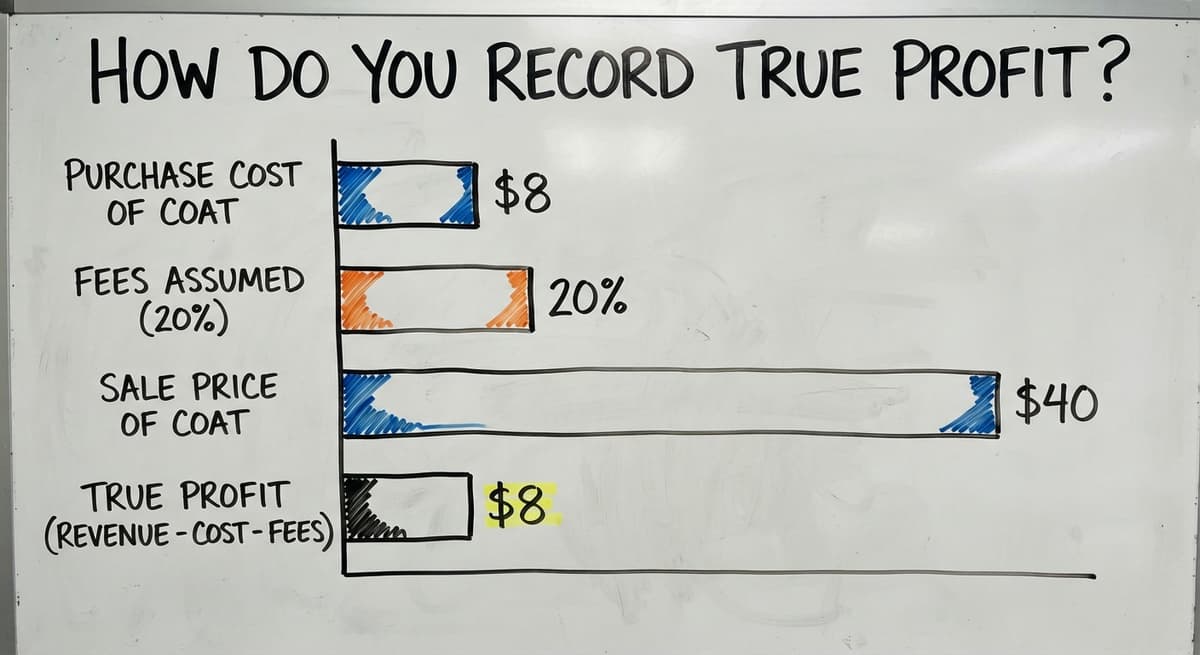
Add sale price, fees and ship cost to the row. Take a sample. You buy a coat for $8 and sell it for $40. Assume fees of 20%, which is $8. Profit is $40 minus $8 minus $8, or $24. Without the cost column, you would only see $40.

When an item comes back, put it back in a bin. Write the bin on the row. Reset the status to To List or Listed. Note the reason for the return, so you can fix the listing.
Every sale closes the loop only when the sheet changes too.
How do you handle returns?
Put the item back in a bin. Write the bin on the row. Reset the status to To List or Listed. Note the reason for the return, so you can fix the listing.
Every sale closes the loop only when the sheet changes too.
How Often Should You Count Your Stock?
Count one section every week, and count everything every few months. A stock count means walking the shelves and matching what you see to the list. Fix any gap on the spot.
Here is the math. Say you hold 400 items in 8 sections of 50. One section a week covers the whole shelf in 8 weeks. Each count takes minutes, not a weekend.
Look for 3 problems:
- Missing items that the list says you own.
- Items sitting in the wrong bin.
- Duplicate SKUs on 2 different items.
Small, regular counts beat one giant count, because errors never get far off.
See it running on your own process first
No build cost. The subscription starts once it is live and doing the job, not before.
Book a call
What Mistakes Make Poshmark Inventory Hard to Track?
The biggest mistake is working without labels, so you hunt for each item by hand. Four more mistakes follow close behind:
- Late updates: a list that lags days behind is wrong when you need it.
- Notes in many places: phone, paper and spreadsheet will disagree.
- No cost record: you cannot know profit if you forget what you paid.
- Skipped counts: small errors pile up until the numbers are far off.
Each mistake has a cheap fix in the steps above. Tag the item, log it once, and count a little each week.
Most tracking trouble comes from skipped habits, not from weak tools.
When Is a Spreadsheet Not Enough?
A spreadsheet is no longer enough when more than one person edits it, stock sits in several places, or updates take hours. These signs show up as a resale hobby turns into a small business. Here are the signs that you have outgrown the sheet:
- Two people change the same row and one edit is lost.
- You hold stock at home, in a unit and in a partner's garage.
- You buy wholesale lots and need to split cost across items.
- You sell on several channels and cannot sync them by hand.
Signs you have outgrown the sheet
- Two people change the same row and one edit is lost.
- You hold stock at home, in a unit and in a partner's garage.
- You buy wholesale lots and need to split cost across items.
- You sell on several channels and cannot sync them by hand.
What manual tracking costs
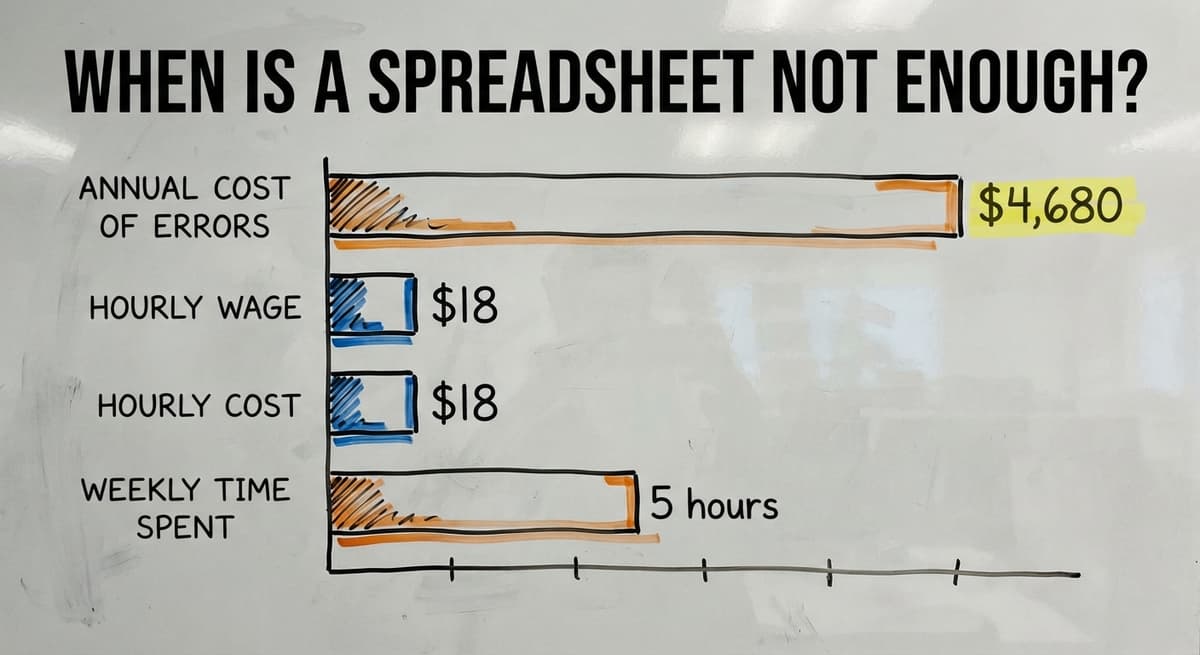
Make a sample. Say you spend 5 hours a week fixing and matching records at $18 an hour. That is 5 x $18 x 52, or $4,680 a year. The Bureau of Labor Statistics publishes pay data for the stock clerks who do this work. Check the current wage for your area and swap in your own numbers.
When the sheet costs more than a fix, it is time to change.
How Can Growing Sellers Move Beyond Manual Tracking?
Growing sellers can replace only the manual steps with software built around how the operation already works. You do not need a large system or a long rollout. Look at inventory management software for small distributors to see what scale fits you.
The plan is simple. Keep your accounting software for the books. Automate the stock counts, bin records and status updates. That is keeping your accounting software while automating manual inventory work, so your accountant sees no change.
Automate the repeat work and keep the tools that already serve you.
Where Can Growing Sellers Find Software and Guidance?
The Software Society is not the source above; it is a local Columbus, Ohio team that builds the software, website and search presence together. It offers custom working software for wholesale and warehousing, shaped to your real steps.
The NIST Manufacturing Extension Partnership offers vendor-neutral guidance on inventory process. The Census Bureau's wholesale data shows how firms track stock against sales.
Quick Checklist for Tracking Poshmark Inventory
Use this list as a daily guide to how to keep track of Poshmark inventory:
- Put a SKU on every item.
- Store each item in a set bin.
- Keep one master list.
- Use clear status labels.
- Update the list the same day.
- Count one section each week.
Your next step is small. Pick one shelf today, label it, and tag every item on it with a SKU. Then add those rows to your list.
A tracked shelf is the first piece of a tracked business.
Frequently asked questions
How do you keep track of inventory?
Give every item a unique SKU, store it in a labeled bin, and record it on one master list. Mark each item as listed, sold, shipped or returned the same day it changes. Count one section of stock each week to catch gaps early.
How do you avoid selling the same item twice?
Keep one master list with a column for each place an item is listed. When an item sells, remove it from every other channel before you pack it. Updating the same hour matters most.
What should a Poshmark inventory list include?
Include the SKU, a short description, cost, date bought, date listed, list price, bin location and status. Add sale price, fees and ship date once the item sells so you can see true profit.
When is a spreadsheet no longer enough?
A spreadsheet falls short when several people edit it, stock sits in several places, or updates take hours each week. Wholesale lots and many sales channels also strain it. At that point, software that automates counts and status updates can help.
Where is my Poshmark package?
Check the order page for the tracking number and carrier scans. If it has not moved, contact the other party through the app. As a seller, record the tracking number and ship date on your inventory list so you can answer quickly.
How many times should you share your closet on Poshmark?
There is no single right number. Sellers test different rhythms and watch their own results. Track listing age and sales on your list to see what works for your stock, and keep a pace you can sustain.
What doesn't sell well on Poshmark?
No single list fits every seller. Items with damage, weak photos, high prices or poor demand tend to sit. Use the date listed column on your inventory list to spot stale items, then reprice, relist or donate them.
Start with a free first look
A 30 minute call, your operation mapped, and a clear picture of what we would build. No obligation and nothing to install.
Book a callRelated guides
More on the same work.
- How to Keep Track of Inventory
- How to Keep Track of Inventory on Clover
- How to Keep Track of Consignment Inventory
- How to Keep Track of Alcohol Inventory
- How to Keep Track of Ebay Inventory
- How to Keep Track of Grocery Inventory
- How to Keep Track of Freezer Inventory
- How to Keep Track of Cigarette Inventory
- How to Create an Inventory Tracking System?
- How to Keep Track of Inventory in Warehouse
- How to Keep Track of Inventory Small Business
- How to Record Inventory on Hand
- How to Manage Inventory in Rocket League
- How to Improve Inventory Management
- How to Manage Fba Inventory
- How to Manage Inventory in Stardew Valley
- How to Manage Inventory Fallout 76
- How to Manage Inventory Diablo 4
- How to Manage Pharmacy Inventory
- How to Manage Hardware Inventory
- How to Manage Food Inventory
- How to Manage Inventory Efficiently
- How to Manage Inventory Apex Legends
- How to Manage Consignment Inventory