


How To Manage Slow-Moving Inventory
To manage slow-moving inventory, find the items that sell far below their peers, learn why they stall, and pick one exit for each: discount, bundle, return, or write off. Then fix how you reorder so the problem does not return. This guide was reviewed in October 2026 for small distributors.
Book a callWhat Is Slow-Moving Inventory?
Slow-moving inventory is stock that sells much more slowly than your other items, but still sells now and then. Some people say slow-moving stock. It is not the same as dead stock, which has had no sales for a long time. It is also not obsolete stock, which you cannot sell at normal value. Picture a wholesale pallet of 40 cases. If it sells 2 cases a month, it will sit for 20 months. That pallet is slow. If it sold nothing in a year, it would be dead.
We build it for your operation, and the first look is free
If you would rather not compare products, describe how your operation already works and we build the system around it.
No build cost. You see it running on your own process first, and the monthly subscription starts only once it is live.
Book a callWhy Does Slow-Moving Inventory Hurt a Small Distributor?
Slow stock hurts because cash sits on the shelf instead of paying bills or buying items that sell. It also takes rack and floor space that faster items could use. Small shops feel this first, since cash and space are both tight.
Slow items also add carrying costs. Those are the costs of holding stock:
- Handling and moving the same boxes again and again
- Insurance on stock you may never sell
- Damage and shrinkage, which is loss from theft or error
- Spoilage or expiration dates that run out
GS1, the group behind barcode standards, publishes its rules at gs1.org and says its standards help "identify, capture and share" product data, which is the base for knowing what you hold.
The point is simple: every idle box costs money twice, once to buy and again to keep.
How Do You Find Slow-Moving Items?
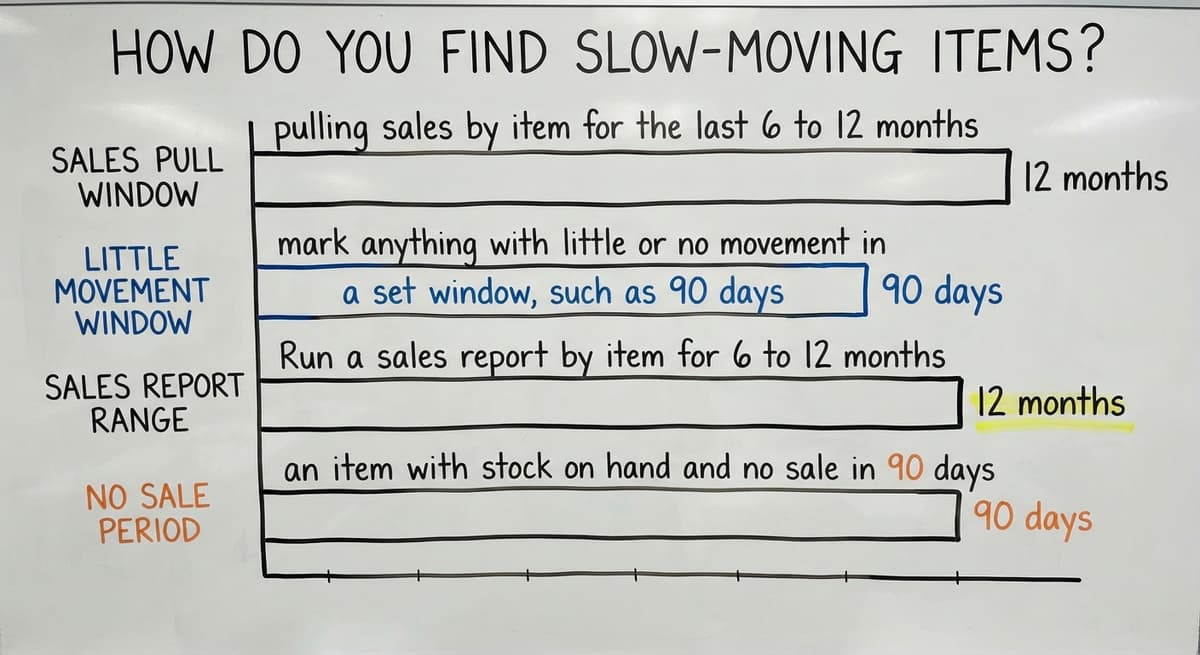
You find slow-moving items by pulling sales by item for the last 6 to 12 months and sorting from lowest to highest. Then mark anything with little or no movement in a set window, such as 90 days.
Follow these steps:
- Run a sales report by item for 6 to 12 months.
- Sort it from the fewest units sold to the most.
- Add on-hand counts next to each item.
- Add the date each item was last sold.
- Add the date each item was last received.
Your accounting package can show sales by item. It often cannot join those sales with on-hand counts and receiving dates. Most owners export to Excel and merge the pieces by hand.
The point: an item with stock on hand and no sale in 90 days belongs on your watch list.
Which Numbers Show How Slow an Item Really Is?
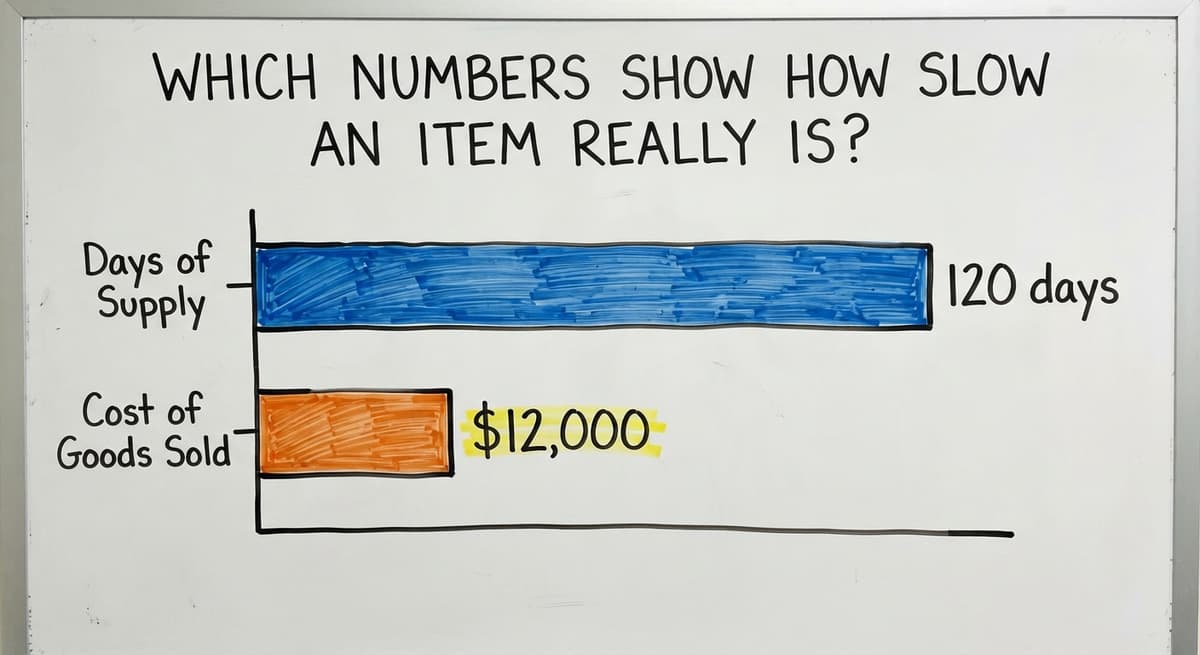
Three numbers show how slow an item is: inventory turnover, days of supply, and age of stock. Each one answers a different question.
- Inventory turnover is cost of goods sold divided by average inventory value. It tells you how many times you sell through stock in a year.
- Days of supply is on-hand units divided by average daily sales. It tells you how long stock will last.
- Age of stock is the days since you received the item.
Here is a small example. You hold 600 units and sell 5 a day. Days of supply is 600 divided by 5, or 120 days. If cost of goods sold is $12,000 a year and average stock is $6,000, turnover is 2.
A low turnover alone is not the alarm. The warning sign is one item turning far slower than the others in its group.
The comparison is easier when one option is built for you
Off-the-shelf means fitting your process to the software. We do it the other way round, and the first look costs nothing.
Book a call
Why Is the Stock Moving Slowly?
Stock moves slowly for a few common reasons, and the right fix depends on which one applies. Check the cause before you act.
Common causes include:
- Over-ordering, when you bought more than demand called for
- Supplier minimum order quantities that force big buys
- A lost customer who bought most of the item
- Seasonal swings in demand
- A price set too high
- A product the supplier replaced with a newer one
Ask your sales staff what they hear from buyers. Then check customer order history for who stopped buying and when. A lost customer calls for a different fix than a bad price.
Diagnose first. A discount will not help an item that a new model replaced.
How Can You Turn Slow Stock Back Into Cash?
You can turn slow stock into cash by picking one exit per item and a firm price floor. Try the options in this order:
- Targeted discounts for a short time, aimed at buyers who have bought the item before
- Bundles that pair the slow item with a fast seller
- Best customers first, with a call or email before any public sale
- Other distributors or liquidators, who often buy lots at a deep cut
- Returns to the supplier, if the terms allow it, even with a restocking fee
Set a price floor before you start. Your floor should be your cost, or a little under if freeing space is worth it. Write it down so no one sells below it by accident.
If nothing works, donate or write off the stock. Talk to your accountant first about the tax treatment.
The point: a planned exit at a known floor beats a panic sale.

What Should You Do With Dead Stock?
For dead stock, set a cutoff date and decide by then: liquidate, donate, scrap, or write down. A common cutoff is 12 months with no sales. Freeing the space is often worth more than waiting for full price. A rack slot that holds dead boxes could hold items that sell every week.
Once you decide, record it. Update the item record so no one reorders it by habit. Mark it inactive and note the date and the reason.
The point: dead stock earns nothing, so the best price is often the one that clears the shelf.
How Do You Stop Buying Too Much in the First Place?
You stop over-buying by setting a reorder point and order size for each item from real sales, not gut feel. A reorder point is the stock level that triggers a new order. For more on this, see Reorder points and safety stock.
Use these rules:
- Set reorder points per item from average daily sales and supplier lead time.
- Compare supplier minimums to what you really sell.
- Order slow items in smaller, more frequent batches where the supplier allows.
- Need manager approval to reorder any item flagged slow.
The point: a simple approval rule stops the same slow item from coming back on the next truck.
See it running on your own process first
No build cost. The subscription starts once it is live and doing the job, not before.
Book a call
How Often Should You Review Slow-Moving Inventory?
Review slow-moving inventory monthly for a quick check and quarterly for a deeper look. Name one owner for the job so it does not slip. Keep a short action list with four choices: price, bundle, return, or write off.
Also track the total dollar value of slow stock over time. If it falls from $40,000 to $30,000 in a quarter, you can see progress. If it climbs, you know to look at ordering.
The point: a steady, small habit beats a big cleanup once a year.
Why Do Spreadsheets Make Slow Stock Hard to Manage?
Spreadsheets make slow stock hard to manage because the data lives in many places and goes stale fast. Sales may sit in an accounting package, counts in Excel, old records in Access files, notes on printed sheets, and promises in email. A report built from these is out of date the day you finish it.
There are other limits:
- Copying numbers by hand leads to errors and missed items.
- No one gets an alert when an item starts to slow.
- Reports depend on one person who knows the file.
These tools work at first. They strain as the item count grows. If this sounds familiar, read about Replacing Excel and Access inventory tracking.
The point: slow items hide in scattered data until someone happens to look.
Can Custom Software Help You Manage Slow-Moving Inventory?
Yes. Custom software can help, and it can be built around how your shop already works. You do not need a full move to a big new system. Your accounting package stays where it is useful. Only the manual parts get replaced. This is the idea behind using your accounting software with custom inventory tools.

A custom tool can do things like:
- Flag items by days since last sale
- Show the dollar value of slow stock on one screen
- Prompt a review before a reorder goes out
- Pull counts and sales into one report with no copying
This works at small scale, not just for big firms. A 5-person warehouse can gain from it as much as a large one. For a wider view, see Inventory management software for small distributors and Custom workflow rollout services.
The point: you keep what works and replace only the steps that cost you time.

What Is the Simplest First Step You Can Take This Week?
The simplest first step is to list your 20 slowest items this week. Export item sales and on-hand quantities. Sort by last sale date. Take the 20 oldest.
Then do this:
- Pick one action for each item: discount, bundle, return, or write off.
- Set a date for each action.
- Block 30 minutes next month to check progress.
If the manual work is the bottleneck, talk with our Columbus, Ohio team. We build working software around how you already work. Warehouse cycle counting basics can also help you trust your counts before you start.
The point: 20 items with a date beside each one is a real start.
Frequently asked questions
What is slow-moving inventory?
Slow-moving inventory is stock that sells much slower than your other items but still sells now and then. Dead stock has no sales for a long time.
How do you calculate inventory turnover and days of supply?
Turnover is cost of goods sold divided by average inventory value. Days of supply is on-hand units divided by average daily sales. With 600 units and 5 sales a day, days of supply is 120.
How often should you review slow-moving stock?
Do a quick check each month and a deeper review each quarter. Give one person the job and track the dollar value of slow stock over time.
Can your accounting software and a spreadsheet application track slow-moving inventory well enough?
They can show sales by item, but you often must merge that with on-hand counts and receiving dates by hand. That work is slow and easy to get wrong, and no alert tells you when an item slows.
Start with a free first look
A 30 minute call, your operation mapped, and a clear picture of what we would build. No obligation and nothing to install.
Book a callRelated guides
The rest of this guide, for the parts of the job this page does not cover.
- How to Manage Inventory in Rocket League
- How to Manage Food Inventory
- How to Manage Inventory Fallout 76
- How to Manage Consignment Inventory
- How to Manage Inventory in Stardew Valley
- How to Manage Fba Inventory
- How to Improve Inventory Management
- How to Manage Inventory Diablo 4
- How to Manage Hardware Inventory
- How to Manage Inventory Efficiently
- How to Manage Spare Parts Inventory
- How to Manage Pharmacy Inventory
- How to Create an Inventory Tracking System?
- How to Keep Track of Ebay Inventory
- How to Keep Track of Inventory
- How to Resolve Inventory Discrepancies
- How to Record Inventory on Hand
- How to Manage Inventory in a Warehouse
- How to Manage Inventory in Retail Store
- How to Manage Inventory Between Etsy and Shopify
- How to Manage Inventory for Small Business
- What is E Inventory Management
- What is Roq in Inventory Management
- What is Barcoding in Inventory Management