


What Is E Inventory Management
(Reviewed and updated: October 2026)
E inventory management means using digital tools to track, control, and update stock in real time across your business. Instead of paper logs, printed pick sheets, or manual spreadsheet updates, every transaction posts automatically to one connected system. The "e" simply means the process runs electronically rather than on paper or in disconnected files.
Book a callWhat E Inventory Management Actually Does
Electronic inventory management handles the full stock cycle in one place. When product arrives, quantities go up. When an order ships, they go down. The system flags reorder points, records buy orders, and generates reports, all without a separate email thread or a second spreadsheet.
That connected loop depends on accurate product spotting. GS1, the global standards body for barcodes, notes that barcode standards "enable supply chain partners to automatically capture and share information about products as they move through the supply chain." Every scan-based count in your warehouse pulls from that same standard.
We build it for your operation, and the first look is free
If you would rather not compare products, describe how your operation already works and we build the system around it.
No build cost. You see it running on your own process first, and the monthly subscription starts only once it is live.
Book a callHow E Inventory Management Supports Your Tax Obligations
Real-time stock tracking also protects your legal obligations. The IRS states plainly in Publication 538: "To figure taxable income, you must value your inventory at the beginning and end of each tax year." A system that keeps a live count makes that valuation a report, not a week of manual work.
How Is E Inventory Management Different from a Spreadsheet?
A spreadsheet is static; e inventory management updates the moment a transaction occurs. That single difference changes how your whole team works.
- Multiple staff can read the same live count without overwriting each other's work.
- Errors from manual data entry drop because the system pulls from the source transaction, not from a person retyping a number.
- Audit trails show who changed what and when, which a shared spreadsheet rarely does reliably.
- Discrepancies surface the same day instead of at month-end.
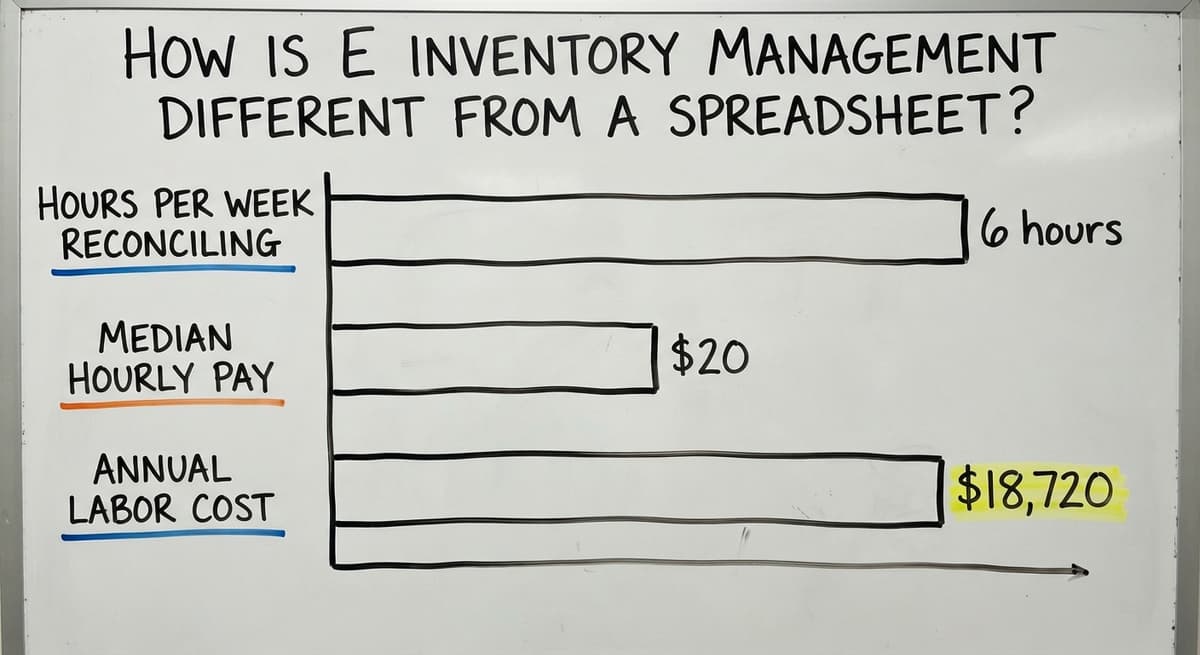
If 3 people each spend 6 hours a week reconciling spreadsheets, and the Bureau of Labor Statistics puts median pay for stock clerks and order fillers near $20 an hour, that is roughly $18,720 a year spent on work a connected system handles automatically. The spreadsheet looks free until you price the labor inside it.
Key Features to Expect from an Inventory Control System
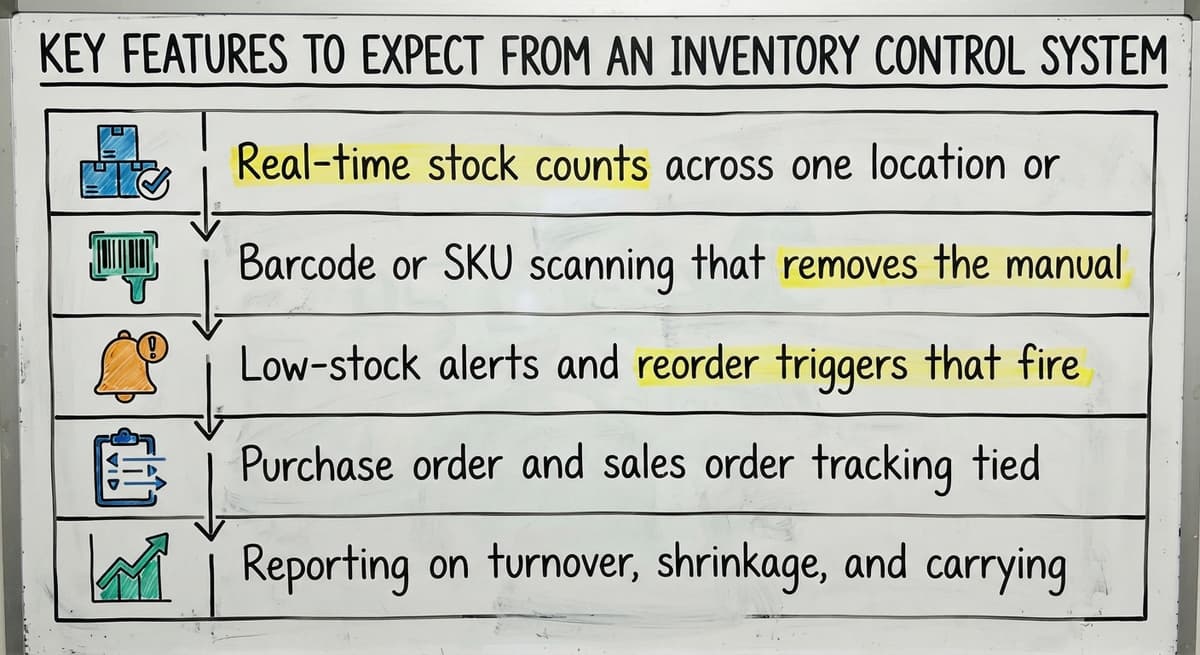
Not every warehouse inventory system ships with the same feature set, but any solid platform should cover these functions before you commit to it.
- Real-time stock counts across one location or many, so every team member sees the same number.
- Barcode or SKU scanning that removes the manual entry step responsible for most receiving errors.
- Low-stock alerts and reorder triggers that fire before a stockout, not after a missed sale.
- Buy order and sales order tracking tied directly to inventory levels, so the books and the shelf match.
- Reporting on turnover, shrinkage, and carrying costs so you can see which products earn their space and which sit idle.
Use this list to compare what your current process covers against what it skips. The gaps are your starting point.
The comparison is easier when one option is built for you
Off-the-shelf means fitting your process to the software. We do it the other way round, and the first look costs nothing.
Book a call
Can I Keep Using My Accounting Software If I Add E Inventory Management?
Yes. Adding electronic inventory management does not need replacing your accounting package. For small wholesale distributors who already rely on their accounting software for financials, this matters.
The inventory layer handles warehouse operations: receiving, picking, counting, and fulfillment. Your accounting software continues to handle the books. Data syncs between the two so every shipment and receipt posts to the correct account without anyone entering it twice. You keep the financial history you have built, and you stop the manual re-keying that causes most matching errors.
Why a Focused Inventory Layer Beats a Full Platform Migration
This is the practical path for operations running 5 to 100 people who have outgrown spreadsheets but are not ready for a full enterprise system. A focused inventory layer that fits alongside your existing accounting package beats a platform migration that touches everything at once. How inventory software works alongside your accounting software is a question worth exploring before you assume a full replacement is required.

Who Needs E Inventory Management and What Problems Does It Solve?
Some operations feel the pain of manual inventory tracking more sharply than others. Wholesale distributors managing hundreds or thousands of SKUs, fulfillment centers processing orders from multiple sales channels, and warehouses where staff still rely on printed pick sheets are the clearest candidates. Wholesale inventory management and distribution inventory software exist precisely because these environments move too fast for a static file.
See it running on your own process first
No build cost. The subscription starts once it is live and doing the job, not before.
Book a callThe Specific Problems E Inventory Management Fixes
The problems these businesses share are specific and familiar.
- Overselling items that are actually out of stock damages customer trust and may trigger obligations under the FTC's Mail, Internet, or Telephone Order Merchandise Rule, which needs you to ship when promised or notify the buyer.
- Received shipments that never get recorded correctly create phantom stock that shows available on screen but missing on the shelf.
- Staff working from different versions of the same spreadsheet make decisions on numbers that do not match.
- No visibility into fast-moving versus idle products means capital sits in the wrong place.
Inventory management software for small business addresses each of these at the source rather than downstream, after the damage is done.
Off-the-Shelf vs. Custom Inventory Management: Which One Fits?
Off-the-shelf tools are built for a generic operation. Your team adapts to the software, not the other way around. That works when your workflow is standard. It creates friction when it is not.

Custom inventory management is built around how your operation already runs. Custom does not mean slow or expensive. A focused build that replaces only the manual parts causing daily pain can go live faster than a full platform migration. You are not buying features your team will never open.
For small to mid-size distributors, a system that fits the workflow beats a system with more features than the team will ever use. The right build keeps your accounting software in place, skips a forced ERP migration, and targets the specific points where your current process breaks down. Custom inventory management software for wholesale distributors is built around that premise: replace the friction, leave the rest alone.
How Do I Get Started with E Inventory Management Without a Long Implementation?
Start by mapping where inventory data lives today and where it breaks down. That audit takes an afternoon and tells you more than any demo.
- List every place a stock number gets recorded: receiving dock, pick sheets, spreadsheets, email.
- Mark the spots where errors happen most: wrong counts on arrival, orders shipped against bad data, month-end surprises.
- Decide what stays. If your accounting software works for your finances, it stays. If a receiving workflow runs well, keep it.
- Tackle the highest-pain point first, not the whole system at once.

Why You Do Not Need a Big-Bang Rollout
Replacing Excel and spreadsheets with custom working software does not need a big-bang rollout. A team that builds around your existing operation, rather than asking you to conform to a new platform, is the lowest-risk first step. Talking through your current process costs nothing and usually surfaces the 2 or 3 changes that would cut the most daily friction.
Frequently asked questions
What does e inventory management mean?
E inventory management means tracking, controlling, and updating stock electronically in real time. The "e" stands for electronic. Every transaction, receiving, shipping, or adjustment, posts automatically to one system instead of a paper log or a manually updated spreadsheet.
How is e inventory management different from a spreadsheet?
A spreadsheet updates only when someone types in it. An e inventory management system updates the moment a transaction occurs. It also supports multiple users at once, reduces manual entry errors, and keeps an audit trail showing who changed what and when.
What features should an e inventory management system include?
Look for real-time stock counts, barcode or SKU scanning, low-stock alerts, buy and sales order tracking tied to inventory levels, and reporting on turnover and carrying costs. Those 5 functions cover the core of what most small distributors need.
Can I keep using my accounting software if I add e inventory management?
Yes. An inventory layer can sit alongside your accounting software rather than replacing it. The inventory system handles warehouse operations and syncs data to your accounting software so the books stay accurate without double entry. No migration required.
Who benefits most from electronic inventory management?
Wholesale distributors managing large SKU counts, fulfillment centers handling multiple sales channels, and warehouses still running on printed pick sheets see the fastest return. Any operation where one inventory error affects the whole team is a strong candidate.
What is the difference between off-the-shelf and custom inventory management software?
Off-the-shelf software is built for a generic workflow. Your team adapts to it. Custom software is built around how your operation already runs. For small to mid-size distributors, a custom build that targets only the manual parts causing daily pain is often faster to deploy and easier to adopt than a full platform.
Does e inventory management help with tax compliance?
Yes. The IRS needs businesses to value inventory at the start and end of each tax year. A system that keeps a live count turns that requirement into a report rather than a week of manual matching.
Start with a free first look
A 30 minute call, your operation mapped, and a clear picture of what we would build. No obligation and nothing to install.
Book a callRelated guides
The rest of this guide, for the parts of the job this page does not cover.
- What is the Difference Between Aggregate and Item Inventory Management
- What is Jit Inventory Management
- What is Kanban System of Inventory Management
- What is the Definition of Inventory Management
- What is an Important Factor in Inventory Management
- What is Abc Classification in Inventory Management
- What is Inventory Management in Working Capital
- What is Poor Inventory Management
- What is Inventory Management and Its Types
- What is the Main Purpose of Inventory Management
- What is Inventory Management in Pharmacy
- What is Effective Inventory Management
- What is Information Technology Inventory Management
- What is Inventory Management in Tally
- What is Risk Pooling in Inventory Management
- What is Inventory Management Mary Kay
- What is Stock Taking in Inventory Management
- What is Hospital Inventory Management
- What is Bin Number in Inventory Management
- What is the Scope of Inventory Management
- What is the Goal of Inventory Management Quizlet
- What is the Implication of Proper Inventory Management
- What is Omni-channel Inventory Management
- What is Inventory Management and Its Importance