


Excess Inventory
Excess inventory is stock you have more of than you can sell before it costs you more to hold than it is worth. It ties up cash, fills warehouse space, and quietly erodes your margin every month it sits. This article covers what causes it, what it really costs a small wholesale distributor, and what you can do about it starting this week.
Reviewed September 2026. Figures are worked from the assumptions stated beside them, so you can substitute your own and the arithmetic still holds.
Reviewed and updated: July 2025
Book a callWhat Is Excess Inventory?
Excess inventory is stock on hand that exceeds what you can sell or use within a reasonable time. A reasonable time depends on your sales velocity, meaning how fast a given SKU actually moves. If you sell 10 units a week and you have 500 on the shelf, that is excess. It is not the same as safety stock, which is a planned buffer against a late shipment or a demand spike. It is not cycle stock, which turns over in the normal course of business. Excess inventory is the quantity left over after both of those are accounted for, and it is costing you money every day it stays.
We build it for your operation, and the first look is free
If you would rather not compare products, describe how your operation already works and we build the system around it.
No build cost. You see it running on your own process first, and the monthly subscription starts only once it is live.
Book a callWhy Excess Inventory Is a Problem
Holding too much stock has real, measurable costs. Cash locked in unsold product cannot fund payroll, new product lines, or equipment. Shelf space costs money to heat, cool, and insure. The longer product sits, the higher the risk of spoilage, damage, or obsolescence.
At year-end, overstock often becomes a write-down that hurts your bottom line. The IRS needs accurate inventory valuation: as IRS Publication 538 states, "To figure taxable income, you must value your inventory at the beginning and end of each tax year." That means dead stock cannot stay invisible forever. Accurate counts also matter for fulfillment. The US Federal Trade Commission needs sellers to ship when promised, and a count you cannot trust puts that obligation at risk. Scan-based receiving, built on the standards that GS1 defines at gs1.org/standards/barcodes, is one of the most reliable ways to keep those counts accurate from the moment product arrives.
What Does Excess Inventory Actually Cost Per Year?
Carrying costs, meaning the total expense of holding stock, usually run 20 to 30 percent of inventory value per year. That figure covers storage, insurance, labor to manage and count the product, and the opportunity cost of cash that could be working elsewhere.
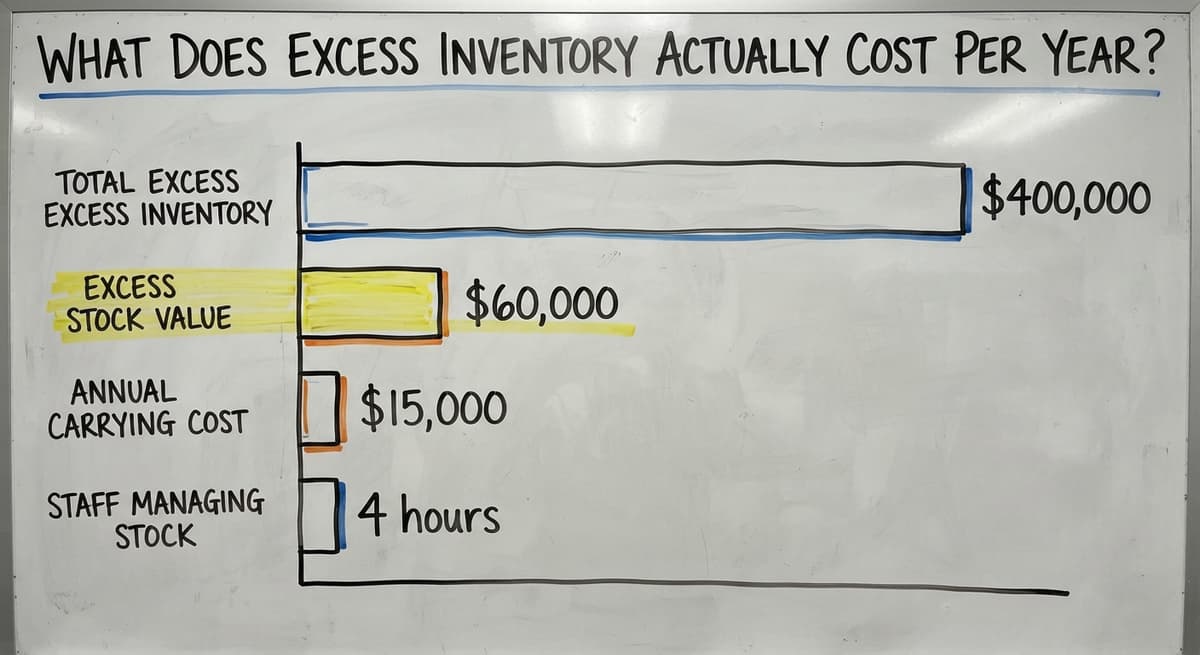
Here is what that looks like in practice. Suppose you carry $400,000 in inventory and 15 percent of it is excess. That is $60,000 sitting on shelves. At a 25 percent carrying cost, you are spending $15,000 a year to hold product you cannot sell. Add 2 staff members spending 4 hours a week managing that stock at $22 an hour, and that is another $9,152 a year, based on wage data from the US Bureau of Labor Statistics. The total cost of that dead stock is closer to $24,000 annually.
Small distributors feel this just as sharply as large ones. The difference is that a large operation has more margin to absorb the loss.
Common Causes of Excess Inventory
Before you can fix overstock, you need to know where it came from. Most excess inventory traces back to a short list of causes.
- Overordering to hit supplier minimums pulls more product than demand justifies, just to unlock a price break.
- Demand forecasting based on old data or gut feel produces buy orders that do not reflect what customers are actually buying now.
- Slow-moving SKUs that never get flagged accumulate quietly until they become a write-off.
- Canceled customer orders leave product stranded with no home.
Each of these is a data problem before it is a purchasing problem. You cannot make a good buying decision with bad information.
The comparison is easier when one option is built for you
Off-the-shelf means fitting your process to the software. We do it the other way round, and the first look costs nothing.
Book a call
Forecasting Errors and the Supplier Minimum Trap
How Bad Forecasting Creates Overstock
Relying on last year's sales numbers without adjusting for current trends is one of the most common paths to overstock. A seasonal spike gets read as a permanent demand shift. A one-time large order inflates the average. Excel-based forecasting works when SKU counts are small, but it breaks down fast as your catalog grows. Each new formula is another place for an error to hide.
Distributors running spreadsheets are especially exposed. A file built for 200 SKUs does not scale cleanly to 800. When the forecast is wrong, the buy order is wrong, and the warehouse pays for it.
The Bulk Discount Trap
Buying more than you need to hit a supplier's price break feels like smart purchasing. It is not, once you factor in holding costs. Say a supplier offers a 6 percent discount if you buy 500 units instead of 200. If your carrying cost is 25 percent per year and those extra 300 units sit for 6 months, the holding cost alone eats most of that discount.
Before committing to a bulk order, calculate the true net cost. Multiply the excess units by your per-unit carrying cost over the time you expect them to sit. If that number is close to or greater than the discount, the deal is not a deal. This is a common pain point for small wholesale distributors who feel pressure to buy big to stay competitive on price.
How to Find Excess Inventory in Your Warehouse Right Now
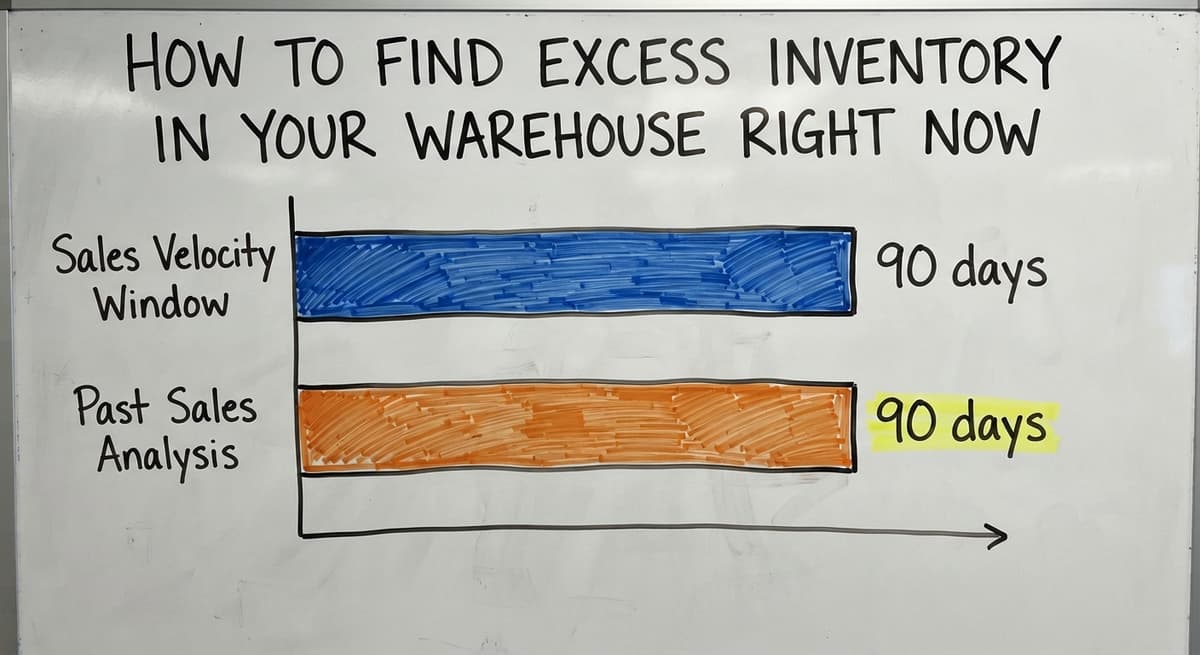
Start with a simple inventory audit. Pull your on-hand quantities and compare them to your sales velocity for the past 60 to 90 days. Any SKU with more than 90 days of supply on hand is a candidate for review. That is your working definition of excess for this exercise.
The challenge is that this data rarely lives in one place. On-hand counts may be in QuickBooks. Sales history may be in a spreadsheet. Receiving records may be on paper. Pulling all three together takes time, and the gaps between them are exactly where excess inventory hides.
You cannot fix what you cannot see. The US Census Bureau's Monthly Wholesale Trade data tracks inventory-to-sales ratios across the wholesale sector, and even at the national level, the ratio shifts enough month to month to show how quickly a healthy stock position can turn into an overstock problem when purchasing does not keep pace with demand changes.
Signs Your Inventory Data Is Hiding the Problem
If any of these sound familiar, your data is not giving you a clear picture.
- Physical counts never match what the system shows.
- Two spreadsheets carry different numbers for the same SKU.
- Receiving and sales data live in separate tools and never sync.
- Staff rely on memory or a walk through the warehouse instead of a report.
These are not minor inconveniences. Each one is a gap where excess inventory can grow undetected for months.

How Do You Get Rid of Excess Inventory Quickly?
The fastest path is to match the disposal method to how far gone the stock is. Fresh overstock has more options than product that has been sitting for two years.
Here is a practical action list, roughly in order of value recovered:
- Return or exchange with the supplier if your agreement allows it. Many distributors miss return windows simply because they do not track buy dates closely enough.
- Bundle slow movers with fast movers to drive volume on both. A customer who buys your top SKU every week may take the slow one if it is packaged with it at a slight discount.
- Run a limited-time discount to existing customers before the product ages further. A targeted offer costs less than a broad markdown.
- Liquidate or donate as a last resort. You recover some value, clear the space, and may qualify for a tax benefit on the donation.
The right choice depends on the product, the margin, and how long it has been sitting.
See it running on your own process first
No build cost. The subscription starts once it is live and doing the job, not before.
Book a callBundling, Promotions, and Supplier Returns
Pairing a slow SKU with a popular one can clear both without a deep markdown. The key is knowing which customers buy related items. That needs a system that connects sales history to current inventory. Without it, you are guessing at which customers to target.
Supplier return programs are underused by most small distributors. Many suppliers offer credit windows or return approvals that go unclaimed because the distributor cannot quickly produce the original buy date and quantity. Clean records make that conversation easy. Disorganized data means you miss the window entirely. Review your supplier agreements now, before you need to use them, and note the return terms for your top 10 vendors.
How to Prevent Excess Inventory from Building Up Again
Prevention is a data discipline, not a one-time fix. The goal is to shift from reacting to overstock after it appears to catching the signals before it does.
Set Reorder Points Based on Real Demand
A reorder point is the quantity at which you place a new order. The basic formula is: average daily sales multiplied by your supplier's lead time in days, plus your safety stock. If you sell 5 units a day and lead time is 10 days, your reorder point is 50 units, before safety stock.
The problem is that most distributors set reorder points once and forget them. Static reorder points cause overstock when demand drops and stockouts when demand rises. Review them whenever you see a meaningful shift in sales trend, not just at year-end.
Regular SKU Reviews Catch Problems Early
A monthly or quarterly SKU review does not need to be complex. Flag any item with more than 60 to 90 days of supply on hand. Assign one person to own the list and act on it. The NIST Manufacturing Extension Partnership recommends regular supply chain reviews as a core practice for small and mid-size operations, not just for large manufacturers.
The honest constraint here is that a consistent SKU review is nearly impossible to run from spreadsheets. If the data is not surfaced automatically, the review gets skipped when things get busy, which is exactly when you need it most.

Are Spreadsheets Making Your Excess Inventory Problem Worse?
Yes, and the reason is structural: a spreadsheet is a static snapshot, not a live view of your operation. Every time someone updates a different file, the versions diverge. Formulas break. Rows get deleted. Errors compound. The result is that excess inventory hides in the gaps between files, invisible until it shows up as a write-off.
Multiple people updating separate files is not a discipline problem. It is a tool problem. A spreadsheet was not built to be a shared, real-time inventory system, and using it as one creates the exact conditions where overstock grows undetected.
Not sure this is the right shape for your operation
Describe how the work runs today. We map it on a call and show you what it would look like built around that, before you spend anything.
Book a callHow Inventory Management Software Solves the Problem
Inventory management software for small distributors gives you one accurate view of stock levels at all times. Purchasing and sales data stay in sync, so the signals that lead to overordering are visible before the order goes out. Automated alerts flag slow-moving inventory before it becomes dead stock. Reports that used to take hours now run in seconds.
The NIST MEP supply chain guidance is clear that connected data is the foundation of good inventory decisions. A system that links receiving, sales, and purchasing removes the manual matching step that is both time-consuming and error-prone.
The right software does not replace your judgment. It gives you the data to use it well.
Can I Fix This Without Replacing QuickBooks?
Yes. Switching accounting systems is not required. A custom working layer can sit alongside QuickBooks and handle inventory, receiving, and fulfillment. QuickBooks keeps doing what it does well: accounting, invoicing, and reporting. The new system handles what it cannot: real-time stock visibility, reorder alerts, and SKU-level performance data.
This is a lower-disruption path than a full ERP replacement. There is no months-long migration, no retraining on a new accounting platform, and no risk to your financial records. QuickBooks integrations for wholesale and distribution are a practical starting point for most small operations.
What to Look for in a Solution for Small Distributors
Not every inventory tool is built for a small warehouse. Here is what actually matters at your scale.
- Works at small scale from day one, not a stripped-down version of an enterprise platform that needs customization to reach basic function.
- Fits how your operation already works rather than forcing a process change before you see any benefit.
- Implements fast, measured in days or weeks, not a multi-month consulting engagement.
- Local or accessible support so that when something goes wrong, a real person responds quickly.
Warehouse management for small teams is a specific problem. A tool built for a 500-person distribution center will not map cleanly to a 12-person operation running out of a single location.

Next Steps to Get Excess Inventory Under Control
Excess inventory is a solvable problem. The data and the process are both within reach for a small distributor.
Start with an audit this week. Pull your on-hand quantities, compare them to the last 90 days of sales, and flag every SKU above 90 days of supply. That list is your problem inventory. From there, match each item to the right disposal method and set a deadline.
For the longer term, talk to a software partner who understands small distribution operations. Not a vendor selling a platform built for enterprise, but someone who can look at how your operation actually runs and build around it. The goal is one connected view of your inventory, not a system that creates new work to keep.
If your current process relies on spreadsheets and memory, the problem will come back. A connected system is what keeps it from returning.
Frequently asked questions
Can you give me an example of excess inventory?
A wholesale distributor orders 600 units of a seasonal product to hit a supplier minimum. The season ends and 200 units remain unsold. Those 200 units are excess inventory. They are not safety stock, which is a planned buffer, and they are not cycle stock, which turns over in normal operations. They are product the business cannot move without a markdown or a special promotion, and they are costing money every month they sit.
How to get rid of excess inventory?
Work through the options in order of value recovered. First, check whether your supplier will take a return or issue a credit. Second, bundle slow-moving items with fast sellers to drive volume without a deep discount. Third, offer a limited-time price reduction to existing customers before the product ages further. If none of those work, liquidate through a secondary market or donate the product. Donation may qualify for a tax benefit, and it clears the space.
How can I sell my excess inventory?
Target your existing customers first. They already buy from you, and a direct offer costs less than a broad promotion. Use your sales history to find customers who buy related items and make them a specific offer on the slow stock. If internal sales are not enough, consider a liquidator, a secondary wholesaler, or an online marketplace that handles surplus goods. The right channel depends on the product category and how quickly you need to move it.
Where can I sell my excess inventory?
For B2B distributors, the most practical options are direct offers to existing customers, negotiated returns to the supplier, secondary wholesalers who buy surplus stock, and online surplus marketplaces. The best channel depends on the product type, the quantity, and how much margin you need to recover. Liquidators move product fast but pay the least. Selling direct to customers takes more effort but recovers the most value.
What is a normal inventory carrying cost for a small distributor?
Industry estimates put carrying costs at 20 to 30 percent of inventory value per year. That covers storage, insurance, labor to manage and count the stock, and the opportunity cost of capital tied up in product. For a small distributor carrying $400,000 in inventory with 15 percent excess, the annual cost of holding that dead stock can easily reach $15,000 or more before you count staff time.
How often should I review slow-moving SKUs?
A monthly review is ideal for high-volume operations. A quarterly review works for smaller catalogs. The key is to set a consistent threshold, such as any SKU with more than 60 or 90 days of supply on hand, and assign one person to own the list and act on it. Without a system that surfaces this data automatically, the review tends to get skipped when operations get busy.
Do I need to replace QuickBooks to fix my inventory problem?
No. A custom working system can sit alongside QuickBooks and handle inventory, receiving, and fulfillment without touching your accounting setup. QuickBooks continues to manage invoicing and financial reporting. The added layer handles real-time stock visibility and reorder alerts. This approach avoids the cost and disruption of a full ERP migration and is a practical path for most small distributors.
What is the difference between excess inventory and dead stock?
Excess inventory is stock you have more of than you can sell within a reasonable time. Dead stock is the far end of that spectrum: product that has not moved in so long that it is unlikely to sell at full price, if at all. All dead stock is excess inventory, but not all excess inventory is dead stock yet. Catching overstock early, before it becomes dead stock, gives you more options and more value to recover.
Start with a free first look
A 30 minute call, your operation mapped, and a clear picture of what we would build. No obligation and nothing to install.
Book a callRelated guides
The rest of this guide, for the parts of the job this page does not cover.
- Multi Location Inventory Management Software
- Inventory Management for Multiple Locations
- Costing Inventory
- Inventory Management System for Manufacturing
- Excel Inventory Template
- Jewelry Inventory Management
- Dental Inventory Management
- Qr Code for Inventory Management
- Inventory Formulas
- Hvac Inventory Management Software
- Calculate Beginning Inventory
- Inventory Management Software for Schools
- Find Beginning Inventory
- Nonprofit Inventory Management
- Manual Inventory Management
- Inventory Bin System
- Inventory Management Software Costs
- Manual Inventory System
- Hvac Inventory Management
- Inventory Reserve Account
- Warehouse Inventory Management Software
- Warehouse Inventory Tracking Software
- Warehouse Inventory Management Systems
- Quickbooks Inventory Management Software