


Closed For Inventory
Reviewed June 2025 for small and mid-size wholesale distributors running QuickBooks.
Closed for inventory means a business stops all orders and shipments so staff can manually count every item on hand. It is an working choice, not a legal rule. The right tracking system makes the shutdown unnecessary.
Book a callWhat Does Closed for Inventory Mean and Why Do Businesses Still Do It?
When a warehouse goes closed for inventory, every door stops moving. No orders ship. No receiving happens. Staff walk every aisle with clipboards or count sheets and tally each item by hand.
This has been standard practice for decades in warehouses, distributors, and fulfillment centers. The closure can last a few hours for a small stockroom or several days for a large operation.
We build it for your operation, and the first look is free
If you would rather not compare products, describe how your operation already works and we build the system around it.
No build cost. You see it running on your own process first, and the monthly subscription starts only once it is live.
Book a callWhy Manual Systems Force a Full Stop
The reason most businesses still do it comes down to their tools. Manual systems like spreadsheets, printed count sheets, and QuickBooks alone cannot track real-time stock movement. Without a live record of what moved and when, the only safe option is to freeze all activity and count from scratch. Counting while orders keep moving creates errors that are hard to untangle later.
As GS1 explains when describing the barcode standards that underpin scan-based counts, a reliable identifier on every item is the foundation of any accurate stock record. Without that foundation, a full stop feels like the only safe path.
For many small distributors, closing feels like the responsible choice. The problem is that the shutdown is not the fix, it is a sign the tracking system is broken.
How Much Does Closing for Inventory Actually Cost?
Closing for inventory costs more than most owners add up before they do it.
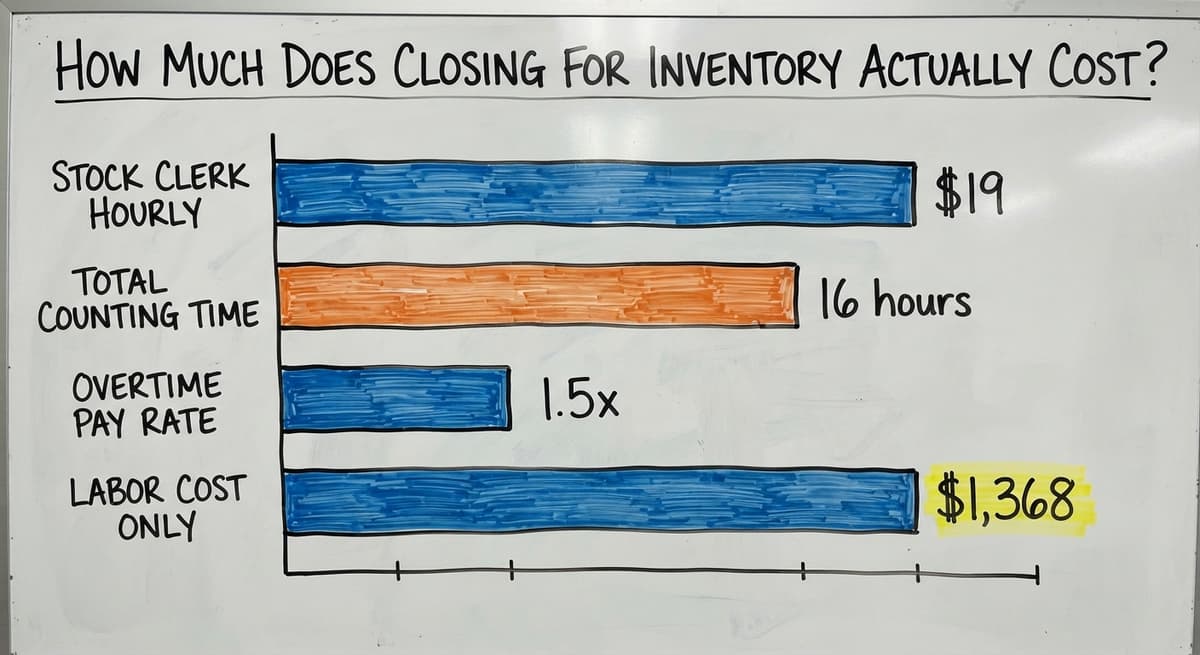
The direct losses stack fast. Orders that cannot ship during a 2-day closure are orders that may not come back. Staff running a weekend count earn overtime. According to the US Bureau of Labor Statistics, stock clerks and order fillers earn around $19 an hour on average. Three people counting for 16 hours at 1.5x overtime is roughly $1,368 in labor alone, before you count the manager hours spent reconciling results.
What a Closure Costs in Customers and Compliance
Customers who hit a closed storefront or a delayed shipment do not always wait. Some cancel. Some find another vendor and stay there.
The FTC's Mail, Internet, or Telephone Order Rule needs sellers to ship by the date they promised or notify the buyer. An inventory closure that delays a shipment puts you in that position every time.
Your competitors may not close at all. While your dock sits quiet, theirs keeps moving.
How Long Does a Closure Typically Last?
Small operations with fewer than 500 SKUs can sometimes finish in a single evening. A 20-person distributor with 2,000 to 5,000 SKUs spread across a disorganized warehouse often needs 2 to 3 full days.
Factors that stretch the count include poor shelf organization, paper-based systems, high SKU counts, and counters who have not done it before. Every extra day compounds the revenue loss, the overtime bill, and the customer frustration from the previous section. A 3-day closure at a 10-person shop is not unusual, and it is rarely planned to be that long.
What Gets Counted and Why Inventory Reconciliation Takes So Long
A physical inventory count covers more than items sitting on shelves. Staff also count goods in the receiving area, items staged for outbound shipment, and anything logged as in transit.
The time-consuming part is matching: comparing what QuickBooks or your ERP shows against what is actually on the floor. Shrinkage, damaged goods, and misplaced stock all create gaps between the two numbers. Finding and explaining each gap takes longer than the count itself.
The comparison is easier when one option is built for you
Off-the-shelf means fitting your process to the software. We do it the other way round, and the first look costs nothing.
Book a callThe IRS Requires Valuation, Not a Shutdown
The IRS needs that businesses value inventory at the start and end of each tax year: "To figure taxable income, you must value your inventory at the beginning and end of each tax year." That obligation is real. The shutdown to meet it is not.
Without real-time data feeding your records all year, every discrepancy has to be hunted down manually during the closure, which is where most of the hours go.

The Problem With Counting Everything at Once
A full physical count gives you one accurate snapshot. The moment you reopen, that accuracy starts to decay.
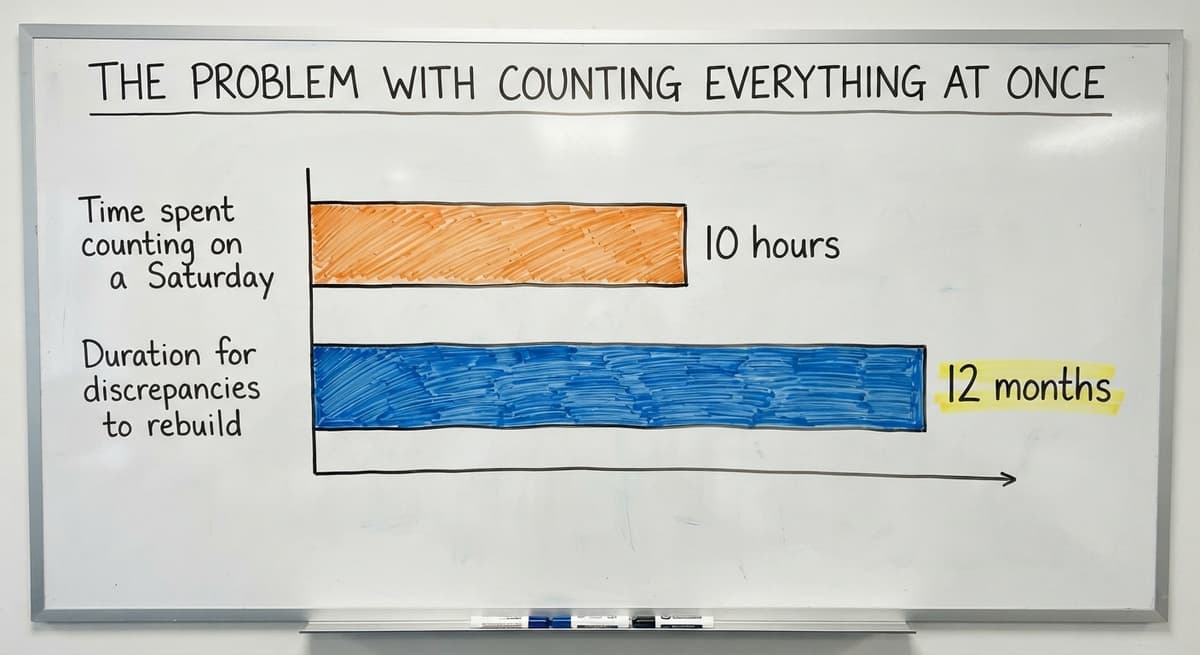
Human counting errors are common, especially under time pressure. Staff fatigue during a long count leads to missed items, double-counts, and transposed numbers. A team that has been counting for 10 hours on a Saturday is not counting carefully.
The deeper problem is structural. A full count fixes the record as of the day you closed. It does nothing to prevent the same discrepancies from building up again over the next 12 months. The count treats the symptom; it does not change the system that creates the problem.
Cycle Counting: A Way to Stay Open During Inventory Counts
Cycle counting means counting a small section of inventory on a rotating schedule instead of everything at once. A team might count one product category each week, working through the full catalog over a quarter.
Because only a portion of stock is being counted at any time, the rest of the operation keeps moving. No closure needed.
Cycle counting keeps inventory accuracy continuous rather than annual. Discrepancies surface in small doses, when they are easier to investigate and fix. The NIST Manufacturing Extension Partnership points to this kind of ongoing process discipline as a core element of a healthy supply chain.
The catch is that cycle counting needs a reliable system to track which items were counted, when they were last checked, and what the result was. Without that tracking layer, the schedule falls apart within weeks.
Can QuickBooks Handle Cycle Counting on Its Own?
QuickBooks has basic inventory features, but it is not built for warehouse-level cycle count management. Most small distributors who try to run cycle counts in QuickBooks end up back in Excel or on printed sheets to manage the schedule.
That creates the same manual problem in a different shape. The cycle count list lives in a spreadsheet. Results get typed back in by hand. Errors creep in at the keyboard rather than on the floor.
QuickBooks is still the right tool for your financials. The gap is in the working tracking layer, the part that records what moved, when, and where, before any of it reaches the books. Filling that gap does not mean replacing QuickBooks; it means adding a layer that feeds it correctly.
How Does Inventory Management Software Eliminate the Need to Close?
Inventory management software removes the need to close because it tracks every movement in real time, so there is never a moment when the record and the floor are far apart.
Receiving, picking, and shipping all update stock counts automatically as each step happens. A barcode scan at the dock door adds units to the record the moment a shipment is confirmed, not at month end. A pick scan removes them the moment an order is pulled.

How Cycle Counts Replace the Annual Shutdown
Managers can see current stock levels from any screen without walking the floor. Cycle counts become a background task assigned to one staff member during a slow period, not a shutdown event that needs the whole team.
Discrepancies show up daily in small doses. A single unit off in one bin is easy to investigate on a Tuesday morning. The same unit off after 11 months of untracked movement is a mystery that takes hours to solve.
For small distributors, real-time inventory tracking through inventory tracking for small distributors tools built around their actual workflow is what makes this practical rather than theoretical.
See it running on your own process first
No build cost. The subscription starts once it is live and doing the job, not before.
Book a callKeeping QuickBooks While Upgrading Inventory Accuracy
Many small distributors worry that better inventory software means ripping out QuickBooks and starting over. That concern is understandable and, in most cases, wrong.
A well-built working layer sits alongside QuickBooks and pushes the right data into it. Financials stay in QuickBooks. Physical inventory management, receiving, cycle count scheduling, and warehouse inventory tracking move to a dedicated system that speaks to QuickBooks rather than replacing it.
Why This Approach Beats a Full ERP Migration
This approach is less disruptive and far less expensive than a full ERP migration. The US Census Bureau's wholesale trade data shows that inventory-to-sales ratios in wholesale distribution are tight, which means carrying costs and stockout risks both matter. A system that improves accuracy without a year-long rollout pays for itself quickly.
QuickBooks integration for warehouses works best when the integration is built to match your specific workflow rather than a generic template. The goal is accurate books fed by accurate operations, not a new platform for its own sake.

How Long Does It Take to Implement Inventory Management Software?
A focused build for a small distributor can go live in weeks, not months, when the scope starts with the highest-pain area.
For most operations, that starting point is the inventory count itself. Replace the printed count sheets and the Excel matching first. That single change delivers immediate relief and creates the data foundation everything else builds on.
Contrast that with a full ERP rollout, which commonly runs 12 to 18 months and costs far more than the problem it solves for a 10 to 50-person shop. Custom warehouse management software built around your actual workflow avoids the features you will never use and the missing pieces you would have to work around.
How to Transition Without Disrupting What Already Works
Replacing Excel with working software does not need a big-bang cutover. A phased approach, starting with counts and receiving, keeps the team's learning curve short and the disruption low.
Existing QuickBooks data does not need to move. A clean inventory baseline, often pulled from your last physical count, is enough to start. Historical financial records stay exactly where they are. The transition adds a new layer; it does not touch what already works.
Signs Your Operation Is Ready to Stop Closing for Inventory
Not every distributor is at the same point. These are the signals that the current setup has run out of room.
- Your count results regularly disagree with what QuickBooks shows, and you cannot explain why.
- Staff spend large hours reconciling count sheets against the system after every closure.
- Customers have complained about delayed shipments or wrong orders tied to stock errors.
- You are managing inventory across Excel, printed sheets, and QuickBooks at the same time.
- You close more than once a year because the annual count never fully holds.
Any one of these points to a tracking gap, not a staffing problem or a discipline problem. The fix is a system that captures movement as it happens, not a more rigorous version of the same manual process.
Not sure this is the right shape for your operation
Describe how the work runs today. We map it on a call and show you what it would look like built around that, before you spend anything.
Book a call
What to Look for in Custom Inventory Software for Small Distributors
Off-the-shelf platforms are built for the average operation. Most small distributors are not average: their SKU structure, receiving process, and customer mix are specific to them.
Custom inventory software maps to your actual workflow rather than asking you to reshape your operation around the software's assumptions. That means no features you will never use and no gaps you have to patch with yet another spreadsheet.
Fulfillment center software solutions built for your size should meet these criteria:
- QuickBooks integration that does not need abandoning your existing financial setup
- Simple enough for warehouse staff to use without a long training program
- Priced and scoped for a 10 to 50-person operation, not an enterprise with a full IT team
- Built to start with your highest-pain area so you see results before the full system is live
The right software fits the operation you have, not the one a vendor imagined.
Frequently Asked Questions About Closing for Inventory
What does "closed for inventory" mean? It means a business has stopped all operations so staff can manually count every item on hand. No orders ship and no receiving happens during the count. It is an working choice driven by system limitations, not a legal requirement.
What does "closing inventory" mean? In accounting, closing inventory refers to the value of stock on hand at the end of an accounting period. It is used to calculate cost of goods sold and appears on the balance sheet. It is a financial figure, not the same as physically shutting down to count.
What is the accounting entry for closing inventory? At period end, the closing inventory balance is recorded as a debit to the inventory asset account and a credit to the cost of goods sold account, adjusting for what was sold during the period. Your accountant or QuickBooks setup handles this automatically when inventory values are entered correctly.
More Frequently Asked Questions About Closing for Inventory
What does "inventory" mean? Inventory is the stock of goods a business holds for sale or use in production. For a wholesale distributor, that means the physical products sitting on shelves, in receiving, and staged for shipment at any given moment.
Is closing for inventory legally required? No. The IRS needs that you value inventory at the start and end of each tax year, but it does not need a shutdown to do it. Cycle counting and real-time tracking can satisfy that obligation without stopping operations.
How often should inventory be counted? It depends on your volume and SKU count. Cycle counting spreads the work across the year and can replace the annual shutdown entirely for most small distributors.
Can a small warehouse afford inventory management software? Custom solutions built for small distributors are often more affordable than large off-the-shelf platforms, especially when scoped to start with one problem rather than replacing every system at once.
Will this work with our current QuickBooks setup? Yes, when the software is built to integrate rather than replace. The working layer handles warehouse inventory tracking and feeds accurate data into QuickBooks, leaving your financial setup intact.

The Bottom Line on Being Closed for Inventory
Closing for inventory is a symptom. The underlying cause is a tracking system that cannot keep up with daily stock movement, so the only way to get an accurate number is to stop everything and count from scratch.
The right software makes accurate inventory a continuous process. Counts happen in the background. Discrepancies surface when they are small. QuickBooks stays exactly where it is, fed by a system that actually knows what is on the floor.
Small distributors do not need a giant ERP to solve this. They need the right working layer on top of what they already use, built around their workflow, not a vendor's template.
Ready to Stay Open During Your Next Inventory Count?
If your operation is in or around Columbus, Ohio, and you are running on QuickBooks with count sheets that never quite match, let's talk about what is actually causing the gap.
The Software Society works with small distributors to build working systems that fit the way you already work. No pressure, no generic demo. Just a straight conversation about whether the problem is solvable and what that would look like for your specific setup.
Reach out through our contact form to schedule a free call. Bring your biggest inventory headache and we will tell you honestly what it would take to fix it.
Frequently asked questions
What does "closed for inventory" mean?
It means a business has stopped all operations so staff can manually count every item on hand. No orders ship and no receiving happens during the count. It is an working choice driven by system limitations, not a legal requirement.
What does "closing inventory" mean?
In accounting, closing inventory refers to the value of stock on hand at the end of an accounting period. It is used to calculate cost of goods sold and appears on the balance sheet. It is a financial figure, not the same as physically shutting down to count.
What is the accounting entry for closing inventory?
At period end, the closing inventory balance is recorded as a debit to the inventory asset account and a credit to the cost of goods sold account, adjusting for what was sold during the period. Your accountant or QuickBooks setup handles this automatically when inventory values are entered correctly.
What does "inventory" mean?
Inventory is the stock of goods a business holds for sale or use in production. For a wholesale distributor, that means the physical products sitting on shelves, in receiving, and staged for shipment at any given moment.
Is closing for inventory legally required?
No. The IRS needs that you value inventory at the start and end of each tax year, but it does not need a shutdown to do it. Cycle counting and real-time tracking can satisfy that obligation without stopping operations.
Can QuickBooks handle inventory management without a shutdown?
QuickBooks has basic inventory features but is not built for warehouse-level cycle count management. Most small distributors end up back in Excel or on printed sheets to manage the schedule. Adding a dedicated working layer that feeds QuickBooks solves the gap without replacing your financial setup.
How long does it take to implement inventory management software?
A focused build for a small distributor can go live in weeks when the scope starts with the highest-pain area, such as replacing printed count sheets. This is far shorter than a full ERP rollout, which commonly runs 12 to 18 months.
What should a small distributor look for in inventory software?
Look for QuickBooks integration that leaves your financial setup intact, a workflow built around your actual receiving and picking process, and pricing scaled to a 10 to 50-person operation. Off-the-shelf platforms built for enterprise rarely fit without large customization.
Start with a free first look
A 30 minute call, your operation mapped, and a clear picture of what we would build. No obligation and nothing to install.
Book a callRelated guides
The rest of this guide, for the parts of the job this page does not cover.
Guides
- Excess Inventory
- Multi Location Inventory Management Software
- Inventory Management for Multiple Locations
- Costing Inventory
- Is Inventory a Long-term Asset
- Inventory Management System for Manufacturing
- Excel Inventory Template
- Jewelry Inventory Management
- Dental Inventory Management
- Qr Code for Inventory Management
- Inventory Metrics
- Inventory Formulas
- Hvac Inventory Management Software
- Calculate Beginning Inventory
- Inventory Management Software for Schools
- Find Beginning Inventory
- Nonprofit Inventory Management
- Manual Inventory Management
- Inventory Bin System
- Inventory Management Photos
- Inventory Management Software Costs
- Manual Inventory System
- Hvac Inventory Management