


What Is The Definition Of Inventory Management
Reviewed and updated: October 2026
Inventory management is the process of tracking, ordering, storing, and using a company's goods from arrival to shipment. The goal is simple: have the right products in the right quantities at the right time. Too much stock ties up cash. Too little costs you the sale. A solid process keeps both risks in check.
Book a callThe Plain-Language Definition of Inventory Management
Inventory management covers every step a product takes inside your operation. Stock arrives on a dock. Someone counts it, records it, and puts it away. When an order comes in, staff pick the items, pack them, and ship them out. When quantities drop low, a buy order goes out to replenish. That cycle repeats every day, across every SKU (stock keeping unit, the unique code that identifies one product) you carry. The definition of inventory management is that full cycle, handled deliberately rather than by guesswork.
We build it for your operation, and the first look is free
If you would rather not compare products, describe how your operation already works and we build the system around it.
No build cost. You see it running on your own process first, and the monthly subscription starts only once it is live.
Book a callWhat Inventory Management Covers Day to Day
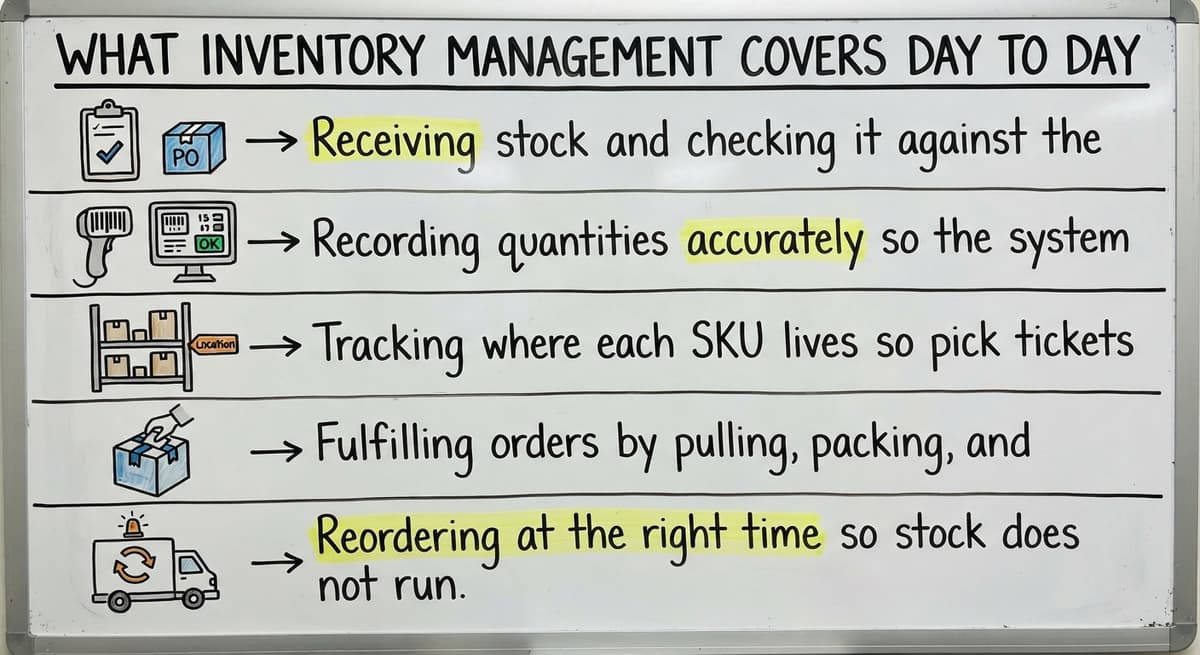
Inventory management is not a month-end task. It runs continuously across your warehouse or distribution center. The core activities include:
- Receiving stock and checking it against the buy order before it goes to a pallet location
- Recording quantities correctly so the system reflects what is physically on the shelf
- Tracking where each SKU lives so pick tickets route staff to the right spot
- Fulfilling orders by pulling, packing, and confirming shipment
- Reordering at the right time so stock does not run out before the next delivery arrives
Barcode scanning ties these steps together. GS1, the global standards body, notes that barcode standards "enable supply chain partners to identify, capture and share information" at every handoff. That shared data is what makes a real-time count possible. Without it, every step above depends on someone writing a number down correctly, every time.
Why Does Inventory Management Matter for Wholesalers and Distributors?
Inventory management matters because every error has a direct dollar cost. A stockout means a lost sale and a frustrated buyer who may not come back. Overstock means cash sitting on a shelf instead of working in the business. The US Census Bureau tracks the inventories-to-sales ratio for wholesale firms, and even small swings in that ratio signal how much capital is locked up in product.
Why Manual Processes Make Inventory Risk Worse
For operations running on spreadsheets and printed count sheets, the risk compounds fast. One cell formula breaks. One sheet does not get saved. One shipment gets received but never entered. By the time the month-end count happens, the books and the shelves tell two different stories. The US Federal Trade Commission needs businesses to ship orders when promised, and an inaccurate count is the most common reason a distributor cannot meet that obligation.
Accurate stock data is not a nice-to-have; it is what keeps orders shipping on time.
Key Terms Inside Inventory Management
A working knowledge of these terms helps any operations manager read a report or talk to a vendor without getting lost.
- SKU (stock keeping unit): a unique code assigned to one product variant. If you sell a bolt in three sizes, each size gets its own SKU.
- Reorder point: the quantity at which you place a new buy order. It is calculated from lead time and average daily usage so stock does not hit zero before the next shipment arrives.
- Lead time: the number of days between placing a buy order and receiving the goods. Longer lead times mean higher reorder points.
- Carrying cost: the total expense of holding inventory, including storage space, insurance, and the cash tied up in unsold product. Carrying cost usually runs between 20 and 30 percent of inventory value per year.
- Shrinkage: the gap between what the system says you have and what is actually on the shelf, caused by theft, damage, or counting errors.
The comparison is easier when one option is built for you
Off-the-shelf means fitting your process to the software. We do it the other way round, and the first look costs nothing.
Book a callWhy the IRS Makes Accurate Inventory a Legal Requirement
The IRS has a stake in your counts. IRS Publication 538 states directly: "To figure taxable income, you must value your inventory at the beginning and end of each tax year." That legal requirement makes accurate stock control a financial obligation, not just an working preference.

Manual Inventory Tracking vs. a Managed System
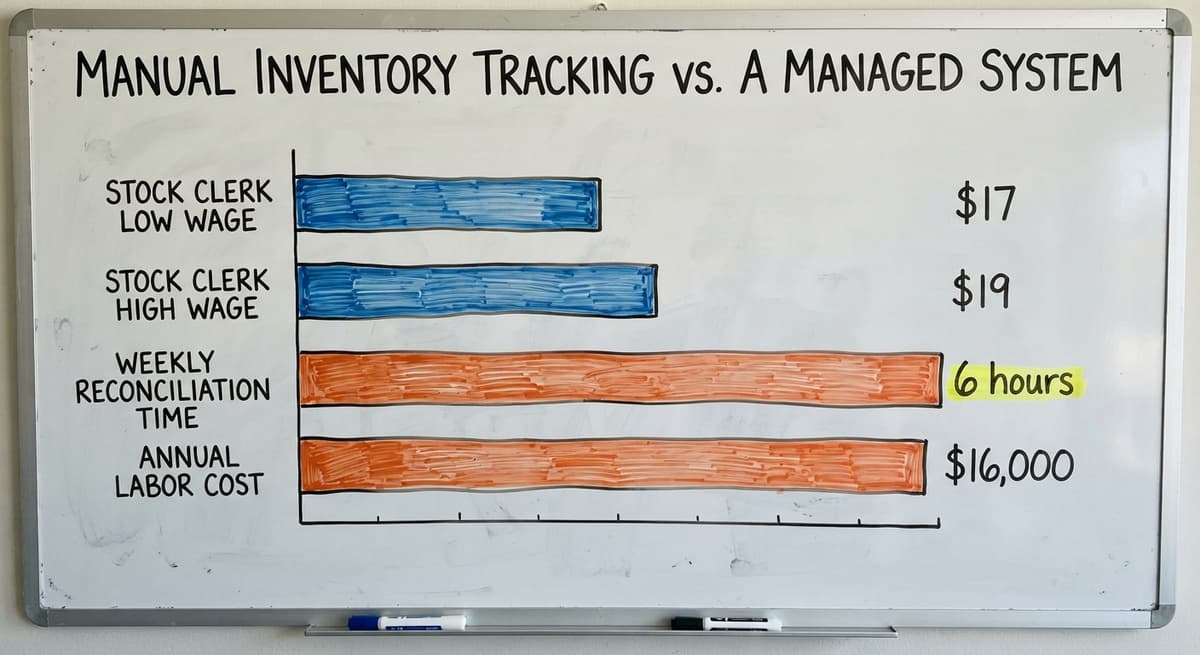
Most small distributors start with Excel, a shared drive, and printed count sheets. That works until it does not. The hidden cost is labor. The Bureau of Labor Statistics reports that stock clerks and order fillers earn a median hourly wage around $17 to $19 per hour. If 3 staff members each spend 6 hours a week reconciling spreadsheets, that is roughly $16,000 to $18,000 a year in labor before you count a single error that ships the wrong product.
What a Connected Inventory System Does Instead
A connected inventory system replaces those manual steps with scans and automated records. Receiving updates the count the moment a barcode is scanned. A pick ticket pulls from live data, not yesterday's printout. Reorder alerts fire at the right quantity without anyone checking a formula.
The real cost of manual tracking is not the spreadsheet; it is the hours spent fixing what the spreadsheet got wrong.
How Inventory Management Connects to the Rest of Operations
Inventory data does not live in isolation. When stock levels update, purchasing knows what to order. When an order ships, fulfillment closes the pick ticket and the count adjusts. When the period closes, accounting pulls the on-hand value for the balance sheet.

How Inventory Software Fits Alongside Existing Tools
Many small distributors already use dedicated accounting software for their books. Inventory management sits alongside it, feeding accurate product costs and stock values into the books without replacing the accounting tool that already works. A good inventory system handles order management for fulfillment centers and warehouse operations without demanding a full software migration. The goal is to replace the manual parts, not the whole operation.
NIST's Manufacturing Extension Partnership recommends aligning supply chain processes before selecting tools, because a system that does not match real workflows creates new problems instead of solving old ones. Inventory management software for wholesale distributors works best when it fits the operation rather than reshaping it.
See it running on your own process first
No build cost. The subscription starts once it is live and doing the job, not before.
Book a callCommon Inventory Management Methods
The method you choose affects how you value stock and how you rotate it on the warehouse floor.
- FIFO (first in, first out): the oldest stock ships first. This is the standard approach for perishables and most general merchandise, and it keeps carrying cost low by moving product before it ages.
- LIFO (last in, first out): the newest stock ships first. LIFO is less common and not permitted under international accounting standards, but some US businesses use it for tax purposes on certain product types.
- Just-in-time: stock arrives as close as possible to when it is needed, reducing the amount held on hand at any moment. This method lowers carrying cost but demands reliable suppliers and accurate lead-time data.
The right method depends on how fast your product moves and how much shelf life it has.
Signs Your Inventory Process Needs a Better System
Some working signals are easy to miss until they become expensive. Recognize any of these and the process is asking for help:
- Stockouts happen regularly even though the system showed enough stock on hand
- Physical counts never match the numbers in the books, no matter how carefully staff count
- Staff spend several hours each week reconciling spreadsheets instead of moving product
- Orders ship with the wrong items because pick lists were printed before a count was updated
- Reorders go out too late or too early because no one has a clear view of actual on-hand quantities
- Receiving discrepancies sit unresolved for days because there is no clear process to flag them
These are not signs of a bad team. They are signs that the tools have not kept pace with the volume. When the process creates the error, a better process is the fix.

What Should a Small Distributor Look for in an Inventory Management System?
The right system fits how the operation already works, not the other way around. Start there before comparing any features. A warehouse that runs 5 staff and 2,000 SKUs does not need the same platform as a national distribution network, and a long, expensive rollout is a real risk for a lean team.
Features That Matter Most for Small Distribution Operations
Look for these qualities:
- Connects to the accounting package already in use, so financial data stays accurate without double entry
- Handles buy orders, receiving, and pick tickets in one place rather than across separate tools
- Scales with the business without requiring a full rebuild when volume grows
- Replaces the manual parts of the current workflow without forcing staff to relearn every process from scratch
- Offers rollout support so the system goes live quickly and correctly
Custom working software for warehouses built around an existing operation costs less to adopt and delivers faster results than a generic enterprise platform. The measure of a good system is how quickly it removes the friction your team already feels, not how many features it lists.
Conclusion
The definition of inventory management is straightforward: track what you have, know where it is, reorder before you run out, and keep the count accurate enough to trust. For a wholesale distributor running on spreadsheets, that definition points directly at the gap between where the operation is and where it needs to be. A purpose-built system closes that gap without replacing the tools that already work. If the signs in this article sound familiar, the next step is finding a system that fits the operation you actually run.
Ready to replace the manual parts without disrupting what works? Explore how a custom workflow rollout built around your existing operation can bring your inventory process in line with the business you are building.
Frequently asked questions
What are the three types of inventory management?
The three most common types are manual tracking (spreadsheets and count sheets), periodic systems (counts taken at set intervals, such as monthly), and perpetual systems (counts updated in real time with every transaction). Perpetual systems give the most accurate picture but need consistent scanning or data entry at every step. The right type depends on how many SKUs you carry and how fast stock moves.
What are the 5 steps of inventory management?
The five core steps are: (1) receive stock and verify it against the buy order, (2) record quantities and assign storage locations, (3) track stock levels as orders are picked and fulfilled, (4) identify when quantities hit the reorder point and place a new buy order, and (5) reconcile physical counts against system records to catch shrinkage or errors. These steps repeat continuously, not just at month end.
What is another term for inventory management?
Stock control is the most common alternative term, particularly in warehouse and distribution settings. You may also hear inventory tracking, stock management, or materials management depending on the industry. All of these describe the same core process: knowing what you have, where it is, and when to reorder.
What are some examples of inventory management skills?
Key skills include reading and reconciling physical counts against system records, writing and processing buy orders correctly, understanding reorder points and lead times, operating barcode scanners and warehouse management software, and identifying discrepancies before they affect shipments. Attention to detail and comfort with data entry matter more than technical expertise for most warehouse roles.
Can an inventory system work alongside your existing accounting software instead of replacing it?
Yes. Most small distributors rely on a dedicated accounting package and do not need to replace it. A purpose-built inventory system connects to that accounting software, feeding accurate stock values and cost of goods data into the books automatically. The inventory tool handles receiving, pick tickets, and reorder alerts while the accounting software handles invoicing and financial reporting. Each tool does what it does best.
What is the difference between FIFO and LIFO in warehouse operations?
FIFO (first in, first out) means the oldest stock ships first. This keeps product fresh and reduces carrying cost. LIFO (last in, first out) means the newest stock ships first. LIFO is used by some US businesses for tax purposes but is not allowed under international accounting rules. For most wholesale distributors handling general merchandise, FIFO is the practical default.
How does a reorder point get calculated?
A reorder point is calculated by multiplying average daily usage by lead time in days, then adding a safety buffer if supply is unreliable. For example, if you sell 20 units a day and your supplier takes 5 days to deliver, your reorder point is 100 units plus whatever buffer you want to hold. When on-hand quantity hits that number, a buy order goes out.
Start with a free first look
A 30 minute call, your operation mapped, and a clear picture of what we would build. No obligation and nothing to install.
Book a callRelated guides
The rest of this guide, for the parts of the job this page does not cover.
- Inventory Asset Definition
- What is the Difference Between Aggregate and Item Inventory Management
- What is Jit Inventory Management
- What is Kanban System of Inventory Management
- What is an Important Factor in Inventory Management
- What is Abc Classification in Inventory Management
- What is Inventory Management in Working Capital
- What is Inventory Management and Its Types
- What is the Main Purpose of Inventory Management
- What is Effective Inventory Management
- What is Information Technology Inventory Management
- What is Risk Pooling in Inventory Management
- What is Inventory Management Mary Kay
- What is Stock Taking in Inventory Management
- What is Bin Number in Inventory Management
- What is the Goal of Inventory Management Quizlet
- What is the Implication of Proper Inventory Management
- What is Omni-channel Inventory Management
- What is Inventory Management and Its Importance
- What is the Importance of Eoq in Inventory Management
- What is the Importance of Quality Inventory Management
- What is Inventory Management Explain Techniques of Inventory Management
- What is Mean by Inventory Management
- What is Inventory Management Meaning in Hindi