


Inventory Account Definition
An inventory account is a general ledger account that records the dollar value of goods a business holds for sale. It tracks money, not item counts. It is the accounting side of stock, kept apart from the shelf count.
Book a callWhat Is an Inventory Account?
An inventory account is a current asset on the balance sheet, the report that lists what a firm owns and owes. Current means the firm expects to sell the goods within 1 year. The balance sheet lists it below cash and accounts receivable, which is money customers owe you. Owners and lenders read it to see how much cash sits tied up in stock.
Reviewed November 2026.
The cost is not an expense until the goods sell. Until then, the money stays on the books as an asset.
Why the Number Matters
The IRS makes this a duty. IRS Publication 538 says, "To figure taxable income, you must value your inventory at the beginning and end of each tax year." The ledger figure is a legal need, not a pastime. Some firms call it the inventory asset account. The name changes, but the job stays the same.
We build it for your operation, and the first look is free
If you would rather not compare products, describe how your operation already works and we build the system around it.
No build cost. You see it running on your own process first, and the monthly subscription starts only once it is live.
Book a callWhat Costs Go Into an Inventory Account?
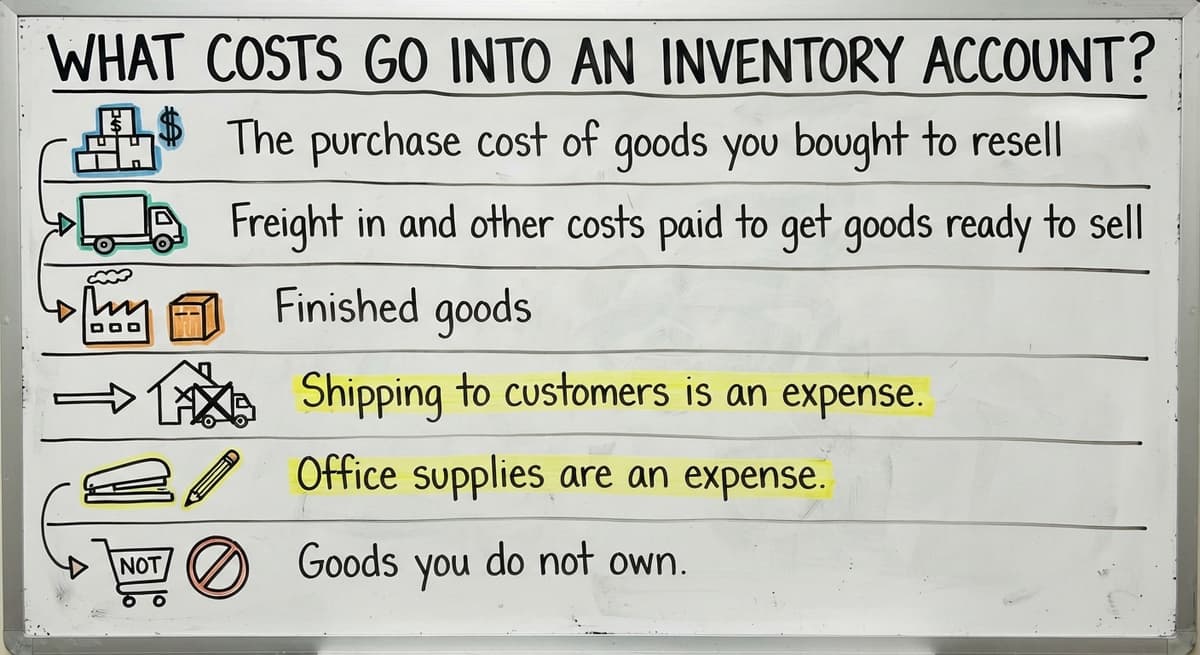
An inventory account holds every cost you pay to buy goods and ready them for sale. Three kinds of cost go in:
- The buy cost of goods you bought to resell.
- Freight in and other costs paid to get goods ready to sell.
- Finished goods, plus raw materials and work in progress if you make products.
Three kinds stay out:
- Shipping to customers is an expense.
- Office supplies are an expense.
- Goods you do not own, such as items held for another firm, are not yours to count.
If you own it and paid to make it sellable, it belongs in the account.
How Does an Inventory Account Change When You Buy and Sell?
Buying stock raises the inventory account with a debit. Selling stock lowers it with a credit. The cost of what you sold moves to cost of goods sold, an expense line that sits on the income statement.

Here is a simple case. You buy 100 units at $10 each. The account rises by $1,000 and your cash falls, or your payables rise. You sell 40 units. Then $400 of cost moves out of inventory and into cost of goods sold. The account now shows $600.
Returns put cost back in. Damaged or lost goods take cost out. A write-off cuts the value of stock that no longer sells. Some firms hold a separate inventory reserve account for that loss.
Inventory Account vs. Inventory Records
The account holds one total in dollars. The records hold each item, its quantity, its location and its cost. The two must agree. When they do not, something is wrong.
A single ledger total cannot tell you which item is short. Only the records can. That gap is where most trouble starts.
Common Ways to Value the Account
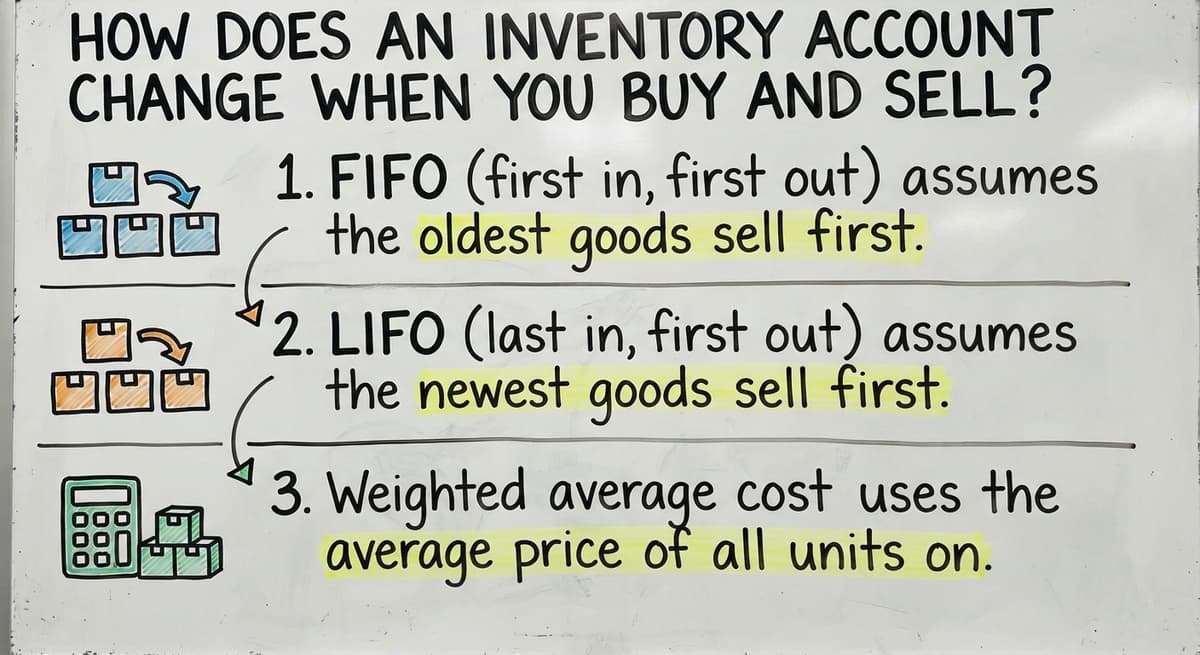
Inventory valuation sets the dollar figure. Three methods are common:
- FIFO (first in, first out) assumes the oldest goods sell first.
- LIFO (last in, first out) assumes the newest goods sell first.
- Weighted average cost uses the average price of all units on hand.
The method you pick changes both the balance and the reported profit. Ask your accountant which method fits your firm.
Not sure this is the right shape for your operation
Describe how the work runs today. We map it on a call and show you what it would look like built around that, before you spend anything.
Book a call
Why Does My Inventory Account Not Match My Physical Count?
The account drifts from the shelf because the people and tools that feed it fall behind. Five causes show up again and again:
- Receiving gets entered days after the truck leaves.
- Breakage goes unrecorded.
- Counts are wrong by a few units each time.
- A vendor sells by the case and a customer buys by the each.
- Orders arrive by email and pick sheets get printed, so edits live on paper.
Side spreadsheets add another gap. Say 2 people spend 5 hours a week fixing them at $22 an hour. That is $11,440 a year spent on repair work. The balance sheet still shows a number that the warehouse cannot back up. Your inventory on hand says one thing and the ledger says another.
The drift is normal. It is also fixable.
How Do I Keep My Inventory Account Accurate?
Accuracy comes from small habits done every day. Follow these 5 steps:

- Record receipts and shipments the same day they happen.
- Run a cycle count, a small count of a few items on a set schedule, and compare it to the ledger.
- Keep one source for item costs and units of measure.
- Review each adjustment and find its cause.
- Scan items instead of typing them. Scan counts rely on the barcode standards from GS1.
You do not need a full system swap. Your accounting software's inventory feature can keep holding the account in your general ledger. Custom software can then handle the manual receiving, counting and tracking steps. Your books stay where they are. Only the paper and spreadsheet work goes away. Tools such as accounting and inventory software for small business, or warehouse inventory tracking software, cover the same ground.
Same-day entries and steady counts keep the ledger and the shelf in step.
Is an Inventory Account an Asset?
Yes, an inventory account is an asset. It becomes an expense only when you sell the goods and the cost moves to cost of goods sold.
Is it the same as inventory on hand? No. The account is a dollar value. Inventory on hand is a count of units.
Can the balance go negative? Some systems allow it. A negative balance signals bad data, such as a sale entered before the receipt.
If your ledger and your shelves disagree, The Software Society can map your manual steps and replace them with a workflow built for your operation.
Frequently asked questions
Is an inventory account an asset or an expense?
An inventory account is an asset. It becomes an expense only when you sell the goods and the cost moves to cost of goods sold.
Is an inventory account the same as inventory on hand?
No. The inventory account is a dollar value in the general ledger. Inventory on hand is a count of units on your shelves.
Can an inventory account balance go negative?
Some systems allow it. A negative balance signals a data problem, such as a sale entered before the matching receipt.
Start with a free first look
A 30 minute call, your operation mapped, and a clear picture of what we would build. No obligation and nothing to install.
Book a callRelated guides
More on the same work.
Guides
- Inventory Reserve Account
- Accounting and Inventory Software for Small Business
- Best Inventory Software
- Classification of Inventory
- Excess Inventory
- Closed for Inventory
- Multi Location Inventory Management Software
- Ms Excel Inventory Template
- Inventory Management for Multiple Locations
- Costing Inventory
- Is Inventory a Long-term Asset
- Inventory Management System for Manufacturing
- Inventory Fixed Assets
- Inventory Management Pics
Common questions
- What is the Definition of Inventory Management
- Inventory Asset Definition
- Stock Inventory Definition
- Inventory Economics Definition
- Definition of Warehouse Management System
- How to Keep Track of Inventory
- What is the Difference Between Aggregate and Item Inventory Management
- What is Jit Inventory Management
- What is Kanban System of Inventory Management
- Mro Inventory Meaning