


Inventory Asset Definition
An inventory asset is any product or material a business owns and plans to sell or use to fill orders. It sits on the balance sheet as a current asset, meaning it is expected to turn into cash within a year. It is not equipment, shelving, or a forklift. Those are fixed assets. Inventory is the actual stock moving through your operation.
Reviewed September 2026. Figures are worked from the assumptions stated beside them, so you can substitute your own and the arithmetic still holds.
Reviewed and updated: June 2025
Book a callWhat Is an Inventory Asset
An inventory asset is goods a business owns and intends to sell. Think of a wholesale distributor with 4,000 cases of product in a warehouse. Those cases are inventory assets. They show up on the balance sheet as a dollar value, recorded at what the business paid for them, not what it plans to charge customers.
Inventory is not the racking that holds the cases. It is not the forklift that moves them. Those are fixed assets because the business keeps them for years. Inventory moves. It gets sold, shipped, and replaced. That cycle is exactly what makes it a current asset.
We build it for your operation, and the first look is free
If you would rather not compare products, describe how your operation already works and we build the system around it.
No build cost. You see it running on your own process first, and the monthly subscription starts only once it is live.
Book a callWhy Inventory Is Classified as a Current Asset
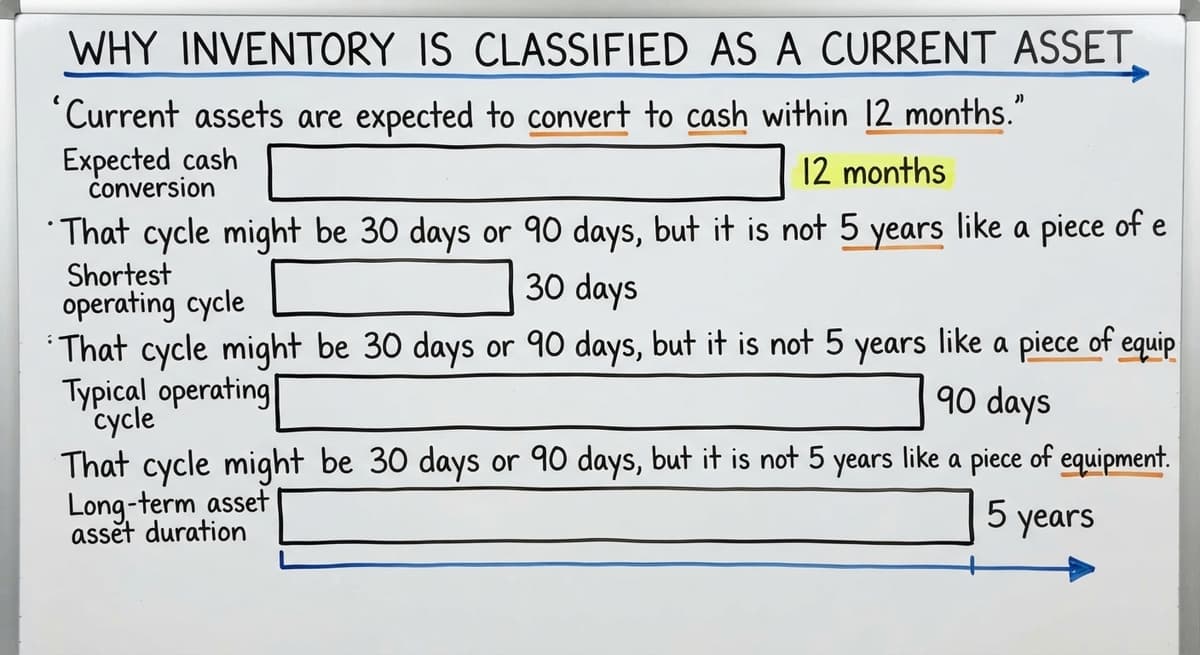
Current assets are expected to convert to cash within 12 months. Inventory qualifies because a business sells it, ships it, and collects payment on a regular cycle. That cycle might be 30 days or 90 days, but it is not 5 years like a piece of equipment.
This classification matters to lenders, accountants, and owners reading a balance sheet. A higher current asset value signals that cash is coming. QuickBooks tracks this classification automatically for small distributors, so the balance sheet reflects inventory value without manual journal entries. GS1, the global standards body behind barcode systems, notes that scan-based receiving and shipping tie directly to barcode standards that make real-time inventory counts possible in the first place.
What Are the Different Types of Inventory Assets?
Most wholesale distributors work with 3 types, and knowing which type you hold changes how you report it. The 3 types are raw materials, work-in-progress, and finished goods.
- Raw materials are components a business buys but has not yet processed or assembled into a product.
- Work-in-progress (WIP) covers goods that are partially assembled or kitted but not yet ready to ship.
- Finished goods are products ready to go out the door to a customer.
Most wholesale distributors deal almost entirely in finished goods. They buy a completed product from a supplier and sell it to a retailer or end buyer. Raw materials and WIP are more common in light manufacturing or kitting operations.
Every stage is still an inventory asset on the balance sheet. The label changes, but the accounting treatment does not.
How Inventory Assets Are Valued on the Balance Sheet
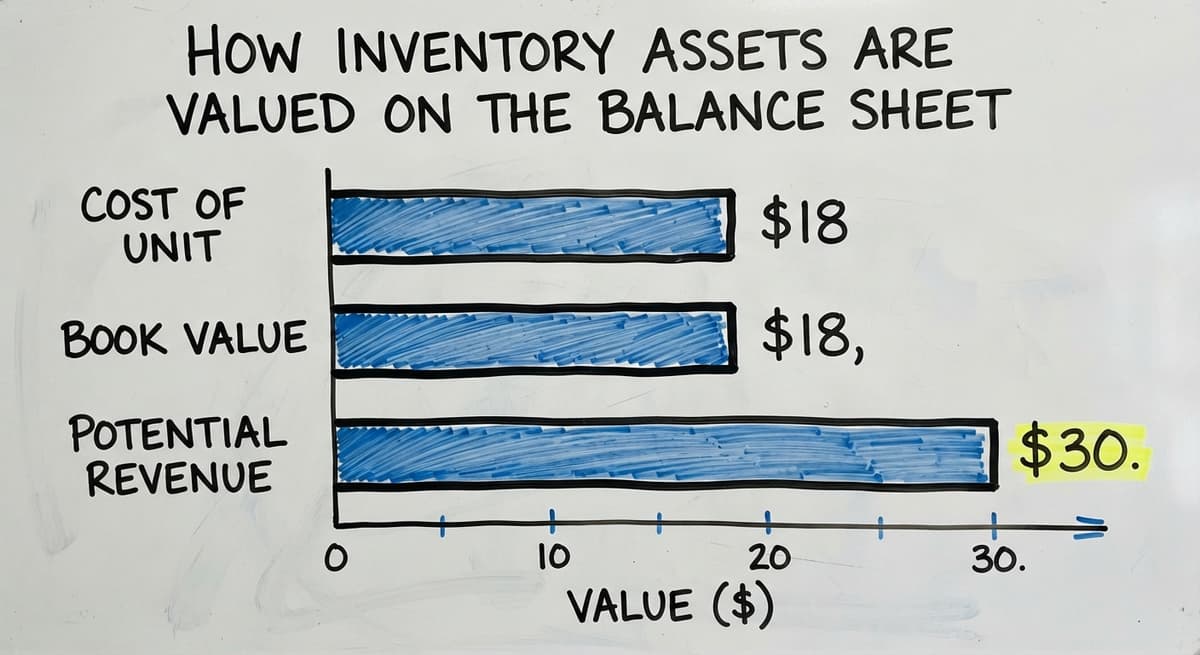
Inventory is recorded at cost, not at the price you plan to sell it for. If you paid $18 for a unit, it goes on the balance sheet at $18, even if you sell it for $30.
The method you use to assign that cost affects your reported profit and your tax bill. Three common methods are used:
- FIFO (first in, first out): The oldest stock is assumed sold first. In a rising-cost environment, this produces higher reported profit.
- LIFO (last in, first out): The newest stock is assumed sold first. This is allowed under US tax rules but not under international accounting standards.
- Weighted average cost: All units are averaged together into one cost per unit.
The comparison is easier when one option is built for you
Off-the-shelf means fitting your process to the software. We do it the other way round, and the first look costs nothing.
Book a call
What the IRS Requires and Why Switching Methods Is a Big Decision
The IRS is direct on this point: IRS Publication 538 states, "To figure taxable income, you must value your inventory at the beginning and end of each tax year." QuickBooks supports FIFO and average cost for small businesses. Talk to your accountant before switching methods, because a change affects multiple years of reporting.
The Difference Between Inventory Assets and Inventory Expenses
Inventory is an asset until the moment it is sold. At that point, it becomes cost of goods sold (COGS), which is an expense on the income statement. This shift is the foundation of gross margin: revenue minus COGS equals gross profit.
Tracking this transition correctly matters for every financial report you produce. If goods leave the warehouse but the asset account is not reduced, your balance sheet overstates what you own. If COGS is not recorded, your profit looks higher than it is.
Spreadsheets often miss this transition entirely. A sale gets logged in one file, but nobody updates the inventory count or the asset value until month-end. By then, the numbers are already wrong.

Why Accurate Inventory Asset Tracking Matters for Operations
Inaccurate inventory figures create 3 real problems: over-ordering stock you already have, running out of stock you thought you had, and producing financial statements that do not match the warehouse floor.
Lenders look at inventory asset values when deciding whether to extend a line of credit. Investors use those figures to judge business health. Both groups rely on the balance sheet being correct.
Operations managers need current figures to make purchasing calls. A buyer working from a spreadsheet updated last Tuesday is making decisions on stale data.
The Real Labor Cost of Manual Inventory Reconciliation
Consider a team of 3 people each spending 6 hours a week reconciling inventory counts manually at $22 an hour. That is $20,592 a year spent producing numbers that are still wrong by Friday. The US Bureau of Labor Statistics reports that stock clerks and order fillers earn around that range, so the math is grounded in real labor costs. Printed sheets and Excel do not scale with volume, and the gaps they create compound over time.

Common Inventory Asset Tracking Mistakes Small Distributors Make
Small distributors make the same errors repeatedly, and each one distorts the inventory asset definition in practice.
- Delaying the receiving entry: Goods arrive on the dock but are not logged in the system for hours or days. The balance sheet shows a lower asset value than what is physically on hand.
- Skipping adjustments for damaged or returned stock: A damaged pallet stays in the asset account at full value. The number is wrong from the day it happened.
- Mixing finished goods and operating supplies in one account: Paper towels and printer ink are not inventory assets. They are supplies. Lumping them together overstates inventory and muddies the balance sheet.
- Monthly or quarterly manual counts as the only source of truth: A count done once a month means every figure between counts is a guess.
See it running on your own process first
No build cost. The subscription starts once it is live and doing the job, not before.
Book a callWhere Most Inventory Record Errors Actually Start
The NIST Manufacturing Extension Partnership provides vendor-neutral guidance on supply chain processes, and a consistent theme in that guidance is that process gaps at the receiving and shipping points are where most record errors originate. Fixing the process at those 2 points removes most of the downstream noise.

How Software Keeps Inventory Asset Records Clean
Inventory management software updates asset values the moment goods are received, moved, or shipped. There is no batch update at month-end. The balance sheet reflects what is actually in the building.
QuickBooks integration for warehouse operations means that a shipment logged in the inventory system posts directly to the correct accounts in QuickBooks. No double entry. No matching session at the end of the week.
Why Small Distributors Benefit Most from Purpose-Built Inventory Tools
Custom workflow rollout built around the way a team already works avoids the disruption of a full ERP migration. A small team at a fulfillment center does not need a system designed for a 500-person manufacturer. They need a tool that fits their receiving dock, their SKU count, and their QuickBooks setup. Teams under 50 staff benefit most because they rarely have a dedicated accountant watching the books daily.

Why Real-Time Inventory Position Determines How Fast You Can Respond to Market Shifts
Inventory management software for small distributors solves the problem at the source: the moment a product enters or leaves the building. That is where the asset record either stays clean or starts to drift. The US Census Bureau's Monthly Wholesale Trade data tracks the national inventories-to-sales ratio for wholesale firms, and that ratio moves with market conditions. A business that cannot read its own inventory position correctly cannot respond when the ratio shifts against it.
Not sure this is the right shape for your operation
Describe how the work runs today. We map it on a call and show you what it would look like built around that, before you spend anything.
Book a callWhat Is the Inventory Asset Definition at a Glance?
An inventory asset is goods a business owns, recorded at cost, and listed as a current asset on the balance sheet. It converts to cash when sold. At the point of sale, it leaves the asset column and enters the expense column as cost of goods sold.
Key facts to keep in hand:
- Inventory is valued at cost, not at selling price
- It is a current asset because it converts to cash within 12 months
- FIFO, LIFO, and weighted average cost are the 3 main valuation methods
- The shift from asset to COGS happens at the moment of sale, not at month-end
Why the Inventory Number on Your Balance Sheet Must Be Actionable
Accurate tracking needs real-time systems, not periodic manual counts. Damaged, returned, and obsolete stock must be adjusted out of the asset account promptly. A balance sheet that reflects the right inventory value gives owners, lenders, and operations teams a number they can act on. One that does not is a liability dressed as a report.
Conclusion
The inventory asset definition is simple: goods you own, recorded at cost, sitting on the balance sheet until sold. What is not simple is keeping that number accurate when goods are moving every day and the team is small.
The gap between the textbook definition and the warehouse floor is where most small distributors lose control of their numbers. Delayed receiving entries, skipped adjustments, and spreadsheets updated once a month all push the balance sheet away from reality.
The Right Starting Point for Getting Inventory Numbers Under Control
How to replace manual inventory tracking with custom software is not a question reserved for large companies. A purpose-built system connected to QuickBooks can close that gap without a costly ERP project. If your current process relies on printed sheets, a clipboard, and a spreadsheet someone emails on Fridays, the asset record is already drifting. When you are ready to get your inventory numbers right, the right starting point is a system built around the way your operation already runs.
Frequently asked questions
What is the definition of an inventory asset?
An inventory asset is any product or material a business owns and intends to sell or use to fulfill orders. It is recorded at cost on the balance sheet and classified as a current asset because it is expected to convert to cash within 12 months.
Why is inventory classified as a current asset and not a fixed asset?
Inventory is classified as a current asset because it is sold and replaced on a regular cycle, usually within a year. Fixed assets like equipment or shelving are kept for years and depreciate over time. Inventory moves through the business and turns into cash through sales.
How is an inventory asset valued on the balance sheet?
Inventory is recorded at cost, not at the price you plan to sell it for. The 3 common valuation methods are FIFO (first in, first out), LIFO (last in, first out), and weighted average cost. The method you choose affects your reported profit and tax liability, so consult your accountant before switching.
When does inventory stop being an asset and become an expense?
Inventory becomes an expense the moment it is sold. At that point it moves from the asset column on the balance sheet to cost of goods sold (COGS) on the income statement. This shift is what drives your gross margin calculation.
What happens when inventory asset records are inaccurate?
Inaccurate inventory records lead to over-ordering, stockouts, and financial statements that do not reflect reality. Lenders and investors rely on these figures to assess business health, and operations managers use them to make purchasing decisions. Wrong numbers at the balance sheet level create problems throughout the business.
What common mistakes do small distributors make when tracking inventory assets?
The most common mistakes are delaying receiving entries, skipping adjustments for damaged or returned stock, mixing supplies with finished goods in the same account, and relying on monthly manual counts as the only source of truth. Each error pushes the balance sheet further from what is actually in the warehouse.
How does inventory management software improve inventory asset accuracy?
Inventory management software updates asset values in real time as goods are received, moved, or shipped. When integrated with QuickBooks, it posts entries directly to the correct accounts without double entry. This keeps the balance sheet current and removes the matching work that manual processes need.
Does the IRS need businesses to value inventory?
Yes. IRS Publication 538 states that to figure taxable income, a business must value its inventory at the beginning and end of each tax year. This makes accurate inventory tracking a legal obligation, not just a best practice.
Start with a free first look
A 30 minute call, your operation mapped, and a clear picture of what we would build. No obligation and nothing to install.
Book a callRelated guides
The rest of this guide, for the parts of the job this page does not cover.
Guides
- Is Inventory a Long-term Asset
- Inventory Fixed Assets
- Excess Inventory
- Closed for Inventory
- Multi Location Inventory Management Software
- Inventory Management for Multiple Locations
- Costing Inventory
- Inventory Management System for Manufacturing
- Inventory Management Pics
- Excel Inventory Template
- Push and Pull Inventory
- Consumable Inventory
- B2b Inventory Management
- Jewelry Inventory Management
- Dental Inventory Management
- The Objective of Inventory Management is To
- Qr Code for Inventory Management
- Inventory Metrics
- Inventory Formulas
- Hvac Inventory Management Software
- Calculate Beginning Inventory
- Inventory Management Software for Schools