


Is Inventory A Long-Term Asset
Reviewed: June 2025
Reviewed September 2026. Figures are worked from the assumptions stated beside them, so you can substitute your own and the arithmetic still holds.
Inventory is a current asset, not a long-term asset. It sits in the current assets section of your balance sheet because your business expects to sell it within 12 months. That single classification affects your working capital, your credit, and how lenders read your books. Get it wrong and your financial statements tell the wrong story.
Book a callIs Inventory a Current Asset or a Long-Term Asset?
Inventory is a current asset. A current asset is anything your business expects to turn into cash within one year. Think of it as the stuff that keeps moving: cash on hand, money customers owe you, and the goods sitting on your shelves waiting to ship.
Common current assets include:
- Cash and cash equivalents, which are the most liquid assets you hold
- Accounts receivable, meaning money customers owe but have not yet paid
- Prepaid expenses, such as insurance you paid in advance
- Inventory, which is the goods you plan to sell
The key point: current assets are expected to move within a year, and inventory is no exception.
We build it for your operation, and the first look is free
If you would rather not compare products, describe how your operation already works and we build the system around it.
No build cost. You see it running on your own process first, and the monthly subscription starts only once it is live.
Book a callWhy Barcode Infrastructure Makes Inventory Counts Reliable
GS1, the global standards body behind barcode systems, notes that scan-based tracking underpins accurate stock counts. According to GS1, "barcodes are the most widely used automatic spotting technology in the world," and that infrastructure is what makes a real-time inventory count possible.
What Are Considered Long-Term Assets?
Long-term assets are things your business holds for more than one year. They do not get sold in the normal course of business. They help you run the business instead.
Common long-term assets include:
- Buildings and land your company owns
- Equipment and machinery used in production
- Vehicles on your fleet
- Patents, trademarks, and other intangible assets
A forklift in your warehouse is a long-term asset. The pallets of product that forklift moves are current assets. That line is the clearest way to see the difference. Long-term assets show up on the balance sheet under a separate section, often labeled "property, plant, and equipment" or "fixed assets." They depreciate over time. Inventory does not depreciate; it either sells or it is written down.
Where Does Inventory Sit on the Balance Sheet?
Inventory appears in the current assets section, usually as the third line item. The standard order runs: cash first, then accounts receivable, then inventory. That order reflects how quickly each asset can become cash.
Why does placement matter? Lenders and investors read the balance sheet from top to bottom. A banker reviewing your credit line wants to see strong current assets because those are the assets that protect them if your business runs into trouble. Inventory that is counted correctly and valued correctly strengthens that picture. Inventory that is overstated or mis-timed weakens it.
The IRS states in Publication 538: "To figure taxable income, you must value your inventory at the beginning and end of each tax year." That is not optional. Accurate placement and valuation of inventory is both a financial and a legal requirement.

Why Inventory Is Classified as a Current Asset
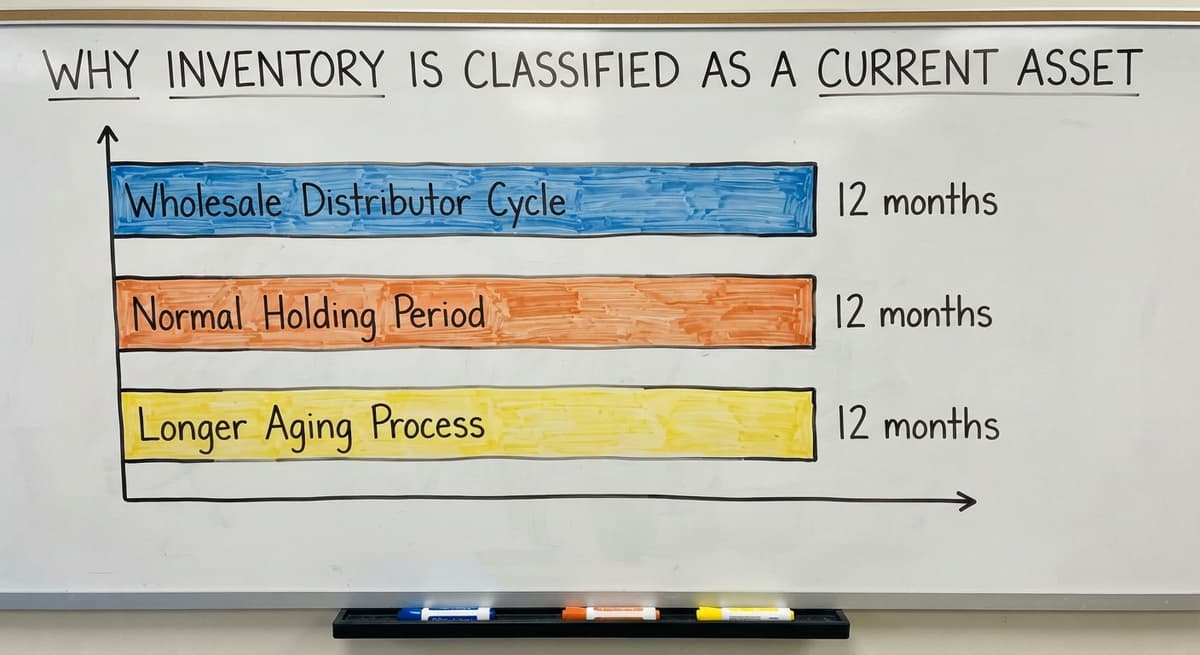
The reason inventory is a current asset comes down to the operating cycle. The operating cycle is the time it takes to buy goods, sell them, and collect the cash. For most wholesale distributors, that cycle runs well under 12 months.
Here is what the cycle looks like in practice:
- You buy product from a supplier.
- The product sits in your warehouse.
- A customer places an order.
- You ship and invoice.
- The customer pays.
Because the full loop closes within a year, inventory qualifies as a current asset under standard accounting rules. If goods sit longer than 12 months without selling, that is worth a conversation with your accountant. Slow-moving stock that has not moved in over a year may signal obsolescence, and it may need to be written down rather than carried at full value.
The comparison is easier when one option is built for you
Off-the-shelf means fitting your process to the software. We do it the other way round, and the first look costs nothing.
Book a callCan Inventory Ever Be a Long-Term Asset?
Rarely, yes. Some businesses have production cycles that stretch past a year. A distillery aging whiskey or a specialty manufacturer building custom equipment on a long contract may hold inventory that legitimately sits for more than 12 months. In those cases, an accountant may reclassify that stock as a long-term asset.
For most wholesale distributors and warehouse operations, this exception does not apply. If your goods are not moving within a year, the problem is not the classification. The problem is the inventory itself. Talk to your accountant before reclassifying anything; doing it wrong distorts your working capital ratio and can raise flags with lenders.
How Accountants Value Inventory
Inventory is recorded at cost or net realizable value, whichever is lower. Net realizable value means what you can actually sell it for, minus any costs to get it sold. If your cost is higher than what the market will pay, you write it down.
Accountants use 3 main methods to assign cost to inventory:
- FIFO (First In, First Out): The oldest goods are assumed sold first. Common in food and perishables.
- LIFO (Last In, First Out): The newest goods are assumed sold first. Less common and not permitted under international accounting standards.
- Weighted average cost: You average the cost of all units on hand. Simpler for businesses with large volumes of similar items.

How Your Inventory Costing Method Affects Taxes
The method you pick affects your cost of goods sold and your taxable income. The IRS Publication 538 covers which methods are acceptable and how to apply them consistently. Switching methods mid-stream needs IRS approval.
How Inventory Classification Affects Working Capital
Does inventory affect working capital? Yes, directly. Working capital equals current assets minus current liabilities. Because inventory is a current asset, every dollar of inventory on your books adds a dollar to your working capital.
For a wholesale distributor, inventory is often the largest single current asset. That makes it the biggest lever on your working capital number. High inventory levels can make working capital look strong on paper. The risk is that inventory is not as liquid as cash. You cannot pay a supplier with a pallet of unsold product.

Why Inaccurate Inventory Counts Distort Working Capital
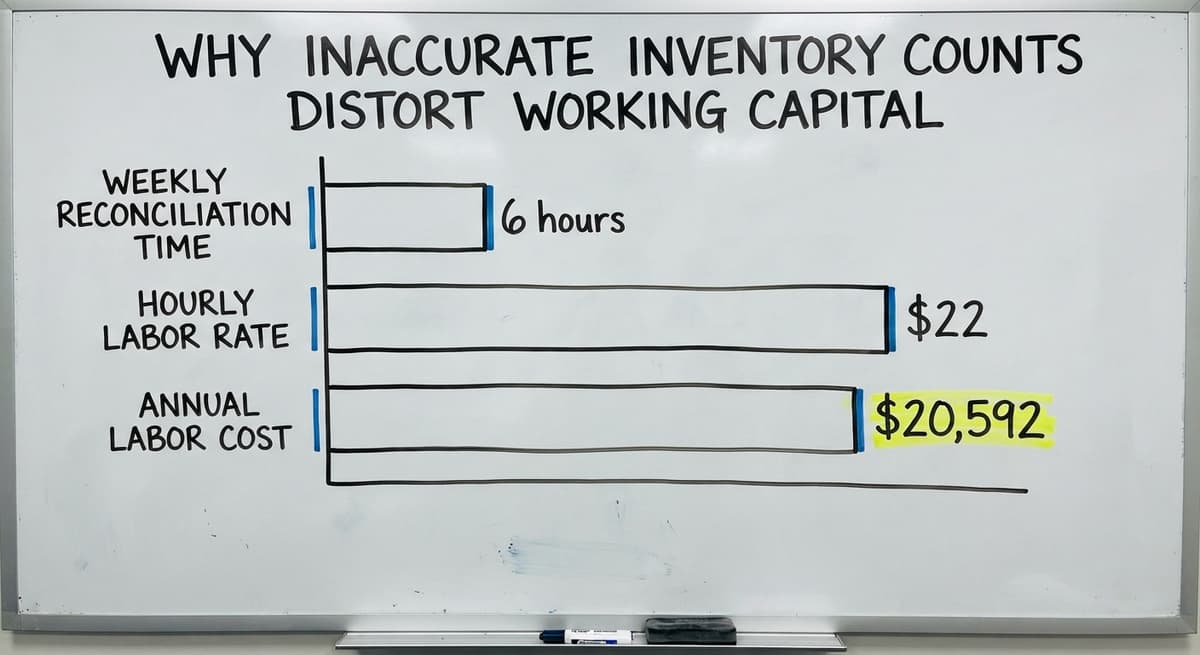
Consider this example: a 3-person warehouse team spending 6 hours a week reconciling inventory counts at $22 an hour generates $20,592 in annual labor cost, based on BLS wage data for stock clerks and order fillers. That time produces no new revenue. It just corrects errors that a better system would prevent. Accurate inventory data keeps your working capital figure honest and your cash flow visible.
See it running on your own process first
No build cost. The subscription starts once it is live and doing the job, not before.
Book a callThe Difference Between Inventory and Fixed Assets in a Warehouse
Inventory classification becomes concrete the moment you walk through your warehouse and look around:
- The building is a fixed, long-term asset.
- The shelving units bolted to the floor are fixed assets.
- The forklift is a fixed asset.
- The goods on those shelves are current assets, specifically inventory.
The physical space and equipment help you run the business for years. The product moves through and turns into cash. A warehouse operator who mixes these up on the books, say by capitalizing a large product buy as equipment, will overstate fixed assets and understate current assets. That flips the balance sheet in a way that misleads anyone reading it.
Fixed assets depreciate; inventory either sells or gets written down. They are not the same thing and should never share a line.

How QuickBooks Handles Inventory Classification
QuickBooks automatically posts inventory to the current asset section of your balance sheet. When you set up an item as an inventory part, QuickBooks assigns it to the Inventory Asset account, which sits under current assets by default. You do not have to move it manually.
The problem shows up when teams bypass the system. Receiving in a spreadsheet and entering totals into QuickBooks at month-end creates a gap between what QuickBooks shows and what is physically in the warehouse. That gap means your current asset balance is wrong for most of the month.
Common QuickBooks Inventory Errors That Break Your Balance Sheet
Common QuickBooks inventory errors include:
- Receiving goods without creating a buy order in QuickBooks, so the Inventory Asset account never updates
- Adjusting quantities manually without adjusting the value, which breaks the cost layer
- Using a non-inventory item type for goods that are actually tracked stock, which posts to an expense account instead of an asset account
QuickBooks integration for warehouse operations works best when every receive, transfer, and sale flows through the system in real time rather than in batches.
Is Your Inventory System Hurting Your Balance Sheet?
Your inventory system is hurting your balance sheet if you recognize any of these signs:
- Your team makes large inventory adjustments at year-end to reconcile the books to the physical count
- The Inventory Asset balance in QuickBooks does not match what a physical count produces
- Staff spend hours each week pulling data from multiple spreadsheets before anyone can run a financial report
Each of these is a symptom of the same problem: the data feeding your balance sheet is not current. An inaccurate current asset value means your working capital ratio, your liquidity ratios, and your tax filings are all built on a number that is wrong. The fix is not a year-end adjustment; it is a system that keeps the count accurate every day.
Not sure this is the right shape for your operation
Describe how the work runs today. We map it on a call and show you what it would look like built around that, before you spend anything.
Book a call
What Happens When Inventory Lives in Spreadsheets
Spreadsheets create version problems fast. One person updates a count. Another ships an order from a different file. By Friday, 3 versions of the same spreadsheet exist and none of them match. The US Census Bureau's Monthly Wholesale Trade data tracks inventory-to-sales ratios across wholesale firms, and those ratios only mean something if the underlying inventory counts are accurate.
How Spreadsheet Errors Expose You to Lenders, Auditors, and Regulators
Outdated counts mean your balance sheet shows the wrong asset value. Lenders see a number that does not reflect reality. Auditors ask questions you cannot answer without digging through old files. The US Federal Trade Commission needs businesses to ship when they say they will, and that obligation depends on knowing what stock is actually available.
Spreadsheet errors compound in a busy fulfillment center. How to replace Excel-based inventory tracking is a question more distributors are asking as their order volume grows past what a manual process can handle.
How the Right Software Keeps Your Books Clean
Inventory management software for wholesale distributors built around your workflow posts accurate counts automatically. Every receive, pick, and adjustment flows into QuickBooks without a manual entry step. The Inventory Asset account stays current because the data behind it is current.
What to look for when you evaluate options:
- QuickBooks integration that pushes data in real time, not in nightly batches that leave the day's transactions unrecorded
- Quantity updates across all locations, so a transfer between 2 warehouses does not create a phantom surplus in one and a shortage in the other
- Simple enough for a 10-person team to adopt quickly, without a year-long rollout or an enterprise price tag
- Barcode scanning support, which removes the manual entry step that causes most receiving errors
Why Real-Time Data Is the Foundation of a Clean Balance Sheet
The NIST Manufacturing Extension Partnership offers vendor-neutral guidance on supply chain processes and consistently points to real-time data as the foundation of a reliable operation. Custom working software for small distribution companies does not need to replace QuickBooks. It needs to feed QuickBooks the right numbers at the right time.
Clean data in means a clean balance sheet out, and that is what lenders, accountants, and auditors actually need from you.
Key Takeaways
Inventory is a current asset. It belongs in the current assets section of your balance sheet because your business expects to sell it within 12 months. That classification affects your working capital, your credit, and your tax filings.
The classification only holds up if the number behind it is accurate. Manual systems and spreadsheets create gaps that distort your financials. QuickBooks does the right thing by default, but only if the data flowing into it is current.
The right software keeps your inventory count accurate in real time, syncs with QuickBooks, and removes the manual steps that cause year-end scrambles. If your team is spending hours reconciling counts before every financial report, that is the problem worth solving first.
Frequently asked questions
What type of asset is inventory?
Inventory is a current asset. It appears in the current assets section of the balance sheet because a business expects to sell it within one year or within its normal operating cycle, whichever is longer.
What are considered long-term assets?
Long-term assets are things a business holds for more than one year and does not sell in the normal course of business. Common examples include buildings, land, equipment, vehicles, and patents. They are sometimes called fixed assets or non-current assets.
What category does inventory fall under?
Inventory falls under current assets on the balance sheet. It usually appears as the third line item, after cash and accounts receivable, because it is slightly less liquid than those 2 categories.
How is inventory treated in accounting?
Inventory is recorded at cost or net realizable value, whichever is lower. Net realizable value is what you can sell it for minus any costs to complete the sale. Accountants use FIFO, LIFO, or weighted average cost to assign a dollar value to the units on hand.
Can slow-moving inventory become a long-term asset?
In rare situations, yes. Businesses with production cycles longer than 12 months, such as distilleries or specialty manufacturers, may reclassify certain stock. For most wholesale distributors, slow-moving inventory should be reviewed for obsolescence and written down rather than reclassified.
How does inventory affect working capital?
Working capital equals current assets minus current liabilities. Because inventory is a current asset, it adds directly to your working capital total. High inventory levels raise the number, but inventory is less liquid than cash, so a strong working capital figure driven by excess stock can hide a cash flow problem.
Does QuickBooks classify inventory correctly by default?
Yes, as long as items are set up as inventory parts rather than non-inventory or service items. QuickBooks posts inventory to the Inventory Asset account under current assets automatically. Errors usually come from manual workarounds or batch entries that bypass the system.
Start with a free first look
A 30 minute call, your operation mapped, and a clear picture of what we would build. No obligation and nothing to install.
Book a callRelated guides
The rest of this guide, for the parts of the job this page does not cover.
Guides
- Excess Inventory
- Closed for Inventory
- Multi Location Inventory Management Software
- Inventory Management for Multiple Locations
- Costing Inventory
- Inventory Management System for Manufacturing
- Excel Inventory Template
- Jewelry Inventory Management
- Dental Inventory Management
- Qr Code for Inventory Management
- Inventory Metrics
- Inventory Formulas
- Hvac Inventory Management Software
- Calculate Beginning Inventory
- Inventory Management Software for Schools
- Find Beginning Inventory
- Nonprofit Inventory Management
- Manual Inventory Management
- Inventory Bin System
- Inventory Management Photos
- Inventory Management Software Costs
- Manual Inventory System
- Hvac Inventory Management