


Multi Location Inventory Management Software
Multi location inventory management software tracks stock levels, orders, and movements across 2 or more physical sites from one system. If you run a wholesale distribution or warehousing operation and spend hours reconciling stock by phone, email, or spreadsheet, this guide is for you. Reviewed and updated July 2025.
Book a callWhat Is Multi Location Inventory Management Software?
Multi location inventory management software is a single system that shows you what stock you have, where it sits, and how it moves, across every warehouse or fulfillment site you operate. Unlike a basic inventory tool built for one stockroom, it treats each location as a distinct node. Staff at any site can see live quantities at every other site without making a call. The software is built for wholesale, distribution, and warehousing businesses where stock moves between sites daily and a wrong count costs real money.
We build it for your operation, and the first look is free
If you would rather not compare products, describe how your operation already works and we build the system around it.
Reviewed September 2026. Figures are worked from the assumptions stated beside them, so you can substitute your own and the arithmetic still holds.
No build cost. You see it running on your own process first, and the monthly subscription starts only once it is live.
Book a callWhy Managing Inventory Across Locations Gets Complicated Fast
When a business opens its second warehouse, the cracks appear quickly. Stock at one site is invisible to staff at another. Someone calls, someone emails, someone updates a spreadsheet, and by the time the reply arrives the number is wrong. Add a third location and the daily matching calls become a part-time job.
QuickBooks handles your accounting well. It was not built for real-time, multi-site stock visibility. It does not know that 40 units left Warehouse A this morning or that 12 arrived at Warehouse B short of what the buy order said.
Why Barcode Technology Alone Does Not Close the Gap
GS1, the global standards body behind barcode and supply chain data, notes that "barcodes are the most widely used automatic spotting technology" for tracking goods, yet most small distributors still rely on manual counts between locations. You can read more about those standards at gs1.org/standards/barcodes. The gap between what the technology can do and what most small operations actually use is where stock errors live.
Is Your Current Setup Holding You Back?
Your current setup is holding you back if any of these sound familiar. Overselling happens because one location shows stock that another already shipped. Staff call or email a different site to check availability before promising a customer a delivery date. Printed pick sheets are out of date before the shift ends. Transfer counts are done by hand and entered later, sometimes wrong. Fulfillment slows because no one is sure which site should ship the order.

Why These Problems Are a Growth Problem, Not a People Problem
None of this means your team is doing a bad job. These problems are a natural result of growth. A setup that worked fine for 1 location simply was not designed to scale to 2 or 3.
The US Federal Trade Commission needs businesses to ship orders within the timeframe promised to customers, or notify the customer and offer a cancellation. Accurate, real-time stock data across every site is what makes that promise keepable. See the FTC's Mail, Internet, or Telephone Order Rule for the full obligation.
The comparison is easier when one option is built for you
Off-the-shelf means fitting your process to the software. We do it the other way round, and the first look costs nothing.
Book a callCore Features to Look for in Multi Location Inventory Management Software
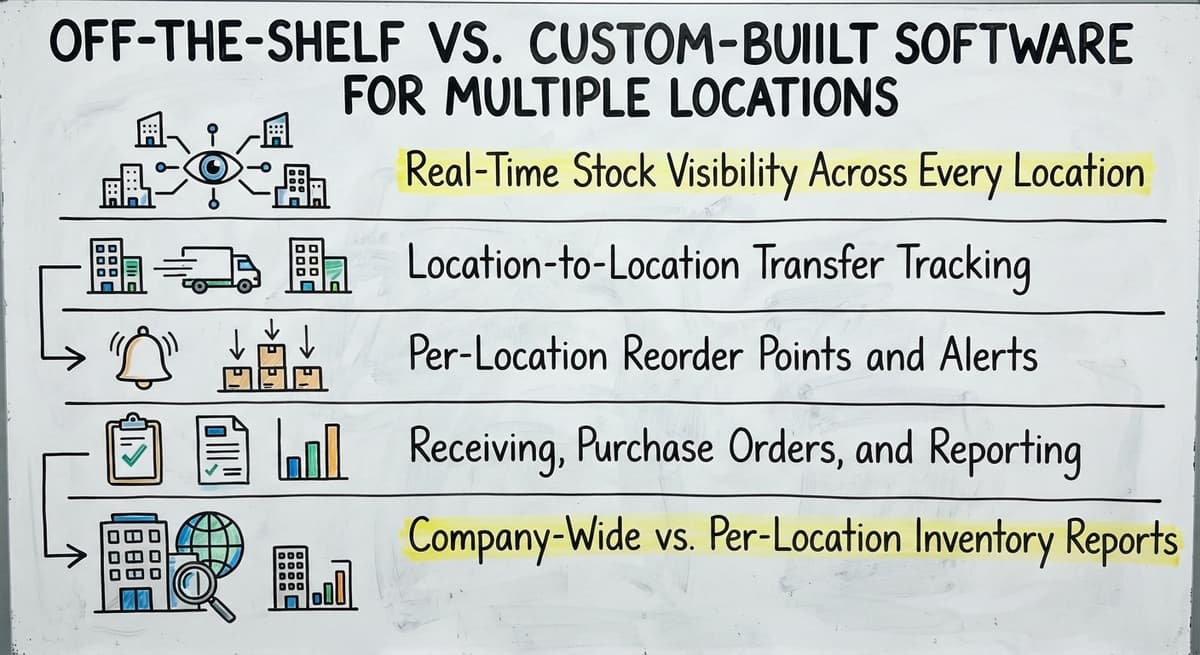
A useful buyer's checklist covers 4 functional areas: live stock visibility, transfer tracking, per-location reorder rules, and receiving tied to buy orders. The sections below walk through each one. Reporting sits across all of them and gets its own section.

Off-the-Shelf vs. Custom-Built Software for Multiple Locations
Off-the-shelf and custom-built software can both work for multi-location inventory management. The right choice depends on how standard your workflow is and how much you are willing to adapt your operation to fit the software. The 2 sub-sections below lay out the honest trade-offs.
Real-Time Stock Visibility Across Every Location
Live quantity-on-hand per location is the foundation. Without it, every order decision is a guess. A buyer placing a sales order needs to know not just that 60 units exist in the system, but that 40 are at the Columbus site and 20 are in transit from Cincinnati. That distinction changes whether you can promise same-day fulfillment or need to route the order differently. Real-time visibility removes the phone call. It also surfaces in-transit stock, so you are not counting goods twice or missing them entirely.
Location-to-Location Transfer Tracking
Every stock transfer between warehouses should generate a paper trail automatically. When Warehouse A ships 30 units to Warehouse B, the system marks those units as in-transit. They do not appear as available at either site until Warehouse B confirms receipt. This single rule prevents double-counting, which is one of the most common sources of phantom inventory. A well-built transfer workflow also flags discrepancies: if 30 left but only 28 arrived, the system notes the difference rather than silently absorbing it.
Per-Location Reorder Points and Alerts
Each site has its own demand pattern and lead time. A distribution center near a major highway may turn stock faster than a regional spoke. Setting a different reorder point for each location means the system alerts you when the Columbus site drops below 15 units, even if the Toledo site still has 80. Alerts can account for supplier lead time, so the trigger fires early enough to avoid a stockout. Nothing runs out silently when reorder rules are set per location rather than across the whole business.
Receiving, Purchase Orders, and Reporting
Incoming shipments need to be assigned to a specific location at the moment of receiving. A buy order matched to the wrong warehouse creates a ghost quantity in one place and a shortage in another. The right system flags receiving discrepancies rather than accepting whatever count the staff member enters.
Company-Wide vs. Per-Location Inventory Reports
Do you need both a company-wide inventory report and a per-location breakdown? Yes, and a good system provides both. Owners want the consolidated picture: total stock value, overall fill rate, slow-moving items. Warehouse managers want their own numbers: what is on hand at their site, what is aging, what is shrinking. Turnover rates, aging stock, and shrinkage reports are the 3 most useful for a small distributor. The IRS is clear on why this matters: "To figure taxable income, you must value your inventory at the beginning and end of each tax year," per IRS Publication 538. Accurate per-location reporting makes that valuation defensible.
How Multi Location Inventory Software Works with QuickBooks
Most small distributors already rely on QuickBooks for accounting, accounts payable, and accounts receivable. The right multi location inventory management software keeps QuickBooks in place for what it does well. It does not replace it.
The approach is a sync. Inventory data, fulfilled orders, and received buy orders flow into QuickBooks as transactions. QuickBooks generates the invoice and posts the cost. Your accountant sees clean books. Your warehouse staff see live stock counts. Neither team has to work in a system built for the other.
You do not need to abandon your existing accounting setup. QuickBooks Integration for Wholesale Distributors is a solved problem when the inventory system is built with that connection in mind from the start. The risk comes when a business chooses inventory software that has no QuickBooks connector and is told to migrate accounting too. That is a much larger project than most small distributors need.
What Off-the-Shelf Tools Do Well and Where They Fall Short
Packaged warehouse inventory software sets up quickly and follows standard workflows. For businesses whose operations match those standards, that is a real advantage. The frustrations appear when the fit is imperfect. Many off-the-shelf platforms are built for large enterprises and priced that way: per-user costs climb fast as headcount grows, and modules you will never use are bundled into the price. Location structures are often rigid. Renaming a warehouse or adding an unusual transfer type may need a workaround or a paid customization. Rollout timelines that vendors quote in weeks often stretch to months once data migration and staff training begin.
See it running on your own process first
No build cost. The subscription starts once it is live and doing the job, not before.
Book a callWhy Some Operations Choose a Custom-Built Approach
Custom Warehouse Management Software matches the way your operation already runs, not the way a software vendor assumes you run. Unusual location naming, non-standard transfer workflows, or receiving processes tied to a specific supplier can all be built in from the start rather than bolted on later.
A custom build can also be scoped narrowly. You do not need a full ERP migration to replace the manual parts of your workflow. A focused build that handles multi-site stock tracking, transfers, and QuickBooks sync, and nothing else, is a realistic outcome for a 10 to 50 person distributor. Rollout timelines are shorter when the scope is tight. The reader who is wary of a long, expensive rollout should ask any vendor: what is the minimum viable scope that solves my actual problem? A good vendor answers that question honestly.

Common Mistakes When Choosing Multi Location Inventory Software
The mistakes that cause the most pain after go-live are predictable. Knowing them before you start saves money and time.
- Buying for future scale instead of current reality means paying for features you will not use for years, while the features you need today are buried or missing.
- Underestimating the data cleanup needed before go-live is the most common cause of delayed launches. Dirty SKU data and mismatched location names slow every rollout.
- Choosing a system with no QuickBooks connector forces a full accounting migration that most small distributors did not budget for and do not need.
- Skipping staff input during selection leads to adoption problems after launch. The people who use the system daily know where the current process breaks.
- Selecting a vendor who disappears after the sale leaves you without support when something breaks or the business changes.
The NIST Manufacturing Extension Partnership offers vendor-neutral guidance on supply chain process decisions that can help frame these conversations before you talk to any software company.
How Do You Evaluate a Multi Location Inventory Software Vendor?
Evaluating a vendor well means asking specific questions before you see a demo. The opening question should be direct: how long does rollout take for a business my size, and who handles support after go-live?
Ask for a demo using your actual SKU list and location structure, not a generic sample dataset. A vendor who can only show a clean demo environment may not handle your real data well. Ask whether the system can be adjusted after launch without a full rebuild. Business needs change, and a system that needs a new project every time you add a location is not built for growth.

Why Vendor Experience at Your Scale Matters
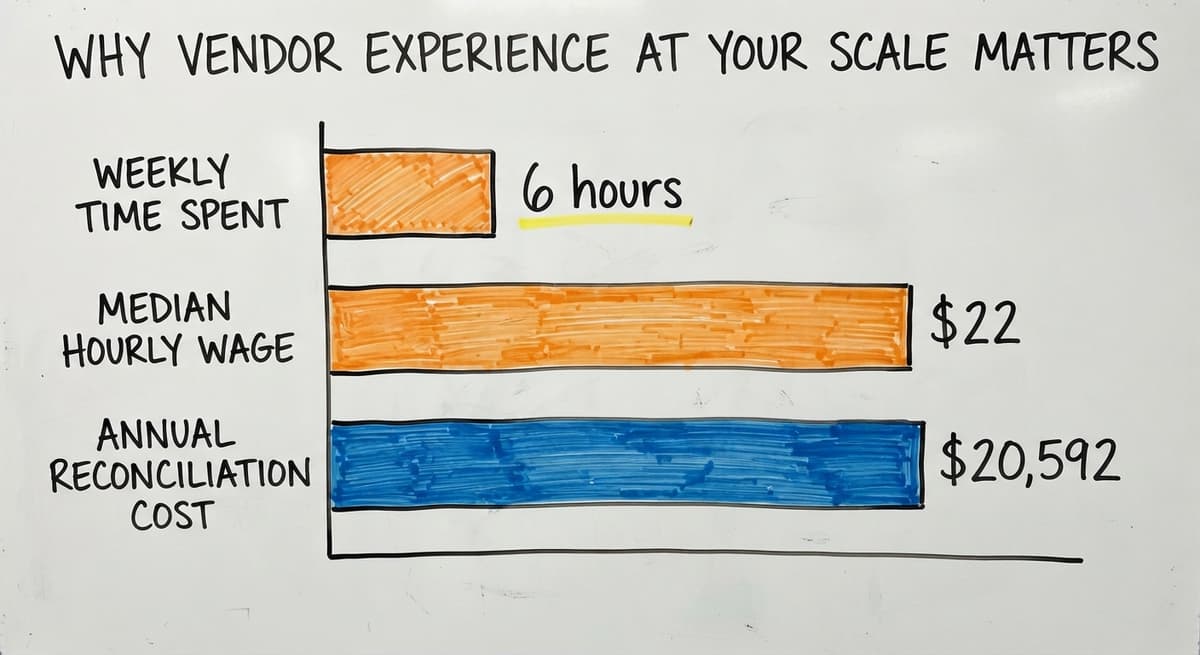
Check whether the vendor has worked with operations your size. A vendor whose reference accounts are all enterprise warehouses with dedicated IT staff will not serve a 20-person distributor well. The US Bureau of Labor Statistics shows that stock clerks and order fillers earn a median wage that makes manual matching expensive fast: 3 staff spending 6 hours a week on manual stock checks at $22 an hour adds up to $20,592 a year, before errors and their downstream costs. A vendor who cannot quantify what their system saves you is not thinking about your business.
What Implementation Should Look Like, and How Staff Adoption Affects It
A realistic rollout for a small or mid-size distributor moves through 4 stages: data mapping, build or setup, testing with real staff, and go-live. The whole process should take weeks, not months, when the vendor does the heavy lifting and the scope is tight.
A phased rollout by location reduces risk. Start with 1 site, confirm the workflow is right, then add the next. This approach also surfaces adoption problems early, when they are easier to fix.
Not sure this is the right shape for your operation
Describe how the work runs today. We map it on a call and show you what it would look like built around that, before you spend anything.
Book a call
Why Staff Adoption Determines Whether the System Actually Works
The best software fails if warehouse staff do not use it consistently. Involve floor staff in selection and testing. They know where the current process breaks, and their buy-in work out whether the system works in practice. Simpler screens and fewer clicks improve daily compliance more than any training session. Training should happen in the real environment, on real orders, not in a classroom with sample data. A good vendor builds that into the rollout rather than treating it as an afterthought.
A Realistic Before-and-After: A Wholesale Distributor With 3 Warehouses
Consider a wholesale distributor running 3 locations across Ohio. Before: each site tracked stock in its own Excel file. QuickBooks handled invoicing. Every morning, the operations manager ran a matching call with all 3 site leads to align counts. Transfers were logged on paper and entered later. Oversells happened weekly.
After implementing multi location inventory management software with a QuickBooks sync: the operations manager sees live stock at all 3 sites on one screen. Transfers generate automatic records. QuickBooks still handles invoicing. The morning call dropped from 45 minutes to a 10-minute check-in. Oversells stopped because the sales team sees real availability before promising a ship date.
The operation did not change. The visibility did. This is a 10 to 50 person business outcome, not an enterprise project. Wholesale Distribution Software built for this scale exists, and it does not need an ERP or a new accounting system.
Key Metrics to Track After Go-Live
Measuring these numbers proves the software is working and shows where to improve next.
- Inventory accuracy rate per location compares system counts to physical counts. A rate below 95% signals a process gap.
- Order fill rate and backorder frequency show whether stock availability is matching customer demand.
- Transfer lead time between locations measures how long stock is in-transit and unavailable.
- Carrying cost and slow-moving stock percentage identify capital tied up in goods that are not turning.
The US Census Bureau's Monthly Wholesale Trade data tracks national inventory-to-sales ratios for wholesale firms. Comparing your own ratio to the sector average gives context to your carrying cost numbers. Tracking these 4 metrics from day one gives you a baseline. Without a baseline, you cannot prove the system paid for itself.
Are You Ready to Start Your Search?
Before talking to any vendor, answer these questions about your own operation. They will sharpen every conversation that follows.
- How many locations do you have now, and how many do you expect in 2 years?
- What does your current receiving process look like at each site?
- Which manual steps cause the most errors today?
- Do you need barcode scanning, mobile access, or both?
- What does success look like 6 months after go-live?
Mapping your own pain points first means you evaluate vendors against your real needs, not their demo script. Replacing Excel and Access Databases With Custom Software is a common starting point for distributors who have outgrown their current tools. The answers to these questions also tell you whether a packaged tool or a custom build is the better fit for your operation.
Next Steps for Finding the Right Fit
Start by writing down the 3 manual steps in your current workflow that cause the most errors. That list is your requirements document. Take it to any vendor conversation and ask them to show you exactly how their system handles each one.
If the fit is unclear, or if your workflow is unusual enough that packaged tools keep requiring workarounds, a custom build may be the faster path. The Software Society is based in Columbus, Ohio and builds custom inventory systems for small and mid-size distributors. The work is scoped to your actual operation, not a template.
Reach out for a no-pressure conversation about your locations, your workflow, and what a realistic build would look like. No demo scripts, no generic proposals. Just a direct conversation about your specific situation.
Frequently asked questions
Can I keep using QuickBooks if I add multi location inventory management software?
Yes. A well-built system syncs inventory data into QuickBooks rather than replacing it. Your accounting, invoicing, and AP/AR stay in QuickBooks. The inventory software handles stock counts, transfers, and receiving across your locations, then passes the relevant transactions to QuickBooks automatically.
How long does rollout take for a small distributor?
Usually weeks, not months, when the vendor does the heavy lifting and the scope is focused on your actual needs. A phased rollout starting with one location reduces risk and surfaces any workflow gaps before you add the next site.
How do I track stock transfers between locations without losing inventory?
The system marks transferred stock as in-transit the moment it leaves the sending site. It does not appear as available at either location until the receiving site confirms the count. Any discrepancy between what shipped and what arrived is flagged automatically rather than silently absorbed.
Do I need to hire IT staff to manage the system after go-live?
No. The right system is maintained by the vendor, not by an internal IT team. Updates, adjustments, and support are handled by the people who built it. This matters most for small distributors with lean internal teams who cannot staff a dedicated system administrator.
Is multi location inventory management software only for large companies?
No. Solutions built specifically for 5 to 100 staff operations exist and are priced for that scale. Enterprise platforms get most of the attention in software reviews, but a focused system scoped to a small distributor's actual workflow is often faster to implement and easier to use than a large platform trimmed down.
What happens if my inventory process is non-standard or unusual?
A custom build can match any workflow, including unusual location structures, non-standard transfer types, or receiving processes tied to specific suppliers. Packaged tools may handle these with workarounds, which add friction over time. If your operation is genuinely different from the norm, that difference is worth discussing with any vendor before you commit.
Do I need a full ERP, or will a focused inventory system be enough?
Most small and mid-size distributors do not need a full ERP. A focused system that handles multi-site stock tracking, transfers, and QuickBooks integration covers the working gap without forcing an accounting migration or a long enterprise rollout. Start with the problem you actually have, not the one you might have in five years.
Start with a free first look
A 30 minute call, your operation mapped, and a clear picture of what we would build. No obligation and nothing to install.
Book a callRelated guides
The rest of this guide, for the parts of the job this page does not cover.
Guides
- Inventory Management for Multiple Locations
- Hvac Inventory Management Software
- Inventory Management Software for Schools
- Inventory Management Software Costs
- Cloud Stock Management Software
- Warehouse Inventory Management Software
- Quickbooks Inventory Management Software
- Inventory and Warehouse Management Software
- Custom Inventory Management Software
- Manufacturing Inventory Management Software
- Cost of Inventory Management Software
- Inventory Management Software Freeware
- Best Inventory Management Software for Small Businesses
- Free Inventory Management Software for Small Business
- Inventory Management Software Barcode Scanner
- Inventory Management Software with Barcode
- Free Inventory Management Software with Barcode Scanner
- Inventory Management System for Manufacturing
- Jewelry Inventory Management
- Dental Inventory Management
- Qr Code for Inventory Management
- Nonprofit Inventory Management
- Manual Inventory Management