

Manufacturing Inventory Management
Manufacturing inventory management means knowing exactly what stock you have, where it sits, and what stage it is in at any given moment. It covers raw materials, work-in-progress, and finished goods. Good inventory management stops production lines from going idle and keeps cash from sitting on shelves. This guide addresses shops running 10 to 80 people, not Fortune 500 factories.
Reviewed September 2026. Each figure comes from the assumptions stated beside it, so you can substitute your own and the arithmetic still holds.
Published 17 July 2026. Reviewed and updated 15 September 2026.
Book a callWhat Does Manufacturing Inventory Management Cover?
Inventory management is not just counting stock. It is knowing what you have before production starts, tracking what is being built right now, and confirming what is ready to ship. Each stage has its own risks, and each one needs its own attention.
The IRS makes the baseline obligation clear. IRS Publication 538 states: "To figure taxable income, you must value your inventory at the beginning and end of each tax year." That is the legal floor. A well-run shop does far more than meet it.
The Three Types of Manufacturing Inventory
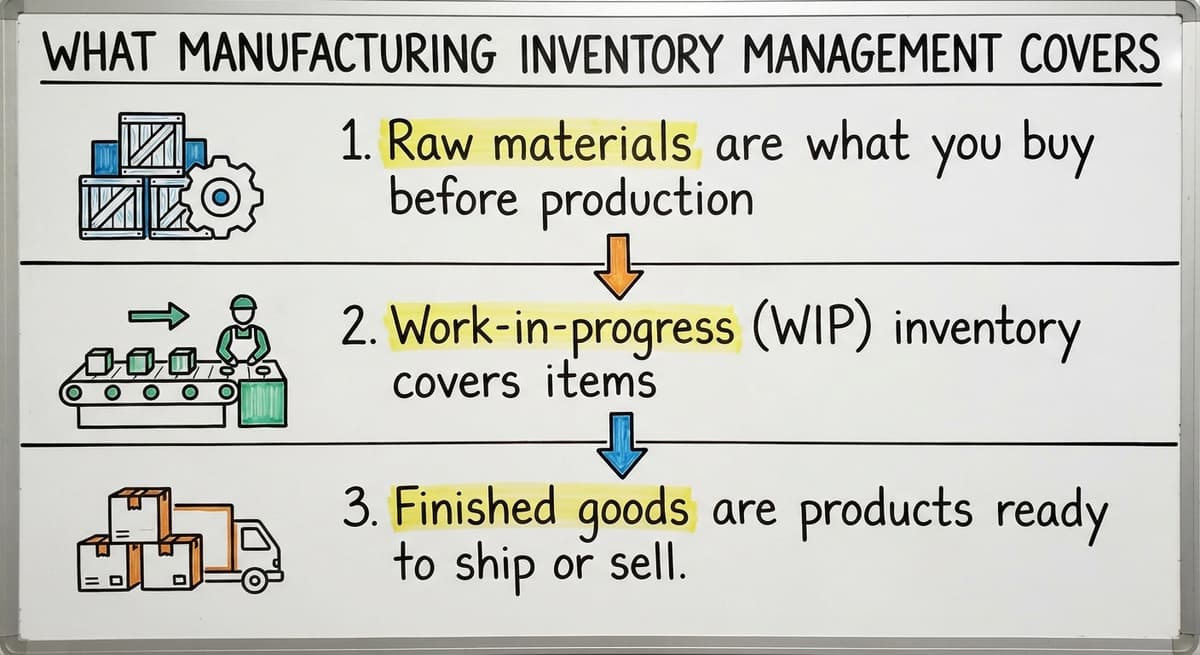
Every manufacturing operation carries 3 distinct inventory types, and each behaves differently.
- Raw materials are what you buy before production starts. A cabinet shop tracks lumber, hardware, and finishing supplies here. Running short stops everything downstream.
- Work-in-progress (WIP) inventory covers items currently being built or assembled. WIP is easy to overlook because it is moving, but it ties up real money and labor.
- Finished goods are products ready to ship or sell. Overstocking here means cash sitting in a warehouse instead of your account.
Tracking each type separately lets you spot the problem at the right stage rather than chasing it after the fact.
As GS1 notes in its barcode standards records, "barcodes are the most widely used automatic spotting technology in the world," and scan-based receiving is one of the simplest ways to keep raw material counts accurate from the moment stock arrives.
Would you rather have it built around your operation?
The first look is free. If you would rather not compare products, describe how your operation already works and we build the system around it.
No build cost. You see it running on your own process first, and the monthly subscription starts only once it is live.
Book a callWhy Does Poor Inventory Tracking Hurt Production?
Poor inventory tracking hurts production because errors compound: one wrong count leads to a missed order, which leads to a stopped line, which leads to a late shipment.
The US Federal Trade Commission's Mail and Telephone Order Rule needs businesses to ship when they say they will. An inaccurate count makes that promise hard to keep.
For a small shop, the costs are direct and personal.
- A stockout stops the production line and delays customer orders, with no warning.
- Overstock ties up cash that could cover payroll or equipment.
- Manual errors in spreadsheets grow over time. One wrong entry in January can distort purchasing decisions through Q3.
- Managers spend hours reconciling numbers instead of running the floor.
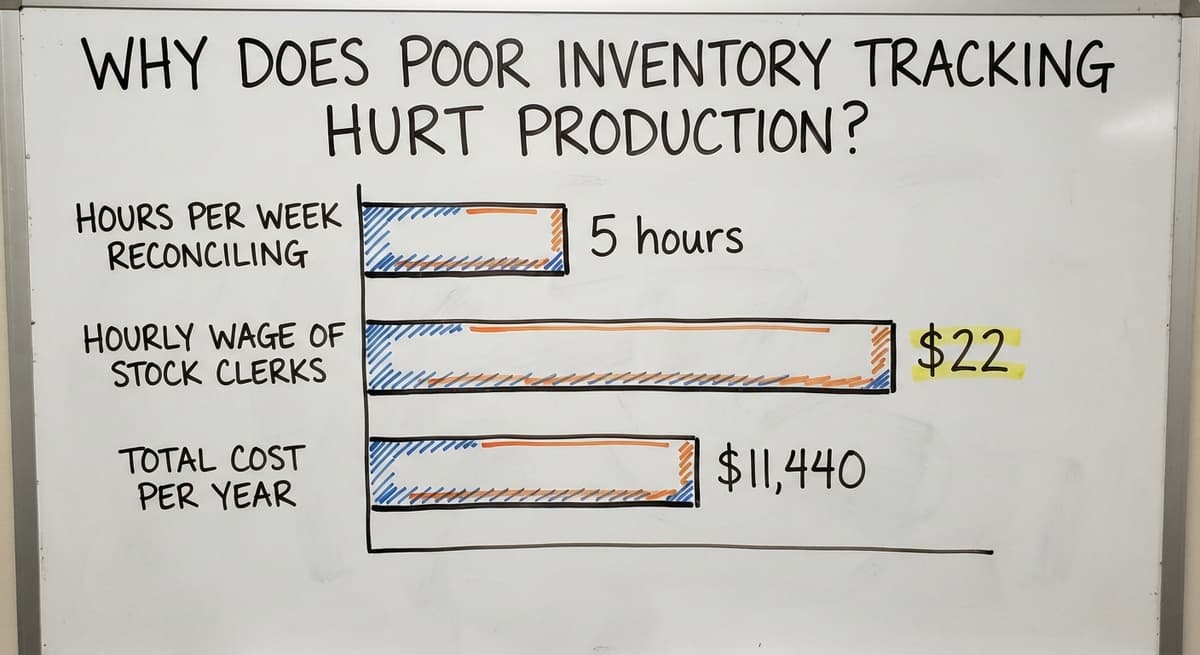
Consider the time cost alone. If 2 people each spend 5 hours a week reconciling inventory data at $22 an hour (near the median for stock clerks per the Bureau of Labor Statistics), that is $11,440 a year spent on a problem a better system would largely remove.
How Do Spreadsheets and the Accounting Software Fall Short for Manufacturing?
The accounting software handles accounting well. It was built for that job, and it does it.
The gap is not a flaw in the software. It is a workflow problem: the accounting software was not designed to track real-time inventory on a shop floor where stock moves every hour.
Spreadsheets have the same issue at scale. When 3 people update the same file, version control breaks down fast. Decisions get made on last Tuesday's numbers because no one is sure which copy is current.
Replacing spreadsheet with a custom workflow system is not about abandoning a familiar tool. It is about giving that tool a job it can actually do.
The real cost is stale data. A purchasing manager who orders based on a spreadsheet that is 2 days old may order too much, too little, or the wrong thing entirely. That is not a technology failure. It is a process that has outgrown its container.
The NIST Manufacturing Extension Partnership offers free, vendor-neutral guidance for small manufacturers on exactly this kind of process gap, and it is worth a look before you buy anything.
Core Metrics and Inventory Strategies Every Shop Should Know
Before choosing a system, know what you are trying to measure. These metrics tell you whether your inventory process is working.
| Metric | What It Tells You |
|---|---|
| Inventory turnover ratio | How often stock is used and replenished in a period |
| Days inventory outstanding | How long stock sits before it is used or sold |
| Carrying cost | The real cost of holding inventory: space, insurance, tied-up cash |
| Order accuracy rate | How often the right materials arrive on time and in full |
Just-in-Time vs Safety Stock
Two main approaches shape how manufacturers order materials. Just-in-time inventory means ordering only when needed, which cuts holding costs but leaves no buffer if a supplier is late. Safety stock means keeping a reserve on hand, which protects the line but costs money to hold.
Neither works without accurate data. A small manufacturer with variable supplier lead times needs a hybrid: just-in-time for reliable, fast-moving materials and a safety stock buffer for anything with a long or unpredictable lead time.
Is the comparison easier when one option is built for you?
Yes. Off-the-shelf means fitting your process to the software, and custom is the other way round. The first look costs nothing.
Book a callSetting a Reorder Point
A reorder point is the stock level that triggers a new buy order before you run out. The basic formula is: lead time demand plus safety stock.
If a part takes 5 days to arrive and you use 10 units a day, your lead time demand is 50 units. Add your safety stock on top of that.
Reorder points remove guesswork from purchasing. They only work, though, if the current stock count is accurate. A reorder point built on bad data is just a faster way to order the wrong thing.

What Is Lot Tracking and Does a Small Manufacturer Need It?
Lot tracking links a specific batch of raw materials to the finished goods made from it, so you can trace any product back to its source if something goes wrong.
Even a 15-person shop benefits from this. If a supplier batch is defective, lot tracking tells you exactly which finished units are affected and which customers received them.
Manual lot tracking in spreadsheets is slow and error-prone. A simple digital system assigns a lot number at receiving, carries it through production, and records it against each finished unit. That is the whole idea. It does not need a full ERP to work.
The NIST MEP supply chain guidance covers traceability practices for small manufacturers and is a useful starting point for shops that need to meet customer or regulatory requirements.
Bill of Materials, Cycle Counting, and ABC Analysis
Three tools work together to keep a small shop's inventory under control without a large team to manage it.
Bill of Materials and Inventory Planning
A bill of materials (BOM) lists every component needed to make one unit of a product. When the BOM connects to your inventory system, the system can calculate what to order before production starts. That removes the last-minute scramble for missing parts that costs a half-day of production.
At a small scale, even a simple linked spreadsheet BOM beats a paper list, but a purpose-built system makes the connection automatic.
Cycle Counting vs Full Physical Inventory
A full physical count shuts operations down, once or twice a year. Cycle counting checks a small portion of inventory on a rolling schedule, a few SKUs each week, without stopping the line.
Errors surface faster, and the disruption is minimal. For most small manufacturers, cycle counting is the better fit: it keeps counts current without the annual chaos of a full shutdown.
ABC Analysis
ABC analysis sorts every SKU into 3 groups by value and usage rate. A items are high-value and need tight, frequent review. B items get standard oversight. C items are low-value and need only minimal tracking effort. This focus matters when your team is small.
Counting every item with the same intensity is a waste of time. Counting A items carefully and C items loosely is how a lean team stays accurate where it matters most.

Common Inventory Mistakes in Manufacturing Operations
Small shops tend to make the same handful of mistakes. Recognizing them early is cheaper than fixing them after a missed order.
- Relying on one person's memory for high-value items creates a single point of failure that shows up the moment that person is out sick.
- Not recording returns, scraps, or damaged goods means the count drifts from reality a little more each week.
- Treating every SKU the same regardless of value wastes attention on C items while A items go unmonitored.
- Waiting for a crisis, a missed shipment, an angry customer, before reviewing the process means the fix always costs more than it should have.
These are not failures of discipline. They are signs that the process has outgrown the tools holding it together.
What does it look like running on your own process?
The first thing you see is it running on your own process, at no build cost. The subscription starts once it is live and doing the job, not before.
Book a callIs a Custom Inventory System Right for Your Shop?
A custom inventory system makes sense when the current process is visibly breaking down: orders get missed, staff build workarounds, and matching takes more time than the work it is meant to support.
Off-the-shelf software solves a generic problem, not your specific one, and forces you to change how you work to match the software.
A custom system is built around the workflow already in place. It uses the language your team uses. It connects to the accounting software for accounting without duplicating data entry, so the accounting software does not have to be replaced, only supplemented where it falls short.
A accounting integration for operations can handle the financial side while a purpose-built inventory layer handles the shop floor.
Rollout does not have to be a year-long project. A focused build that replaces printed sheets and email threads, without touching the entire operation, can be up and running in weeks. That is a very different scope from a full ERP rollout, and it is the right scope for most 10-to-80-person shops.
The NIST MEP recommends that small manufacturers map their current process before evaluating any software. That step alone reveals where the real problem is.
Questions to Ask Before Choosing Inventory Software
Before committing to any solution, get clear answers to these questions.
- Does it connect to the accounting software, or does it need replacing it entirely?
- Can it handle lot tracking and BOMs at our scale without custom development on top?
- How long does rollout take, and who does the actual work?
- Will the team use it, or will they find a workaround within a month?
- Is there ongoing support from the people who built it, not just a ticket queue?

How Do You Start Improving Your Inventory Process?
The right first step is not buying software. It is mapping what you do now and finding where errors happen most often. Talk to the people doing the work, not just the managers. The person pulling pick sheets knows exactly where the process breaks.
Identify 2 or 3 specific pain points before you look at any tool.
Set a baseline metric, inventory turnover, order accuracy, hours spent reconciling, so you can measure whether anything actually improved. That baseline also tells you what a good outcome looks like before you spend a dollar.
Warehouse management for small operations does not have to start big. A focused fix on the highest-pain area, lot tracking, reorder points, BOM links, beats a wide rollout that the team never fully adopts.
Frequently Asked Questions About Manufacturing Inventory Management
How do you manage inventory in manufacturing? Track raw materials, work-in-progress, and finished goods separately. Set reorder points so purchasing is automatic rather than reactive.
Use cycle counting to keep counts current. Connect your bill of materials to your stock levels so you know what to order before production starts, not after it stalls.
What is EOQ and ROP? EOQ stands for economic order quantity, the order size that balances ordering costs against holding costs.
ROP is reorder point, the stock level that triggers a new order. Both are formulas, not software features. They work best when your current stock counts are accurate, because a formula built on bad data produces a bad answer.
What are the four types of inventory management? The 4 common methods are FIFO (first in, first out), LIFO (last in, first out), average cost, and specific spotting.
For most small manufacturers, FIFO matches physical reality best: the oldest materials get used first, which matters for perishables and for lot tracking. The IRS needs a consistent method once chosen. See IRS Publication 538 for the rules.
What are the 5 stages of the inventory management process? The 5 stages are: purchasing (buying raw materials), receiving (checking and recording what arrives), storage (putting stock in the right place), production (moving materials through WIP), and fulfillment (shipping finished goods).
Errors at any stage carry forward. Most small shops lose accuracy at receiving, because that is where manual entry is fastest and least checked.
Can a small manufacturer keep the accounting software and still improve inventory management? Yes. The accounting software handles accounting well. The gap is on the shop floor, where real-time stock movement happens.
A purpose-built inventory layer that connects to the accounting software gives you both: accurate financials and accurate counts, without re-entering data twice.
What is the difference between inventory management and warehouse management? Inventory management tracks what you have and when to reorder it. Warehouse management covers where things are stored and how they move through a physical space.
For small manufacturers, the two overlap heavily, but they are separate problems. A shop with one storage area mostly needs inventory management. A shop with multiple locations or complex pick paths may need both.

Next Steps for Your Manufacturing Operation
Good manufacturing inventory management starts with knowing what you have, at every stage, without relying on memory or a spreadsheet that three people updated last week.
The tools to do that do not have to be expensive or disruptive. They do have to fit how your team actually works.
If your current process is outgrown rather than broken, the fix is narrower than you think.
A system built around your workflow, connected to the accounting software, and focused on your 2 or 3 biggest pain points will do more than a full ERP rollout that takes a year to configure.
The Software Society works with operations like yours, including shops in and around Columbus, Ohio, to build focused inventory and workflow systems that connect to the tools already in place.
If you want to talk through what your operation actually needs, reach out. No pitch, just a practical conversation about where things are breaking and what a fix would look like.
Frequently asked questions
How do you manage inventory in manufacturing?
Track raw materials, work-in-progress, and finished goods separately. Set reorder points so purchasing is automatic rather than reactive. Use cycle counting to keep counts current without shutting down operations.
Connect your bill of materials to stock levels so you know what to order before production stalls, not after.
What is EOQ and ROP?
EOQ is economic order quantity, the order size that balances ordering costs against holding costs.
ROP is reorder point, the stock level that triggers a new buy order. Both are formulas, not software features. They only produce useful answers when the stock counts feeding them are accurate.
What are the four types of inventory management?
The 4 common methods are FIFO (first in, first out), LIFO (last in, first out), average cost, and specific spotting.
For most small manufacturers, FIFO matches physical reality best. The IRS needs a consistent method once chosen. See IRS Publication 538 for the rules on valuation.
What are the 5 stages of the inventory management process?
The 5 stages are purchasing, receiving, storage, production, and fulfillment. Errors at any stage carry forward into the next. Most small shops lose accuracy at receiving, where manual entry happens fastest and with the least check.
Can a small manufacturer keep the accounting software and still improve inventory management?
Yes. The accounting software handles accounting well. The gap is on the shop floor where real-time stock movement happens. A purpose-built inventory layer connected to the accounting software gives you accurate financials and accurate counts without entering data twice.
What is the difference between inventory management and warehouse management?
Inventory management tracks what you have and when to reorder. Warehouse management covers where things are stored and how they move through a physical space.
For small manufacturers the two overlap, but a shop with one storage area mostly needs inventory management. Multiple locations or complex pick paths may need both.
What is the best inventory method for manufacturing: FIFO, LIFO, or average cost?
There is no single best answer. FIFO works well when older materials must be used first, which covers most manufacturers. Average cost suits operations with stable pricing and high volume.
LIFO is less common and restricted under international accounting rules. The right choice depends on your product, your suppliers, and your tax situation.
How can manufacturers reduce excess and obsolete inventory?
Set a reorder point per component from real consumption instead of a guess, review anything with no movement in 90 days, and buy to the production schedule rather than to a supplier's price break.
Most of the excess sits in components bought in bulk for a product that changed.
How do you calculate safety stock for raw materials?
Maximum daily usage multiplied by maximum lead time, minus average daily usage multiplied by average lead time.
A component used 20 to 30 a day on a 10 to 14 day lead time needs 30 × 14 minus 25 × 12, or 120 units of safety stock.
What are the best inventory KPIs for a manufacturing company?
Inventory accuracy from cycle counts, raw material turnover, work-in-progress days, scrap rate per work order, and stockouts that stopped a line. Five numbers, reviewed weekly, show whether stock is helping production or hiding in it.
What are the best inventory management methods for a small manufacturer?
ABC classification to count the 20 percent of components that carry 80 percent of the value, reorder points on those A items, weekly cycle counts instead of an annual shutdown, and issue-by-scan to work orders so the count moves when the material does.
What is in a free first look?
A 30 minute call, your operation mapped, and a clear picture of what we would build. No obligation and nothing to install.
Book a callRelated guides
The rest of this guide, for the parts of the job this page does not cover.
Guides
- Manufacturing Inventory Management Software
- Manufacturing Inventory Software
- Inventory Management System for Manufacturing
- Manufacturing Serial Number
- Warehouse Inventory Management Software
- Warehouse Inventory Management Systems
- Quickbooks Inventory Management Software
- Inventory and Warehouse Management Software
- Custom Inventory Management Software
- Warehouse Inventory Management System
- Retail Inventory Management
- Multi Location Inventory Management Software
- Inventory Management for Multiple Locations
- Cost of Inventory Management Software
- Retail Inventory Management Systems
- Inventory Management Software Freeware
Common questions
- Why is Warehousing and Inventory Management Important
- What is the Difference Between Aggregate and Item Inventory Management
- How to Manage Inventory in a Warehouse
- What is the Best Warehouse Inventory Management System?
- What is the Difference Between Warehousing and Inventory Management
- What is B Type of Inventory in Warehouse Management
- What is Warehousing and Inventory Management
- What is Jit Inventory Management