

What Is The Difference Between Warehousing And Inventory Management
Warehousing is the physical act of storing, receiving, and shipping goods. Inventory management is the system of knowing what you have, where it is, and when to reorder. One is a place and a set of tasks.
Published 30 July 2026. Reviewed and updated 15 September 2026.
The other is a layer of knowledge that sits on top of those tasks. You can run a warehouse without good inventory management. Most operations do. That is where the problems start.
Book a callWhat Is the Difference Between Warehousing and Inventory Management?
The short version: warehousing is about physical flow. Inventory management is about information flow. Both matter. They are not the same thing.
A warehouse without inventory management is a room full of stuff you cannot fully account for. Inventory management without a warehouse is just a spreadsheet with no floor to back it up. You need both, and you need them to talk to each other.
Most small wholesale distributors and fulfillment centers have the warehouse part down. They have racks, staff, and a receiving dock. What they lack is a clean, real-time picture of what is actually on those racks at any given moment.
Would you rather have it built around your operation?
The first look is free. If you would rather not compare products, describe how your operation already works and we build the system around it.
No build cost. You see it running on your own process first, and the monthly subscription starts only once it is live.
Book a callWhat Does Warehousing Cover?
Warehousing is the physical side of your operation. It includes everything that happens to a product from the moment it arrives at your dock to the moment it leaves on a truck.
Put numbers on the errors and it gets clearer. 200 orders a day at a 2 percent mispick rate is 4 wrong shipments a day and roughly 1,000 orders a year going out wrong.
Cutting that to 0.5 percent leaves 250 orders a year, which is 750 fewer apologies.
The Physical Tasks Inside a Warehouse
The physical tasks inside a warehouse are 6: receiving, put-away, storage, picking, packing, and shipping. It also covers the layout of your building, the racks and bins you use, the equipment your team operates, and the people doing the work.
Here is a simple example. A wholesale distributor gets a pallet of 200 units from a supplier.
Someone on the dock counts the boxes, checks them against the purchase order, and moves them to a specific bin location in the rack. That whole sequence is a warehousing task. It is physical. It is about movement and space.
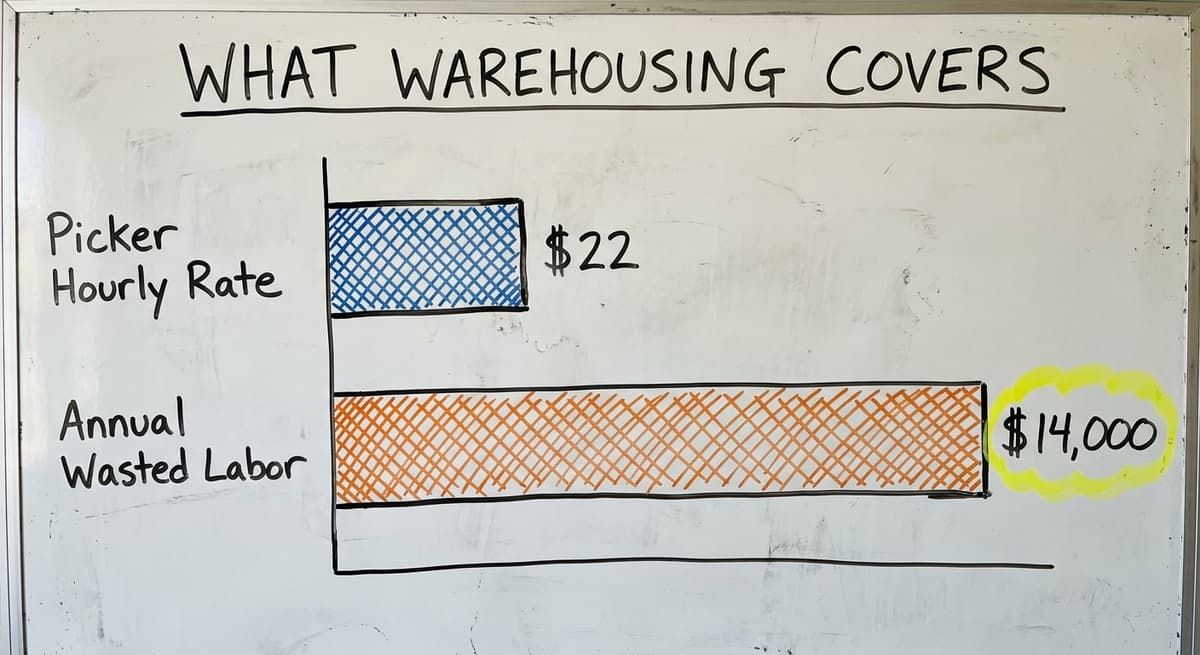
Warehousing decisions affect three things directly: speed, accuracy, and labor cost. A poor layout means your team walks farther for every pick. That adds up fast. 3 pickers walking an extra 20 minutes per shift at $22 an hour adds roughly $14,000 a year in wasted labor, and that is before you count pick errors.
How Do Barcodes and Standards Connect to Warehousing?
Accurate warehousing depends on being able to identify products quickly and correctly. That is where barcode standards come in.
The global body that sets barcode rules states that "barcodes are the foundation of supply chain efficiency," as noted on their barcode standards page. Every scan at your receiving dock or pick station relies on those standards working correctly.
Reviewed August 2026. Each figure comes from the assumptions stated beside it, so you can substitute your own and the arithmetic still holds.
When a product is not labeled clearly, or when your team is reading labels by eye instead of scanning them, errors creep in. A wrong count at receiving becomes a wrong count in your records. That gap compounds over time.

What Does Inventory Management Cover?
Inventory management is about knowledge, not physical space. It answers the questions your warehouse floor cannot answer on its own.
The Questions Inventory Management Answers
Inventory management is the answer to 4 questions:
- How many units do you have on hand right now?
- How many are committed to open orders?
- What is moving fast and what is sitting?
- What needs to be reordered today?
- Where exactly is a specific product in your facility?
Inventory management lives in your systems. For many small distributors, that means a mix of small business accounting software for the financials, spreadsheet files for stock counts, and printed pick lists for the floor.
Each tool does part of the job. None of them talk to each other in real time.
What Happens When Inventory Management Breaks Down?
Poor inventory management shows up in 5 specific, painful ways:
- Stockouts on items you thought you had
- Overstock on slow-moving product that ties up cash
- Lost product that was received but never logged correctly
- Wrong counts that take hours to reconcile at month-end
The IRS is clear on why this matters beyond operations. IRS Publication 538 states: "To figure taxable income, you must value your inventory at the beginning and end of each tax year." That is not optional. It means your inventory records are a legal document, not just an operational tool.
The US Census Bureau's Monthly Wholesale Trade data tracks inventory-to-sales ratios across wholesale firms. When that ratio drifts, it is a sign that inventory records are not keeping pace with what is actually moving.
Most small operations do not track this number at all, which means they are managing blind.
The comparison is easier when one option is built for you
Off-the-shelf software means fitting your process to it. We do it the other way round, and the first look costs nothing.
Book a call
Where Do Warehousing and Inventory Management Overlap?
Warehousing and inventory management are closely connected. What happens physically in your warehouse should show up in your inventory records within minutes. In most small operations, it does not.
The Gap Between the Floor and the System
The gap between your warehouse floor and your inventory system is where things break down. A product arrives at your dock. Your team puts it away in bin location C-14.
But the receiving entry in your bookkeeping software gets done at the end of the day, or the next morning, or when someone remembers.
In the meantime, your records say you have fewer units than you actually do. A sales rep quotes a customer based on the old number.
An order goes out for product that is not there. Or product sits because no one knew it had arrived.
An order picked and shipped but not updated in the system right away creates billing errors and fulfillment gaps.
The US Federal Trade Commission's guide on mail and internet order merchandise is clear that sellers must ship when they say they will. Accurate, real-time inventory is what makes that possible.
Why Does the Gap Cost More Than You Think?
Good warehouse inventory management software bridges the physical and the digital. What happens on the floor gets captured in real time, not hours later. This is where most small and mid-size operations have the biggest gap, and it is also where the fix delivers the clearest return.
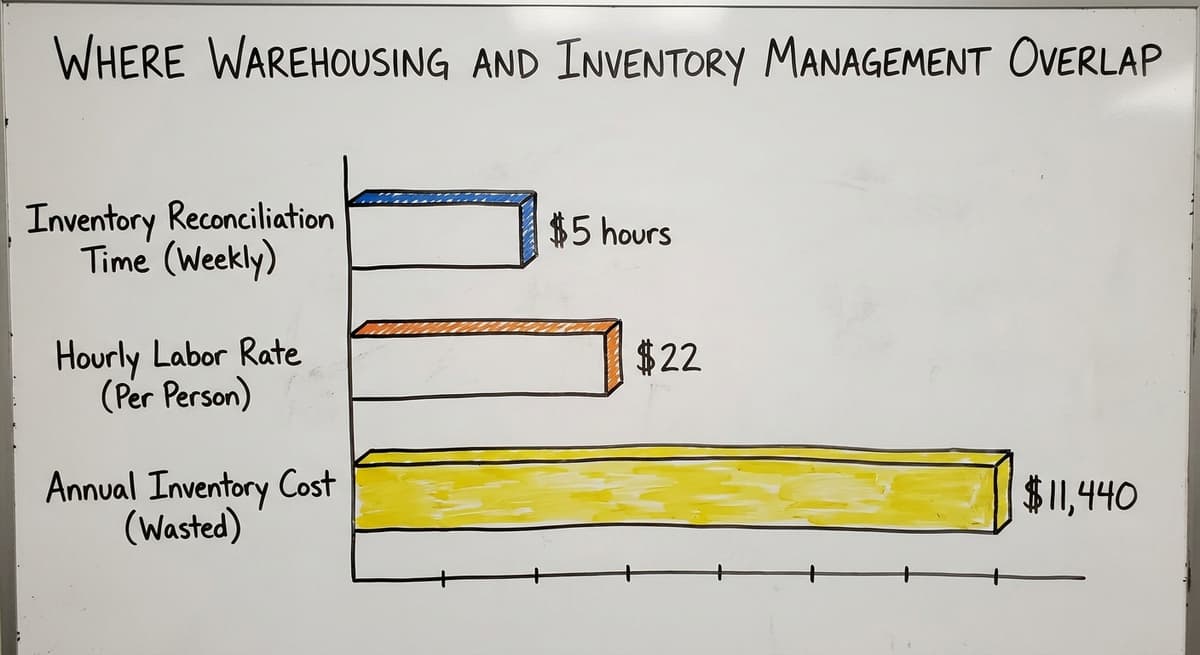
If 2 people spend 5 hours a week reconciling inventory counts at $22 an hour, that is $11,440 a year spent on a problem that a connected system solves automatically.
The math is not complicated. The decision to fix it is, because it means changing how the floor works.

Why Does the Difference Matter for Your Operation?
If you are running a wholesale distribution business or a fulfillment center with 5 to 100 staff, you are probably dealing with both warehousing and inventory management problems at once. But they need different fixes.
Fixing a Warehousing Problem vs. Fixing an Inventory Problem
A warehousing problem shows up as slow picks, mis-ships, or a dock that backs up every afternoon. The fix is about layout, process, or training.
You might reorganize your bin locations so fast-moving items are closer to the pack station. You might add a step to your receiving process. These are physical changes.
An inventory management problem shows up as bad counts, stockouts, or hours spent reconciling numbers that should match but do not. The fix is about data capture and reporting. You need your system to know what the floor knows, in real time.
Most operations have both problems. They show up differently, and the fix is different too. Trying to solve an inventory problem by rearranging your warehouse will not work. Trying to solve a warehousing problem by buying new software will not work either.
What Can Your Accounting Software Do and Not Do?
Your accounting software handles your financials well. It was built for that, not to manage bin locations, pick queues, or real-time stock counts. It does not know that a product sits in bin C-14, update when your team scans a barcode at the pick station, or alert you when stock drops below a reorder point during the day.
Replacing your accounting system is not the answer. Most operations have years of data and accounting workflows built around it. The answer is connecting your accounting system to something built for the warehouse floor.
The NIST Manufacturing Extension Partnership offers vendor-neutral guidance on exactly this kind of supply chain process improvement: layering the right tools onto existing operations rather than replacing everything at once.
If you are wondering whether your operation has outgrown spreadsheets and manual processes, the signs are obvious: you spend more time fixing records than running the floor.

What Does Good Warehouse Inventory Management Software Do?
Good warehouse inventory management software does not replace what you already have. It connects the physical warehouse operation to your inventory records so the two stay in sync.
Real-Time Capture on the Floor
Good warehouse inventory management software is software that captures receiving, picking, packing, and shipping as they happen. When your team scans a barcode at the dock, the system updates.
When a picker pulls from bin C-14, the system updates. You do not wait until end of day to know where you stand.
This matters for order fulfillment. It matters for customer promises. And as the FTC's order merchandise rule makes clear, it matters for your legal obligation to ship when you say you will.
Real-time inventory is not a luxury for operations your size. It is the foundation of a reliable fulfillment process.
The Bureau of Labor Statistics tracks wages for stock clerks and order fillers. When you know what your team costs per hour, you can calculate exactly what manual reconciliation is costing you.
Most owners have never done that math. Once they do, the case for better software is easy to make.
What does it look like running on your own process?
The first thing you see is it running on your own process, at no build cost. The subscription starts once it is live and doing the job, not before.
Book a callWorks Alongside Your Accounting Software, Not Instead of It
The best systems for small distributors and warehouses are built to work alongside your accounting platform rather than replacing it. Your accounting stays where it is.
Your financial history stays intact. The warehouse layer handles bin locations, pick queues, and real-time stock counts, then passes clean data back to your accounting platform for the financial side.
This is also where custom-built software has a real advantage. A system shaped around how your operation already works fits better than an enterprise platform that asks you to change everything to match its defaults.
Choosing warehouse management software for small distributors comes down to this: does it connect to what you already use, and does it work the way your floor actually works?
For a look at how this kind of layered approach works in practice, the warehouse inventory management software overview on this site covers the key features worth checking before you buy.
Frequently Asked Questions
Is warehousing the same as logistics?
No. Logistics is broader. It covers transportation, supply chain planning, and the movement of goods between locations. Warehousing is one part of logistics. It is the storage and handling piece.
You can have excellent warehousing and still have logistics problems if your transport or supplier side is broken.
Can your accounting software handle inventory management for a warehouse on its own?
For basic inventory, yes. Your accounting software can track quantities and values. It cannot track bin locations, manage pick queues, or update stock counts the instant your team works the floor.
For a small operation with simple needs, it may be enough. For a wholesale distributor or fulfillment center with daily order volume, it leaves too many gaps.
What are the 7 types of warehouses?
The 7 common types are: private warehouses (owned by the business), public warehouses (rented space), bonded warehouses (for goods under customs control), climate-controlled warehouses, distribution centers, fulfillment centers, and smart warehouses that use automation.
Most small wholesale distributors operate private or leased distribution space. The type that fits your operation depends on your product, your volume, and how much control you need over the space.
What are the four types of inventory management?
The 4 main types are: just-in-time (JIT), which keeps stock lean and orders only when needed; FIFO (first in, first out), which moves older stock first; LIFO (last in, first out), which is used in specific accounting contexts; and ABC analysis, which ranks inventory by value and movement speed so you focus effort where it matters most.
Most small distributors use a mix of FIFO and ABC without naming them as such.
Is warehouse inventory hard?
Warehouse inventory is not complicated in theory. In practice, it gets hard when your systems do not match your physical reality. Manual counts drift. Spreadsheets fall out of sync.
Your ledger software does not know what the floor knows. The work itself is straightforward. Keeping the records accurate without a connected system is where most operations struggle.
What are the 5 KPIs for a warehouse?
The 5 most useful warehouse KPIs are: order accuracy rate (how often you ship the right thing), inventory accuracy (how closely your records match physical counts), pick rate (units or orders picked per hour), on-time shipment rate, and carrying cost of inventory (what it costs to hold your current stock).
Not tracking at least 3 of these means managing by feel rather than by fact.
What is the first sign that my inventory management is broken?
The clearest early sign that your inventory management is broken is time. If your team spends hours each week reconciling counts that should already match, something is broken.
Frequent stockouts on items you thought you had, or overstock building up on items that stopped moving, are the next signs. Wrong picks and customer complaints about missing items follow close behind.
Do I need separate software for warehousing and inventory management?
Separate software for warehousing and inventory management is not necessarily required. The right system connects both. You want one platform that handles the physical warehouse tasks, like receiving and picking, while keeping your inventory records continuously current.
The way custom warehouse software works alongside your financial software is the model most small distributors land on: keep the accounting in place and add a layer that handles the floor.
Running a warehouse or distribution operation where your inventory records never quite match your physical count points to the gap between warehousing and inventory management.
Fixing it is not about a bigger spreadsheet or a new accounting system. It takes a connected layer that captures what happens on your floor and keeps your records honest without delay. That is what good warehouse inventory management software does, and this is the sort of system The Software Society builds to fit how your operation already works.
Frequently asked questions
Frequently asked questions
Is warehousing the same as logistics?
No. Logistics is broader. It covers transportation, supply chain planning, and the movement of goods between locations. Warehousing is one part of logistics. It handles storage and handling only.
You can have excellent warehousing and still have logistics problems if your transport or supplier side is broken.
Can your accounting software handle inventory management for a warehouse on its own?
For basic inventory, yes. Your bookkeeping system can track quantities and values. It cannot track bin locations, manage pick queues, or update stock counts as work happens on the floor.
For a small operation with simple needs, it may be enough. For a wholesale distributor or fulfillment center with daily order volume, it leaves too many gaps.
What are the 7 types of warehouses?
The 7 common types are: private warehouses (owned by the business), public warehouses (rented space), bonded warehouses (for goods under customs control), climate-controlled warehouses, distribution centers, fulfillment centers, and smart warehouses that use automation.
Most small wholesale distributors operate private or leased distribution space. The type that fits your operation depends on your product, your volume, and how much control you need over the space.
What are the four types of inventory management?
The 4 main types are: just-in-time (JIT), which keeps stock lean and orders only when needed; FIFO (first in, first out), which moves older stock first; LIFO (last in, first out), which is used in specific accounting contexts; and ABC analysis, which ranks inventory by value and movement speed so you focus effort where it matters most.
Most small distributors use a mix of FIFO and ABC without naming them as such.
Is warehouse inventory hard?
It is not complicated in theory. In practice, it gets hard when your systems do not match your physical reality. Manual counts drift. Spreadsheets fall out of sync.
Your ledger software does not know what the floor knows. The work itself is straightforward. Keeping the records accurate without a connected system is where most operations struggle.
What are the 5 KPIs for a warehouse?
The 5 most useful warehouse KPIs are: order accuracy rate (how often you ship the right thing), inventory accuracy (how closely your records match physical counts), pick rate (units or orders picked per hour), on-time shipment rate, and carrying cost of inventory (what it costs to hold your current stock).
Not tracking at least 3 of these means managing by feel rather than by fact.
What is the first sign that my inventory management is broken?
The clearest early sign is time. If your team spends hours each week reconciling counts that should already match, something is broken.
Frequent stockouts on items you thought you had, or overstock building up on items that stopped moving, are the next signs. Wrong picks and customer complaints about missing items follow close behind.
Do I need separate software for warehousing and inventory management?
Not necessarily. The right system connects both. You want one platform that handles the physical warehouse tasks, like receiving and picking, while keeping your inventory records current as things change.
The model most small distributors land on is keeping accounting in your financial platform and adding a layer that handles the floor.
What is the difference between inventory management and warehouse management?
The difference is that warehousing is the physical act of storing, receiving, and shipping goods, while inventory management is the system of knowing what you have, tracking its location, and knowing when to reorder. Warehousing is about physical flow and space.
Inventory management is about information flow and knowledge. Both are needed, and they must work together, since a warehouse without inventory management is just stuff you cannot account for, and inventory management without a warehouse is only records with nothing backing them up.
What are the main functions of inventory management?
The main functions of inventory management are tracking how many units are on hand, how many are committed to open orders, what is moving fast versus sitting still, what needs to be reordered, and where a specific product sits within the facility. It turns physical stock into usable knowledge so decisions about ordering, selling, and reporting can be made accurately, rather than guessed at from incomplete or outdated records.
What are the main functions of a warehouse?
A warehouse's main functions are receiving, put away, storage, picking, packing, and shipping. It also covers the layout of the building, the racks and bins used, the equipment operated, and the people doing the physical work. These are the tasks that move a product from arrival at the dock to departure on a truck, and they directly affect speed, accuracy, and labor cost.
What is a warehouse management system?
A warehouse management system is the software layer that connects what happens physically on the warehouse floor to the inventory records kept in a business's systems. It captures receiving, put away, picking, and shipping activity as it happens instead of hours later, closing the gap between the physical stock on hand and what the records show, so orders, billing, and reordering decisions are based on accurate, current information.
What is in a free first look?
A 30 minute call, your operation mapped, and a clear picture of what we would build. No obligation and nothing to install.
Book a callRelated guides
The rest of this guide, for the parts of the job this page does not cover.
Guides
- Warehouse Inventory Management Software
- Warehouse Inventory Management Systems
- Inventory and Warehouse Management Software
- Warehouse Inventory Management System
Common questions
- What is the Difference Between Aggregate and Item Inventory Management
- What is the Best Warehouse Inventory Management System?
- What is B Type of Inventory in Warehouse Management
- What is Warehousing and Inventory Management
- What Are the Benefits of Warehouse Management System
- What is the Point of Warehouse Management System
- What Are the Top 5 Warehouse Management Systems?
- What is Asn in Warehouse Management System
- What is a Warehouse Management System
- What is a Warehouse Management System Used For
- What is the Most Popular Warehouse Management System?
- What is the Purpose of a Warehouse Management System
- What is a Warehouse Management System Pdf
- What is a Simple Warehouse Management System?
- What is a Warehouse Management System Example
- What Warehouse Management System Does Amazon Use
- Why is Warehousing and Inventory Management Important
- How to Manage Inventory in a Warehouse
- How to Manage Inventory Between Etsy and Shopify
- What is the Most Important Part of Warehouse Organization