

What Is B Type Of Inventory In Warehouse Management
B type inventory in warehouse management is the middle tier of ABC classification: items that matter, but not enough to watch daily. Running a warehouse means constant decisions about where to focus attention, and ABC classification gives a simple framework for them. This guide, reviewed in September 2026, explains what B type inventory is, how it compares to A and C, and how to manage it.
Published 29 July 2026. Reviewed and updated 15 September 2026.
Book a callThe Basics of ABC Inventory Classification in Warehouse Management
ABC classification is a sort of every item in your warehouse into one of 3 groups based on value and how often it moves. The idea comes from the Pareto principle: a small number of items drive most of your revenue or warehouse activity.
- A items are your top performers. High value, fast-moving, or both.
- B items sit in the middle. Moderate value, moderate movement.
- C items are low value or slow-moving. They take up space but do not drive much revenue.
This method works in warehouses of all sizes, from a small regional distributor to a large fulfillment center. You do not need expensive software to start. You need sales data and a willingness to rank your SKUs honestly.
The classification gives your team a shared language. Everyone knows that an A item needs daily attention and a C item can wait. B items are where the confusion starts.
Would you rather have it built around your operation?
The first look is free. If you would rather not compare products, describe how your operation already works and we build the system around it.
No build cost. You see it running on your own process first, and the monthly subscription starts only once it is live.
Book a callWhat Is B Type Inventory?
Defining B Type Inventory
B type inventory sits between A and C. These are products with moderate sales frequency and moderate value. They are not your best sellers, but they are not collecting dust either.
The obligation behind all of this is not optional. IRS Publication 538 states: “To figure taxable income, you must value your inventory at the beginning and end of each tax year.” A stock figure nobody trusts makes that number a guess.
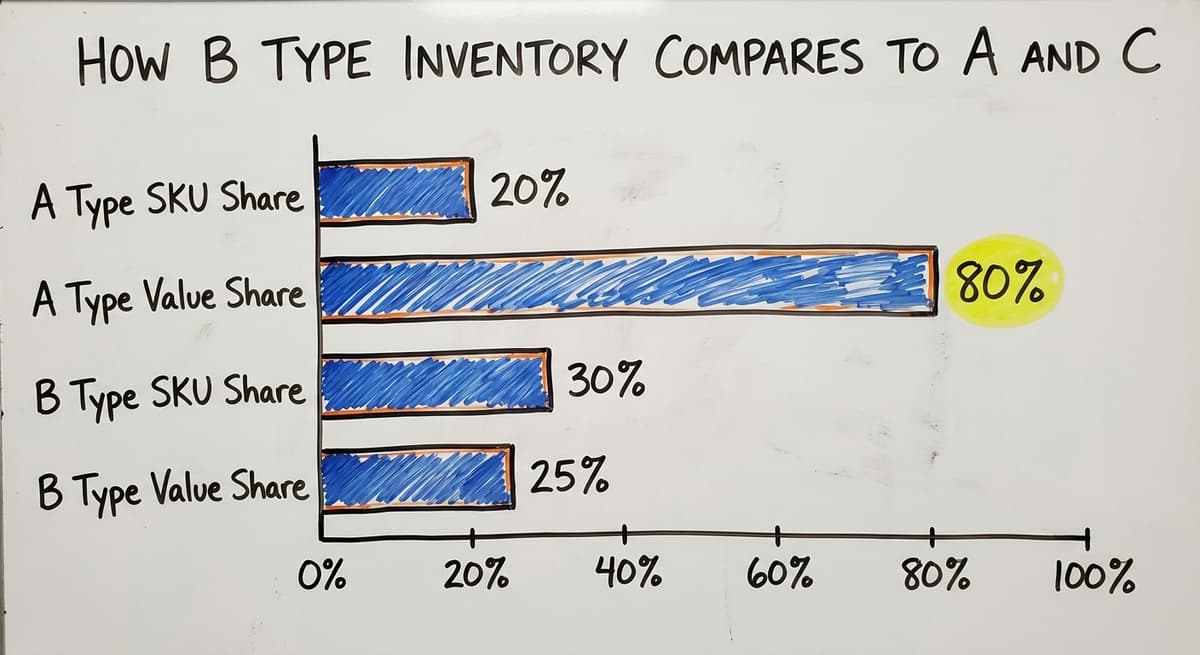
B items make up around 30 percent of your total SKUs and account for roughly 15 to 25 percent of total inventory value. That is a meaningful chunk of your stock.
Examples include:
- Mid-range products that sell a few times a week but not every day
- Seasonal staples that move steadily during certain periods
- Secondary product lines that support your core offerings
B items need consistent attention. Urgency for them is lower than for A items, but ignoring them causes real problems over time.
Why Are B Items Easy to Overlook?
The honest reason B items get ignored is that they do not demand attention the way A items do. A stockout on your top seller gets noticed fast. A stockout on a B item might go unnoticed for days.
Reviewed August 2026. Each figure comes from the assumptions stated beside it, so you can substitute your own and the arithmetic still holds.
Proper storage and handling of B inventory still matters for safety and compliance.
As OSHA notes, "warehouses present a number of serious hazards" that apply to all stock, not just your highest-value items, which means your B inventory needs organized, accessible placement just like everything else.
B items are overlooked in manual systems because staff naturally gravitate toward the most urgent tasks. That quiet neglect adds up.

How Does B Type Inventory Compare to A and C?
A, B, and C Side by Side
Understanding what is B type inventory in warehouse management is easier when you see all three categories together.
| Category | Typical SKU Share | Typical Value Share | Count Frequency | Storage Location |
|---|---|---|---|---|
| A | 10 to 20% | 70 to 80% | Weekly or more | Prime, easy-access |
| B | 30% | 15 to 25% | Monthly or quarterly | Accessible but not prime |
| C | 50% | 5 to 10% | Annually or as needed | Bulk or back storage |
A items get the tightest inventory control. They live in the best storage locations and get counted most often. C items get minimal oversight because the cost of managing them closely outweighs the benefit.
B Items Can Move Between Categories
B items do not stay B items forever. A product that sells moderately today might become a top seller next quarter. A once-popular item might slow down and drift toward C.
That is why periodic review matters. Check your ABC classifications at least once or twice a year. Look for:
- Items that have moved up in sales volume and should be reclassified as A
- Items that have slowed down and belong in C
- New SKUs that need to be placed in the right category from the start
Without that review, your classification becomes stale and your stock management decisions are based on outdated information.
The comparison is easier when one option is built for you
Choosing between off-the-shelf software and a custom-built system is easier when one option follows your process at no initial cost. Off-the-shelf means fitting your process to the software. We do it the other way round, and the first look costs nothing.
Book a callWhy Does B Type Inventory Matter for Your Operation?
The Revenue Case for Paying Attention to B Items
B type inventory represents steady, reliable revenue. It is not flashy, but it keeps orders moving. Ignoring B items leads to two problems: stockouts that push customers to competitors, and overstock that ties up cash you could use elsewhere.
For small warehouses and distributors, B items represent the backbone of repeat orders. Customers who buy your mid-range products consistently are your most loyal buyers.
Proper ABC inventory classification helps your team know where to focus. When everyone understands the categories, picking, replenishment, and cycle counting decisions become faster and more consistent.
Where Do Manual Processes Let B Items Slip?
Warehouses running on spreadsheets or a mix of spreadsheets and your accounting software tend to lose track of B items. Here is why: attention goes to the urgent A items, obvious C problems get flagged eventually, and B items quietly drift into inaccuracy.
You might not notice until a regular customer calls about a backorder on something you thought you had in stock. By then, the problem has already cost you time and trust.
Getting B inventory right does not require a full ERP overhaul. It requires consistent data, a clear reorder point for each item, and a system that flags issues before they become customer problems.
An overview of warehouse inventory management software can help you understand what that looks like in practice.

How to Identify Your B Type Inventory?
Ranking Your SKUs
Identifying B type inventory is a sales-data exercise: 12 months is enough. Pull annual sales value or movement frequency for every SKU. If you use accounting software, you can export this. Even a basic report gives you a starting point.
Then rank every item from highest to lowest by that metric.
- The top 10 to 20 percent of SKUs by value or movement become your A items.
- The bottom 50 percent become your C items.
- Everything in the middle is your B inventory.
The exact cutoffs depend on your product mix. Some operations use strict percentage rules. Others adjust based on natural breaks in the data. Either approach works as long as you apply it consistently.
What does it look like running on your own process?
The first thing you see is it running on your own process, at no build cost. The subscription starts once the system is live and doing the job, not before.
Book a callKeeping Classifications Current
Keeping ABC classifications current is manageable once in a spreadsheet program, but doing it every quarter across hundreds or thousands of SKUs is where manual processes break down.
Errors creep in. Items get missed. The spreadsheet becomes a snapshot of the past rather than a guide for today.
Review your ABC classifications at least twice a year. If your product mix changes frequently, quarterly reviews make more sense.
The limitations of standard accounting software for growing distributors become visible fast when you try to run this kind of analysis at scale without additional tools.
Note which items are trending up or down. That trend data is as useful as the classification itself.
Managing B Type Inventory More Effectively
Setting Reorder Points and Storage Locations
Once you know which items are B type, managing them well comes down to a few practical habits.
Set reorder points based on average demand, not your best-case or worst-case weeks. B items do not need the tight safety stock that A items require, but they do need a buffer.
A reorder point that is too low causes stockouts. One that is too high ties up cash.
For storage, B items belong in accessible locations, just not your prime spots. Save those for A items. B inventory should be easy to reach but does not need to be at the front of every pick path.
Cycle counting best practices for small warehouses recommend counting B items monthly or quarterly, which is less intensive than A items but more frequent than C.
Using Software to Keep B Items Visible
The biggest risk with B type inventory in a manual system is invisibility. Items that do not trigger daily alerts and do not cause obvious problems tend to drift out of accurate tracking.
Software that connects to your existing accounting platform can flag B items automatically when stock drops below reorder points.
You do not need to replace your current system to get that visibility. A custom inventory layer built around your actual workflows can handle ABC tracking without adding complexity for your team.
For operations weighing their options, custom warehouse software vs off-the-shelf ERP is a practical comparison worth reviewing before committing to a solution.

When Does Manual Tracking of B Inventory Break Down?
Past 300 SKUs, manual tracking of B items becomes unreliable. Staff spend time hunting for accurate stock levels instead of fulfilling orders. Counts drift. Reorder points get missed.
The signs that your current process is failing:
- Frequent stockouts on mid-range items that should be predictable
- Inaccurate counts discovered during receiving or customer complaints
- Staff spending significant time on manual lookups instead of warehouse tasks
- No clear owner for B item replenishment decisions
These are not signs of a staffing problem. They are signs of a systems problem. How to reduce stockouts in a small warehouse starts with getting B item tracking under control, because that is where the quiet failures accumulate.
A warehouse inventory tool that connects to your accounting system and handles ABC classification automatically solves this without requiring a full software replacement.
The Software Society builds custom workflow implementations designed around how your operation actually runs, so your team gets the visibility it needs without managing a complicated new system.
If your B inventory is falling through the cracks, that is a solvable problem. Start by pulling your sales data, ranking your SKUs, and identifying where your current process loses track of the middle. Then decide whether your tools are keeping up.
Frequently asked questions
Frequently asked questions
What are four types of inventory?
The four common types of inventory are raw materials, work-in-progress, finished goods, and maintenance or repair supplies.
In a warehouse or distribution context, finished goods are most relevant, and those are further classified using ABC analysis into A, B, and C categories based on value and movement.
What are the different types of warehouse inventory?
Warehouse inventory is organized by function: receiving stock, active pick stock, reserve or bulk stock, and safety stock.
Many warehouses also classify inventory by movement or value using ABC analysis, where A items are high-priority, B items are moderate, and C items are low-priority. Both frameworks can be used together.
What percentage of stock is classified as B type inventory?
B type inventory makes up around 30 percent of all SKUs and accounts for roughly 15 to 25 percent of overall inventory value. These percentages vary depending on the product mix and the specific cutoffs a business chooses when running its ABC analysis.
How often should B type inventory be counted or reviewed?
B type inventory is cycle counted monthly or quarterly. This is less frequent than A items, which are counted weekly, and more frequent than C items, which may only be counted annually.
Classifications should also be reviewed at least once or twice a year to catch items whose sales value or pace of movement has shifted.
What are the 5 KPIs for a warehouse?
Common warehouse KPIs include inventory accuracy, order fulfillment rate, pick accuracy, on-time shipment rate, and carrying cost of inventory. ABC classification directly supports several of these by helping teams prioritize where to focus counting, storage, and replenishment efforts.
What are different types of inventory management?
Common inventory management approaches include just-in-time, ABC analysis, first-in first-out, last-in first-out, economic order quantity, and demand forecasting. Most small and mid-size warehouses use a combination of these rather than a single method.
ABC analysis is one of the most practical starting points because it requires only sales data and a ranking process.
What happens when B type inventory is not tracked properly?
When B items are not tracked properly, the most common results are unexpected stockouts on steady-selling products and overstock situations that tie up cash.
Because B items do not trigger the same urgency as A items, the problems build slowly and often go unnoticed until a customer order cannot be filled.
Can small warehouses use ABC classification without expensive software?
Yes. ABC classification can be done manually using a spreadsheet and sales data from your bookkeeping software or another accounting tool. The process involves ranking SKUs by annual sales value and grouping them into A, B, and C tiers.
Manual classification works well for smaller SKU counts. As the number of SKUs grows, automated tools become more practical to keep classifications accurate over time.
What is ABC analysis in inventory management?
ABC analysis sorts every item in a warehouse into one of three groups by combining value with how often it moves, following the idea that a small share of items drives most revenue or activity.
Top performers form the A group, moderate value and moderate movement place items in the B group, and low value or slow moving stock falls into the C group. This gives teams a shared way to prioritize attention.
What is the difference between A, B, and C inventory?
High value, fast moving products form the A group, getting the most attention, prime storage, and frequent counting. The B group covers the middle ground, with moderate value and moderate movement, stored in accessible but not prime locations and checked on a regular seasonal schedule.
Low value or slow moving stock makes up the C group, kept in bulk or back storage with minimal oversight since managing it closely costs more than it benefits.
How are B-type inventory items identified?
Identifying B type inventory starts by pulling each SKU's sales value and movement frequency, then ranking all items from highest to lowest by that metric.
The top 10 to 20 percent become A items, the bottom 50 percent become C items, and everything left over falls into B inventory. Exact cutoffs vary by product mix, using either strict percentages or natural breaks in the data, applied consistently.
What are examples of B-class inventory?
Examples of B class inventory include mid range products that sell a few times a week but not daily, seasonal staples that move steadily during certain periods, and secondary product lines that support a business's core offerings. These items are not top sellers, but they do not sit idle either, and they make up around 30 percent of total SKUs and a meaningful share of overall inventory value.
Start with a free first look
A 30 minute call, your operation mapped, and a clear picture of what we would build. No obligation and nothing to install.
Book a callRelated guides
The rest of this guide, for the parts of the job this page does not cover.
Guides
- Warehouse Management System Types
- Warehouse Inventory Management Software
- Warehouse Inventory Management Systems
- Inventory and Warehouse Management Software
- Warehouse Inventory Management System
Common questions
- What is the Best Warehouse Inventory Management System?
- What is the Difference Between Warehousing and Inventory Management
- What is Warehousing and Inventory Management
- What Are the 7 Types of Warehouses?
- What is Inventory Management and Its Types
- What Are the Benefits of Warehouse Management System
- What is the Point of Warehouse Management System
- What Are the Top 5 Warehouse Management Systems?
- What is Asn in Warehouse Management System
- What is a Warehouse Management System
- What is a Warehouse Management System Used For
- What is the Most Popular Warehouse Management System?
- What is the Purpose of a Warehouse Management System
- What is a Warehouse Management System Pdf
- What is a Simple Warehouse Management System?
- What is a Warehouse Management System Example
- What Warehouse Management System Does Amazon Use
- Why is Warehousing and Inventory Management Important
- How to Manage Inventory in a Warehouse