


Why Is Stock Rotation Important In Relation To Food Safety
Stock rotation sits at the center of every food safety program in a warehouse. Get it right and your customers receive product within its usable window. Get it wrong and expired inventory ships, complaints follow, and regulators take notice. This article explains why stock rotation matters for food safety, which methods work best for wholesale distributors, and what an working breakdown actually costs.
Book a callWhat Stock Rotation Means in a Food Warehouse and Why It Matters for Food Safety
Stock rotation is the practice of moving older inventory to the front of a storage location so it ships before newer stock arrives. It applies to any perishable or date-sensitive product: packaged foods, beverages, refrigerated goods, frozen items. A warehouse worker practicing rotation places new receipts behind existing stock rather than on top of it. An operations manager enforcing rotation builds that rule into receiving and picking procedures. The goal is simple: the oldest product leaves first, and nothing sits long enough to expire before it ships.
We build it for your operation, and the first look is free
If you would rather not compare products, describe how your operation already works and we build the system around it.
Reviewed October 2026. Figures are worked from the assumptions stated beside them, so you can substitute your own and the arithmetic still holds.
The arithmetic is worth doing before the software conversation. 3 people spending 6 hours a week between them chasing the same questions, at 22 dollars an hour, is 936 hours a year of paid time spent confirming what a system would already know. Over 3 years that is 2,808 hours.
No build cost. You see it running on your own process first, and the monthly subscription starts only once it is live.
Book a callWhy Expired Inventory Is a Food Safety Failure, Not a Quality Complaint
Food past its use-by or best-by date can carry harmful bacteria including Salmonella and Listeria. That makes an expired product reaching a customer a food safety failure, not a quality complaint. The IRS addresses inventory accounting methods directly, noting in IRS Publication 538 that "once you adopt an inventory method, you must get IRS approval before changing to a different method," which underscores how seriously regulators treat the systems businesses use to manage dated goods. Stock rotation is the working habit that closes the gap between what sits in the warehouse and what actually ships. No rotation means a higher probability that expired inventory gets picked, packed, and delivered.
What Is the Difference Between FIFO and FEFO?
FIFO and FEFO are the two methods that drive correct rotation, and choosing the right one depends on how your product dates are assigned. FIFO (First In, First Out) ships the product received earliest, regardless of printed date codes. It works well for stable shelf-life items where every lot carries a consistent expiration window.
FEFO (First Expired, First Out) ships the product with the earliest expiration date first, regardless of when it arrived. Food distributors often need FEFO because different production runs from the same supplier carry different dates. A pallet received last Tuesday may expire before a pallet received two weeks ago if the production batches differ. FEFO accounts for that. Wholesale operations receiving mixed-date lots from multiple suppliers should default to FEFO at the pick stage to ensure the correct date code ships every time.
The comparison is easier when one option is built for you
Off-the-shelf means fitting your process to the software. We do it the other way round, and the first look costs nothing.
Book a callWhat Happens When Stock Rotation Breaks Down
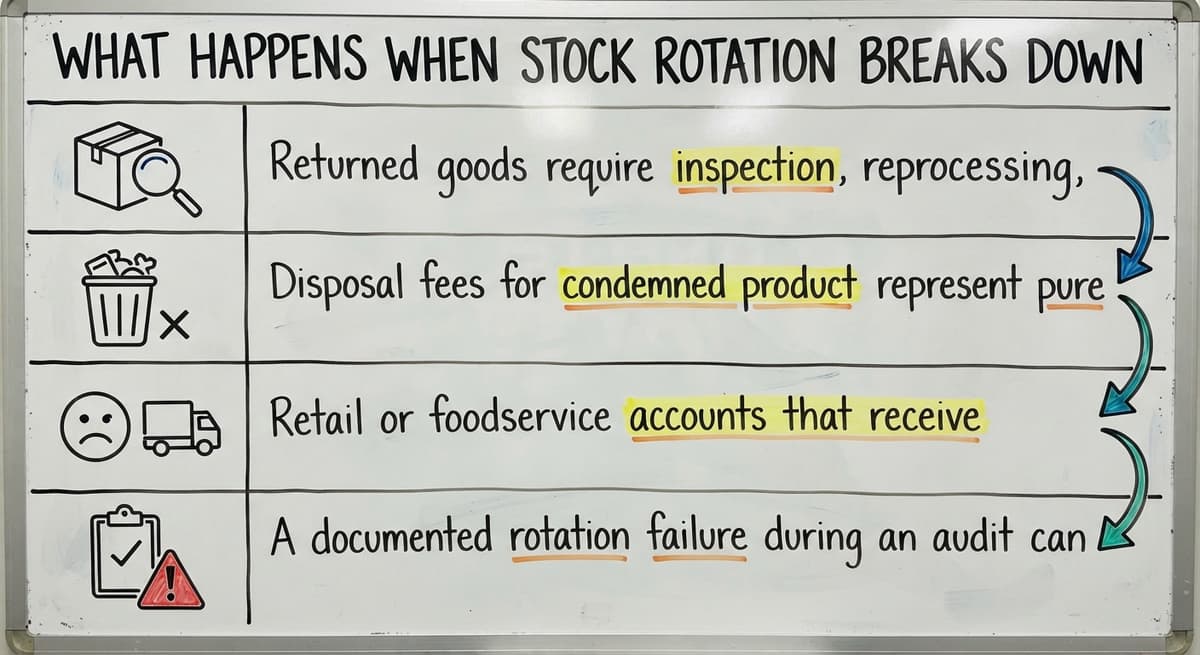
Rotation failures produce concrete, measurable consequences. When expired inventory ships, the immediate result is a customer complaint. Depending on the product and the severity, the next step may be a recall.
The business costs stack up quickly:
- Returned goods need inspection, reprocessing, or disposal, each carrying a labor and freight cost
- Disposal fees for condemned product represent pure loss with no revenue offset
- Retail or foodservice accounts that receive short-dated product may reduce orders or end the relationship
- A documented rotation failure during an audit can trigger regulatory penalties under FDA oversight
Reputational damage is harder to quantify but just as real. A wholesale distributor's value to a buyer is reliable, safe product delivered on time. Shipping expired inventory undermines that value in a single transaction. The financial and relationship cost of one rotation failure usually exceeds the cost of building a proper system to prevent it.

Regulatory Reasons Stock Rotation Is Required
Stock rotation is not optional best practice for food distributors. The FDA Food Safety Modernization Act (FSMA) needs documented hazard controls across food storage and distribution operations. Rotation procedures fall directly within those controls.
Third-party audits conducted under programs such as SQF or AIB examine date-code controls and rotation practices as part of their standard scope. Auditors look for written procedures, evidence that those procedures are followed, and records that support both. A food safety plan without documented rotation procedures is an incomplete plan, and an incomplete plan creates audit findings that can affect a distributor's ability to supply certain accounts.

How Poor Inventory Visibility Makes Rotation Harder
You cannot rotate what you cannot see. When lot numbers and expiration dates are not tracked in a system, warehouse workers rely on what is written on the box or what they remember from last week's receiving. That is guessing, not rotation.
The common scenario in smaller operations: inventory tracked in spreadsheets, dates marked by hand on cartons, no automated alert when product nears its expiry window. A picker working under time pressure grabs the nearest case rather than the earliest-expiring one. The spreadsheet shows units on hand but gives no indication which units should move first.
Poor visibility does not cause rotation failures on its own, but it makes correct rotation nearly impossible to enforce consistently across a full warehouse team.

Lot Tracking and Expiration Date Visibility in Your Inventory System
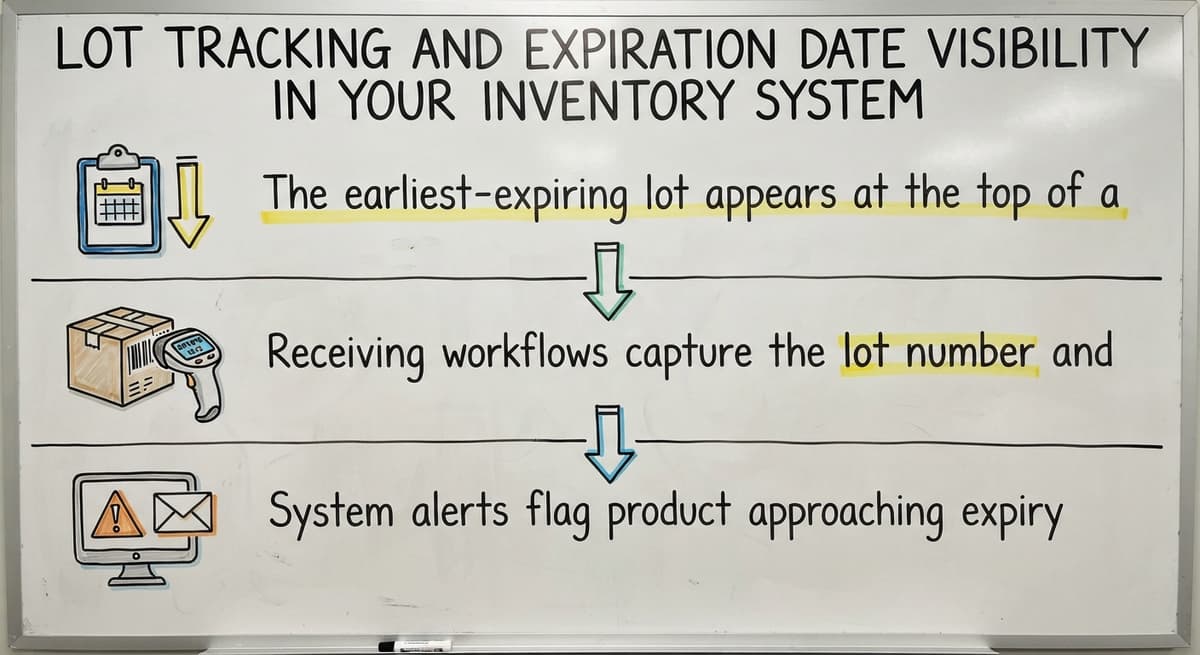
An inventory system that tracks lot numbers and expiration dates at the item level gives pickers the information they need to rotate correctly without relying on memory or handwritten labels. Practically, this means:
- The earliest-expiring lot appears at the top of a pick list automatically, so the picker does not have to calculate which case to grab
- Receiving workflows capture the lot number and date code at the point of putaway, creating a record that follows the product through its time in the warehouse
- System alerts flag product approaching expiry before it becomes a problem, giving the team time to rank those units in outbound orders
See it running on your own process first
No build cost. The subscription starts once it is live and doing the job, not before.
Book a call
How Lot Tracking Supports Recall Response
Lot tracking also supports recalls directly. When a supplier flags a production lot, a system with lot-level records can locate every affected unit in the warehouse and every order that already shipped it. Without lot tracking, a recall response depends on manual searching, which is slow and incomplete. For operations interested in building this ability, lot tracking and expiration date management in warehouse operations connects directly to how a purpose-built inventory layer captures and acts on date-code data.

Stock Rotation in a Wholesale Distribution Operation
Wholesale distributors face a specific challenge that retail shelf-stockers do not: mixed-date pallets. A single delivery from one supplier may include cases from two or three production runs, each carrying a different expiration date. Manual rotation across those cases is error-prone even for experienced staff. Enforcing FEFO at the pick stage through a structured inventory workflow removes that error from the equation. When the system presents the correct lot to the picker, the decision is already made. The picker confirms and moves on.

Aligning the Inventory System to the Way a Distributor Actually Operates
This is an working discipline issue as much as a technology one. A custom inventory workflow built around the way a specific distributor already receives and ships product will get more consistent use than a generic system that needs the team to work around it. Inventory management software for wholesale distributors addresses this gap by aligning the system to the operation rather than asking the operation to adapt to the software. Software supports correct rotation; it does not replace the discipline of building rotation into every step of the receiving and picking process.

How Does Stock Rotation Reduce Expired Product Write-Offs?
Better rotation means more product sold within its usable window, which directly improves gross margin on perishables. Every case disposed of before it ships is lost revenue plus a disposal cost. That combination, called expired shrinkage, comes straight off the bottom line.
For a distributor moving high volumes of short-shelf-life product, even a modest reduction in shrinkage produces a measurable margin improvement. Product that would have been written off instead ships to a customer and generates revenue. The math is straightforward: sell more of what you buy, write off less of what you store.
Rotation also reduces the labor cost of managing expired inventory: identifying it, segregating it, documenting it, and arranging disposal. Preventing expiry is less expensive than managing it after the fact.
Not sure this is the right shape for your operation
Describe how the work runs today. We map it on a call and show you what it would look like built around that, before you spend anything.
Book a callTraining Your Team and Recognizing When Your Process Needs an Upgrade
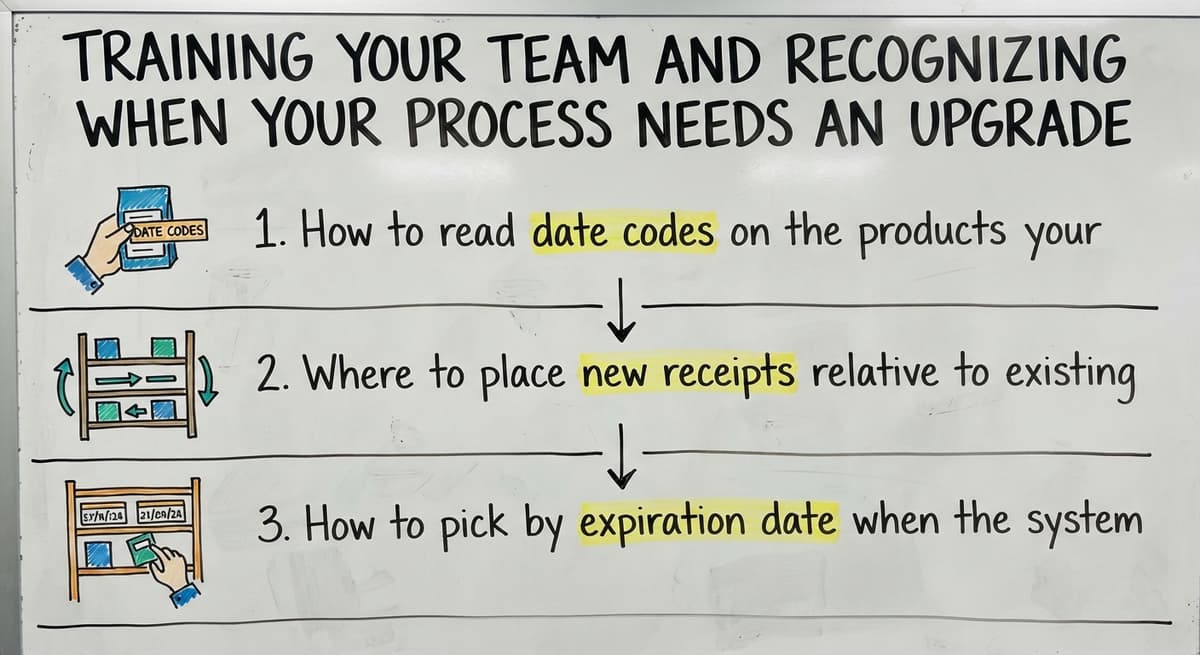
Software and written procedures only work when the warehouse team understands and follows them. Training on rotation should cover three specific skills:
- How to read date codes on the products your operation handles, since formats vary by supplier
- Where to place new receipts relative to existing stock during putaway
- How to pick by expiration date when the system presents multiple lots
A written standard operating procedure (SOP) for rotation gives new hires a reference and gives auditors records. Building rotation steps directly into the receiving and pick workflows reduces reliance on memory, which is where most failures originate.
Signals That Your Rotation Process Is No Longer Reliable
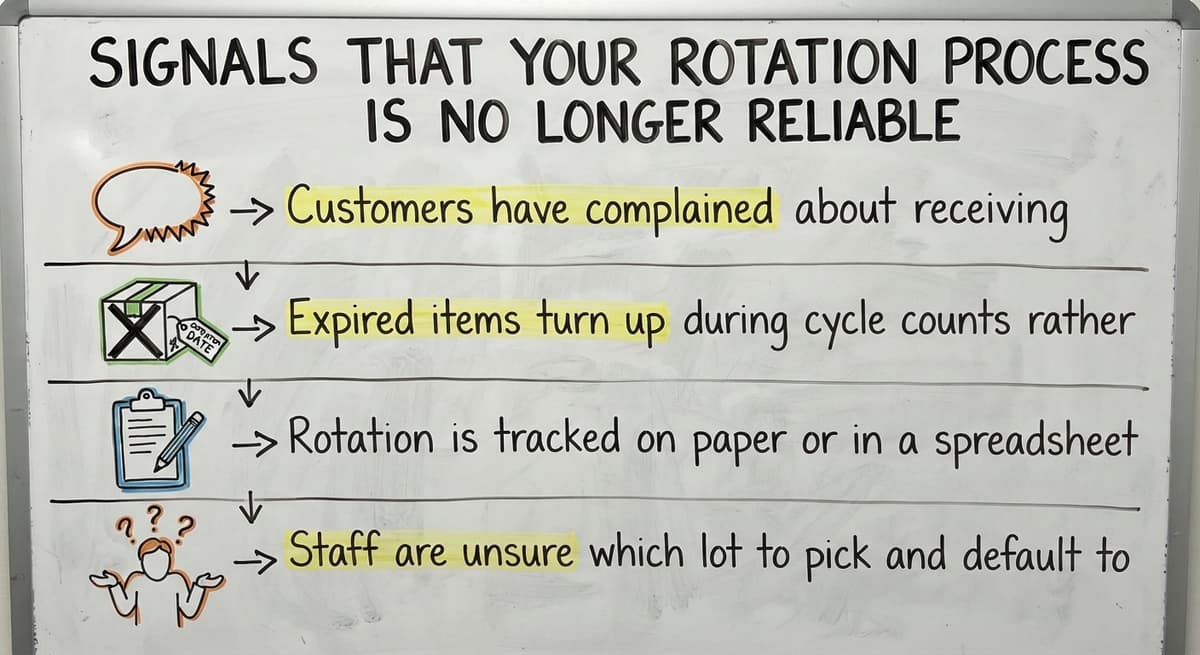
If your current process needs an honest assessment, run through these signals:
- Customers have complained about receiving short-dated product in the past six months
- Expired items turn up during cycle counts rather than being caught before picking
- Rotation is tracked on paper or in a spreadsheet with no system alerts
- Staff are unsure which lot to pick and default to whatever is physically closest
These are working signals, not just technology gaps. If more than one of these is true, the rotation process is not reliable enough to prevent a food safety failure.
Building Stock Rotation Into Your Inventory Workflow
The most reliable rotation systems embed the rule into the workflow rather than depending on individual judgment at each pick. When FEFO is enforced at receiving and at the pick list level, the team does not have to decide which lot moves first. The system already decided. For smaller distributors, a practical path forward is adding a purpose-built inventory layer on top of existing accounting tools. Keeping your existing accounting software for financial records while connecting it to a system that handles lot tracking, date-code visibility, and pick-list sequencing gives the operation what it needs without rebuilding from scratch.
Connecting Inventory and Accounting Without Disrupting Either
Accounting software integration with warehouse inventory systems makes that connection without disrupting the accounting workflow the team already knows. How custom inventory workflows replace manual spreadsheet tracking walks through what that transition looks like in practice for operations currently managing rotation on paper. Customers trust a food distributor to deliver safe, in-date product. Building rotation into the workflow is how that trust gets earned and kept.
Frequently asked questions
What is the definition of stock rotation?
Stock rotation is the practice of organizing inventory so that older stock, meaning product received earlier or with an earlier expiration date, is picked and shipped before newer stock. In a food warehouse, this means placing new receipts behind existing product at putaway and picking from the front. The goal is to ensure no product sits long enough to expire before it leaves the facility.
What is the importance of stock rotation?
Stock rotation prevents expired product from reaching customers, which is a food safety risk, not just a quality issue. Food past its use-by date can carry harmful bacteria. Beyond safety, proper rotation reduces expired shrinkage, supports regulatory compliance under FSMA, and protects a distributor's relationship with retail and foodservice accounts that depend on receiving in-date product.
What's the most important rule for stock rotation?
The most important rule is that the product with the earliest expiration date ships first. For most food distributors, this means following FEFO (First Expired, First Out) rather than simply FIFO (First In, First Out), because different production lots from the same supplier can carry different dates. Picking by expiration date rather than receipt date is what prevents short-dated product from sitting while newer stock moves.
What are the 5 C's in food safety?
The 5 C's in food safety are usually listed as: Clean, Cook, Chill, Cross-contamination prevention, and Comply. They are a training framework used in food handling education. Stock rotation supports the Chill and Comply components directly by ensuring temperature-sensitive perishable goods move through the supply chain within their safe usable window and that operations meet regulatory requirements for date-code control.
What regulations need food distributors to practice stock rotation?
The FDA Food Safety Modernization Act (FSMA) needs food storage and distribution operations to implement documented hazard controls, which include date-code management and rotation procedures. Third-party audit programs such as SQF and AIB also examine rotation practices as part of their standard scope. A food safety plan submitted for regulatory review must include documented rotation procedures to be considered complete.
How does lot tracking help with product recalls?
When a supplier flags a production lot as unsafe, an inventory system with lot-level records can locate every affected unit still in the warehouse and identify every order that already shipped product from that lot. Without lot tracking, that search is manual and incomplete, which slows the recall response and increases the risk that affected product reaches end consumers.
What are the signs that a current rotation process is not working?
Key warning signs include: customers complaining about receiving short-dated product, expired items discovered during cycle counts rather than before picking, rotation tracked only on paper or in a spreadsheet with no system alerts, and staff defaulting to picking whatever is physically closest rather than the earliest-expiring lot. Any one of these signals a reliability gap in the rotation process.
Start with a free first look
A 30 minute call, your operation mapped, and a clear picture of what we would build. No obligation and nothing to install.
Book a callRelated guides
The rest of this guide, for the parts of the job this page does not cover.
Guides
- Stock Software
- Make to Stock Examples
- Hospital Stock Management System
- Cloud Stock Management Software
- Procedure for Stock Control
- Low Stock Alert
- Types of Stock Control Systems
- Real Food Barcodes
- Warehouse Stock Management Software
- Small Business Stock Management Software
- Warehouse Stock Software
Common questions
- What is Inventory Management and Why is It Important
- Why is Warehousing and Inventory Management Important
- Why is Inventory Management Important for Small Businesses
- How to Manage Food Inventory
- What is an Important Factor in Inventory Management
- What is Fluctuation Stock in Inventory Management
- How to Stock Control
- How to Maintain Stock Levels
- How to Prevent Stock Discrepancies
- What is Stock Taking in Inventory Management
- How to Calculate Cycle Stock
- Why Warehouse Management System
- What is the Most Important Part of Warehouse Organization