


Specific Identification Inventory Method
Specific identification is an inventory costing method that tracks the exact cost of every unit. Reviewed November 2026.
When a unit sells, its buy price moves straight to cost of goods sold (COGS), the expense for what you sold. Nothing is averaged or guessed.
You will learn how to tag units at receiving, what records to keep, and how to treat lot numbers for goods that are not one of a kind. The guide also says plainly when to skip the method. Costing methods differ in effort and in reported profit. Pick the one that matches your stock and your staff.
Book a call
What Is the Specific Identification Inventory Method?
The method makes no guess about which units sold first or last. Other names are specific cost and specific unit costing. Whatever stays on the shelf is ending inventory, the value of stock you still hold at period end. That value matches the true price of those exact units. Each unit carries one cost from buy to sale.
The specific identification inventory method costs stock by following each unit on its own. You record what you paid for one unit. You follow that unit until a customer buys it. Then the price you paid becomes COGS.
How the Specific Identification Method Works
The specific identification method works in 4 steps, and each step ties one item to one cost.
- Give each item or lot a unique ID at the receiving dock.
- Record the buy price, including freight and vendor fees, for that item.
- Record exactly which item went to the customer.
- Move that item's cost into COGS on the sale date.
Everything left on the shelf is ending inventory at actual cost. Scan-based IDs make step 3 fast. GS1 calls its standards "the global language of business" in its barcode standards overview. A shared ID format means one label works for you and your vendors.
We build it for your operation, and the first look is free
If you would rather not compare products, describe how your operation already works and we build the system around it.
No build cost. You see it running on your own process first, and the monthly subscription starts only once it is live.
Book a callWhat Does Specific Identification Look Like With Real Numbers?
Specific identification gives a clean profit figure for each sale. Say a distributor buys 3 used forklifts at $12,000, $14,500 and $16,000. A customer buys the $14,500 unit for $18,000. COGS is exactly $14,500. Gross profit is $18,000 minus $14,500, or $3,500.
Now use an average cost. The 3 units cost $42,500 in all. Divided by 3, the average is $14,167. Profit would show as $3,833, and that is $333 too high. Ending inventory under specific ID is $28,000, the price paid for the two units still on the floor. Each number follows a real machine.
Who Should Use Specific Identification Costing?
Specific identification costing fits stock that is unique, high in value, and low in count.
Best fit
The method suits goods that are easy to tell apart. It also suits businesses where each unit carries a separate price tag.
- Vehicles and heavy equipment carry serial numbers and wide price gaps.
- Jewelry, art, and antiques are each one of a kind.
- Custom orders have a buy price that belongs to one customer.
If you can walk to the item and read its tag, the method works.
Poor fit
High-volume, identical goods are a poor fit. Screws, cases of drinks, and packaging all fall here. Tracking each unit costs more than the accuracy is worth. A wholesaler with thousands of SKUs (stock keeping units, the codes for each product) needs another approach for most stock. Some firms use specific ID for a small slice of stock only. Big, rare pieces get tracked one by one, and an easier approach covers the rest.
Benefits and Drawbacks of the Specific Identification Method
The specific identification method has 4 clear gains and 4 real costs. Weigh both before you switch.

Benefits
When each item carries its own price, the books show what each sale actually involved. Businesses that track at the item level gain a clearer view of their results.
- Expense matches revenue as closely as any method can match it.
- Each sale shows its own profit, so you see which deals pay.
- Manipulation is hard because the cost follows the item.
- Item-level data helps you price goods and spot slow or costly stock.
Drawbacks and risks
- Record keeping is heavy, and every item needs a separate entry.
- Errors creep in when tags, serial numbers, or lot numbers get lost or mismatched.
- Profit can swing when the owner picks the unit to sell.
- Large volumes fail without good tracking tools in place.
The method pays off only when your records are as good as your stock is rare.
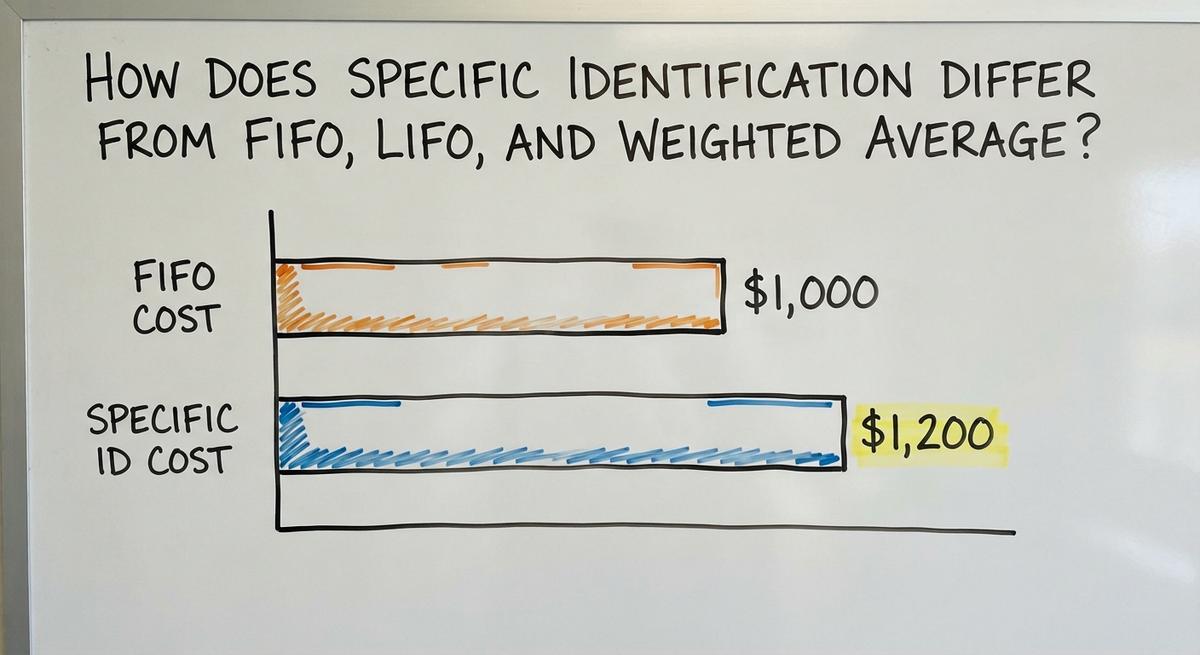
How Does Specific Identification Differ From FIFO, LIFO, and Weighted Average?
Specific identification differs from FIFO, LIFO, and weighted average in one way: the other three assume a cost, and specific ID uses the real one.
FIFO vs specific identification
FIFO (first in, first out) assumes the oldest stock sells first. Say you buy 100 cases at $10, then 100 at $12. You ship 100 cases. FIFO books $1,000 of cost. If the newer cases left the building, specific ID books $1,200. FIFO is simpler for identical goods. Specific ID is more exact for unique goods.
LIFO and the averaging methods
LIFO (last in, first out) assumes the newest stock sells first. Weighted average blends all costs into one number. The moving average method inventory idea works the same way, with the blend updated after each buy. Both are shortcuts. Specific ID is not. The choice changes reported profit and taxes. IRS Publication 538 says "you must value your inventory at the beginning and end of each tax year." Ask your accountant what inventory pricing methods fit your books.
Not sure this is the right shape for your operation
Describe how the work runs today. We map it on a call and show you what it would look like built around that, before you spend anything.
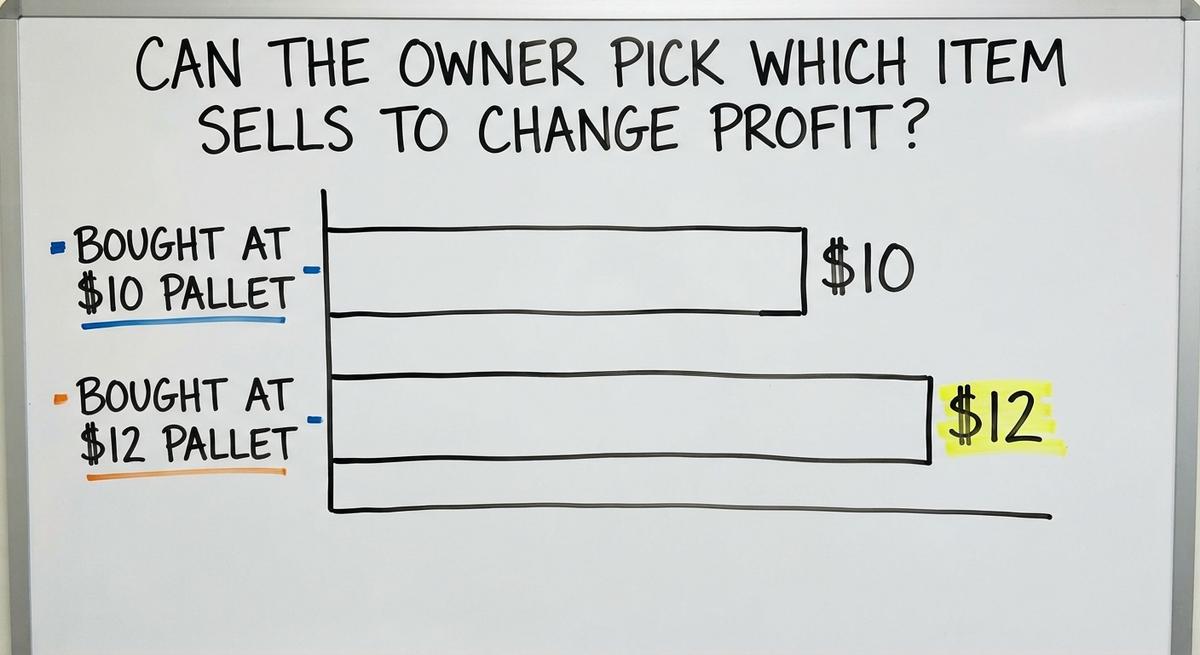
Book a callCan the Owner Pick Which Item Sells to Change Profit?
Yes, an owner can shift profit under the specific identification method by choosing which item sells when identical items carry different costs. Two matching pallets bought at $10 and $12 give two different profits. Choosing the unit moves the number.
The item must truly be the one delivered to the customer. Keep inventory records that show what shipped, such as a scan at pick and ship. A buyer who gets the unit you promised is also a legal matter. The FTC's mail order rule guide covers shipping when you said you would. Check with a CPA on rules for your case.
What Records Do You Need to Keep, and How Do You Tag Items?
Specific identification needs 4 groups of records, and every one must link to the item's ID.
Records for each item
Each item in a specific identification system needs a short file with these entries:
- The unique ID, serial number, or lot number for the item.
- Buy date, vendor, and total landed cost, meaning price plus freight, duties, and prep.
- Sale date, customer, and the ID of the item that was sold.
- Warehouse location and the current status of the item.
The ID is the thread. Lose it and the cost has no home.
Tagging in the warehouse
An inventory method that tracks cost by item needs a steady way to tag stock. Use serial numbers, barcodes, or labeled lots. Label items at receiving, not later. Scan or write the ID at pick and ship. Keep one list that everyone updates the same way. Serial number tracking works only when every hand follows the same habit. One skipped step can break the link between an item and its cost.
Lot tracking for items that are not unique
Lot tracking extends the specific identification idea to identical goods. It groups them by buy batch. You track cost by lot, not by single unit. It suits food, chemicals, and goods with expiration dates. Say a lot of 50 cases cost $2,000. Each case carries $40 of cost. A recall then points to one lot and one cost. Lot tracking is the middle ground between detail and effort.
The comparison is easier when one option is built for you
Off-the-shelf means fitting your process to the software. We do it the other way round, and the first look costs nothing.
Book a call
Can You Do Specific Identification in Accounting Software and Spreadsheets?
A common workaround is a spreadsheet with item IDs and costs. Spreadsheets bring risks: typing errors, version confusion, and lost files. Keep your accounting software for the books. Track item-level cost in the sheet, then post the totals to the ledger. Match the two at each month end. A spreadsheet that feeds the books is safer than one that replaces them.
Popular accounting software inventory setups often use average cost or FIFO, so exact item cost needs extra work. Be honest about that limit before you promise item-level profit.
How Do You Know Your Manual Tracking Is Not Keeping Up?
Manual tracking is falling behind when your books and your item list stop agreeing. Watch for these signs:
- Item costs differ between the sheets and the books.
- Staff keep a separate printed list or email thread.
- Month end takes days to reconcile.
- Nobody can state the true profit on a given sale.
The time adds up. Two people spending 5 hours a week at $20 an hour is $10,400 a year. The BLS tracks pay for stock clerks and order fillers if you want local rates.
Common mistakes feed these signs:
- Leaving freight, duties, or prep costs out of the item's price.
- Reusing or losing serial numbers on the specific identification list.
- Applying the method to goods not worth the effort.
- Failing to record returns against the original item.
Fix the mistakes first, and the signs fade.
How to Decide If the Specific Identification Method Is Right for You
The specific identification method is right when the answer to 4 questions is yes.
- Are your items unique and easy to tell apart?
- Are they worth enough to justify item-level tracking?
- Is the unit count low enough to manage by hand?
- Can staff scan and record every sale without exceptions?
Next, check if the extra work buys better profit data. Talk to your accountant before you switch. Think about a mix too. Use specific ID for big items and another inventory method for the rest. The Census Bureau's monthly wholesale data shows how much stock wholesalers carry, and NIST offers supply chain guidance on process. Match the method to your stock, then keep it.
Key Takeaways
The specific identification inventory method pairs each item with its own cost. It suits unique, high-value goods that are few in number. It needs clean records and steady tracking, from the receiving dock to the shipping door. For identical, high-volume stock, pick an easier approach. Choose the one that fits your stock and your team, and ask your accountant before you change. Start small: tag your top 20 costliest items this week and see what the profit data tells you.
Frequently asked questions
What is the specific identification inventory method?
It is a costing method that follows each item from buy to sale. The item's own buy price becomes the cost of goods sold when it leaves, with no average or guess.
When should a business use specific identification?
Use it for items that are unique, high in value, and few in number. A heavy equipment dealer or art seller fits. A seller of bulk fasteners does not.
What records are needed for specific identification?
Keep each item's ID or serial number, buy date, vendor, and landed cost. Add the sale date, the customer, and where the item sits in the warehouse.
Can choosing which item to sell change reported profit?
Yes, when identical items carry different costs. Picking the cheaper or costlier unit moves profit. Records must show which unit truly shipped, and a CPA can explain the rules.
Can a business with thousands of SKUs use this method?
Only for a slice of stock. Thousands of low-cost SKUs make item-level tracking too costly, so apply it to big or rare items and use a simpler method elsewhere.
What is the difference between a serial number and a lot number?
A serial number marks one unit. A lot number marks a batch bought together. Use serial numbers for one-of-a-kind goods and lot numbers for identical goods.
Does the method help with inventory valuation?
Yes. Inventory valuation under this method adds up the true cost of each item on hand, so the balance sheet shows what those exact items cost.
Start with a free first look
A 30 minute call, your operation mapped, and a clear picture of what we would build. No obligation and nothing to install.
Book a callRelated guides
More on the same work.
Guides
- Weighted Average Inventory Valuation Method
- Moving Average Method Inventory
- Inventory Pricing Methods
- Inventory Accuracy Formula
- Cycle Counting Inventory
- Inventory Audit Checklist
- Inventory Audit
- Inventory Management Best Practices
- Inventory Shrinkage Accounting Entry
- Inventory Shrinkage is Recorded When
- Calculate Inventory Shrinkage
- Inventory Accuracy
- Inventory Process Flow
- Warehouse Inventory Management Software
- Warehouse Inventory Tracking Software
- Warehouse Inventory Management Systems
- Best Inventory Software
- Quickbooks Inventory Management Software
- Warehouse Inventory Systems