


Inventory Pricing Methods
Inventory pricing methods are rules that put a dollar value on the stock you hold and sell. Reviewed November 2026.
Four rules cover most firms.
They are FIFO, LIFO, weighted average, and specific spotting.
Each rule gives a different cost of goods sold (COGS).
COGS is the cost of the items you sold.
It shows all four rules side by side.
Book a callWhat Are Inventory Pricing Methods?
Inventory pricing methods are rules for costing each item you hold and sell.
Many people call them inventory costing methods.
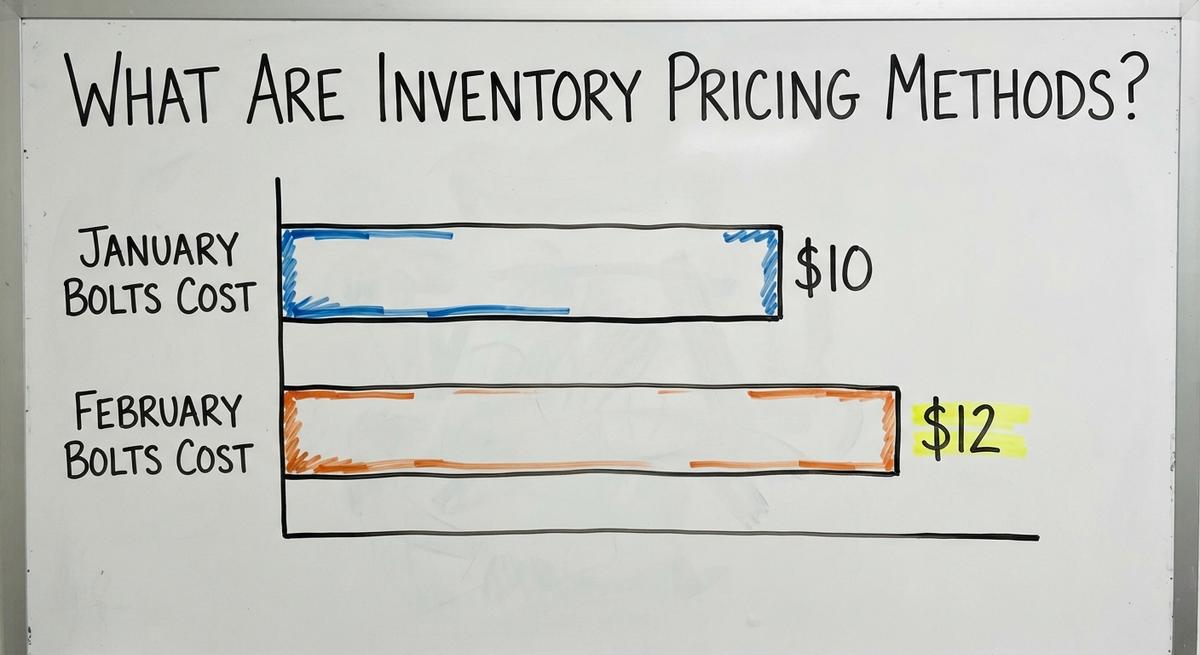
The same box of bolts can cost $10 in January.
It can cost $12 in February.
A rule picks the cost that goes on each sale.
Four methods cover most firms:
- FIFO sends the oldest costs to sales first, so the newest costs stay on the shelf.
- LIFO sends the newest costs to sales first, so the oldest costs stay on the shelf.
- Weighted average cost spreads the total spend evenly across every unit you own, old and new.
- Specific spotting tracks the real cost of each unit or lot from receiving to shipping.
Pick one rule and apply it the same way every time.
We build it for your operation, and the first look is free
If you would rather not compare products, describe how your operation already works and we build the system around it.
No build cost. You see it running on your own process first, and the monthly subscription starts only once it is live.
Book a callWhy Your Inventory Pricing Method Matters
Your method is the lever on reported profit.

The same sales can show a $40 swing in profit on 30 units.
The example below proves it.
Four things move with your choice:
- COGS rises or falls with your choice, so reported profit moves up or down by the same amount.
- Inventory valuation on the balance sheet changes, as unsold units carry different costs under each rule.
- Taxes and bank reports change, as both start from your profit and your stock value.
- Margins on each sale look better or worse, depending on the cost that lands on the order.
The law also sets a floor.
Two sources matter here:
- IRS Publication 538 says "To figure taxable income, you must value your inventory at the beginning and end of each tax year."
- GS1 publishes the global barcode standards that many scan-based counts rely on to keep records accurate.
A clear method turns a legal duty into a rule your staff can follow.
Why Do Inventory Costs Change Between Purchases?
Inventory costs are never fixed.
Supplier prices, freight, and fees move between buy orders.
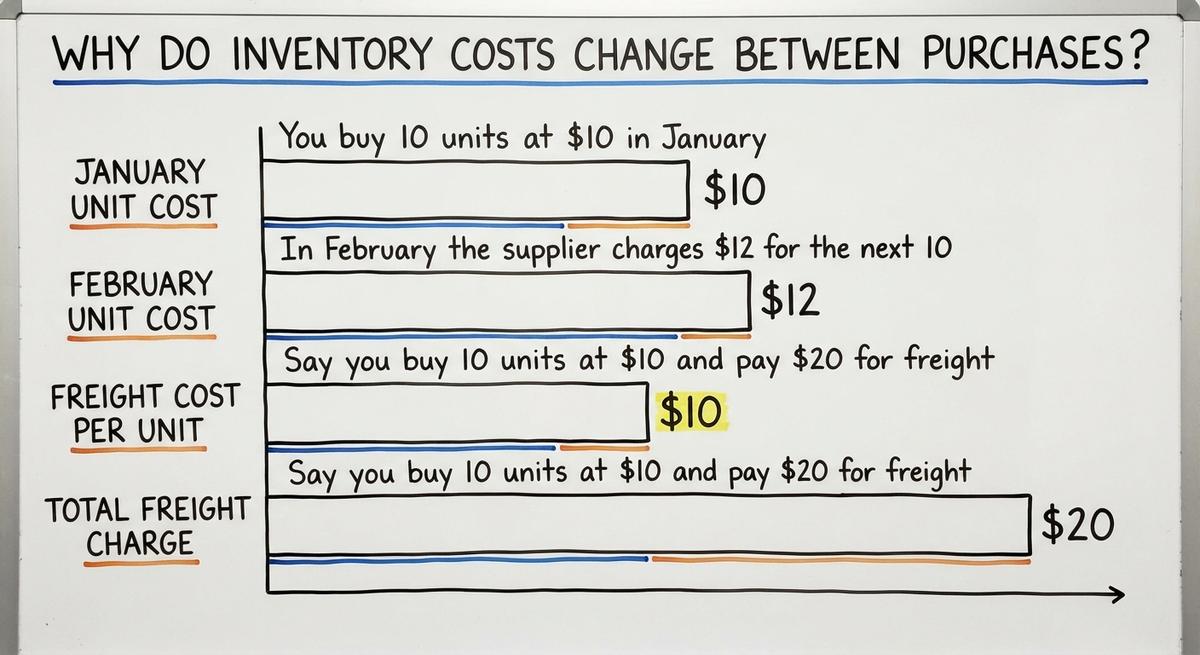
You buy 10 units at $10 in January.
In February the supplier charges $12 for the next 10.
Now one shelf holds the same item at 2 costs.
Landed cost is the full cost to get an item to your dock.
It builds on the supplier price with these add-ons:
- Freight pays the carrier to move the goods from the supplier to your receiving dock.
- Duties are taxes charged at the border on goods that you import from other countries.
- Fees cover handling, insurance, and any other charge that attaches to the shipment.
Say you buy 10 units at $10 and pay $20 for freight.
Landed cost is $120 for 10 units, or $12 each.
A costing method decides which of those costs follows each sale.
The Four Main Inventory Pricing Methods
The four methods are FIFO, LIFO, weighted average, and specific spotting.
Each answers one question.
Which cost goes on the item you just sold?
One running example lets you compare the results.
The 3 buys:
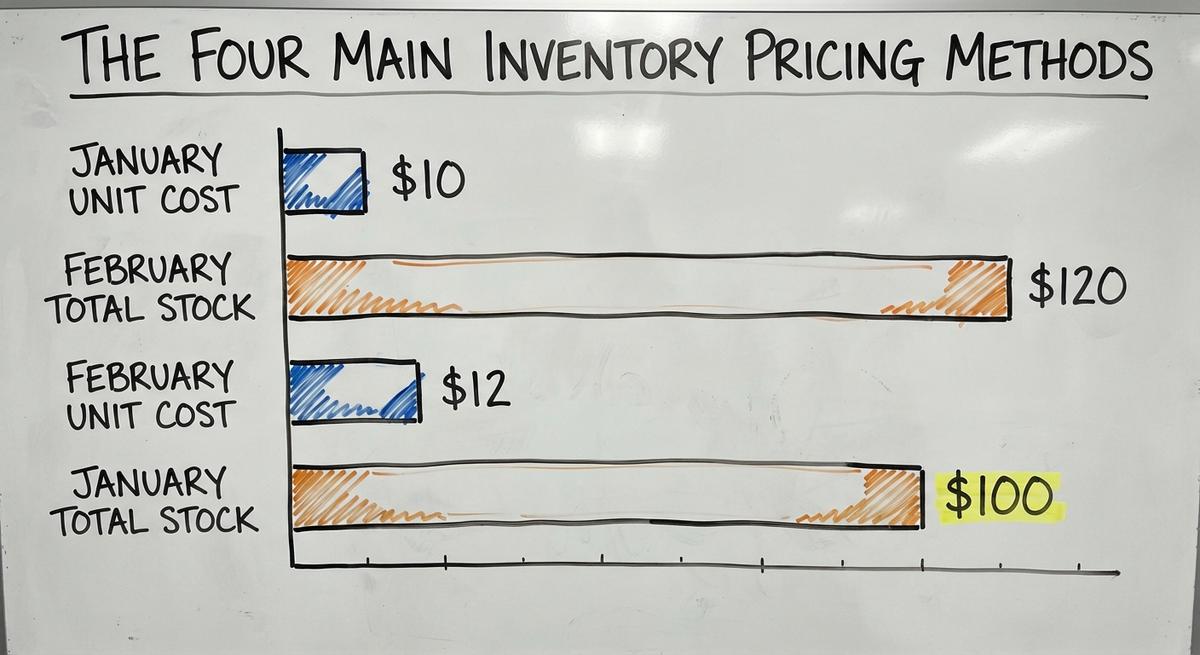
- January: 10 units at $10 each, for a total of $100 of stock bought that month.
- February: 10 units at $12 each, for a total of $120 of stock bought that month.
- March: 10 units at $14 each, for a total of $140 of stock bought that month.
You then sell 15 units at $20 each.
Sales total $300.
The 30 units cost $360 in all.
Every method starts from these same numbers.
FIFO (First In, First Out)
FIFO is the inventory method that sells your oldest cost first.
The name is short for first in, first out.
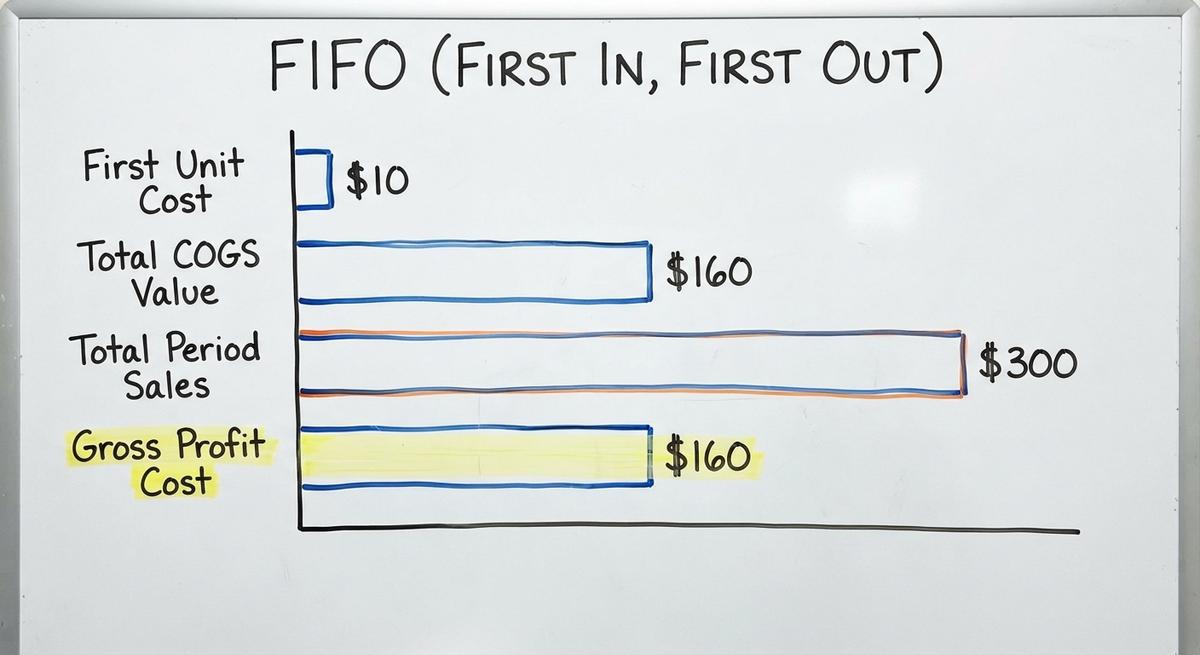
You sold 15 units.
The first 10 come from January at $10.
The next 5 come from February at $12.
Here are the results:
- COGS is 10 x $10 plus 5 x $12, which comes to $160 for the 15 units sold.
- Gross profit is $300 in sales less the $160 cost, which leaves $140 for the period.
- Ending stock is worth $200, made up of 5 units at $12 and 10 units at $14.
FIFO suits items that expire or go out of date.
Old stock leaves first, so cost follows the stock.
With rising prices, FIFO shows higher profit.
Higher profit means higher tax.
At a 25% rate, the $140 profit costs $35 in tax.
FIFO gives the highest profit and tax bill in a climbing market.
Not sure this is the right shape for your operation
Describe how the work runs today. We map it on a call and show you what it would look like built around that, before you spend anything.
Book a callLIFO (Last In, First Out)
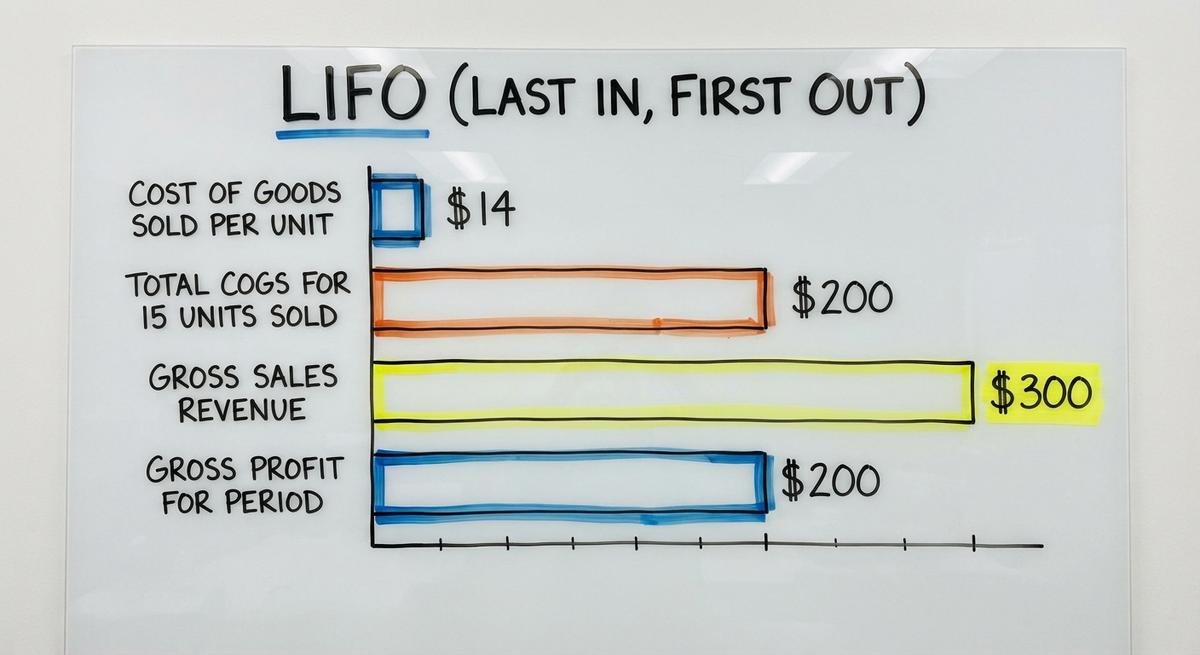
LIFO is the inventory rule that sells your newest cost first.
The name is short for last in, first out.
You sold 15 units.
The first 10 take March at $14.
The next 5 take February at $12.
Here are the results:
- COGS is 10 x $14 plus 5 x $12, which comes to $200 for the 15 units sold.
- Gross profit is $300 in sales less the $200 cost, which leaves only $100 for the period.
- Ending stock is worth $160, made up of 10 units at $10 and 5 units at $12.
US tax rules allow LIFO.
Many other countries do not.
Older costs stay on the shelf.
So the stock value on your balance sheet can look low.
Rules for LIFO are strict, and a switch is hard to undo.
Ask your accountant before you choose LIFO.
Weighted Average Cost
Weighted average cost is total cost divided by total units.

Add all 3 buys: $360 for 30 units.
The average is $12 a unit.
Here are the results:
- COGS is 15 units x $12, which comes to $180 for the units that left the building.
- Gross profit is $300 in sales less the $180 cost, which leaves $120 for the period.
- Ending stock is 15 units x $12, which is also worth $180 on the balance sheet.
The average smooths out price swings.
One high or low buy cannot jump a margin.
A moving average setup redoes the average after every buy.
Here is how it runs on the example:
- After January, 10 units cost $100, so the running average sits at $10 a unit.
- After February, 20 units cost $220 in all, so the running average moves up to $11 a unit.
- After March, 30 units cost $360 in all, so the running average lands at $12 a unit.
Bulk items that look alike fit well.
Think of fasteners or bags of salt.
No one cares which bag left first.
Weighted average gives the calm middle result of $120 profit.
Specific Identification
Specific spotting is the inventory method that tracks each unit's real cost.

You match each sale to the exact item that left.
Say your 15 sold units came 5 from January, 5 from February, and 5 from March.
COGS is $50 + $60 + $70 = $180.
Profit is $120.
The result depends on the units that shipped.
A different pick gives a different profit.
This method fits items with serial numbers or one-of-a-kind items:
- Machines carry a serial number, so each one keeps the exact price paid at receiving.
- Used equipment varies in price from unit to unit, so an average would hide the real cost.
- Art is unique by nature, so each piece needs its own cost record from buy to sale.
The cost is effort.
Each unit needs a tag, a serial number, or a lot code from receiving to shipping.
Use specific spotting only where you can trace every unit.
How Do the Four Inventory Pricing Methods Compare?
3 profits appear across the 4 methods: $140, $100, and $120.

Here is the running example side by side.
| Method | How it works | COGS | Best for | Watch out for |
|---|---|---|---|---|
| FIFO | Oldest cost sells first | $160 | Dated or perishable goods | Higher tax in a rising market |
| LIFO | Newest cost sells first | $200 | US firms with rising costs, after advice | Strict rules, low stock value |
| Weighted average | Total cost divided by units | $180 | Bulk items that look alike | Hides real price swings |
| Specific spotting | Real cost of each unit | $180 | Serial-numbered or unique items | Heavy tracking work |
Tax shows the cash effect.
Take a 25% rate on each profit:
- FIFO shows $140 of profit, so a 25% rate means $35 in tax on this example.
- LIFO shows $100 of profit, so tax falls to $25 and $10 less cash leaves the business.
- Weighted average shows $120 of profit, so tax comes to $30 at the same 25% rate.
- Specific spotting also shows $120 here, so tax is $30, but a different pick would change it.
No method is wrong.
Each rule tells a different story about the same $360 of stock.
The comparison is easier when one option is built for you
Off-the-shelf means fitting your process to the software. We do it the other way round, and the first look costs nothing.
Book a call
Which Inventory Pricing Method Fits a Wholesale Distributor?
Weighted average and FIFO are the common picks for wholesale inventory.
A distributor holds many SKUs.
A SKU is one item with its own code.
Stock arrives often.
Supplier prices change from order to order.
The US Census Bureau tracks monthly wholesale trade, including inventories and sales.
Use it to see how large this sector is.
Match the method to how stock moves:
- Pallets of look-alike goods fit weighted average, as no one picks by receipt date on the floor.
- Goods that ship oldest first fit FIFO, as the cost then follows the stock out the door.
- Few high-value items may fit specific spotting, as each one is worth its own cost record.
Cost flow should mirror what your crew does on the floor.
Which Method Fits a Warehouse or Fulfillment Center?
Warehouse inventory comes in 2 kinds: client stock and your own stock.

Client stock stays on their books.
They pick the costing method.
You report units, lots, and dates.
Your own stock follows your own rule.
Lot and date tracking is the key need.
A lot is a batch received together.
Each lot needs these fields:
- Lot code names the batch, so a picker or an auditor can find it fast.
- Receipt date shows when the batch arrived, which sets its place in the FIFO line.
- Quantity and unit cost let you value what is left in the batch at any time.
Specific spotting makes sense when a client sends unique items, such as serial-numbered devices.
Each unit keeps its own cost.
For goods that look alike, FIFO or weighted average costs less to track.
Track lots from the dock and the right method gets easier to run.
Which Method Fits Perishable or Dated Goods?
FIFO is the best fit for perishable goods.
Perishable inventory leaves by date, so the oldest stock ships first.
Some firms ship by first expiry, first out.
That means the item that expires soonest ships soonest.
It ships first even if it arrived later.
Two flow rules apply:
- First in, first out ships the oldest receipt first, and the books charge the oldest cost first.
- First expiry, first out ships the soonest expiry first, even if that lot arrived after others.
Cost flow should follow shelf flow where possible.
If your crew ships the oldest box first, the books should charge the oldest cost first.
A gap between the two makes your margins wrong.
When expiry dates and receipt dates differ, track both in your records.

Inventory Pricing Methods vs. Selling Price
Inventory pricing methods are rules for cost, not price.
A costing method values stock.
It does not set the price you charge.
Many people mix these up.
Ask what cost method values inventory, and the answer is a cost rule.
Costs still feed price.
Say an item costs $12 and sells for $20.
The profit is $8.
- Markup is profit over cost, so $8 / $12 gives a markup of 66.7% on this item.
- Margin is profit over price, so $8 / $20 gives a margin of 40% on this item.
Same sale, two numbers.
Know which one your team means.
The method picks the cost; you still pick the price.
Can You Change Your Inventory Pricing Method?
A change is possible with a good reason.
You can change your inventory pricing method, but it needs steady use.
Tax rules can need approval first.
The IRS has a form for a change in accounting method.
Talk to your accountant before you switch.
Plan any change like this:
- Name the reason for the change, such as a better match to how your stock moves.
- Ask your accountant if approval is needed before you make any move on the books.
- Start at the first day of a new year so the periods stay clean.
- Restate opening stock values under the new rule, so old and new numbers line up.
- Write the new rule down and use it everywhere, for every item in the class.
A year start keeps your reports clean and easy to compare.
What Data Do You Need to Apply Any Method?
You need 4 facts for every buy.

They are the date, the quantity, the unit cost, and any freight or fees.
Without them, no inventory method works.
With them, any method works.
Collect the data in this order:
- Receiving records should match what the crew actually counted at the dock on the day of arrival.
- Buy cost per unit comes from the supplier invoice, so keep a copy of each invoice on file.
- Freight and fees are spread across the units in that shipment, so each unit carries its fair share.
- Sales records are tied to items and quantities, so each sale can pull its cost from the right layer.
- Lot or serial codes are needed if you use specific spotting, so each unit can be traced.
Scan-based receiving cuts typing errors.
Barcodes follow standards from GS1.
Clean records matter more than the method you choose.
See it running on your own process first
No build cost. The subscription starts once it is live and doing the job, not before.
Book a callHow QuickBooks Handles Inventory Costing
QuickBooks is typical: it supports only some methods.
Like most common accounting tools, its inventory features have limits.
Average cost and FIFO appear in many setups.
Support differs by version and plan.
Other methods may need extra tools or manual work.
Check 3 things in your own account:
- Your version and plan decide which costing options appear in the settings of your account.
- Your settings show which method the system uses now, so confirm it matches your written rule.
- Your reports should match your physical counts after a test month, with any gap traced to a cause.
Read your own help pages, or ask your accountant, before you rely on any default.
The tool follows its settings, so check them before you trust it.

Common Inventory Pricing Mistakes
4 mistakes cause most costing errors.
Each one skews COGS and inventory value.
Each one is easy to avoid.
- Ignoring freight and landed cost makes every margin look better than it is on the report.
- Mixing methods across items with no rule makes reports hard to compare and hard to defend in an audit.
- Skipping a cost update after a price change leaves old costs on new stock and bends your margins.
- Skipping regular counts lets errors pile up until year end, when they cost the most to fix.
A written rule and a monthly review stop all four.
How Inventory Counts Affect Your Costs
Inventory counts are what set the true value of your stock.
Shrink is stock lost to theft, damage, or error.
Every lost unit stays on your books.
It carries full cost until a count says otherwise.
Cycle counts check a few items each week.
They do not wait for one big yearly count.
They catch errors early.
Accuracy also protects customers.
The FTC's Mail, Internet, or Telephone Order Merchandise Rule covers shipping promises.
It needs you to ship when you said you would.
You cannot ship stock you do not have.
Use clear reason codes for each count gap:
- Damage covers goods broken in storage or handling, and the write-off shows the loss in the period.
- Miscount covers errors in a past count or receipt, and the fix brings the records back in line.
- Theft or loss covers units that left without a sale, and the entry removes their cost from stock.
Adjust each count gap with a clear reason code.

When Manual Costing Stops Working
Spreadsheets are fine for a few dozen SKUs.
Manual costing stops working when effort outweighs value.
Past that, inventory errors grow.
Where Spreadsheets Cause Costing Errors
Spreadsheets fail in 4 common ways with inventory costing:
- Copied formulas break when someone adds a row or drags a cell, and no one sees the damage.
- Lot layers get lost, so FIFO and specific spotting lose their trail and the costs drift.
- Two people edit different files, and no one knows which copy holds the right numbers.
- Costs are entered late, so reports use old numbers and margins look wrong for weeks.
Signs You Have Outgrown Them
Watch for 4 signs in your inventory work:
- Month-end close takes days, and the team waits on the sheet before it can post anything.
- Margins on paper do not match cash in the bank, and no one can explain the gap.
- Staff disagree on stock numbers, so each person trusts a different file or a different count.
- SKU or order volume keeps growing, and each new line adds more manual work to the sheet.
Put a price on the hours.
Say two people spend 8 hours a week on it.
At $20 an hour, that costs $16,640 a year.
The math is 2 x 8 x 52 x $20.
The Bureau of Labor Statistics publishes pay data for stock clerks.
Use your own local wage.
Weigh that against the price of inventory management software.
Other options include tighter processes.
Custom tools can also keep your current accounting system.
NIST offers vendor-neutral supply chain guidance.
If the sheet costs more than the fix, switch.
How Do You Choose an Inventory Pricing Method?
5 steps pick the right inventory pricing method.
Work through them in order
Frequently asked questions
What are inventory valuation methods?
Inventory valuation methods are the rules that set the dollar value of unsold stock. The main four are FIFO, LIFO, weighted average cost, and specific spotting. Each assigns buy costs to sales in a different order.
What is the best inventory method?
No single method is best for every firm. Choose by how your goods move, what you must report, and what your accountant advises. Dated goods favor FIFO. Look-alike bulk goods favor average cost.
Is LIFO allowed in the United States?
Yes, US tax rules allow LIFO. Many other countries ban it under international standards. US firms that use it for taxes must follow extra reporting rules, so get your accountant's advice first.
Does the costing method change the price I charge customers?
No, the method only sets the cost recorded for each sale. You still choose your selling price. A different method can change the margin you see, though the customer pays the same amount.
Which inventory pricing method is most common?
Weighted average and FIFO are the most common picks for small firms. Both are simple to run and fit look-alike goods. Your own stock flow and your accountant's advice should decide, not popularity.
Can I use more than one method?
Yes, if each item class follows one written rule. Use FIFO for dated goods and average cost for bulk items, for example. Do not switch an item's method at random.
Does the method change cash flow?
The method changes taxable profit, so it changes the tax you pay. It does not change what you paid suppliers. Higher reported profit means a bigger tax bill sooner.
When do spreadsheets stop working for inventory costing?
Spreadsheets stop working when closes run for days, counts and books disagree, or staff dispute numbers. Growth in SKUs and orders brings those signs on fast.
Start with a free first look
A 30 minute call, your operation mapped, and a clear picture of what we would build. No obligation and nothing to install.
Book a callRelated guides
More on the same work.
Guides
- Moving Average Method Inventory
- Price of Inventory Management Software
- Warehouse Management System Pricing
- Inventory Accuracy Formula
- Cycle Counting Inventory
- Inventory Audit Checklist
- Inventory Audit
- Inventory Management Best Practices
- Inventory Shrinkage Accounting Entry
- Inventory Shrinkage is Recorded When
- Calculate Inventory Shrinkage
- Inventory Process Flow
- Warehouse Inventory Management Software
- Warehouse Inventory Tracking Software
- Warehouse Inventory Management Systems
- Best Inventory Software
- Quickbooks Inventory Management Software
- Warehouse Inventory Systems