


Fifo Method Inventory Valuation
FIFO, short for first in, first out, is a way to value inventory. The method treats early buy costs as sold first. Recent costs stay on the books as ending inventory. That is the core of FIFO method inventory valuation.
Reviewed November 2026.
The guide gives a worked example, shows the profit and tax effects, and lists record-keeping steps for small wholesalers and warehouses.
Book a call
What Is the FIFO Method of Inventory Valuation?
FIFO is a cost flow rule for stock. It assigns the oldest buy costs to goods sold first.
A cost layer is one batch of goods bought on one date at one unit price. FIFO inventory valuation uses those layers to set cost of goods sold (COGS). The layers left over set the value of ending inventory.
The FIFO valuation method comes down to one rule about which layer leaves first.
Is FIFO the same as shipping the oldest stock first?
Physical FIFO is a shipping habit, and FIFO cost flow is an accounting rule. Physical FIFO means you ship the oldest stock first. FIFO cost flow means you charge the earliest costs first.
The two often match but do not have to. A crew can pick the newest cartons and still report FIFO costs. Valuation is a rule about cost, not about where boxes sit.
Barcode standards from GS1 sit behind many scan-based counts. Scans help prove which lot moved. The law also sets the stakes. IRS Publication 538 says "you must value your inventory at the beginning and end of each tax year."
Pick the rule, then keep records that prove it.
We build it for your operation, and the first look is free
If you would rather not compare products, describe how your operation already works and we build the system around it.
No build cost. You see it running on your own process first, and the monthly subscription starts only once it is live.
Book a callHow Does the FIFO Method Work Step by Step?
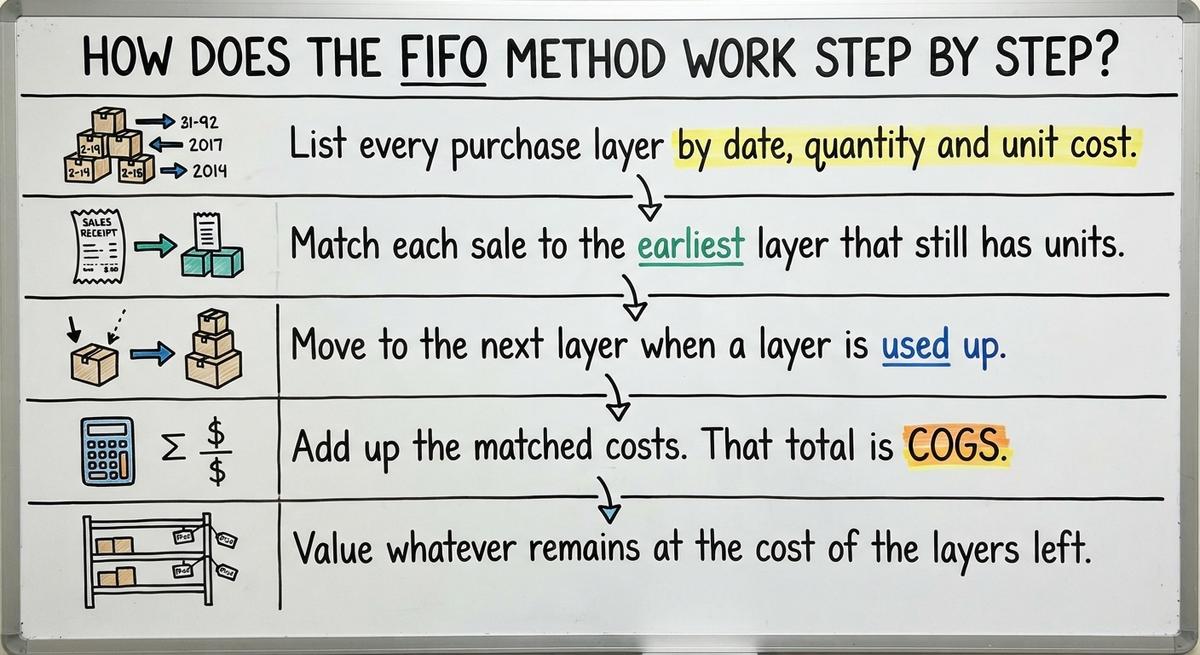
FIFO works in 5 steps. Each sale draws on the earliest layer first. The next layer comes into play when that one runs out.
- List every buy layer by date, quantity and unit cost.
- Match each sale to the earliest layer that still has units.
- Move to the next layer when a layer is used up.
- Add up the matched costs. That total is COGS.
- Value whatever remains at the cost of the layers left. That is ending inventory.
Each layer is a small ledger, so one wrong cost shifts every later number.
FIFO formula for cost of goods sold
The FIFO formula is a short pair of lines. Ending inventory follows from COGS.
`` FIFO COGS = units sold x cost of the oldest layers used Ending inventory = beginning inventory + buys - COGS ``
Use the same layers for both lines, and the books will balance.
FIFO Inventory Valuation Example With Numbers
A FIFO example uses 3 price layers. A distributor buys cases of one product at three prices. Then it sells 150 cases.
- Layer 1: 100 cases at $10 each.
- Layer 2: 100 cases at $12 each.
- Layer 3: 100 cases at $14 each.
The sale takes all of layer 1, then 50 cases from layer 2.
FIFO COGS = 100 x $10 + 50 x $12 = $1,600.
The cases left are 50 from layer 2 and all 100 from layer 3.
Ending inventory = 50 x $12 + 100 x $14 = $2,000.
Check the work. Total buys were $3,600. COGS of $1,600 plus ending inventory of $2,000 also equals $3,600.
When both totals add up to buys, the layers are sound.
How Does FIFO Affect Profit and Taxes?
FIFO profit is tied to price swings. It rises when prices rise and falls when they fall. Early costs hit COGS first. Ask a CPA how this treatment applies to your tax return.

Price direction decides how FIFO shifts reported profit.
When prices rise
Rising costs are good news for reported profit. Old, low costs flow into COGS. Say the 150 cases above sell for $20 each. Revenue is $3,000. FIFO COGS is $1,600, so gross profit is $1,400. A method that charges the newest costs first would show COGS of $2,000 and profit of $1,000.
That extra $400 is taxable income. Ending inventory under FIFO sits near current prices. The balance sheet looks strong, and the tax bill grows with it.
Higher reported profit under FIFO also means higher tax.
When prices fall
Falling costs are hard on FIFO profit. Old, high costs hit COGS first. Stock left on the shelf may also be worth less than its recorded cost. Accounting rules call for a write-down in that case.
The lower of cost or net realizable value rule means you carry stock at the smaller of what it cost and what it can sell for, minus selling costs.
A price drop can hit twice: thin margin now, and a write-down after.
Not sure this is the right shape for your operation
Describe how the work runs today. We map it on a call and show you what it would look like built around that, before you spend anything.
Book a callFIFO vs. LIFO vs. Weighted Average Cost
FIFO vs LIFO is a choice about which costs leave first. LIFO, or last in, first out, charges the latest buys to COGS. US GAAP allows LIFO. IFRS does not.
Weighted average cost blends all costs into one average. Some firms call a rolling version the moving average method inventory.
| Method | How it assigns cost |
|---|---|
| FIFO | Oldest costs go to COGS first |
| LIFO | Newest costs go to COGS first |
| Weighted average | One blended cost per unit |
The three methods differ only in which costs reach COGS.
Which Inventory Valuation Method Fits Which Kind of Goods?
The best valuation method is the one that matches your goods. FIFO fits goods that expire or move in order. LIFO fits firms that want lower taxable income when prices climb.
The weighted average inventory valuation method fits bulk goods that blend together, like grain or fuel. Other inventory pricing methods exist too. The specific spotting inventory method tracks the real cost of each unique item. It suits cars and jewelry.
Match the method to how your goods flow.
Is the FIFO Method Right for Your Business?
FIFO is right for most firms that sell goods in the order they arrive. Weigh the gains against the costs before you commit to this valuation method.

A good fit depends on your goods, your records and your tax picture.
What are the pros of FIFO?
FIFO has 3 main pros. The best known is that anyone can follow it. Early costs go to COGS first, so the logic is easy to explain. Lenders and auditors grasp it fast.
- FIFO matches how most goods move, especially date-coded items.
- Balance sheet inventory sits close to current cost under FIFO.
- US GAAP and IFRS both accept FIFO, so the method works under either standard.
Simple logic and current balance sheet values are the pros of FIFO.
Cons of FIFO
FIFO has 3 main cons. Each one comes from the way the method charges old costs to sales first.
- Profit looks higher when costs climb, as older and lower costs meet current sales.
- The tax bill can rise in years of price increases, as higher profit means higher taxable income.
- Cost-layer records must be good, and small shops often lack them.
Without clean records, FIFO layers cannot be tracked reliably.
Which businesses should use FIFO?
FIFO suits 3 kinds of business best. Each one handles goods that move in order or that carry dates.
- Food, drink, chemical and health product sellers with expiration dates.
- Wholesalers and distributors with steady turnover.
- Fulfillment centers that hold client-owned or date-sensitive goods.
Ask your CPA before you choose a method for wholesale inventory valuation.
The comparison is easier when one option is built for you
Off-the-shelf means fitting your process to the software. We do it the other way round, and the first look costs nothing.
Book a callCan You Switch Inventory Valuation Methods?
A method change is allowed with a sound reason and steady use. A firm cannot flip methods each year to move profit around.
A tax method change can need IRS approval on Form 3115. Talk to a CPA first. Then work through this list:
- Plan the change for the start of a fiscal year.
- Write down why you are changing and what it does to the numbers.
- Restate opening inventory under the new method.
A clean start date and a paper trail protect you in an audit.
Does Accounting Software Handle FIFO Inventory Valuation?
FIFO support is uneven across products and versions. Some setups, such as certain accounting software editions, use average cost. Others support FIFO layers. Check your own edition before you assume anything.
Costs drift when events happen outside the system:
- Goods arrive and no one enters the receipt that day.
- Returns come back at a guessed cost.
- Stock adjustments happen in a sheet, not in the ledger.
Each gap breaks a layer. The software then values stock at a cost that never existed.
Software only supports FIFO method inventory valuation when the data going in is complete.
Which Costs Belong in Each FIFO Layer?
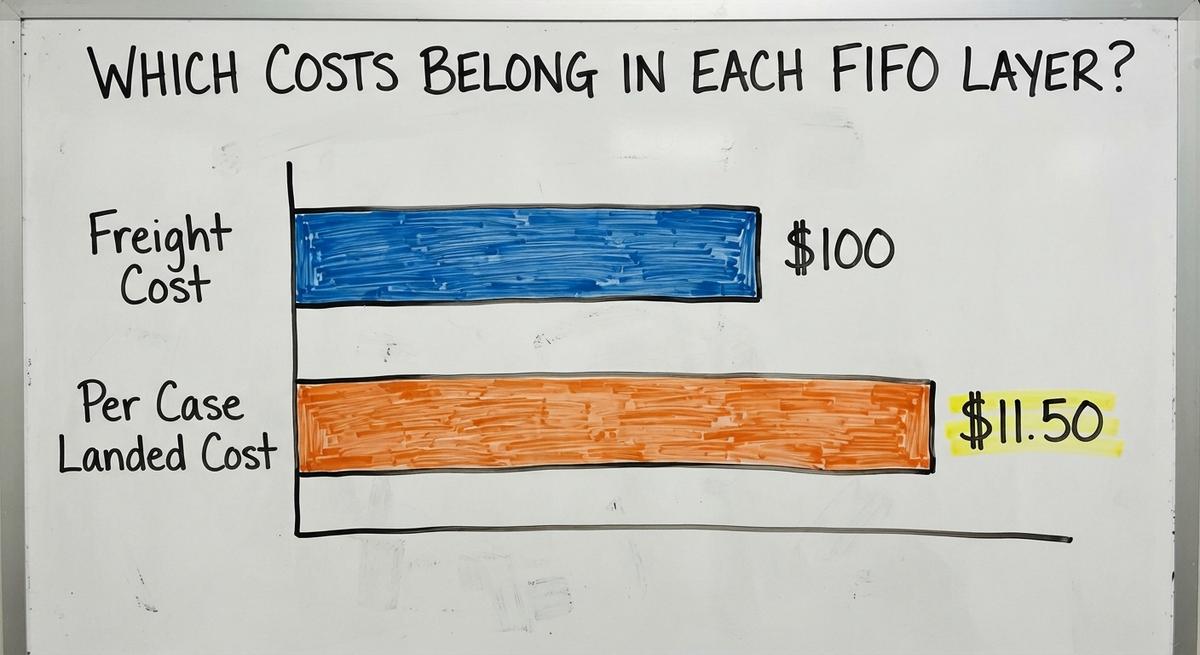
A FIFO layer is the full cost to get goods ready to sell. That total is landed cost. Include the buy price, freight in, duties and prep costs. Leave out selling costs and general overhead. Discounts and rebates lower the layer cost.
Here is a quick case. You buy 100 cases at $10. Freight is $100 and duties are $50. Landed cost is $1,150, or $11.50 a case.
Landed cost is the figure that belongs on every layer.
How returns, damage and shrinkage change layers
Shrinkage is stock that vanishes through theft, loss or error. Returned goods need a cost. Use the original layer cost. Write off damaged or lost stock from the right layer, not the newest one.
Regular cycle counts catch shrinkage early. A cycle count is a small, rolling count of a few items each week.
Honest layers need honest counts.
See it running on your own process first
No build cost. The subscription starts once it is live and doing the job, not before.
Book a call
Common FIFO Valuation Mistakes in Spreadsheets
Spreadsheets break FIFO in 4 common ways.
- Missing receipt costs. Staff skip the cost of each receipt, so layers have no price.
- Overwritten prices. Someone types the newest unit cost over the old one.
- Left-out landed cost. Freight, duties and handling never reach the layer.
- Version confusion. Three copies of one file hold three different answers.
One overwritten cell can change COGS for a whole month.
How to Track FIFO Cost Layers Accurately
Accurate FIFO tracking is built on one rule: record every receipt the day it arrives. Any provider or system can use this routine.
- Log date, quantity and landed cost for each receipt.
- Add lot or batch numbers where you can.
- Compare system counts to physical counts on a set schedule.
- Cut re-keying between sheets, email and the accounting package.
Re-keying is where errors start. Each retype is a chance to swap a digit. The NIST Manufacturing Extension Partnership offers vendor-neutral guidance on supply chain and inventory process.
Fewer hand-offs mean fewer wrong costs.

Signs You Have Outgrown Manual FIFO Tracking
Manual FIFO tracking has 3 warning signs.
- Slow close. Month-end inventory value takes days to reconcile.
- Mismatched numbers. The sheet, the ledger and the warehouse disagree.
- One expert. Only one person understands the tracking file.
A fix does not mean a new accounting system. Automate only the manual steps, like receipt entry and count checks. Keep the package you already use.
If the close takes 3 days now, ask what you could do with 2 of them back.
Next Steps for FIFO Inventory Valuation
FIFO is simple on paper and fragile in practice. Start with your receipts. Check that each one has a date, a quantity and a landed cost. Then review one month of COGS against your layers. Share the result with your CPA.
If the steps above show gaps, map the manual hand-offs that cause them and fix those first.
Frequently asked questions
What is the difference between FIFO and LIFO?
FIFO charges the oldest costs to goods sold first. LIFO charges the newest costs first. When prices rise, FIFO shows higher profit and LIFO shows lower profit. US GAAP allows both, but IFRS bans LIFO.
How do you calculate FIFO cost of goods sold?
List buy layers from oldest to newest. Multiply the units sold from each layer by that layer's unit cost, starting with the oldest. Add the results. Sell 150 units from 100 at $10 and 100 at $12, and COGS is $1,600.
What costs go into a FIFO layer?
A layer holds landed cost: the buy price plus freight in, duties and prep costs. Selling costs and general overhead stay out. Discounts and rebates reduce the layer's unit cost.
Does FIFO work with accounting software?
Many packages handle FIFO, but support varies by product and version. Some default to average cost. Read your edition's records, and keep receipts, returns and adjustments inside the system so layers stay correct.
Does FIFO raise my taxes?
When costs rise, FIFO reports higher profit, so taxable income can be higher than under LIFO. When costs fall, the reverse holds. Confirm the effect on your return with a CPA.
Can a business change its inventory valuation method?
Yes, with a sound reason and steady use afterward. A tax method change can need IRS approval on Form 3115. Plan it for a year start, document it, and ask a CPA first.
Which businesses should use FIFO?
Sellers of food, drinks, chemicals and health goods fit FIFO best. So do wholesalers with steady turnover and fulfillment centers holding date-sensitive stock. Ask a CPA before you pick or change a method.
Start with a free first look
A 30 minute call, your operation mapped, and a clear picture of what we would build. No obligation and nothing to install.
Book a callRelated guides
More on the same work.
Guides
- Weighted Average Inventory Valuation Method
- Inventory Valuation Fifo
- Specific Identification Inventory Method
- Inventory Pricing Methods
- Moving Average Method Inventory
- Weighted Inventory Method
- Inventory Audit Checklist
- Inventory Shrinkage is Recorded When
- Inventory Audit
- Inventory Accuracy
- Inventory Management Best Practices
- Shrinkage in Inventory
- Inventory Accuracy Formula
- Inventory Process Flow
- Inventory Shrinkage Accounting Entry
- Calculate Inventory Shrinkage
- Cycle Counting Inventory