


Weighted Inventory Method
The weighted inventory method is one average cost for every unit.
Reviewed November 2026.
Divide total cost by total units to find it.
The result sets cost of goods sold and ending inventory.
Book a callWhat Is the Weighted Inventory Method?
The weighted inventory method is a way to give every unit the same average cost.
Some call it the weighted average cost method. The average is total cost divided by total units.
The method fits items that are alike and bought in many batches. Think bolts, bags of salt, or cases of soap.
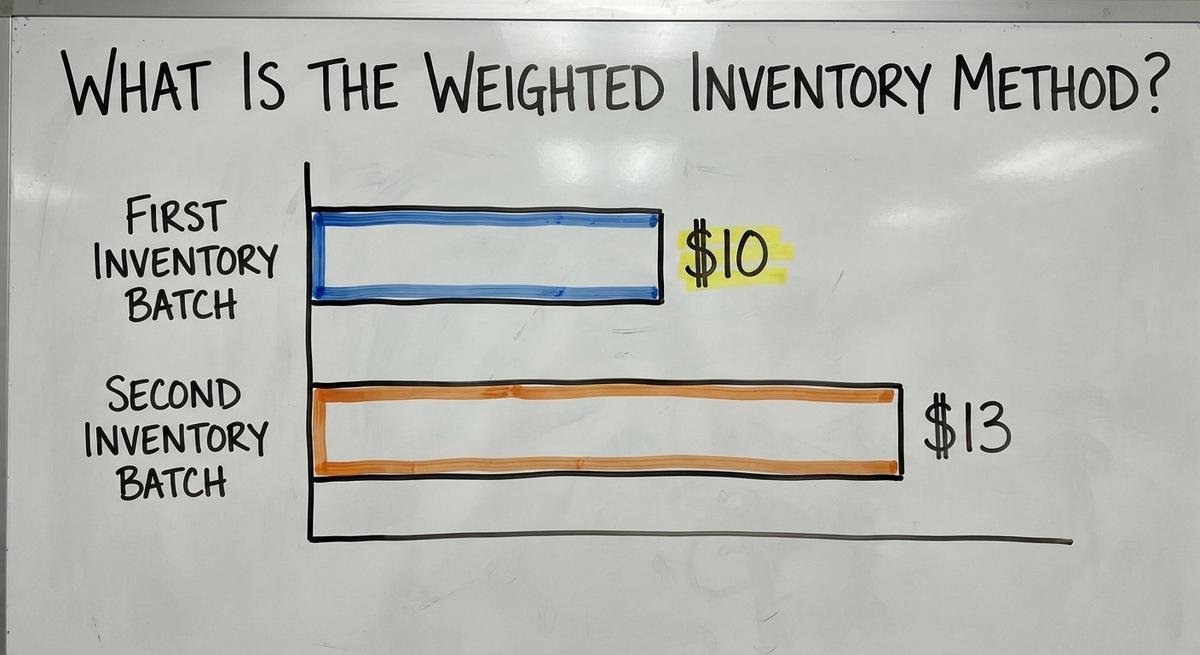
Price swings get smoothed out. A $10 batch and a $13 batch blend into one steady number.
That blend makes weighted average inventory easy to read.
Why Distributors Use the Weighted Inventory Method
4 reasons drive the choice. Buy prices change from one buy to the next, so distributors pick the weighted inventory method.
- Tracking the cost of each batch takes hours, and one average cost removes that work for the whole team.
- Bulk, mixed, or hard-to-separate stock has no clear batch to point to, so a single average fits better.
- Steady cost numbers make margins easier to compare from week to week and from one product line to another.
- Scan-based counts feed the average well, and GS1 publishes the barcode standards behind those counts.
One average per item keeps the books simple and steady.
We build it for your operation, and the first look is free
If you would rather not compare products, describe how your operation already works and we build the system around it.
No build cost. You see it running on your own process first, and the monthly subscription starts only once it is live.
Book a callWhat Is the Formula for the Weighted Inventory Method?
The formula is weighted average cost = total cost of goods available for sale ÷ total units available.
Average cost = total cost ÷ total units
Each part has a plain meaning:
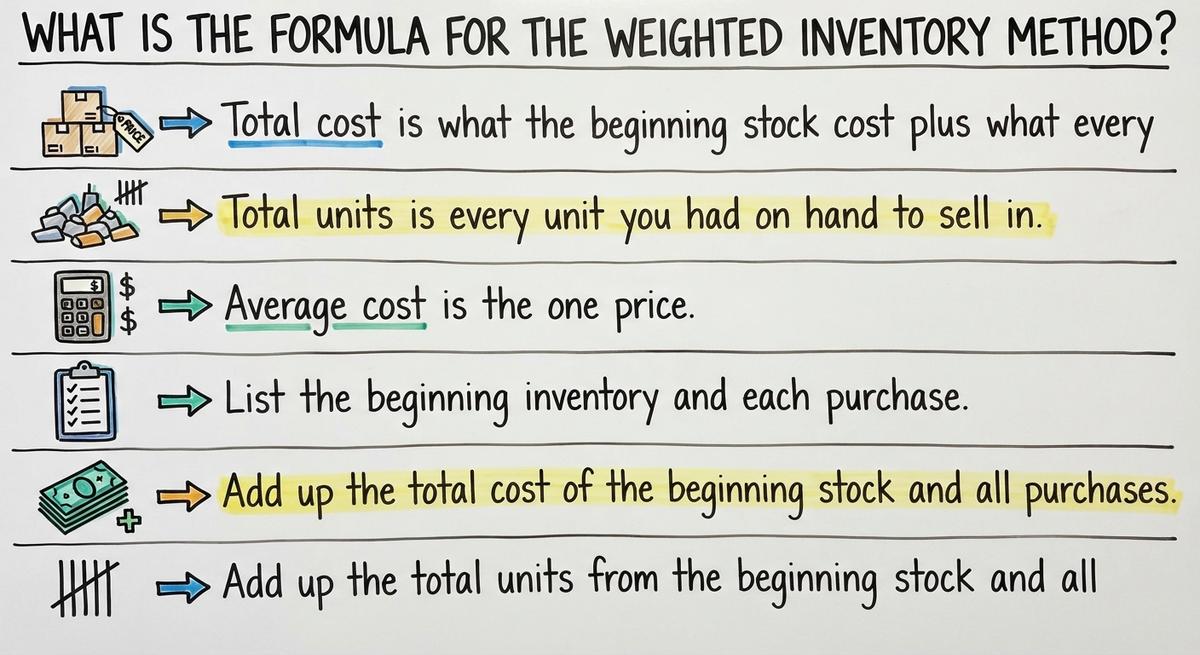
- Total cost is what the beginning stock cost plus what every new buy cost during the period.
- Total units is every unit you had on hand to sell in that period, counted in one measure.
- Average cost is the one price that each unit carries into cost of goods sold and ending stock.
Count all units in the same measure. Do not mix cases and single items.
The same measure on every line keeps the average honest.
How to Calculate Weighted Average Inventory Cost
The calculation takes 5 steps. Work them in order:
- List the beginning inventory and each buy, with the units and the cost of each batch listed side by side.
- Add up the total cost of the beginning stock and all buys in the period, using the same cost basis.
- Add up the total units from the beginning stock and all buys, counting every unit in one measure.
- Divide the total cost by the total units to get the average cost per unit for the period.
- Multiply the average by units sold for cost of goods sold, and by units left for ending inventory.
The last step splits one pool of cost into two answers.
A Simple Example With Real Numbers
The example uses 100 units bought at $10 and 200 units bought at $13. Here is the math:
- Multiply 100 units by $10 to get $1,000 as the cost of the first batch of beginning stock.
- Multiply 200 units by $13 to get $2,600 as the cost of the second batch bought later.
- Add the two batches to get a total cost of $3,600 for 300 units on hand.
- Divide $3,600 by 300 units to get an average cost of $12 per unit for every item.
Now sell 150 units. Cost of goods sold is the cost of the items you sold.
That is 150 × $12 = $1,800. Ending inventory is the cost of items left. It is also 150 × $12 = $1,800.
Every unit costs $12, so the sold half and the unsold half both land at $1,800.
Not sure this is the right shape for your operation
Describe how the work runs today. We map it on a call and show you what it would look like built around that, before you spend anything.
Book a callPeriodic vs. Perpetual Weighted Average
Weighted average inventory has 2 forms. A periodic system finds the average once, at period end.

A perpetual system recalculates after every buy. That second form is the moving average cost.
Perpetual gives a more current cost. It needs better records, since every receipt must post on time.
The answers can differ. Say you buy 100 units at $10, sell 50, then buy 200 units at $13.
- Periodic uses $12 for all units, so the 50 units sold carry a cost of $600 in the books.
- Perpetual uses $10 at the time of sale, so the 50 units sold carry a cost of $500.
The same buys give two cost figures, and timing is the only cause.
A Moving Average Example
Moving average is a running average. The moving average method inventory shows its work after each event.
Start with 100 units at $10. The average is $10.
Sell 50 units. The average stays at $10, since a sale does not change the average. Cost left is $500 for 50 units.
Buy 200 units at $13. Cost is now $500 + $2,600 = $3,100 for 250 units.
The new average is $3,100 ÷ 250 = $12.40.
Only a new buy moves the moving average.
Weighted Inventory Method vs. FIFO
FIFO is first in, first out. It assumes the oldest stock sells first.

When prices rise, FIFO shows lower cost and higher profit. The weighted method lands in the middle.
Use the earlier data: 100 units at $10, 200 at $13, and 150 sold.
| Method | Cost of goods sold / ending inventory |
|---|---|
| FIFO | $1,650 sold, $1,950 left |
| Weighted average | $1,800 sold, $1,800 left |
| LIFO | $1,950 sold, $1,650 left |
Weighted average sits between the two extremes on both lines.
How Does the Weighted Inventory Method Differ From LIFO?
LIFO is last in, first out, so the newest stock sells first. The weighted inventory method differs in which cost it assumes sells.
US rules allow LIFO. International rules do not. A distributor with overseas partners should check this early.
Weighted average avoids the big swings of either extreme. Ask an accountant how each choice affects your taxes.
Average costing is the calm option between two sharp ones.
How the Weighted Inventory Method Affects Profit and Taxes
Cost of goods sold is the link between your inventory method and profit. It feeds straight into gross profit.
Sell the 150 units at $20 each for $3,000 in sales:
- FIFO gross profit is $3,000 − $1,650 = $1,350, the highest of the three methods shown here.
- Weighted average gross profit is $3,000 − $1,800 = $1,200, which sits in the middle of the range.
- LIFO gross profit is $3,000 − $1,950 = $1,050, the lowest of the three methods shown here.
Average cost smooths profit when prices jump. The IRS speaks to this in Publication 538.
It says "you must value your inventory at the beginning and end of each tax year."
A CPA should confirm your method and any change to it.
The method you pick shows up on your tax return.
Pros and Cons of the Weighted Inventory Method
The weighted inventory method has 2 sides. Weigh both against your stock before you commit.
Pros
4 strengths make the weighted method popular with distributors:
- The method is simple to explain and apply, even to staff who are new to costing work.
- Price spikes hit the average less, so one pricey batch does not wreck the numbers for a month.
- Bulk and interchangeable items fit well, such as fasteners, cleaning supplies, and other goods bought in volume.
- Record-keeping is lighter than tracking each batch on its own, which saves time for busy receiving teams.
The Census Bureau tracks wholesale inventories and sales each month. Stock is a large asset for these firms.
A simple method that holds up is worth a lot.
Cons
4 limits come with the weighted method:
- The average hides real price changes, so you can miss a supplier raising costs on a key item.
- Unique or serialized items do not fit, since each one has its own cost that the average erases.
- The average can lag behind current replacement cost after a fast price rise in the market.
- Counts and costs must be accurate, or the average carries the error into every later number.
The method is only as good as the numbers fed into it.
The comparison is easier when one option is built for you
Off-the-shelf means fitting your process to the software. We do it the other way round, and the first look costs nothing.
Book a call
When Should a Distributor Avoid the Weighted Inventory Method?
3 cases call for another method. Items that are not alike do not suit the weighted inventory method.
- Perishable goods suit FIFO, since the oldest stock must leave first and the books should show that.
- Serialized or high-value items suit the specific spotting inventory method, which tracks the true cost of each item.
- Mixed catalogs can use different methods for different items, as long as each choice stays within accounting rules.
The question of what is the cost method to value inventory has no single answer. Compare inventory pricing methods item by item.
Then check with your accountant.
The right method matches how the item really moves.
Common Mistakes With the Weighted Inventory Method
4 mistakes make weighted average costs wrong. Each one is easy to spot once you know it:
- Left-out landed costs: Freight-in and duties belong in unit cost when your policy says to include them.
- Mixed units: Cases and single items in one line give a false average that skews every later figure.
- Missed returns and write-offs: Damaged, lost, or returned stock must leave the books, or the unit count stays too high.
- Rare counts: Stock that is not counted often drifts from the records, and the average drifts with it.
The FTC expects sellers to ship when they said they would. An accurate count protects that promise.
Each mistake adds a small error that grows with every new buy.
Why Does Cost Data Go Wrong in Spreadsheets?
Spreadsheets are a common source of cost errors. Receipts arrive late, copies drift apart, or one formula breaks.
Weighted average inventory needs every receipt entered on time. A missed entry skews every later average.
Many warehouse inventory teams run on printed sheets, email, and Excel copies. Those versions drift apart fast.
One wrong formula spreads through every cost below it.
The Bureau of Labor Statistics tracks pay for stock clerks and order fillers. Each hour spent fixing copies is a paid hour.
One shared record beats five copies.
Weighted Average Costing in an Accounting Package
Average costing is a common setting in accounting tools. Many packages offer it for inventory in common setups.
Features differ by version and setup, so check yours.
Enter receipts and bills correctly, or the costs come out wrong. Many teams sync receiving data into their accounting software.
Bills must match what arrived.
Manual work outside the package breaks the numbers. A count fixed in a spreadsheet but never posted is one example.
The package can only average what you post.

See it running on your own process first
No build cost. The subscription starts once it is live and doing the job, not before.
Book a callHow to Keep Weighted Average Costs Accurate
4 habits keep weighted average costs accurate. NIST offers vendor-neutral guidance on supply chain and inventory process.
- Record receipts the same day they arrive, before the paperwork piles up and details start to slip.
- Use one list of item names and units, so each product has one line and one clear average.
- Count stock on a regular cycle, such as weekly for fast movers, so the records stay close to the shelf.
- Review large cost changes before posting, since one typo can shift the average for every unit after it.
Small daily habits beat a big yearly cleanup.
Questions to Ask Before You Automate Costing
5 questions help you vet any provider. Ask them before you hand weighted inventory costing to software:
- Fit: Does the tool match how receiving already works at your dock, from truck arrival to shelf?
- Accounting: Will it keep your accounting tool in place and work with it where that tool helps?
- Proof: Can it show how each cost was figured, line by line, so your team can audit the result?
- Training: Can staff use it without long training, so the new process does not slow down receiving?
- Method: Does it support perpetual and periodic averages if you need both for different items or reports?
A tool you cannot audit is a tool you cannot trust.

Next Step
Your next step is 1 small test. Pick one item this week.
Work its weighted average by hand with the 5 steps above. Then compare your answer to your system.
If the two differ, you have found where your costs drift.
Fix that gap first.
Frequently asked questions
Is weighted average allowed under GAAP?
Yes. US GAAP and international rules both accept weighted average cost. Apply it the same way each period and to like items, and tell your accountant if you plan to switch.
Can a business change its inventory costing method?
Yes, with a sound reason. A tax method change can need IRS approval. Keep the new method steady afterward. Ask a CPA before you switch.
Does average costing work for small warehouses?
Yes. A small warehouse with alike items gains the most, since one average replaces many batch records. Keep counts accurate and units the same.
Can an accounting package run average costing?
Many can. Check your version and setup, because features differ. Costs stay right only when every bill and receipt is posted on time.
Which costing method shows the lowest profit when prices rise?
LIFO shows the lowest profit in rising markets, since it matches the newest, highest costs to sales. FIFO shows the highest. Ask a CPA about tax effects.
How often should I count stock?
Count on a fixed cycle. Fast movers and high-value items need counts more often than slow ones. Regular counts catch errors before they spread into your average.
Start with a free first look
A 30 minute call, your operation mapped, and a clear picture of what we would build. No obligation and nothing to install.
Book a callRelated guides
More on the same work.
Guides
- Weighted Average Inventory Valuation Method
- Fifo Method Inventory Valuation
- Specific Identification Inventory Method
- Inventory Pricing Methods
- Moving Average Method Inventory
- Inventory Audit Checklist
- Inventory Shrinkage is Recorded When
- Inventory Audit
- Inventory Accuracy
- Inventory Management Best Practices
- Shrinkage in Inventory
- Inventory Accuracy Formula
- Inventory Process Flow
- Inventory Shrinkage Accounting Entry
- Calculate Inventory Shrinkage
- Cycle Counting Inventory
Common questions
- What is the Cost Method to Value Inventory
- How to Record Inventory Shrinkage
- What is Cycle Counting in Inventory Management
- What Common Events Could Result in Inventory Shrinkage
- What is Cycle Counting in Inventory
- What is a Good Inventory Accuracy Percentage
- What is Free Stock in Inventory Management
- What is Stock Out Cost in Inventory Management