


Inventory Valuation Fifo
Reviewed and updated: October 2026
FIFO, or First In, First Out, means the oldest inventory you bought is the first inventory you sell, for accounting purposes. Under FIFO inventory valuation, the cost of goods sold reflects your earliest buy prices. The inventory left on your balance sheet carries your most recent costs. This article explains how it works, what it costs you at tax time, and why manual FIFO tracking breaks down past a certain scale.
Book a callWhat Inventory Valuation FIFO Means for Your Books
FIFO stands for First In, First Out. It is a rule about which cost hits your books, not which physical box leaves the shelf.
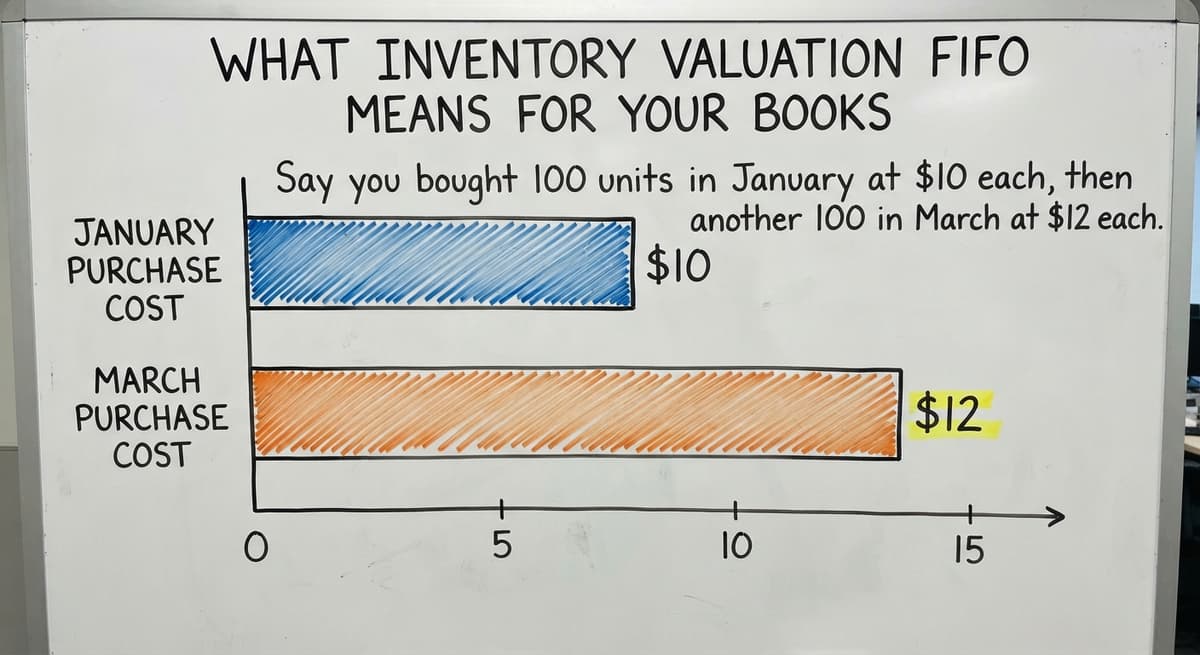
Say you bought 100 units in January at $10 each, then another 100 in March at $12 each. Under the FIFO inventory method, the January cost is assigned to the first units sold. The March cost follows. Your accountant does not need to know which actual case the forklift moved. The date of buy work out the cost layer.
We build it for your operation, and the first look is free
If you would rather not compare products, describe how your operation already works and we build the system around it.
No build cost. You see it running on your own process first, and the monthly subscription starts only once it is live.
Book a callWhy Consistent Inventory Valuation Is a Legal Requirement
The IRS is direct about why this matters. IRS Publication 538 states: "To figure taxable income, you must value your inventory at the beginning and end of each tax year." FIFO is one of the accepted methods for doing that. Picking one and using it consistently is a legal requirement, not a preference.
The method you choose changes two things at once: your reported profit and your tax bill.
How FIFO Inventory Valuation Works Step by Step
How do I calculate FIFO inventory valuation? Start with your oldest buy layer and work forward until the units sold are accounted for.
Here is a plain example:
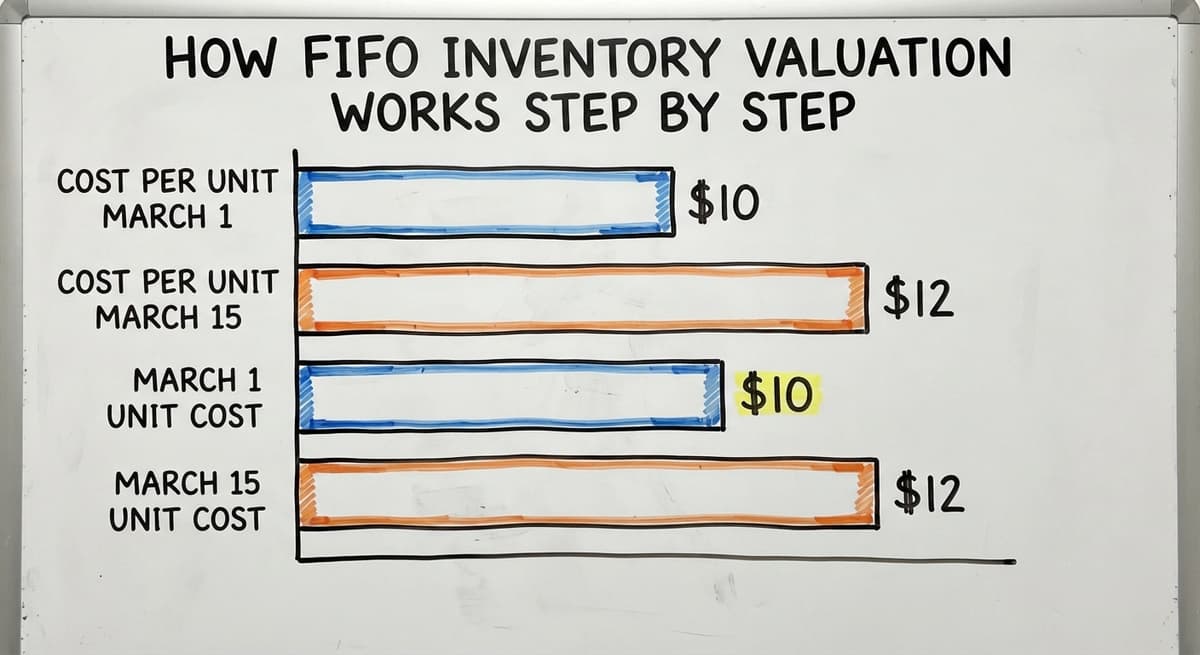
- You receive 100 units at $10 each on March 1.
- You receive 100 units at $12 each on March 15.
- You sell 120 units in March.
Under FIFO, the first 100 units sold carry the $10 cost. The next 20 carry the $12 cost. Your cost of goods sold for those 120 units is (100 x $10) + (20 x $12) = $1,240. The 80 units still on hand are valued at $12 each, giving you an ending inventory value of $960. A reader can check that math with a calculator in under a minute, which is the point: FIFO is not complicated. Keeping the data clean is where the work is.
How FIFO Affects Cost of Goods Sold and Gross Profit
COGS, or cost of goods sold, is what you paid for the units you sold. Gross profit is revenue minus COGS. Change COGS and you change gross profit. Change gross profit and you change what lenders, buyers, and the IRS see.
GS1's barcode standards, which govern how goods are identified and tracked at the scan level, make it possible to tie a physical receipt to a specific cost layer automatically. Without that link, COGS is a guess dressed as a number.
How Rising Costs Make Your Valuation Method Matter More
When buy costs are rising, FIFO pushes the lower older costs into COGS first. That produces a higher gross profit figure than LIFO would. Higher gross profit looks better to a lender. It also means more taxable income, which matters at year-end.
The valuation method you choose is not an accounting detail; it shapes how healthy your business looks on paper and how much you pay in taxes.
The comparison is easier when one option is built for you
Off-the-shelf means fitting your process to the software. We do it the other way round, and the first look costs nothing.
Book a callFIFO vs. LIFO and Weighted Average: The Core Differences
Three methods are in common use. Each one produces a different COGS from the same set of buys.
| Method | COGS in rising-cost market | Ending inventory value | Allowed under IFRS |
|---|---|---|---|
| FIFO | Lower (older, cheaper costs first) | Higher (recent costs on balance sheet) | Yes |
| LIFO | Higher (newer, pricier costs first) | Lower (older costs on balance sheet) | No |
| Weighted average | Middle ground | Middle ground | Yes |
LIFO, or Last In, First Out, assumes the newest inventory sells first. That raises COGS when prices climb, which lowers taxable income. It is a legal method under US GAAP. It is not allowed under IFRS, the international accounting standard. US companies with foreign investors or export customers often default to FIFO for that reason alone.
Why Weighted Average Hides What FIFO Reveals
Weighted average cost blends all buy prices into a single average and applies it to every unit sold. It is simpler to calculate by hand. The tradeoff is that it hides cost swings. If one vendor raised prices by 15% and another held steady, a blended average will not show that. FIFO tracks each buy layer separately, so cost trends stay visible by SKU and by vendor.
For distributors buying the same SKU from multiple vendors at different prices, FIFO usually reflects reality better than an average.
When FIFO Is the Right Choice for Wholesale Distributors
FIFO is a natural fit when products have expiration dates, shelf-life limits, or model-year cycles. A food distributor rotating stock oldest-first is already running FIFO physically. The accounting method should match that reality.
For most wholesale and fulfillment operations, FIFO aligns with how goods already move. Stock received first ships first. The cost layers follow the same sequence. That match between physical flow and accounting method reduces the chance of a gap between what the books say and what is on the shelf.
When input costs are rising, FIFO also produces a higher gross profit figure. That can strengthen a financing conversation. A lender looking at your balance sheet will see inventory valued at current replacement cost rather than older, lower prices.
If your operation already rotates stock oldest-first, FIFO is not just the right accounting choice; it is the one that matches how your warehouse already works.
What FIFO Means for Your Tax Bill
In an inflationary period, FIFO produces lower COGS and higher taxable income compared to LIFO. That means a larger tax bill in years when your buy costs are climbing.
Changing your valuation method after the fact needs IRS approval through Form 3115. That process takes time and adds cost. Picking the right method early avoids it. Confirm your specific situation with your accountant. This section explains the mechanics; it does not replace professional tax advice.
Can You Track FIFO Manually? Where It Breaks Down
Can you track FIFO manually with a spreadsheet? Yes, for a short time, with a small number of SKUs and a single receiving location.
The standard approach is a spreadsheet with columns for buy date, vendor, quantity, and unit cost. Each new receipt adds a row. Each sale pulls from the oldest open row first. It works until it does not.
Multiple vendors, partial receipts, price corrections, and customer returns each create a branch in the logic. A single missed entry means every COGS figure after it is calculated from the wrong starting point. By the time someone notices, the error may be 3 months deep.
The Real Labor Cost of a Manual FIFO Spreadsheet
The US Bureau of Labor Statistics reports that stock clerks and order fillers earn a median of about $18 per hour. 3 people spending 5 hours a week reconciling a FIFO spreadsheet costs roughly $14,040 a year in labor alone, before errors are factored in. That number does not include the time an accountant spends untangling variances at month-end.
A spreadsheet is not a FIFO system; it is a record of what you hope happened, and the gap between hope and reality grows with every SKU you add.
See it running on your own process first
No build cost. The subscription starts once it is live and doing the job, not before.
Book a call
Why an Accounting Package Alone Often Falls Short
A standard accounting package like most small-business accounting software does support FIFO inventory valuation. The requirement is that every receipt and every adjustment be entered correctly and on time. For a small operation with 1 location and 50 SKUs, that is manageable.
Wholesale distributors with high SKU counts, multiple locations, or frequent vendor price changes often find the native inventory module too limited. The result is a gap between what the accounting package shows and what is physically on the shelf, filled in by a separate spreadsheet or a manual count.
Why the Gap Between the Dock and the Books Is a Systems Problem
This is a systems problem, not a software problem. An accounting package is built to record transactions. It is not built to manage a receiving dock. When those two functions run in separate tools with no automatic link, FIFO data drifts.
Accounting software integration for warehouse operations works best when a purpose-built receiving layer feeds clean, timestamped data into the accounting record automatically. Without that layer, someone is manually bridging the gap, and manual bridges break.
The accounting package is fine where it sits; the operations layer needs its own structure before the numbers reach it.
What a Proper FIFO Tracking System Actually Does
Good inventory tracking software does 4 things that a spreadsheet cannot do reliably at scale:
- It records every buy receipt with date, quantity, and unit cost at the moment goods arrive, not at the end of the day.
- It applies the correct buy cost layer to each sale or shipment without manual calculation.
- It flags a receipt that does not match a buy order, or a price change that was not approved, before the error enters the valuation.
- It pushes a clean journal entry to the accounting package so the books stay accurate without double entry.
How Multi-Location FIFO Breaks Without the Right System
Custom warehouse receiving software can mirror the exact workflow the receiving team already uses. It pulls buy orders, matches them to receipts, locks in the cost layer, and sends the journal entry forward, all without a manual step. Split shipments, vendor credits, and landed cost adjustments can be handled the way the business actually handles them, not forced into a generic template.

Inventory management software for wholesale distributors built this way also handles multi-location FIFO cleanly. A unit received in one warehouse on Monday and a unit received at a second location on Wednesday are separate cost layers, even if they share a SKU. Manual systems almost always collapse these into a single pool, which distorts the valuation for both sites.
A system built around the operation keeps each site's FIFO calculation separate and accurate without adding work at the dock.
What Reports Should a FIFO System Produce?
What reports should my FIFO inventory system produce? A working system should answer 3 questions on demand, without a manual spreadsheet build.
- Cost-layer report: Every open buy lot, its unit cost, and how many units remain in that layer.
- COGS by SKU and period: What each product cost to sell, by week or month, by location.
- Gross margin by product line: Real-time visibility into which SKUs are profitable, not a figure reconstructed at month-end.
If your current setup cannot produce these reports on demand, the FIFO data is being estimated, not tracked. Inventory matching for fulfillment centers depends on these reports being accurate before the close, not assembled during it.
Not sure this is the right shape for your operation
Describe how the work runs today. We map it on a call and show you what it would look like built around that, before you spend anything.
Book a callWhy Real-Time Margin Visibility Changes Replenishment Decisions
The US Census Bureau's Monthly Wholesale Trade data shows that wholesale inventories-to-sales ratios shift month to month across sectors. A distributor who cannot see real-time margin by product line is making replenishment decisions without knowing which SKUs are actually profitable at current costs.
If the report takes more than a few clicks to produce, the system is not tracking FIFO; it is storing data that someone else has to turn into a FIFO calculation.

Common FIFO Mistakes and How to Audit Your Process
Most FIFO errors come from 4 recurring habits:
- Entering receipts after the fact instead of at delivery, which breaks the date sequence FIFO depends on.
- Using one cost pool for a SKU sourced from multiple vendors at different prices.
- Leaving freight and landed costs out of the cost layer, so the layer is understated from day one.
- Skipping regular physical counts, which lets errors compound for months before anyone notices.
How to Run a 90-Day FIFO Audit on Three SKUs
To audit your current process, pick 3 high-turnover SKUs and trace every receipt and sale for the last 90 days. Verify that the cost applied to each sale matches the oldest open buy layer at the time of the sale. Compare the system's ending inventory value for those SKUs to a physical count and a current vendor price list.
If those numbers do not reconcile, the gap you found in 3 SKUs is almost certainly present across the full catalog. Replacing Excel-based inventory tracking is often the fastest fix, not because spreadsheets are bad tools, but because they are the wrong tool for a job that needs automatic timestamping and layer locking.
The NIST Manufacturing Extension Partnership recommends that small and mid-sized manufacturers and distributors document their inventory processes and audit them regularly. A process that has never been audited is a process that has never been confirmed to work.
Three SKUs traced for 90 days will tell you more about your FIFO accuracy than a year of month-end closes.
Getting FIFO Right Without a Full ERP
A full ERP is not required to get accurate FIFO valuation. What is required is a system that captures receipts correctly, applies cost layers consistently, and reconciles with the accounting package already in use.
Custom workflow rollout can do exactly that for a small or mid-sized distributor. The goal is to replace the manual parts: the spreadsheet, the printed receiving sheet, the email chain asking what price was on that last order. The accounting package stays where it is useful. The operations layer gets a purpose-built tool that feeds it clean data.

Why Accurate Inventory Data Is Also a Fulfillment Obligation
The FTC's guidance on order fulfillment makes clear that a business must ship when it says it will. Accurate inventory data is what makes that promise keepable. A FIFO system that drifts from reality does not just create accounting errors; it creates fulfillment failures.
If your team is maintaining a separate spreadsheet to track what the accounting package cannot, that spreadsheet is your real inventory system, and it is a liability. The fix is a connected system built around how your operation already works, not a platform migration that replaces everything at once.
The right FIFO system is the one your receiving team will actually use, built around the workflow they already follow.
Frequently asked questions
Which inventory valuation method is better, FIFO or LIFO?
There is no single answer. FIFO produces higher gross profit and a balance sheet inventory value closer to current replacement cost, which helps with lenders and foreign investors. LIFO reduces taxable income when costs are rising, which can lower your tax bill in the short term. LIFO is not allowed under international accounting standards, so companies with foreign investors or export business usually choose FIFO. The right method depends on your tax situation, your financing needs, and whether you operate internationally. Confirm the choice with your accountant before you start, because changing methods later needs IRS approval.
How do I calculate the FIFO inventory calculation?
List your buy layers in date order, oldest first. When a sale occurs, assign the cost from the oldest layer until it is used up, then move to the next layer. For example: 100 units at $10, then 100 units at $12, then a sale of 120 units. The first 100 sold carry the $10 cost. The next 20 carry the $12 cost. COGS is (100 x $10) + (20 x $12) = $1,240. The 80 remaining units are valued at $12 each. The math is straightforward; the challenge is keeping the buy layer data accurate and current.
Does IFRS use LIFO or FIFO for inventory valuation?
IFRS does not allow LIFO. Companies reporting under International Financial Reporting Standards must use either FIFO or the weighted average cost method. This is a key reason why US companies with foreign investors, overseas subsidiaries, or plans to list internationally often default to FIFO even when LIFO might offer a short-term US tax advantage.
Is FIFO allowed in GAAP?
Yes. FIFO is fully accepted under US Generally Accepted Accounting Principles. Both FIFO and LIFO are permitted under GAAP, along with the weighted average cost method. GAAP requires that you apply the chosen method consistently from year to year. Switching methods needs disclosure and, for tax purposes, IRS approval through Form 3115.
How does FIFO inventory valuation affect my balance sheet?
Under FIFO, the inventory on your balance sheet reflects your most recent buy prices. In a rising-cost market, that means the balance sheet inventory value is close to what it would cost to replace those goods today. Lenders and potential buyers often view this favorably because the asset value is not understated. Under LIFO, older lower costs stay on the balance sheet, and the inventory value can look significantly lower than replacement cost.
How do I handle customer returns under FIFO?
A customer return raises the question of which cost layer the unit goes back into. Most operations return it to the most recent open layer or record it as a separate adjustment at the original sale cost. Either approach works, but the method must be consistent and documented. Inconsistent handling of returns is one of the most common reasons FIFO valuations drift from reality over time. Your system should enforce the same rule every time, not leave it to whoever processes the return that day.
Can I get accurate FIFO tracking without implementing a full ERP?
Yes. A full ERP is not required. What is required is a system that records receipts with the correct date and cost at the time of delivery, applies cost layers automatically to each sale, and reconciles with your existing accounting package without double entry. A purpose-built receiving and inventory layer can do all of that for a small or mid-sized distributor without a large license fee, a long rollout, or a forced migration away from the accounting tools already in use.
Start with a free first look
A 30 minute call, your operation mapped, and a clear picture of what we would build. No obligation and nothing to install.
Book a callRelated guides
The rest of this guide, for the parts of the job this page does not cover.
Guides
- Classification of Inventory
- Excess Inventory
- Closed for Inventory
- Multi Location Inventory Management Software
- Ms Excel Inventory Template
- Inventory Management for Multiple Locations
- Costing Inventory
- Is Inventory a Long-term Asset
- Inventory Management System for Manufacturing
- Inventory Fixed Assets
- Inventory Management Pics
- Inventory Monitoring
- Excel Inventory Template
- Push and Pull Inventory
- Types of Inventory Control
- Consumable Inventory
- B2b Inventory Management
- Jewelry Inventory Management
- Dental Inventory Management
- The Objective of Inventory Management is To
- Qr Code for Inventory Management