


What Is Fifo In Inventory Management
FIFO stands for First In, First Out. It means the oldest stock you received ships before newer stock does. Reviewed and updated October 2026.
The rule applies to both physical goods movement and to cost accounting. It prevents waste, keeps records accurate, and protects margin. Every section below answers a question a warehouse owner or operations manager actually asks.
Book a callThe Simple Definition of FIFO in Inventory Management
FIFO, short for First In, First Out, means the first unit that arrived is the first unit that leaves. Think of a grocery shelf. Staff place new cans at the back and pull older cans from the front. Shoppers always grab the oldest stock first without thinking about it. That is FIFO in action.
The same logic runs through a warehouse. Older pallets ship before newer ones. The FIFO method also shows up in bookkeeping, where the oldest buy price is assigned to each unit sold. Both uses share one goal: keep old stock moving before it causes a problem.
We build it for your operation, and the first look is free
If you would rather not compare products, describe how your operation already works and we build the system around it.
No build cost. You see it running on your own process first, and the monthly subscription starts only once it is live.
Book a callHow FIFO Works on the Warehouse Floor
Physical FIFO starts at the receiving dock. Staff log each shipment with an arrival date or lot number. A lot number is a code that ties a batch of goods to a specific receipt, supplier, or production run.
From there, bin locations and rack rows are arranged so the oldest stock sits at the front of the pick queue. Pickers pull from that front position first. They do not choose which batch to take. The layout decides it for them.
GS1, the global standards body behind supply chain barcodes, notes that its standards enable "accurate and efficient traceability" across the supply chain, and its barcode specifications at gs1.org/standards/barcodes are the foundation most scan-based receiving systems build on.
Consistency across every shift is what makes warehouse inventory control work. One crew that skips date logging can undo a week of correct picks.
FIFO in the Books: What Does FIFO Mean for Cost of Goods Sold?
How does FIFO affect cost of goods sold in accounting? FIFO assigns the oldest buy price to each unit sold, so when costs rise over time, the price recorded against each sale is lower than what you paid for newer stock.
That produces a lower cost of goods sold and a higher reported profit during inflationary periods. The IRS needs businesses to value inventory consistently. IRS Publication 538 states: "To figure taxable income, you must value your inventory at the beginning and end of each tax year," per irs.gov/publications/p538.
Many small distributors already use FIFO as their inventory costing method inside an accounting package without enforcing it physically in the warehouse. That gap between the books and the floor is where errors grow.
Which Products Need FIFO Most
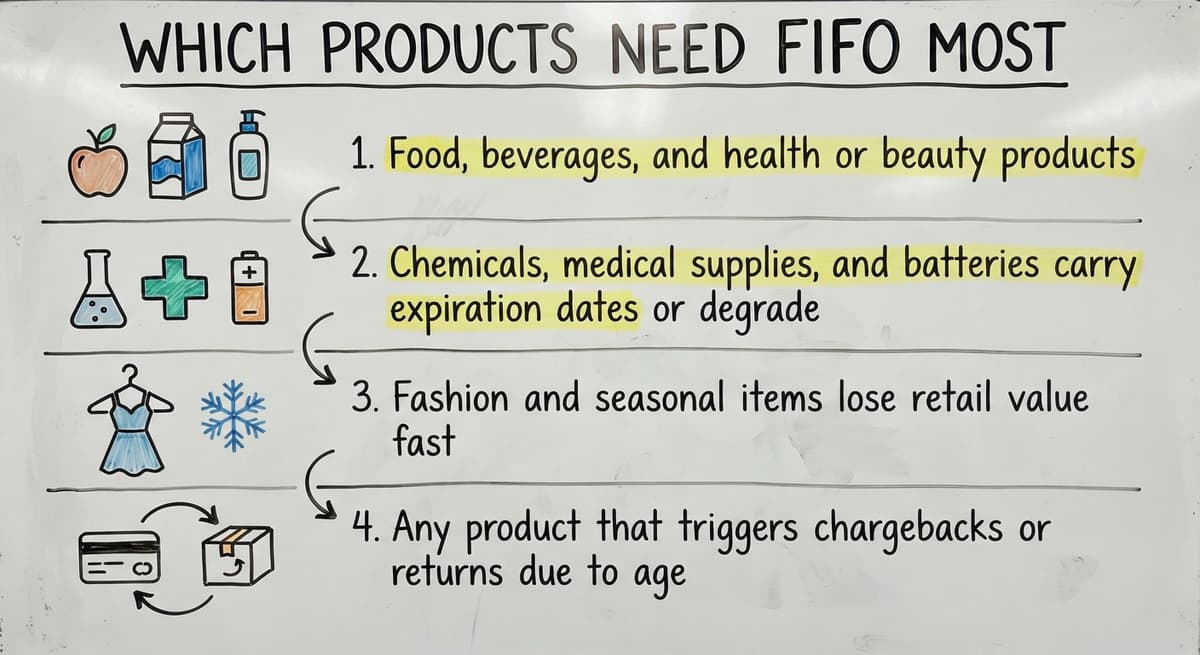
Not every product carries the same urgency, but some categories cannot afford to skip it. Perishable and regulated goods sit at the top of the list.
- Food, beverages, and health or beauty products expire and cannot be sold past their date without legal risk.
- Chemicals, medical supplies, and batteries carry compliance windows that regulators enforce.
- Fashion and seasonal items lose retail value fast. Selling last season's stock at full price becomes impossible after a few months.
- Any product that triggers chargebacks or returns when shipped late or out of date belongs in this group.
Non-perishable commodity goods are a lower priority, but lot tracking still helps with recalls and traceability. The NIST Manufacturing Extension Partnership identifies traceability as a core supply chain ability at nist.gov/mep/supply-chain. Even shelf-stable products benefit from knowing which batch went where.
The comparison is easier when one option is built for you
Off-the-shelf means fitting your process to the software. We do it the other way round, and the first look costs nothing.
Book a callFIFO vs. LIFO: A Quick Comparison
LIFO means Last In, First Out. The newest stock sells first. That leaves older inventory sitting at the back of the warehouse, aging.

LIFO is permitted under US tax rules but banned under international accounting standards, so companies that report overseas cannot use it. The tax appeal of LIFO is that it raises cost of goods sold during periods of rising prices, which lowers taxable income.
Most warehouses handling physical goods default to FIFO because it matches how goods actually move. Letting newer stock ship while older stock sits creates spoilage, chargebacks, and write-offs that erase any tax benefit. FIFO vs. LIFO is in the end a question of whether the accounting benefit outweighs the working cost of aging stock.
A Note on Tax Treatment
Inventory costing methods such as FIFO carry tax implications that vary by business structure and industry. For guidance on which inventory method suits your tax situation, consult a licensed CPA familiar with IRS Publication 538.
Common Problems When FIFO Is Done Manually
Manual FIFO breaks down in predictable ways. The problems are not random. They follow the same pattern across wholesale distributors and fulfillment operations.
- Pickers pull from the nearest bin, not the oldest one, because nothing stops them from doing so.
- Handwritten receiving dates get lost or misread, especially across multiple shifts or when labels peel.
- Spreadsheets tracking lot numbers fall out of sync with physical stock after the first unlogged receipt.
- Errors compound across shifts, so the actual inventory position drifts further from the recorded one each day.

What Manual FIFO Errors Cost in Labor
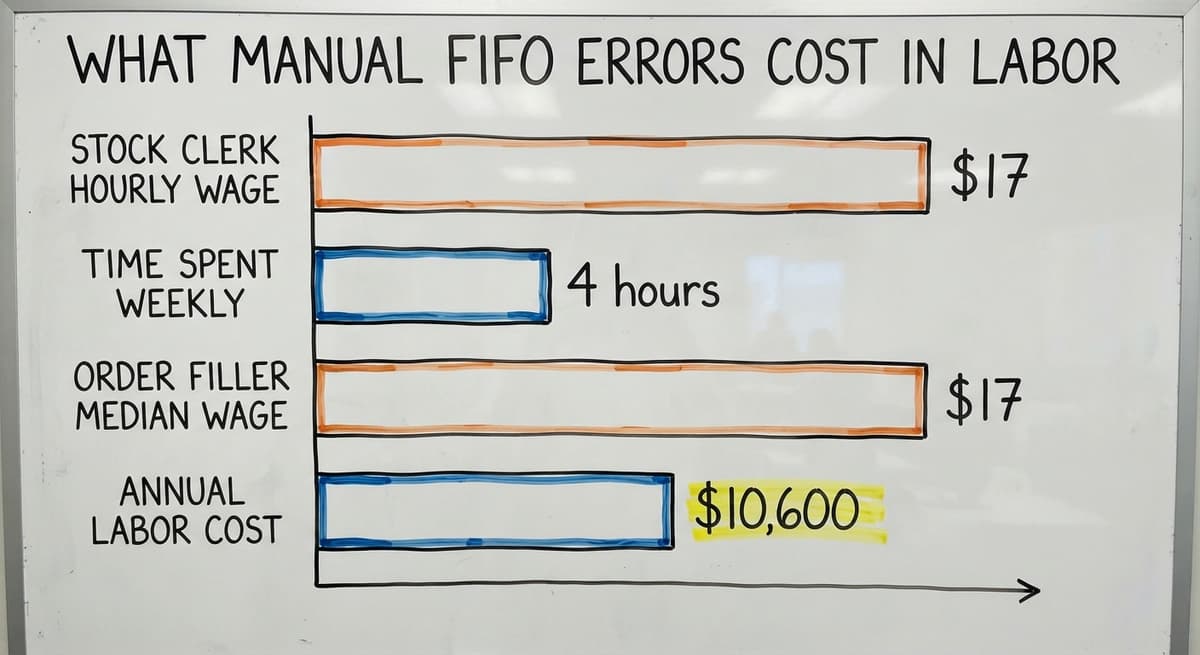
The US Bureau of Labor Statistics reports that stock clerks and order fillers earn a median wage around $17 per hour at bls.gov/oes/current/oes435071.htm. 3 people spending 4 hours a week each reconciling FIFO errors at $17 an hour costs over $10,600 a year, before counting the cost of a single spoiled shipment or chargeback.
See it running on your own process first
No build cost. The subscription starts once it is live and doing the job, not before.
Book a callHow Software Enforces FIFO Automatically
Inventory software removes the decision from the picker. That single change fixes most of what manual FIFO gets wrong.
Here is how an automated system handles the pick order:
- Receiving staff scan each inbound shipment. The system logs the date and lot number at that moment.
- When an order is released, the system builds the pick list in FIFO order. The picker sees the correct bin, not the closest one.
- Aged inventory gets flagged before it becomes a write-off, giving the team time to act.
- Financial records stay aligned with physical movement because the same receipt event updates both the warehouse count and the costing layer.

How Software Fits Into an Existing Operation
Integration with an accounting package keeps your accounting software's inventory records current without double entry. A system built around the team's existing bin layout needs less retraining and gets adopted faster than one that forces a new physical setup. The goal is to replace the error-prone steps, not the entire operation.
When Custom Inventory Software Fits Better Than Off-the-Shelf
Off-the-shelf inventory platforms are built for the average operation. Small and mid-size distributors often have workflows that do not fit standard software without expensive add-ons or workarounds that create new problems.
A custom system matches the exact bin layout, lot tracking rules, and receiving workflow the team already uses. Staff spend less time learning new screens and more time shipping correctly. Integration with your accounting software for warehouse and distribution stays in place for accounting. Only the manual, clipboard-driven steps get replaced.
The US Census Bureau's Monthly Wholesale Trade data at census.gov/wholesale/index.html shows that wholesale inventories-to-sales ratios shift with economic conditions, which means carrying the wrong stock at the wrong time has a real dollar cost. A system that enforces FIFO automatically reduces that exposure without adding headcount.
For operations that have outgrown spreadsheets, exploring inventory management software for wholesale distributors or learning how to replace spreadsheets in a warehouse operation are natural next steps. Custom warehouse software vs. off-the-shelf platforms is a decision worth making deliberately, not by default.
What Are the Key Takeaways on FIFO in Inventory Management?
FIFO is the right starting point for any operation that cannot afford waste, chargebacks, or inaccurate books. Here is what this article covered:
- FIFO means the oldest stock ships first, which reduces spoilage, keeps compliance windows intact, and produces reliable cost of goods sold figures.
- It applies to physical warehouse operations and to accounting records. Both need to match.
- Manual FIFO fails under real warehouse conditions because pickers take shortcuts and paper records drift.
- The right software enforces FIFO at the pick level, flags aged inventory early, and keeps financial records aligned without adding manual steps.
- A system built around how the team works gets adopted. One that fights the existing layout does not.
Lot tracking and expiration date management in inventory is where FIFO either holds or collapses. Get that layer right and the rest follows.
Frequently asked questions
What is FIFO and LIFO in inventory?
FIFO means First In, First Out: the oldest stock you received sells first. LIFO means Last In, First Out: the newest stock sells first. FIFO matches how physical goods actually move and prevents older stock from aging. LIFO is permitted under US tax rules but not under international accounting standards. Most warehouses handling perishable or dated goods use FIFO because leaving old stock at the back creates spoilage and write-offs.
What is FIFO with an example?
A distributor receives 100 units of a product on March 1 at $10 each, then 100 more on March 15 at $12 each. Under FIFO, the first 100 units sold are costed at $10, the March 1 price. The March 15 batch ships next. In the warehouse, the March 1 pallet sits at the front of the rack so pickers pull it first. The accounting and the physical movement follow the same sequence.
Is FIFO allowed in GAAP?
Yes. FIFO is fully allowed under US Generally Accepted Accounting Principles. It is also the only inventory costing method permitted under International Financial Reporting Standards, which govern reporting in most countries outside the US. LIFO is allowed under US GAAP and US tax rules but is not accepted under IFRS. If your business reports internationally or may be acquired by a company that does, FIFO avoids a future restatement.
How do you do FIFO step by step?
- Log every inbound shipment with an arrival date or lot number at the receiving dock. 2. Store older stock at the front of each bin or rack row so it is physically first in the pick path. 3. Generate pick lists that direct staff to the oldest batch before newer ones. 4. Record each sale against the oldest buy price in your accounting records. 5. Audit regularly to confirm the physical position matches the system record. Software automates steps 3 and 4 and reduces audit gaps.
What goes wrong when FIFO is managed manually?
Pickers pull from the nearest bin rather than the oldest. Handwritten dates get lost or misread across shifts. Spreadsheets tracking lot numbers fall out of sync after the first unlogged receipt. Errors build on each other until the recorded inventory position no longer reflects what is actually on the shelf. The cost shows up as spoilage, chargebacks, or a surprise discrepancy at year-end counting.
Can FIFO work alongside an accounting package without replacing it?
Yes. Inventory software can enforce FIFO at the warehouse level and pass costed transaction data to an accounting package automatically. The accounting package handles financial reporting as it always has. Only the manual, error-prone receiving and picking steps get replaced. This approach avoids a full system migration and keeps the finance team working in familiar screens.
Which products need FIFO most urgently?
Products with expiration dates or compliance windows need FIFO most: food, beverages, health and beauty items, pharmaceuticals, chemicals, and batteries. Fashion and seasonal goods are close behind because their value drops sharply after the selling window closes. Any product where a late or out-of-date shipment triggers a chargeback or return belongs in the high-priority group. Non-perishable commodity goods benefit from FIFO for traceability but face less immediate risk.
Start with a free first look
A 30 minute call, your operation mapped, and a clear picture of what we would build. No obligation and nothing to install.
Book a callRelated guides
The rest of this guide, for the parts of the job this page does not cover.
Guides
Common questions
- What is the Difference Between Aggregate and Item Inventory Management
- What is Jit Inventory Management
- What is Kanban System of Inventory Management
- What is the Definition of Inventory Management
- What is an Important Factor in Inventory Management
- What is Abc Classification in Inventory Management
- What is Inventory Management in Working Capital
- What is Inventory Management and Its Types
- What is the Main Purpose of Inventory Management
- What is Effective Inventory Management
- What is Information Technology Inventory Management
- What is Risk Pooling in Inventory Management
- What is Inventory Management Mary Kay
- What is Stock Taking in Inventory Management
- What is Bin Number in Inventory Management
- What is the Goal of Inventory Management Quizlet
- What is the Implication of Proper Inventory Management
- What is Omni-channel Inventory Management
- What is Inventory Management and Its Importance
- What is the Importance of Eoq in Inventory Management
- What is the Importance of Quality Inventory Management
- What is Inventory Management Explain Techniques of Inventory Management
- What is Mean by Inventory Management