

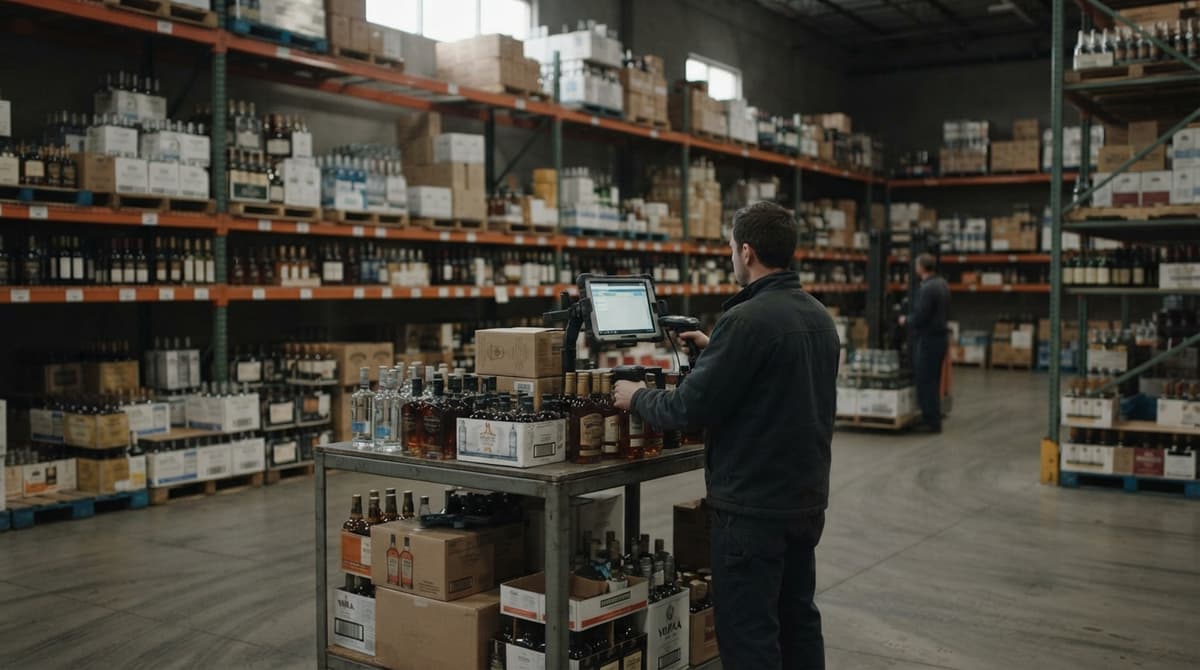
How to Keep Track of Liquor Inventory
To keep track of liquor inventory, follow 5 steps. Give each product one code. Store it in a labeled spot. Log every receipt and shipment the same day. Count on a set schedule. Then compare each count to your records and chase the gaps.
It is written for wholesalers and warehouses, where cases, bottles, shelf spots, and accounting totals all have to agree.
Book a callWhat Does It Mean to Keep Track of Liquor Inventory?
Keeping track of liquor inventory means you know what you have, where it sits, and what moved in or out. You watch 3 things: bottles on hand, bottles received, and bottles shipped or lost. Liquor is harder than most goods. Each bottle is worth real money. Each brand comes in many sizes, such as 375 ml, 750 ml, and 1.75 L. Stock moves as full cases and as single bottles. Wholesale liquor inventory has to hold all of that at once. A clear count of every size and pack is the whole job.
We build it for your operation, and the first look is free
If you would rather not compare products, describe how your operation already works and we build the system around it.
No build cost. You see it running on your own process first, and the monthly subscription starts only once it is live.
Book a callWhy Is Liquor Inventory Tracking So Important?
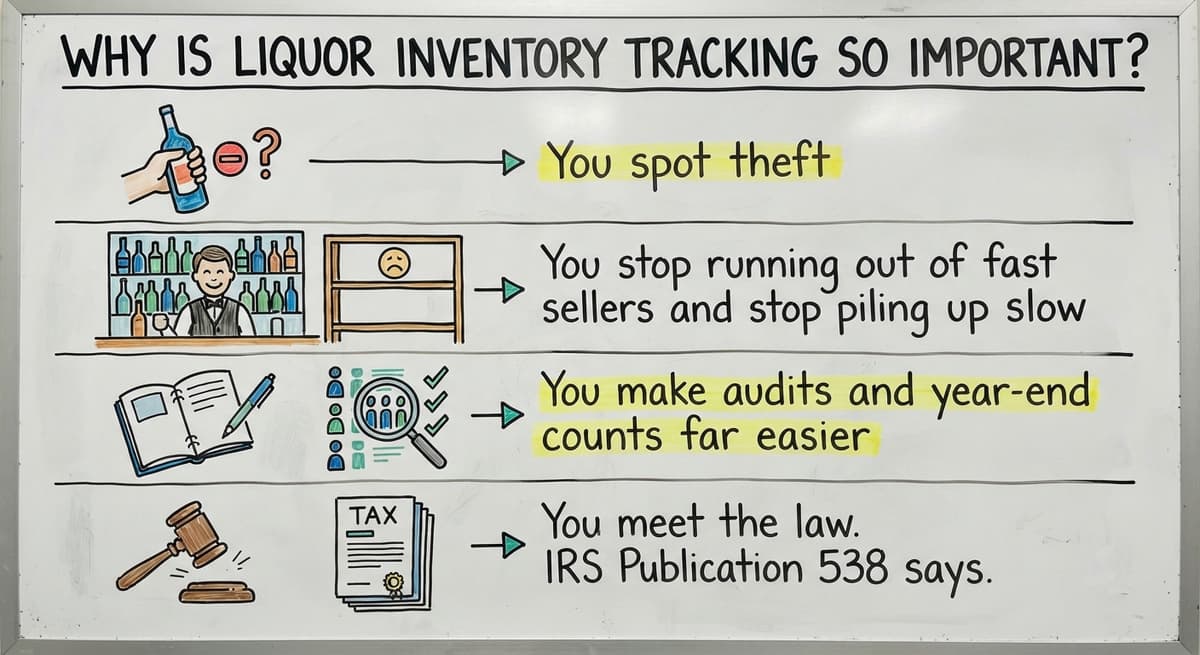
Liquor inventory tracking matters because your cash sits on the shelf. A case of 12 bottles that cost $180 holds $180 of your money. Small errors add up fast. Good records help in 4 ways:
- You spot theft, breakage, and mis-picks early, before they repeat.
- You stop running out of fast sellers and stop piling up slow ones.
- You make audits and year-end counts far easier.
- You meet the law. IRS Publication 538 says: "To figure taxable income, you must value your inventory at the beginning and end of each tax year."
Scans help too. GS1, the group behind product code rules, explains on its barcode standards page how "barcodes" let any scanner read the same item. Accurate stock is the base for every other number you report.
Step 1: How Do You Give Every Product One Clear Name and Code?
Give each product one SKU, which is a short code for one exact item, and use that code everywhere. Make a new SKU for each brand, size, and pack. A 750 ml bottle sold in a case of 12 gets one SKU. The same brand in 1.75 L gets another. Never let the same item go by two names on two sheets. "House Vodka 750" and "Vodka, House, 750 ml" will split your count in half. Keep the full item list in one place, and let everyone read from it. One item, one code, one list keeps every later step clean.
How do you track cases and single bottles together?
Pick the bottle as your base unit, and store the case as a fixed conversion. For a case of 12, the rule is 1 case = 12 bottles. Receive in cases. Count in bottles. Sell in either. Then 5 cases and 7 loose bottles is 67 bottles, and every report uses that one number. Without this rule, one person writes "5" and another writes "67" for the same stock. Some brands ship in cases of 6, so set the conversion on each SKU, not once for all. A single base unit lets cases and bottles live in the same number.
What goes in a good item record?
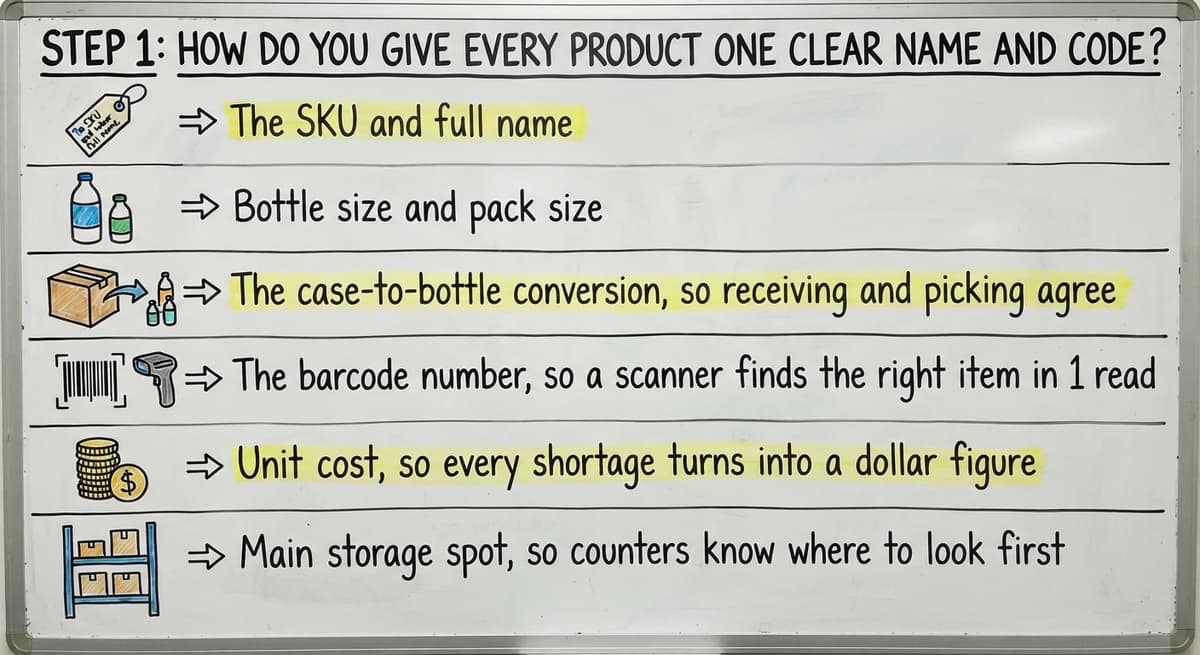
An item record is the single row that describes one SKU, and each field in it prevents a specific mistake. Keep these fields:
- The SKU and full name, so no one has to guess which item is which.
- Bottle size and pack size, so a 1.75 L is never mixed with a 750 ml.
- The case-to-bottle conversion, so receiving and picking agree.
- The barcode number, so a scanner finds the right item in 1 read.
- Unit cost, so every shortage turns into a dollar figure.
- Main storage spot, so counters know where to look first.
A record that answers these 6 questions needs no side notes.
Not sure this is the right shape for your operation
Describe how the work runs today. We map it on a call and show you what it would look like built around that, before you spend anything.
Book a callStep 2: How Do You Set Up Storage Locations?
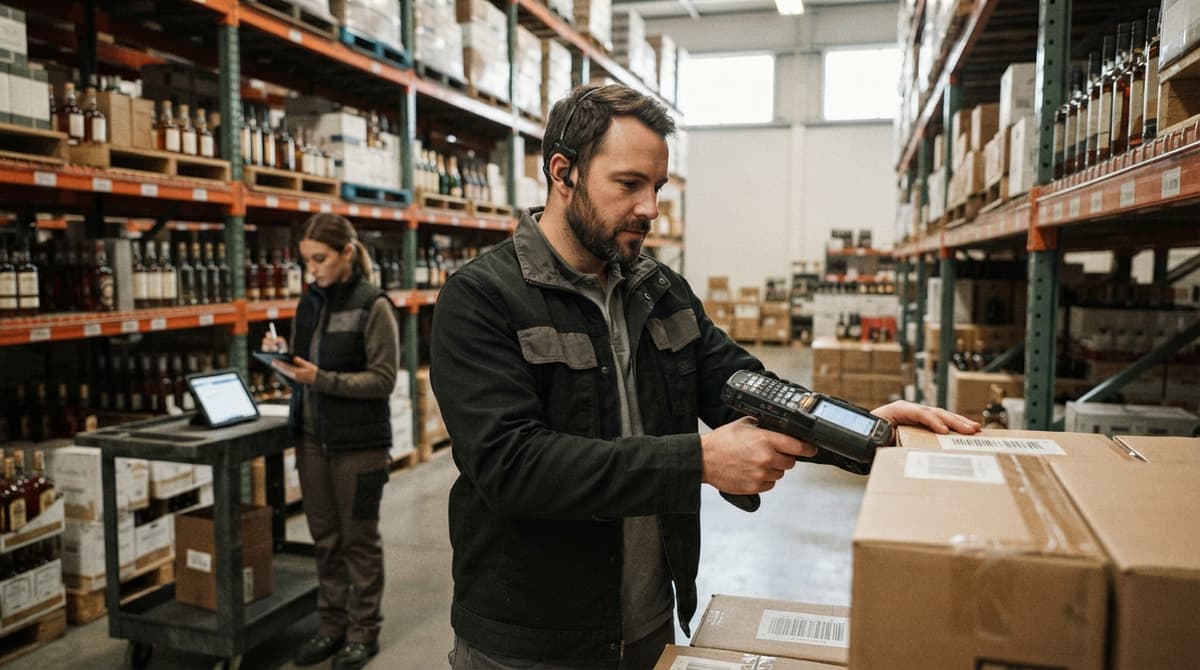
Set up storage by labeling every aisle, rack, shelf, and bin, so each bottle has an address. Use a simple pattern such as A-03-2, for aisle A, rack 3, shelf 2. Keep high-value bottles in a locked or limited-access area. Record the location with each count, not just the total. Keep each product in as few spots as you can. Stock split across 6 places is easy to miss and easy to take. Readers who want the wider view can see how to keep track of inventory in warehouse settings of any kind. An address on every bottle turns a search into a lookup.
What should a location label look like?
A good label is short, large, and printed, so a picker can read it from 6 feet away. Put the label on the rack edge, not on the bottles. Include the aisle, rack, and shelf in the same order every time. Add a barcode to the label if you scan counts. Mark each locked cage by its own name, such as "CAGE 1". Then log who holds the key. When a bin moves, change the label and the record on the same day. A label that lies is worse than no label.

Step 3: Why Should You Record Every Receipt and Shipment the Same Day?
Record each receipt and shipment the same day, because memory fades by the next morning. Check incoming cases against the buy order before you sign. Count the cases and look for broken glass. Log breakage and returns as their own entries, never as a quiet change to the total. Match each outgoing order to what the picker actually pulled, not to what was ordered. A same-day entry beats an end-of-week catch-up every time. If you sell by phone or online, the FTC's guide to the mail, internet, or telephone order rule covers the duty to ship when you said you would. An honest same-day log protects that promise.
What does a same-day log look like?
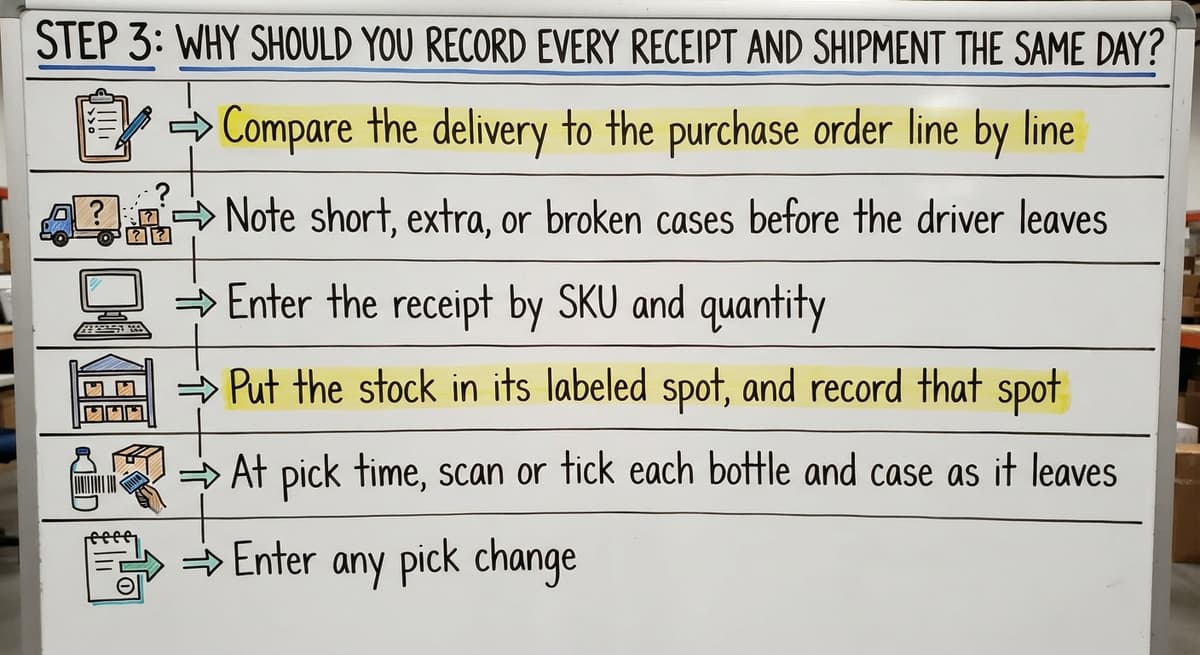
A same-day log is a short routine that the receiving and shipping crews repeat for every load. Follow this order:
- Compare the delivery to the buy order line by line.
- Note short, extra, or broken cases before the driver leaves.
- Enter the receipt by SKU and quantity, with the date and your initials.
- Put the stock in its labeled spot, and record that spot.
- At pick time, scan or tick each bottle and case as it leaves.
- Enter any pick change, such as a swap or a short, before the truck is loaded.
Six quick steps at the dock save hours of detective work later.

Step 4: How Often Should Liquor Inventory Be Counted?
Count liquor on a schedule that mixes a full count with small, frequent checks. A full liquor inventory count every month or every quarter covers the whole building. Cycle counts, which are quick counts of a small group of items, fill the gaps. Run them weekly on top sellers and high-value bottles. Use 2 people. One counts, and one records. Count at the same time of day, away from busy picking. Frequent small counts catch a loss while it is still small. The NIST Manufacturing Extension Partnership shares vendor-neutral supply chain guidance for firms that want to tighten these routines.
What count schedule works for a wholesale warehouse?
A schedule works when each kind of count has a clear job and a clear owner. This table shows one plan you can adjust.
| Count type | How often | What you count | Who does it |
|---|---|---|---|
| Full count | Monthly or quarterly | Every SKU in every spot | 2 people, off hours |
| Cycle count, top sellers | Weekly | The 20 fastest SKUs | 2 people, 30 minutes |
| Cycle count, high value | Weekly | Locked cage and top-shelf items | 2 people with the key holder |
| Spot check | After any big variance | The one SKU in question | A lead and 1 counter |
Pick the plan you can keep up, because a plan you skip protects nothing.
The comparison is easier when one option is built for you
Off-the-shelf means fitting your process to the software. We do it the other way round, and the first look costs nothing.
Book a callHow do you count liquor bottles for inventory?
Count liquor bottles one location at a time, in the same order each round. Walk the aisle, and count full cases first. Then count loose bottles. Write the count as bottles, using your conversion for the cases. Have the second person write the number down before the first one speaks the next. Record the location with each line. For a half-full or opened bottle, mark it as a separate line or pull it from sale. Last, sign and date the sheet. A fixed route and 2 sets of eyes make a count you can trust.
Step 5: How Do You Compare Counts to Your Records and Find Variances?
Compare counts to records by working out what stock should be, and then checking what is really there. The formula is simple: starting stock + received - shipped = expected stock. Next, compare expected stock to the physical count. Flag any gap above a set limit for review. Then look for patterns by product, shift, or location. One short bottle is noise. The same SKU short every Friday is a signal. The gap between expected and counted stock is where the problems show up.
What is a liquor inventory variance?
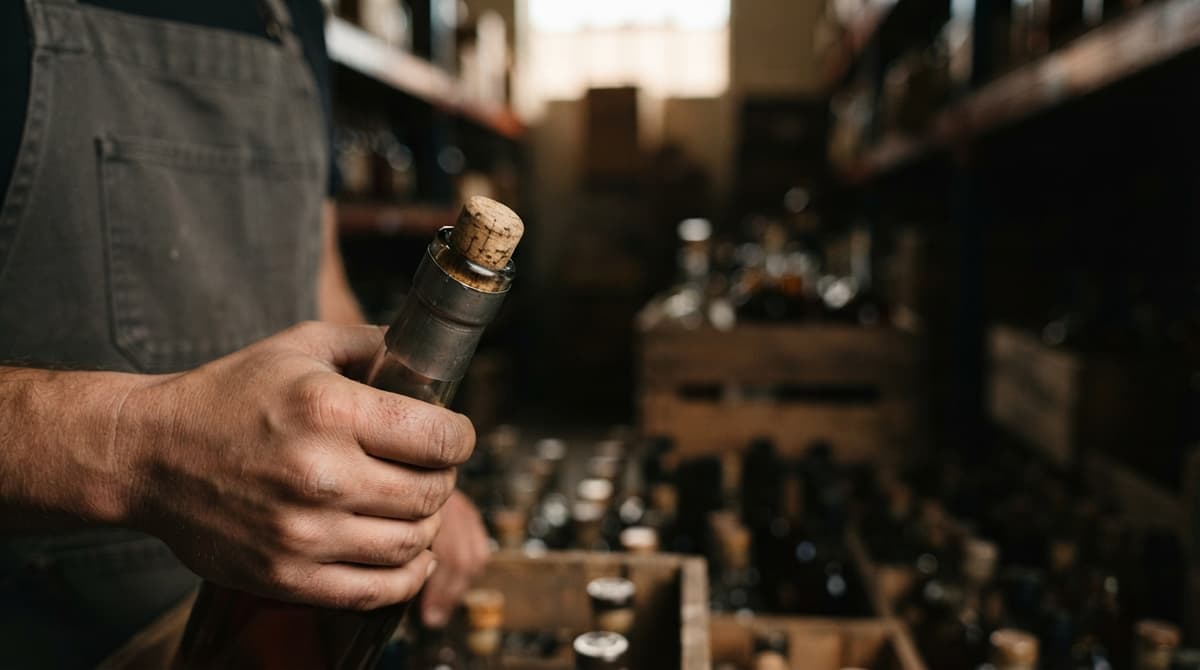
An inventory variance is the difference between the stock your records say you have and the stock you actually count. A negative variance means bottles are missing. A positive one means bottles showed up that you did not log. Both matter, because both mean a record is wrong. Set a limit by value. You might allow 0 bottles of variance on top-shelf items and 2 on low-cost ones. Anything past the limit gets a note and a name. A variance is a question, and the limit decides which questions you chase first.
A worked variance example
Let us say you start the week with 120 bottles of one 750 ml SKU. You receive 4 cases, which is 48 bottles. You ship 96 bottles. Expected stock is 120 + 48 - 96 = 72 bottles. The count shows 66. The variance is -6 bottles. At $15 a bottle, that is $90 for 1 week. If it repeats for 52 weeks, it costs you $4,680 a year on 1 SKU. Check the pick sheets first, then the dock log, then the shelf. A $90 miss looks small until you multiply it by the year.
How Do You Set Par Levels and Reorder Points?
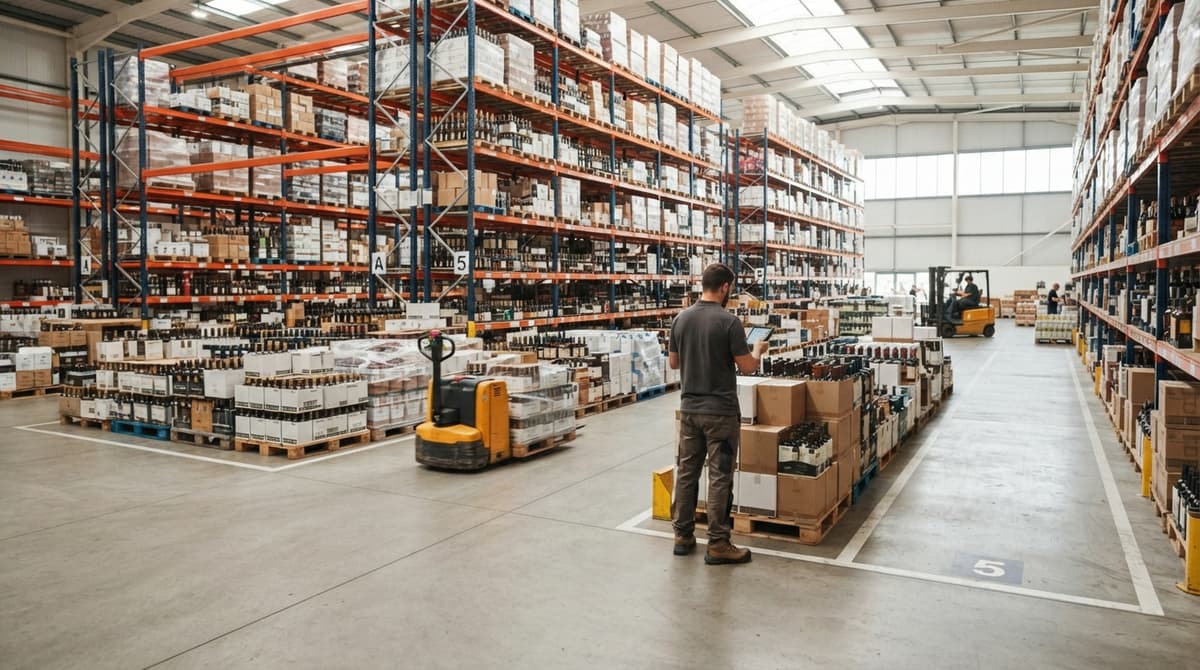
Set par levels by deciding how much of each SKU you want on hand, and then set a reorder point that tells you when to buy. A par level is the amount you want on hand after a delivery. A reorder point is the lower level that triggers a new order. Base both on weekly sales and supplier lead time, which is the wait between order and delivery. Review them each season, because holidays change demand. The Census Bureau's Monthly Wholesale Trade reports show national wholesale inventories and the inventories-to-sales ratio. Your par levels are the same idea, applied to each SKU.
A par level worked example
Suppose a SKU sells 30 cases a week and your supplier takes 1 week to deliver. Add 10 cases as a cushion, which is called safety stock. The reorder point is 30 x 1 + 10 = 40 cases. If you usually order 30 cases at a time, the par level is 40 + 30 = 70 cases. Now say December sales jump 50% to 45 cases a week. The reorder point becomes 45 x 1 + 10 = 55 cases. Raise it before the rush, and lower it in January. Par levels are only right when they follow the calendar.
Can You Track Liquor Inventory in a Spreadsheet or on Paper?
Yes, you can track liquor inventory in a spreadsheet or on paper at small volume, but the limits show up fast. Common problems are copies of files, typos, no live view, and no audit trail, which is a record of who changed what. Printed sheets and email threads drift out of sync with each other. If you also want the wider view, see how to keep track of inventory small business owners use before they grow. A spreadsheet is a fine start and a poor long-term home.

When should a warehouse move off spreadsheets?
Move off spreadsheets when the sheet creates more work than it saves. Watch for these signs:
- You added more staff, and now 2 people edit the same file at once.
- You added a second building or a second storage area.
- Counts and records mismatch most weeks, and nobody knows why.
- The file lives in 4 copies, and you ask which one is real.
- Month-end takes days because someone has to retype the numbers.
One of these signs is a warning. Three of them mean the sheet has already cost you money.
See it running on your own process first
No build cost. The subscription starts once it is live and doing the job, not before.
Book a callHow Does Liquor Inventory Connect to Your Accounting Software?
Liquor inventory connects to accounting software through totals: stock value, cost of goods, and what you owe. Many firms use their accounting software's inventory features for that side. Accounting tools do that job well. Warehouse details often live outside them. Those include shelf locations, case-to-bottle conversion, and cycle counts. So keep the accounting package where it works. Add a thin layer for the manual parts. For the basics, see our notes on how to keep track of inventory across a whole business. The accounting package owns the money, and a warehouse layer owns the bottles.
How do you avoid double entry between systems?
Avoid double entry by typing each fact once and letting it flow to the other system. A receipt should be entered at the dock. The cost and quantity should then pass to the books on their own. Do the same with shipments. Never ask a clerk to retype a pick sheet into the books. When we build a connection, we can link to your accounting software so totals stay in step with the floor. Pick one system as the source for each fact. Then check the 2 totals against each other every month. Typing a number twice is the cheapest way to create a variance.
When Does Custom Inventory Software Make Sense?
Custom inventory software makes sense when your current method cannot keep up with your volume. Common triggers are outgrowing sheets, repeated count errors, and slow reconciling at month-end. You do not need a huge system. A big ERP, which is a large all-in-one business suite, often forces your team to change how it works. Better software follows the steps your team already uses. It replaces only the manual ones and leaves your accounting package in place. It also works at small scale. A Columbus, Ohio team can build it with you, and we do this kind of workflow build. Fix the manual steps and keep what already works.
What does the manual work cost?
Manual tracking costs staff hours, and you can price them with your own numbers. The Bureau of Labor Statistics lists pay for shipping, receiving, and inventory clerks, so check your local rate. Say 2 people spend 5 hours a week on counts, retyping, and fixing mismatches. At $20 an hour, that is 2 x 5 x $20 = $200 a week. Over 52 weeks, it is $10,400 a year. That is before any missing bottles. Add the hours to the shortage, and the real price of a manual process comes into view.
What Are the Most Common Liquor Tracking Mistakes?
The most common mistakes are habits, not hard problems, and each one has a simple cure. Check your own shop against this list, and then compare it with how to keep track of alcohol inventory in any setting:
- Counting only once a year hides losses for 12 months.
- Mixing case and bottle units makes one SKU look like 2 different numbers.
- Letting many people adjust stock without a note leaves no trail to follow.
- Ignoring small variances lets a $90 leak grow into a $4,680 one.
Each of these mistakes stays small only if you catch it early.
Where Should You Start?
Start with Step 1 this week. Clean up your item list, set the bottle as your base unit, and give each SKU a code. Then add locations, same-day logging, and a count schedule. Most of this takes habits, not money. If your sheets are cracking under the load, we can help. Our team builds custom inventory workflows that replace the manual parts and keep your accounting package in place. Reach out to talk through how your cases, bottles, and counts move today.
Frequently asked questions
How to count liquor bottles for inventory?
Count one location at a time in the same route each round. Count full cases first and loose bottles next. Write everything in bottles, using your case conversion. Use 2 people: one counts and one records. Note the location on each line, and set aside opened bottles as their own line.
What is a liquor inventory variance?
A liquor inventory variance is the gap between the stock your records show and the stock you count. A negative gap means missing bottles. A positive gap means unlogged stock. Set a limit by value, and review anything above it.
How do you set par levels for liquor?
Multiply weekly sales by supplier lead time in weeks, and add safety stock to get the reorder point. Add your usual order size to get the par level. Review both before holidays, since demand shifts.
Can you track liquor inventory in a spreadsheet?
Yes, at small volume. A spreadsheet works with 1 editor, 1 location, and few SKUs. It breaks down with file copies, typos, no live view, and no audit trail. Move on when staff, sites, or mismatches grow.
What is a good way to track inventory?
No single method is best for everyone. The choice depends on your volume, staff, and number of locations. A spreadsheet fits a tiny operation. An inventory app or cloud platform fits growing teams. A custom build fits firms whose steps do not match off-the-shelf tools.
How often should liquor inventory be counted?
Do a full count monthly or quarterly. Add weekly cycle counts on top sellers and high-value bottles. Count at the same time of day, away from busy picking, with 2 people.
How does liquor inventory connect to accounting software?
Your accounting software holds the totals and costs. Shelf locations, case-to-bottle conversion, and counts often live outside it. A connection layer can pass receipts and shipments to the accounting software so no one types the same number twice.
How do you track cases and single bottles together?
Use the bottle as the base unit. Store each case as a fixed conversion, such as 1 case = 12 bottles. Receive in cases, count in bottles, and report in one number. Set the conversion on each SKU.
Start with a free first look
A 30 minute call, your operation mapped, and a clear picture of what we would build. No obligation and nothing to install.
Book a callRelated guides
More on the same work.
- How to Keep Track of Inventory
- How to Keep Track of Inventory on Clover
- How to Keep Track of Computer Inventory
- How to Keep Track of Consignment Inventory
- How to Keep Track of Alcohol Inventory
- How to Keep Track of Product Inventory
- How to Keep Track of Ebay Inventory
- How to Keep Track of Poshmark Inventory
- How to Keep Track of Grocery Inventory
- How to Keep Track of Lularoe Inventory
- How to Keep Track of Freezer Inventory
- How to Keep Track of Cigarette Inventory
- How to Keep Track of Inventory Electronically
- How to Keep Track of Paparazzi Inventory
- How to Create an Inventory Tracking System?
- How to Track Non Inventory Items
- How to Keep Track of Inventory in Warehouse
- How to Keep Track of Inventory Small Business
- How to Record Inventory on Hand
- How to Manage Inventory in Rocket League
- How to Improve Inventory Management
- How to Manage Fba Inventory
- How to Manage Inventory in Stardew Valley
- How to Manage Inventory Fallout 76