


Inventory Quotes
An inventory quote is a price estimate tied to stock you can actually ship today. It differs from a regular sales quote because it pulls live data: what is on the shelf, what is already reserved, and how long replenishment takes. If your quote does not reflect those three things, you are guessing. This page explains how to stop guessing. Reviewed June 2025.
Book a callWhat Inventory Quotes Are and Why They Break Down
An inventory quote connects a customer's request to real stock data before a price goes out the door. A general sales quote can be built from a price list alone. An inventory quote adds quantity on hand, reserved stock, and lead time to that price. Operations managers, not accountants, own this process in most small warehouses.
The breakdown usually starts with data that is a day or a week old. According to the US Census Bureau's Monthly Wholesale Trade data, wholesale inventories and sales shift month to month across every product category. A quote built on last Tuesday's spreadsheet may not match what is on the shelf today.
Quoting wrong stock has a direct legal dimension too. The FTC's Mail, Internet, or Telephone Order Merchandise Rule needs sellers to ship within the time they promise or give customers the right to cancel. An inaccurate inventory quote sets up that failure before the order is even placed.
Customer trust is the business cost that shows up last but hurts longest. A buyer who gets a backorder notice after accepting a quote will look for another supplier. Getting the quote right the first time is the cheapest retention tool a small distributor has.
We build it for your operation, and the first look is free
If you would rather not compare products, describe how your operation already works and we build the system around it.
No build cost. You see it running on your own process first, and the monthly subscription starts only once it is live.
Book a callWhy Spreadsheets and QuickBooks Alone Fall Short for Inventory Quotes
Most small distributors start with the same setup: an Excel file for stock counts, email for quote delivery, and QuickBooks for invoicing. That is not a criticism. It is how most operations begin, and it works up to a point.
The Spreadsheet Problem
Spreadsheets break down in 3 specific ways. First, version control fails when 2 people update the same file. Second, stock counts go stale between physical counts. Third, manual price lookups introduce errors that no one catches until a customer complains.
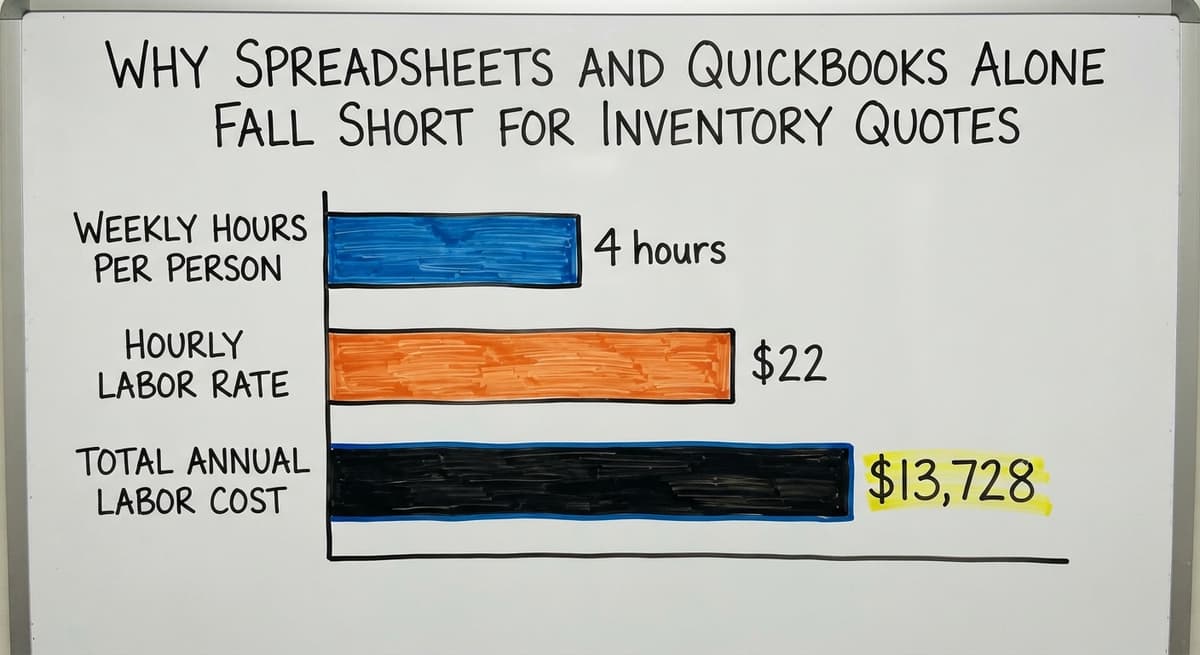
Consider a team of 3 people each spending 4 hours a week on manual quote work at $22 an hour, which is close to the median wage for shipping and receiving clerks tracked by the Bureau of Labor Statistics. That is $13,728 a year in labor, before counting the cost of a single quoting error.
Where QuickBooks Hits Its Limit
QuickBooks handles basic invoicing well. It was built for that. What it was not built for is real-time bin-level stock visibility, multi-warehouse logic, or a quote-to-pick workflow that moves a confirmed quote to the warehouse floor without manual re-entry.
The answer is not to replace QuickBooks. A custom layer can sit on top of it, pull live stock data, apply your pricing rules, and push an accepted quote back into QuickBooks as an invoice. The accounting stays where it is. The quoting gets smarter.
What Quantity on Hand vs. Available to Quote Actually Means
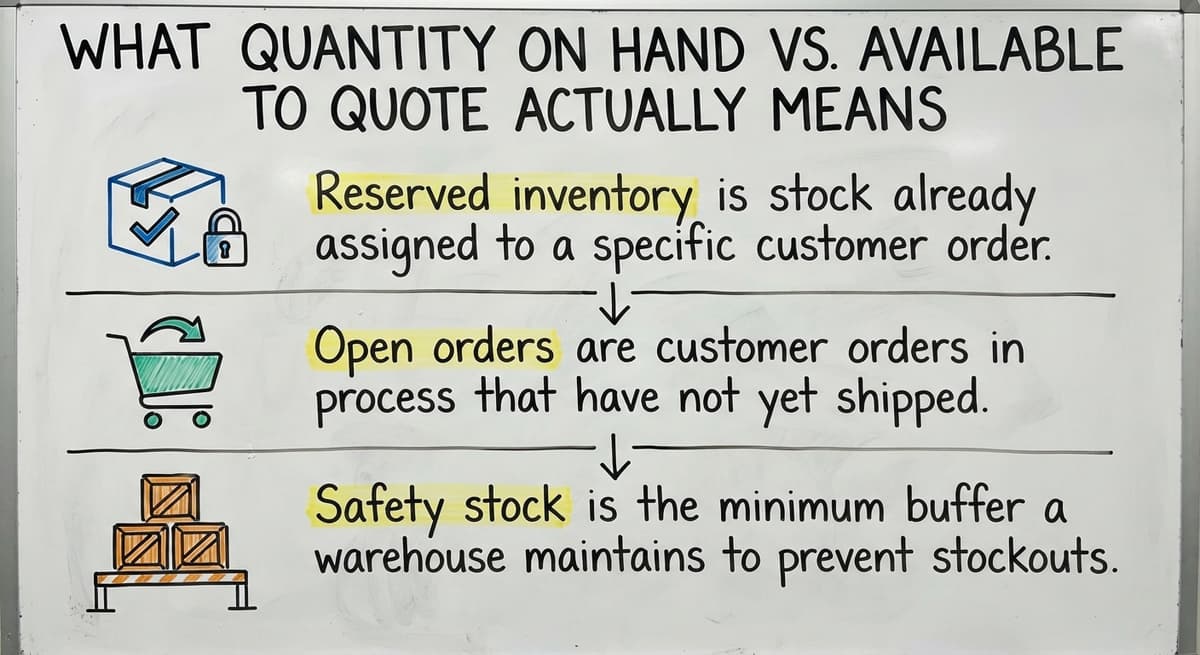
Quantity on hand is every unit in the building. Available to quote is what is left after you subtract reserved inventory, units already committed to open orders, and any safety stock your operation holds as a buffer.
Quoting from total on-hand is one of the most common fulfillment mistakes in wholesale distribution. A warehouse might show 200 units on hand, but 150 are reserved for open orders and 20 are held as safety stock. The real number available to quote is 30.
Three terms matter here:
- Reserved inventory is stock already assigned to a confirmed order but not yet shipped.
- Open orders are customer orders in process that have not been fulfilled.
- Safety stock is the minimum buffer a warehouse keeps to cover supplier delays.
Quoting from the right number prevents the backorder call that costs you the relationship.
The comparison is easier when one option is built for you
Off-the-shelf means fitting your process to the software. We do it the other way round, and the first look costs nothing.
Book a callHow Pricing Rules and Lead Times Affect Accuracy
Pricing rules and lead times are the two parts of an inventory quote most likely to be wrong when built by hand.
Pricing Rules
Common pricing scenarios in wholesale distribution include volume tiers, customer-specific contract pricing, and promotional rates with end dates. Manual quoting makes it easy to apply the standard price to a customer who earned a lower rate, or to honor a promotion that expired last month.
A system with built-in pricing rules applies the right price automatically based on who is asking and how much they want. That removes the lookup step and the error that comes with it.
Why Does Lead Time Matter in an Inventory Quote?
Lead time is the answer to the customer's real question: when will I have it? The opening mistake is quoting a lead time without checking current stock. If a product is at 5 units and the reorder cycle is 14 days, a customer who needs 50 units needs to know that before they accept the quote, not after.
Factor in both your reorder point, the stock level that triggers a buy order, and your supplier's fulfillment window. A quote that includes an honest lead time protects the relationship even when the news is not what the buyer hoped to hear.

Quote Expiration and the Connection to Purchase Orders
Why Inventory Quotes Need an Expiration Date
Stock moves. Prices change. A quote without an expiration date is a promise with no time limit, and that promise can become impossible to keep. Standard expiration windows in wholesale distribution run 7 to 30 days depending on how fast your inventory turns. Fast-moving SKUs need shorter windows.
When a customer accepts a quote after stock has changed, the result is either a backorder, a margin hit to cover a price increase, or an awkward conversation. An expiration date forces a re-check before acceptance becomes an obligation.
From Accepted Quote to Purchase Order
When a customer accepts a quote and available stock is short, someone has to trigger a buy order to cover the gap. In a manual process, that means checking the quote, checking the stock count, drafting a PO, and sending it to the supplier. Each step is a handoff where something can be missed.
A connected system handles this automatically. The accepted quote checks available stock, finds the shortfall, and generates a draft PO against the right supplier. For a team of 5 to 20 people, that automating can recover several hours a week and remove the class of errors that comes from manual re-entry. The NIST Manufacturing Extension Partnership notes that connected supply chain processes reduce the coordination burden on small and mid-size operations specifically.
See it running on your own process first
No build cost. The subscription starts once it is live and doing the job, not before.
Book a callInventory Quote Software: What to Look For and How to Choose
The right tool depends on the size of the operation and how the team already works. Here are the features that matter for small-to-mid-size wholesale distributors.
Must-Have Features
- Real-time stock lookup pulls current available-to-quote quantity at the moment the quote is built, not from a file saved yesterday.
- Customer-specific pricing applies the right rate automatically based on the customer record, removing the manual lookup.
- Quote-to-order conversion turns an accepted quote into a sales order or invoice without re-entering the data.
- Audit trail records who built the quote, what stock level it was based on, and when it was sent, so disputes are easy to resolve.
- Quote expiration controls flag or close quotes automatically when the window passes.
- Reorder point alerts connect low-stock conditions to the quoting screen so the person building the quote sees the lead time risk at once.
Barcode-based stock counts feed accurate data into all of these features. GS1's barcode standards underpin scan-based inventory counts, and "GS1 standards enable the capture and sharing of accurate, real-time data across the supply chain."
Custom Software vs. Off-the-Shelf
Off-the-shelf inventory quote software is faster to buy and slower to fit. Most packages need the business to change its workflow to match the software's logic. That works well when the software's logic is better than the current process. It works poorly when the existing process has rules built up over years that the software cannot replicate.
Custom inventory quote software is built around the workflow the team already uses. It can keep QuickBooks in place, connect to the existing stock data, and add only the quoting layer that is missing. The build takes longer than buying a subscription, but the result fits the operation rather than fighting it. For a small distributor with specific pricing rules or a non-standard warehouse layout, that fit is worth the difference.

What a Custom Inventory Quote Tool Looks Like in Practice
A Columbus-area wholesale distributor selling industrial fasteners was running quotes through email and a shared Excel file. The stock count in the file was updated once a week. Pricing was looked up in a separate QuickBooks report. A quote took about 45 minutes to build and send.
After a custom quote tool was built on top of their existing QuickBooks setup, the process changed to a single screen. The rep types the customer name, selects the SKUs, and sees live available-to-quote quantity pulled from the warehouse scan system. Pricing rules apply automatically based on the customer's contract tier. The quote goes out in under 10 minutes. When the customer accepts, the tool pushes the order back into QuickBooks as an invoice. The Excel file is no longer part of the process.
The IRS needs accurate inventory records regardless of the tool used. IRS Publication 538 states: "To figure taxable income, you must value your inventory at the beginning and end of each tax year." A connected system makes that valuation easier to produce because the data is current and traceable.
Not sure this is the right shape for your operation
Describe how the work runs today. We map it on a call and show you what it would look like built around that, before you spend anything.
Book a callTracking Quotes and Using the Data to Manage Stock
Quote data is demand data. Every quote sent is a signal about what customers are trying to buy. Tracking how many quotes were sent, accepted, declined, or expired tells a purchasing manager which SKUs are in demand and which price points are losing deals.
The feedback loop works like this: high quote volume on a SKU signals rising demand, which should lower the reorder point trigger so stock arrives before it runs out. When quotes live in email threads and Excel files, that loop is broken. No one can pull quote volume by SKU without building the report manually.
A connected system closes the loop. Quote data feeds into inventory management automatically, and reorder points adjust based on real demand signals rather than last year's buy history. That shift from reactive to informed purchasing is one of the clearest gains a small distributor gets from fixing the quote process.

Can I Improve My Inventory Quote Process Without Replacing QuickBooks?
Yes, and for most small distributors that is exactly the right approach. QuickBooks handles the accounting. A custom layer handles the quoting. The two connect through an integration that pulls stock and pricing data from QuickBooks and pushes accepted quotes back as invoices.
Nothing in the accounting workflow changes. The team does not learn a new system for invoicing or payroll. They learn one new screen for building quotes. That is a much smaller change to manage, and it means the improvement does not need a full ERP migration or a months-long rollout.
If your current process is slowing down sales or producing fulfillment errors, the fix is usually a targeted addition, not a full replacement.
Questions to Ask Before Choosing Inventory Quote Software
Before talking to any vendor, an operations manager should have answers to these questions.
- Does it connect to QuickBooks, and does that connection go both ways?
- Can it handle our specific pricing rules, including customer-tier and volume pricing?
- Does it show available-to-quote quantity, not just total on hand?
- How long does setup take, and who does the work?
- Can it be tailored to match the way our team already builds quotes?
- Who supports it after go-live, and how do we reach them?
- Does it produce an audit trail we can use to resolve disputes?
A vendor who cannot answer questions 1, 3, and 5 clearly is selling a general tool, not a solution to the specific problem. The right partner will ask about your workflow before describing their product.

Next Steps
Accurate inventory quotes start with knowing what is actually available to sell, applying the right price, and setting a realistic lead time. Spreadsheets and standalone QuickBooks can handle early-stage volume, but they break down as the business grows. A targeted custom tool can fix the specific gaps without replacing the systems that already work.
If your team is spending more than a few hours a week building quotes manually, or if backorders are a recurring problem, it is worth a conversation about what a custom inventory quote tool could look like for your operation.
Frequently asked questions
What are 5 short quotes?
This question is usually about inspirational one-liners, not business inventory. Five well-known short quotes are: "Less is more" (Robert Browning), "Just do it" (Nike), "Stay hungry, stay foolish" (Steve Jobs), "Done is better than perfect" (Sheryl Sandberg), and "Work hard, be kind" (Conan O'Brien). If you are looking for inventory quotes in the business sense, those are formal price estimates tied to available stock, not sayings.
What is a fancy word for inventory?
Common formal alternatives include "stock," "merchandise," "goods on hand," or "stockpile." In accounting contexts you may see "inventory assets" or "stock-in-trade." In warehouse operations, plain words like "stock" or "on-hand units" are more useful than formal substitutes because they are less likely to be misread.
What are 10 positive quotes for work?
This question is about motivational sayings, not inventory or business quoting. If you landed here looking for warehouse or distribution content, this page covers inventory quotes as formal price documents tied to live stock data. For motivational quotes, a general search will return hundreds of curated lists from sources better suited to that topic.
What is a powerful 3-word quote?
Popular 3-word quotes include "Just do it," "Make it happen," and "Never give up." These are motivational phrases, not inventory or pricing documents. If you reached this page looking for guidance on building accurate inventory quotes for a wholesale distribution business, the sections above cover that topic in full.
What is the difference between quantity on hand and available to quote?
Quantity on hand is every unit in the building. Available to quote subtracts reserved inventory, units tied to open orders, and safety stock from that total. Quoting from on-hand rather than available quantity is one of the most common causes of backorders in wholesale distribution.
Why do inventory quotes need an expiration date?
Stock levels and prices change. A quote without an expiration date can be accepted after the stock is gone or after costs have risen, leaving the seller to absorb the difference. Most wholesale distributors set expiration windows of 7 to 30 days depending on how fast their inventory turns.
What features should a small wholesale distributor look for in inventory quote software?
The most important features are real-time available-to-quote stock lookup, customer-specific pricing rules, quote-to-order conversion without re-entry, and an audit trail. Reorder point alerts and quote expiration controls are also valuable. Look for a tool that connects to QuickBooks rather than replacing it.
How does an accepted inventory quote connect to a buy order?
When a customer accepts a quote and available stock is short, a buy order needs to go to the supplier to cover the gap. A connected system generates that PO automatically from the accepted quote. A manual process needs someone to check the quote, check the stock, and draft the PO separately, which adds time and creates room for error.
Start with a free first look
A 30 minute call, your operation mapped, and a clear picture of what we would build. No obligation and nothing to install.
Book a callRelated guides
The rest of this guide, for the parts of the job this page does not cover.
Guides
- Inventory Quote
- Classification of Inventory
- Excess Inventory
- Closed for Inventory
- Multi Location Inventory Management Software
- Inventory Management for Multiple Locations
- Costing Inventory
- Is Inventory a Long-term Asset
- Inventory Management System for Manufacturing
- Inventory Fixed Assets
- Inventory Management Pics
- Excel Inventory Template
- Push and Pull Inventory
- Consumable Inventory
- B2b Inventory Management
- Jewelry Inventory Management
- Dental Inventory Management
- The Objective of Inventory Management is To
- Qr Code for Inventory Management
- Inventory Metrics
- Inventory Formulas