


Inventory Quote
An inventory quote is a price estimate built from your actual, current stock levels. It differs from a generic sales quote because it pulls live data, not last week's spreadsheet. If you run a wholesale or distribution operation, getting this right means fewer canceled orders and fewer angry customers.
Reviewed September 2026. Figures are worked from the assumptions stated beside them, so you can substitute your own and the arithmetic still holds.
Reviewed and updated: June 2025
Book a callWhat Is an Inventory Quote and Why Does Accuracy Matter?
A regular sales quote tells a customer what something costs. An inventory quote goes further: it confirms you actually have the item, in the right quantity, right now. That distinction matters most in wholesale and distribution, where stock moves fast and a quote sent at 9 a.m. can be wrong by noon.
The IRS makes the stakes clear even at the accounting level. IRS Publication 538 states: "To figure taxable income, you must value your inventory at the beginning and end of each tax year." If your counts are off, your quotes are off, and so are your books.
Stock availability is the foundation every accurate quote rests on.
We build it for your operation, and the first look is free
If you would rather not compare products, describe how your operation already works and we build the system around it.
No build cost. You see it running on your own process first, and the monthly subscription starts only once it is live.
Book a callWhy Inventory Quotes Go Wrong for Distributors and Warehouses
Quoting an item that is out of stock costs more than the lost sale. It costs the customer's trust. For small to mid-size operations, repeat business is everything, and a wrong quote can end a relationship.
The US Census Bureau Monthly Wholesale Trade data shows that wholesale inventories shift continuously relative to sales. A static spreadsheet cannot keep up with that pace.
When Quoting Lives in Email Threads and Printed Pick Lists
The pain gets worse when quoting lives in email threads and printed pick lists. A sales rep sends a request to the warehouse. The warehouse replies hours later. By then, 3 pallets of that SKU may have shipped to someone else. The rep sends the quote anyway because they never got the update.
GS1 notes that "barcodes are the most widely used automatic spotting technology in the world," yet many small distributors still reconcile those scans manually against a separate quote sheet. That gap is where errors live.
How Does a Manual Inventory Quote Process Break Down?
Manual quoting breaks down the moment the spreadsheet falls behind the warehouse floor. Here is what that looks like in practice.
A sales rep gets a request for 200 units of SKU-4417. She opens the shared Excel file, sees 240 units available, and builds a quote. She emails it to the customer. The customer approves it the next morning.
Meanwhile, the warehouse shipped 180 of those units to a different customer overnight. Nobody updated the spreadsheet.
Now the sales rep has a confirmed order she cannot fill. She calls the warehouse. The warehouse checks a different printed list. Both numbers are wrong.

What Manual Quote Errors Actually Cost in Labor
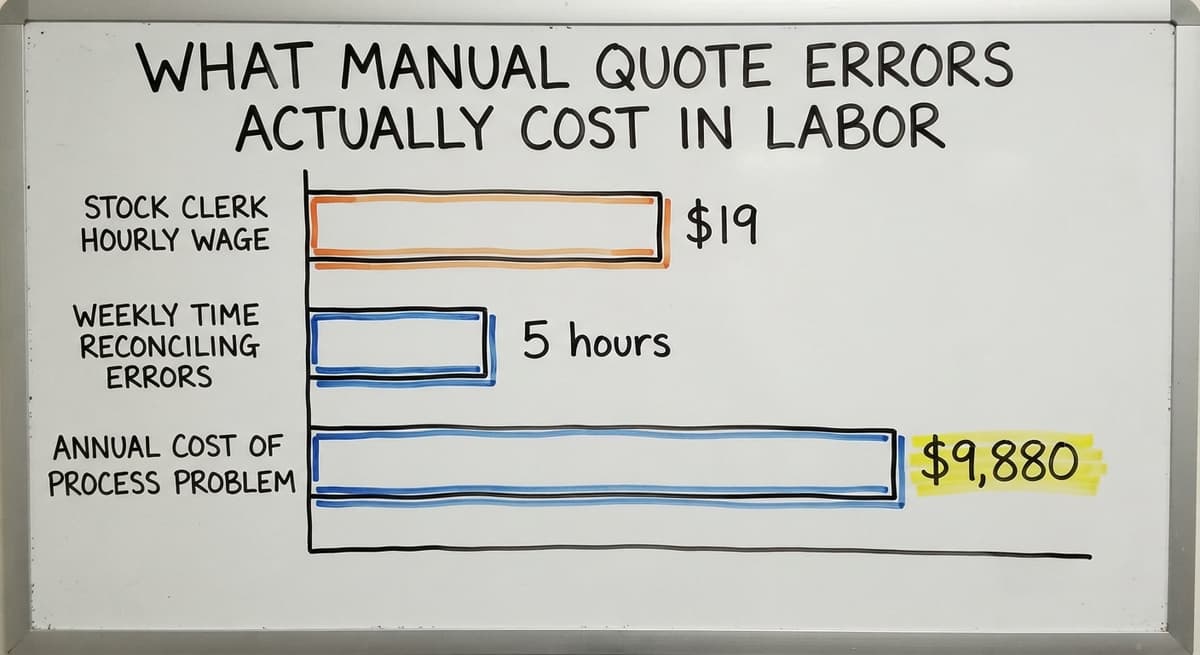
The US Bureau of Labor Statistics reports that stock clerks and order fillers earn around $19 per hour. If 2 people spend 5 hours a week reconciling quote errors, that is $9,880 a year spent fixing a process problem, not doing productive work.
Version confusion, stale data, and copy-paste errors are not user mistakes. They are what happens when a manual process handles a job that needs live data.
The comparison is easier when one option is built for you
Off-the-shelf means fitting your process to the software. We do it the other way round, and the first look costs nothing.
Book a callWhat Data Fields Belong in an Accurate Inventory Quote?
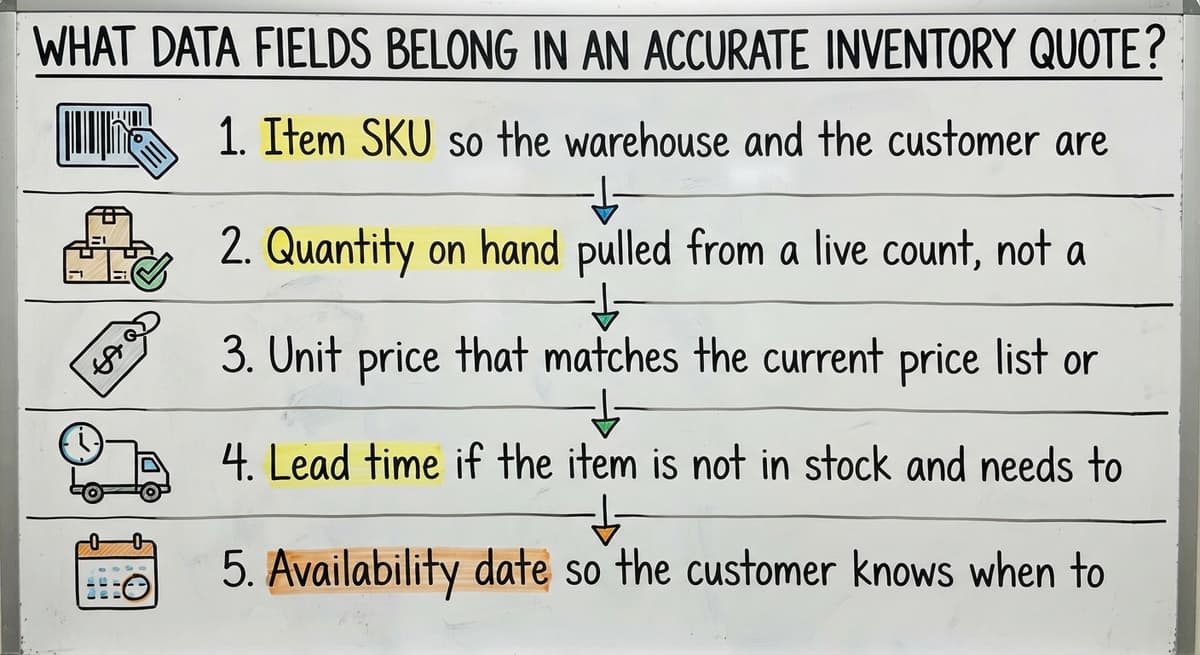
Every field in an inventory quote needs to reflect what is true right now, not yesterday's count. The core fields are:
- Item SKU so the warehouse and the customer are talking about the same product
- Quantity on hand pulled from a live count, not a cached report
- Unit price that matches the current price list or the customer's contract rate
- Lead time if the item is not in stock and needs to be ordered
- Availability date so the customer knows when to expect delivery

Optional Quote Fields That Protect Margin and Reduce Back-and-Forth
Optional fields that protect margin and reduce back-and-forth:
- Discount tiers based on order volume
- Customer-specific pricing for accounts with negotiated rates
- Freight estimates tied to the ship-to ZIP code
Each of these fields can be filled manually. The problem is that manual entry introduces a lag. A quote built on data that is 24 hours old is a guess, not a commitment. Real-time stock levels turn a quote into a promise you can keep.
How QuickBooks Handles Inventory Quoting and Where It Falls Short
QuickBooks is a strong accounting tool. It handles estimates, sales orders, and basic item tracking well. For a distributor running fewer than 20 SKUs out of a single location, it may be enough.
The gap appears when stock moves fast or complexity grows. QuickBooks does not show you what is currently picked, staged, or already committed to another open order. It shows you what the system recorded last, which is not the same thing.
When QuickBooks Alone Is Not Enough
The tipping point usually arrives when a distributor hits multiple storage locations, a high SKU count, or frequent price changes. Consider a distributor quoting 50 line items split across 2 warehouses. QuickBooks may show 300 units of an item across both locations combined. But 200 of those units are already allocated to a confirmed order in the other building.
The rep quotes all 300. The customer expects all 300. The warehouse can only ship 100.
That is not a QuickBooks failure. QuickBooks was designed for accounting, not real-time warehouse visibility. The fix is not to replace QuickBooks. It is to add a layer that handles live stock and quoting while QuickBooks keeps doing what it does well.

How Inventory Management Software Connects Live Stock to Every Quote
Inventory management software solves the lag problem by pulling current stock levels into a quote automatically. The sales rep does not check a spreadsheet. The system checks the warehouse database at the moment the quote is built.
Pricing rules and customer tiers apply without a manual lookup. If a customer qualifies for a 10% volume discount at 500 units, the system applies it. The rep does not need to remember which accounts have special rates.
A good system also flags problems before the quote leaves. If stock drops below the quoted quantity while the quote is still open, the system alerts the rep. That warning prevents the over-promise that damages the relationship.
See it running on your own process first
No build cost. The subscription starts once it is live and doing the job, not before.
Book a callReal-Time Stock Visibility: Why Does It Change Everything?
Real-time stock visibility means knowing exactly what is on the shelf right now, not what was there when the last report ran. It prevents quoting items already allocated to another order.
The ripple effect is large. Fewer over-promises mean fewer canceled orders. Fewer canceled orders mean fewer emergency buys at bad prices. Fewer emergency buys protect margin. The US Federal Trade Commission's Mail and Internet Order Rule also needs sellers to ship when promised or notify the customer promptly. Accurate stock data is what makes that promise possible to keep.
Visibility is not a technology feature. It is the working condition that makes every other part of the quote process work.
Customer-Specific Pricing and Quote-to-Order Conversion
Many distributors offer different prices to different customers based on volume, contract terms, or relationship history. Managing that in a spreadsheet means someone has to remember which rate applies to which account, every single time.
Software stores those tiers and applies them at quote time without a manual check. That protects margin because the wrong rate does not slip through. It also speeds up the quoting process because the rep is not hunting for a price list.
Turning an Approved Quote Into a Sales Order Without Re-Entering Data
Re-typing quote data into a sales order is one of the most common sources of entry errors in a distribution operation. A unit quantity gets transposed. A SKU gets misread. The customer gets the wrong item.
Connected software converts an approved quote into an order in a single step. The same data that built the quote becomes the order record. Inventory counts update at once so the stock that was quoted is now reserved.
One click from approved quote to confirmed order removes the human error that lives in the re-entry step, and it keeps the count accurate for every quote that follows.

From Approved Quote to Fulfilled Shipment
An inventory quote does not end when the customer says yes. It needs to reach the warehouse as a pick list without a phone call or a forwarded email.
A connected system passes the order data directly to the warehouse queue. The picker sees the SKU, the quantity, and the bin location. There is no translation step where something gets lost. What was quoted is what gets picked.
Why Connected Information Flow Matters Even in Small Warehouses
In a small fulfillment center, a direct handoff from quote to pick list matters because the same person who picks may also be the one answering the phone. Cutting out the manual handoff saves time and reduces the gap between what the customer was promised and what lands on their dock.
The NIST Manufacturing Extension Partnership highlights connected information flow as a core principle of supply chain efficiency. That principle applies just as much to a 10-person warehouse as to a large manufacturer. A quote that flows cleanly into fulfillment is the last step in making the whole process reliable.

Signs Your Inventory Quote Process Needs an Upgrade
Quote process problems are normal growing pains, not failures. Most operations hit them somewhere between 15 and 50 SKUs.
- Quotes take more than a day to produce because someone has to check multiple sources
- Stock errors appear after quotes go out and before orders are confirmed
- Staff spend hours each week reconciling spreadsheet versions
- Customers receive quotes for items that are no longer in stock
- Customer complaints about wrong pricing arrive more than once a month
- Sales and warehouse staff regularly disagree on what is available
If 3 of those 6 describe your operation, the process is costing you more than you realize. The goal is not a perfect system. It is a system where a wrong quote is the exception, not the routine.
Not sure this is the right shape for your operation
Describe how the work runs today. We map it on a call and show you what it would look like built around that, before you spend anything.
Book a callShould Small Distributors Buy a Full ERP System Just to Fix Quoting?
A full ERP system is tempting because it promises to solve everything at once. The mismatch is real: ERP rollouts built for companies 10 times your size take months to deploy, cost far more than quoting alone justifies, and need staff to learn workflows designed for a different kind of operation.
A targeted solution handles inventory quoting without replacing your accounting system, your warehouse process, or your team's habits. That is a better fit for a 10-to-75-person distributor.
What to Look for in Inventory Quote Software
Focus on the features that close your specific gaps. Must-haves for most distributors:
- Live inventory sync so quoted quantities reflect current stock
- Customer pricing tiers applied automatically at quote time
- Quote-to-order conversion without re-entering data
- QuickBooks integration so accounting stays intact
Nice-to-haves that add value without adding complexity:
- PDF quote generation for customers who need a formal document
- Approval workflows for quotes above a set dollar threshold
- Mobile access so a rep can build a quote from the warehouse floor
Buy only what closes the gap you have. A system with 40 features you do not use is not an asset.
Keeping QuickBooks While Adding Real Inventory Quote Capabilities
Switching away from QuickBooks is not required. A custom layer can handle quoting and live stock visibility while QuickBooks continues to manage accounting. When a quote is approved in the new system, an invoice is created in QuickBooks automatically. The 2 systems stay in sync without manual entry in either direction.
This approach replaces the manual steps, not the familiar tools. Your bookkeeper keeps working in QuickBooks. Your sales team gets a quoting tool that shows real stock. Your warehouse gets a pick list without a phone call.
A focused custom build targeting only the quoting workflow can be deployed in weeks, not months. That is a sharp contrast to an ERP rollout that can run 6 to 18 months before the first quote goes out.
The right build matches how your operation already works and fills only the gaps that are costing you orders.
Next Steps to Fix Your Inventory Quote Workflow
An accurate inventory quote is built on live stock data, customer-specific pricing, and a clean path from approval to fulfillment. Most small distributors already have the pieces. The gap is the connections between them.
Before choosing any software, map your current quoting steps on paper. Note where you check a spreadsheet, where you wait for a reply, and where errors have appeared. That map tells you exactly what needs to change.
If you want to talk through what that looks like for your specific operation, reach out. The conversation starts with your workflow, not a product demo.
Frequently asked questions
What is an inventory quote and how is it different from a regular sales quote?
An inventory quote is a price estimate tied to your actual, current stock levels. A regular sales quote states a price but does not confirm availability. The difference matters in wholesale and distribution because stock moves fast and a quote built on stale data can result in orders you cannot fill.
How does QuickBooks handle inventory quoting and where does it fall short?
QuickBooks handles estimates and basic item tracking well. It falls short when a distributor has multiple locations, a high SKU count, or items already allocated to open orders. QuickBooks shows recorded quantities, not real-time committed stock, which creates the risk of quoting inventory that is already spoken for.
Can a distributor keep QuickBooks and still improve their quoting process?
Yes. A custom quoting layer can handle live stock visibility and customer pricing while QuickBooks continues to manage accounting. When a quote is approved, the invoice flows into QuickBooks automatically. There is no need to switch accounting systems to fix the quoting problem.
What are the signs that a quoting process needs better software support?
Common signs include quotes taking more than a day to produce, stock errors discovered after quotes go out, staff spending hours reconciling spreadsheets, and customer complaints about wrong pricing or unavailable items. These are normal growing pains for distributors between 15 and 50 SKUs, not permanent failures.
What are 5 good quotes short?
This question is about inspirational short quotes, not inventory quoting. Five well-known short quotes: "Less is more" (Robert Browning), "Do or do not" (Yoda, Star Wars), "Stay hungry, stay foolish" (Steve Jobs), "Be the change" (attributed to Gandhi), and "Just start" (common in entrepreneurship). These are unrelated to the inventory quoting process covered in this article.
How to estimate inventory cost?
Inventory cost is estimated by multiplying the quantity on hand by the unit cost for each SKU, then totaling across all items. The IRS needs a specific valuation method such as FIFO, LIFO, or average cost. IRS Publication 538 covers the rules. In practice, inventory management software calculates this automatically from live stock counts and buy costs.
What is a fancy word for inventory?
Common formal terms for inventory include stock, merchandise, goods on hand, and stockpile. In accounting, the term is often "inventory assets" or "current assets." In logistics, you may see "on-hand units" or "available stock." Plain language works best in operations: "what is on the shelf" is clearer than any formal substitute.
What is a powerful 3-word quote?
This question is about inspirational phrases, not inventory quoting. Well-known 3-word quotes include "Just do it" (Nike), "Yes we can" (Barack Obama), and "Think different" (Apple). If you arrived here looking for inventory quoting help, the article above covers how to build accurate, real-time quotes for wholesale and distribution operations.
Start with a free first look
A 30 minute call, your operation mapped, and a clear picture of what we would build. No obligation and nothing to install.
Book a callRelated guides
The rest of this guide, for the parts of the job this page does not cover.
Guides
- Inventory Quotes
- Classification of Inventory
- Excess Inventory
- Closed for Inventory
- Multi Location Inventory Management Software
- Inventory Management for Multiple Locations
- Costing Inventory
- Is Inventory a Long-term Asset
- Inventory Management System for Manufacturing
- Inventory Fixed Assets
- Inventory Management Pics
- Excel Inventory Template
- Push and Pull Inventory
- Consumable Inventory
- B2b Inventory Management
- Jewelry Inventory Management
- Dental Inventory Management
- The Objective of Inventory Management is To
- Qr Code for Inventory Management
- Inventory Metrics
- Inventory Formulas