


Dental Inventory Management
Dental inventory management is the process of tracking, ordering, and organizing every supply your practice uses, from gloves and gauze to composite and anesthetics. A solid system prevents stockouts, cuts waste, and keeps your supply spend in line with revenue. This guide covers how to build that system, whether you are starting with a spreadsheet or ready for dedicated software.
Reviewed September 2026. Figures are worked from the assumptions stated beside them, so you can substitute your own and the arithmetic still holds.
Reviewed and updated: July 2025
Book a callWhat Is Dental Inventory Management
Dental inventory management means knowing what supplies you have, what you need, and when to order more. It covers every item your practice touches: disposables, restorative materials, infection control products, instruments, lab supplies, and medications. Good inventory control is not a back-office chore. It is a daily operations habit that keeps chairs running and patients happy. Most practices already do some version of this. The goal is to make it less stressful and more reliable, no matter how small or large your team is.
We build it for your operation, and the first look is free
If you would rather not compare products, describe how your operation already works and we build the system around it.
No build cost. You see it running on your own process first, and the monthly subscription starts only once it is live.
Book a callWhy Dental Inventory Management Matters
Running out of composite mid-prep costs you time, money, and patient trust. Over-ordering ties up cash and fills your shelves with products that expire before you use them. Both problems hit the bottom line in ways that are easy to miss until they add up.
Poor dental supply tracking also frustrates staff. When no one knows where something is or whether it has been ordered, the team wastes time searching instead of caring for patients.
Barcode-based tracking is one proven fix. As GS1 explains, their barcode standards give every product a unique, scannable identity that removes the guesswork from receiving and counting. Better data means fewer surprises, and fewer surprises means a calmer practice.
What Dental Supplies Need to Be Tracked?
Every category of dental supplies needs tracking, but high-turnover items demand the most attention. The major categories are:
- Disposables: gloves, masks, bibs, suction tips, and barriers that move fast and run out without warning
- Restorative materials: composite, bonding agents, cements, and impression materials with expiration dates to watch
- Anesthetics and medications: cartridges, topical gels, and any controlled substances that carry extra compliance requirements
- Infection control: surface disinfectants, sterilization pouches, and indicators
- Instruments: handpieces, scalers, and burs that need repair or replacement tracking
- Lab supplies: impression trays, bite registration materials, and lab case packaging
Controlled substances need separate logs and stricter oversight under DEA rules. Treat that category as its own mini-system inside your broader inventory process.
How Most Dental Offices Manage Inventory Today
Most practices rely on one dedicated person, often the office manager or a lead assistant, doing a weekly walk-through with a clipboard or a printed list. Sticky notes on cabinet doors mark what is running low. Vendor reps stop by and suggest reorders based on what they see on the shelf.
This approach works at very small scale. When 1 or 2 people know the supply room by heart, informal systems hold together. The trouble starts when that person leaves, the practice adds a second location, or patient volume jumps. Memory is not a system. Vendor suggestions are not neutral. What feels like control can quietly become reactive ordering, and reactive ordering costs more than planned ordering every time.
Problems That Show Up Without a Real System
When dental practice operations run on memory and habit, specific problems appear. They tend to sneak up rather than announce themselves.
- Rush orders arrive with premium shipping fees because no one caught the shortage in time
- Duplicate buys happen when two staff members order the same item independently
- Expired products sit undiscovered until a clinical team member finds them at the point of use
- Search time adds up fast: staff hunting for supplies during a procedure is lost chair time
- Budget overruns show up at month-end with no clear cause because no one tracked spend as it happened
Each issue is fixable. All of them together signal that the practice needs a real inventory management system.
The comparison is easier when one option is built for you
Off-the-shelf means fitting your process to the software. We do it the other way round, and the first look costs nothing.
Book a callKey Metrics Every Dental Practice Should Watch
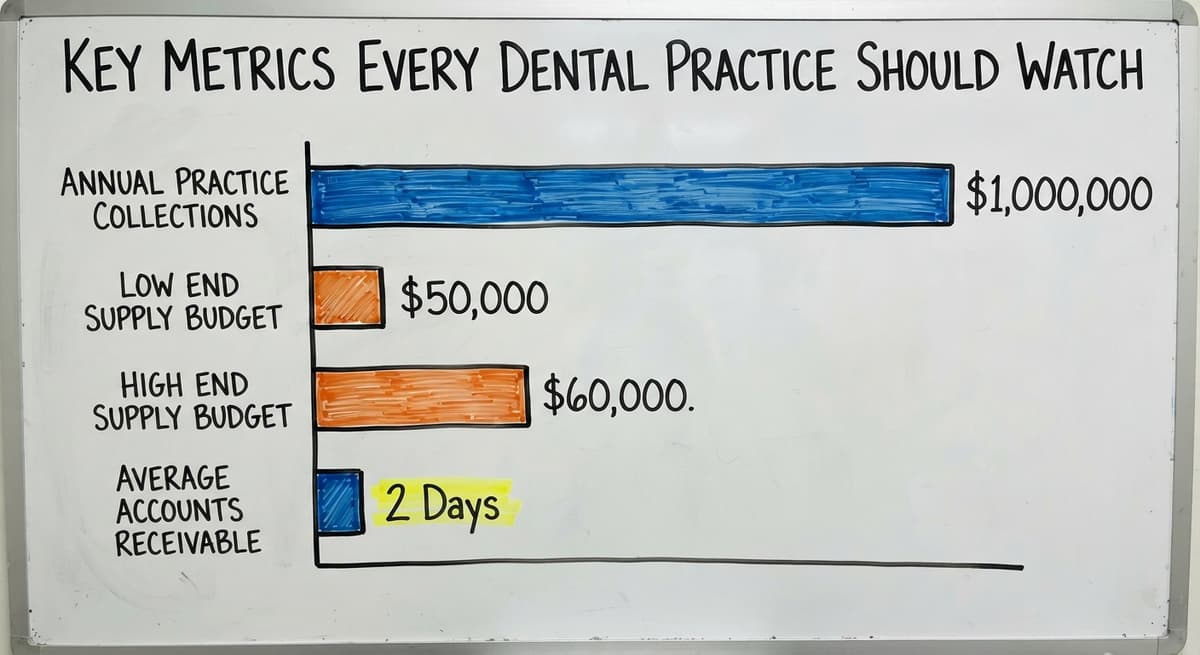
Numbers make inventory decisions easier. The industry benchmark for supply spend as a percentage of collections is 5 to 6 percent. If your practice collects $1,000,000 a year, your supply budget should land between $50,000 and $60,000. Spending more than that is worth investigating.
Four metrics worth tracking every month:
- Supply spend as a percent of collections: your clearest benchmark for whether spending is in range
- Days of supply on hand: how long your current stock would last at normal usage
- Reorder frequency and average order value: rising frequency often signals poor par-level setting
- Expired product write-off rate: measures waste directly
The IRS also has a stake in your counts. IRS Publication 538 states plainly: "To figure taxable income, you must value your inventory at the beginning and end of each tax year." Tracking these numbers is not optional for tax purposes, so you may as well make them useful for operations too.

Setting Par Levels for Dental Supplies
A par level is the minimum quantity that should always be on the shelf. When stock drops to the par level, it is time to reorder. Set it too low and you run out. Set it too high and cash sits idle on a shelf.
How to Calculate a Par Level
Start with 2 numbers: your average weekly usage and your supplier's lead time in weeks. Multiply them together, then add a small buffer for demand spikes.
For example: your practice uses 4 boxes of nitrile gloves per week. Your supplier takes 1 week to deliver. Your par level is 4 boxes plus a 1-box buffer, so 5 boxes. When the count hits 5, you order.
Review par levels every quarter, or any time patient volume shifts by more than 10 percent. A summer slowdown and a post-holiday surge both change the math. Par levels that match real usage are the foundation every other part of this system builds on.
How to Organize Your Supply Room for Easier Counting
Supply room organization is not about aesthetics. It is about speed and accuracy. A well-organized room cuts count time and reduces errors.
- Group by category and label every shelf so anyone on the team can find or put away an item without asking
- Use first-in, first-out (FIFO) rotation: new stock goes behind older stock so older products get used first and expiration waste drops
- Assign one inventory lead who owns the room and keeps the system consistent, even when the rest of the team turns over
- Create a reorder zone: a dedicated shelf or bin where items that have hit par level wait to be ordered, visible to anyone who walks in
A tidy, labeled room is the physical version of your data. If the room is chaotic, the counts will be too.

How Do You Build a Dental Inventory Tracking Spreadsheet?
A spreadsheet is the right starting point for most practices that are moving off paper. Build one with these columns and you will have the core of a working dental supply tracking tool:
| Column | What It Captures |
|---|---|
| Item name | Exact product name, no abbreviations |
| Category | Disposable, restorative, anesthetic, etc. |
| Unit | Box, bottle, pack, each |
| Par level | Minimum quantity before reorder |
| Current count | Updated at each count cycle |
| Reorder point | Quantity that triggers an order |
| Vendor | Primary supplier name |
| Last order date | When the most recent order was placed |
This structure answers the basic questions: what do we have, what do we need, and who do we call? A spreadsheet built this way beats a clipboard every time, and it costs nothing to start.
See it running on your own process first
No build cost. The subscription starts once it is live and doing the job, not before.
Book a callWhen a Spreadsheet Is No Longer Enough
Spreadsheets have real limits. The signs that a practice has outgrown manual tracking are usually clear once you know what to look for:
- Stockouts happen even though someone just did a count
- A second location means 2 separate files that never quite match
- Staff turnover wipes out the institutional knowledge that made the old system work
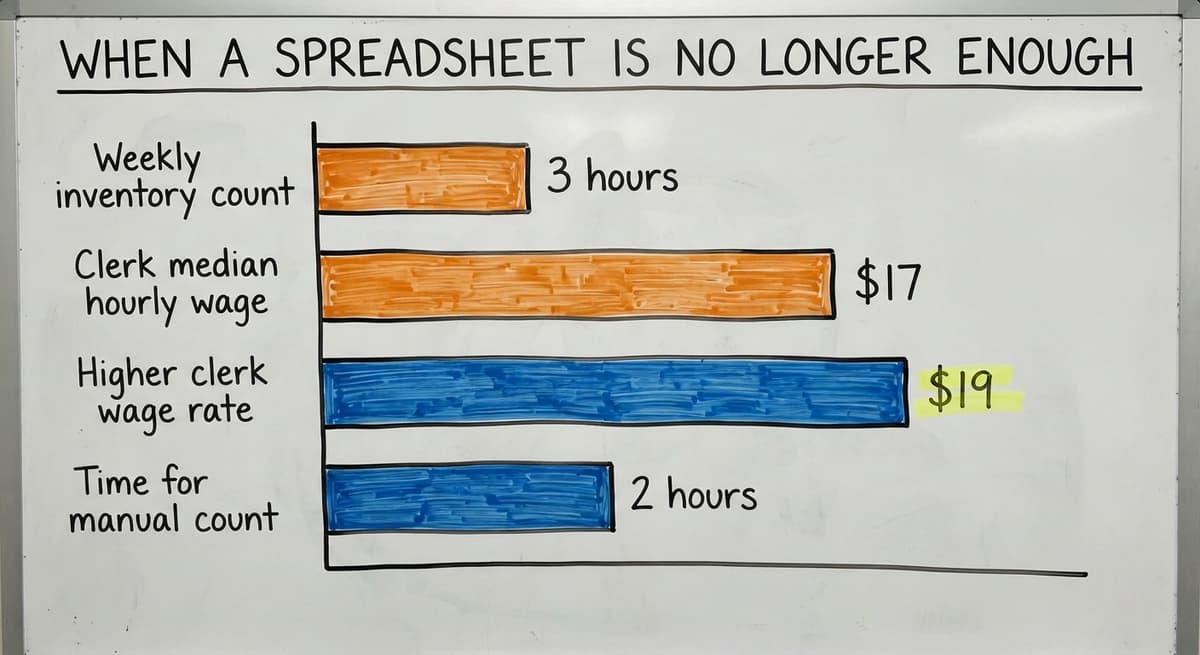
- The weekly count takes more than 2 hours and still misses things
At that point, the cost of the problem, in staff time, rush orders, and expired write-offs, outweighs the cost of a better tool. The Bureau of Labor Statistics reports that stock clerks and order fillers earn a median wage around $17 to $19 per hour. Three staff members spending 3 hours each per week on manual counts costs roughly $8,000 to $9,000 a year in labor alone, before you count errors. That math makes a software investment easy to justify.

What Dental Inventory Management Software Does
Dedicated dental inventory software replaces the manual steps that cause most tracking failures. Here is what a solid platform handles:
- Reorder alerts fire automatically when stock hits the par level, so no one has to remember to check
- Usage history builds over time, turning ordering into a data-driven decision rather than a guess
- Vendor records live in one place: contact info, pricing, lead times, and order history
- Reports show spend by category, by month, and by location, which makes budget conversations easier
- Some systems connect directly to practice management software, so patient volume data can inform supply planning
The shift from reactive to planned ordering is where most of the savings come from. Software makes that shift sustainable without depending on one person's memory.
Features to Look for in Dental Inventory Software
Not every platform fits every practice. Before you commit, check that the software handles these specific needs:
- Barcode or QR code scanning removes the manual entry step that causes most receiving errors
- Automated reorder triggers based on par levels you set, not vendor suggestions
- Expiration date tracking with alerts before products go bad, not after
- Multi-location support if you run or plan to run more than one office
- Reporting and spend analysis that shows supply costs as a percent of revenue
- Integration with practice management or accounting tools like QuickBooks so data does not have to be entered twice
- Ease of use for non-technical staff, because a system no one uses is not a system
NIST's Manufacturing Extension Partnership recommends evaluating any supply chain tool against your actual workflow before buying. That advice applies directly to dental software selection.
Off-the-Shelf Software vs. Custom Inventory Solutions
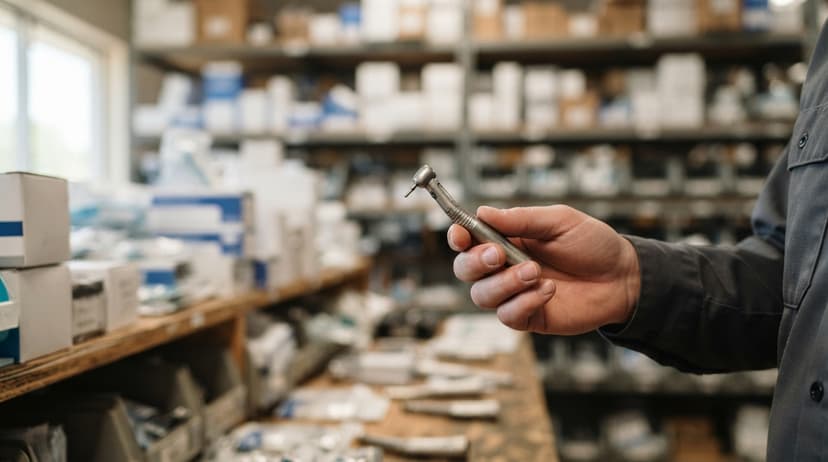
Off-the-shelf inventory tools are built for a broad audience. They work well for practices with straightforward workflows and standard supply categories. Setup is fast and cost is predictable. The trade-off is that you adapt your process to the software, not the other way around.
Custom workflow rollout builds the system around how your practice already operates. Staff do not have to unlearn habits. Reports match the numbers your owner actually reviews. Compliance fields fit your specific controlled substance process.
Custom does not always mean expensive or slow. For a practice with a unique mix of specialties, multiple locations, or tight accounting integration needs, a custom build often pays back faster than forcing a generic tool to fit.
The right choice depends on 3 things: practice size, workflow complexity, and how much the off-the-shelf gaps would cost you in workarounds. Explore custom workflow rollout for small businesses to see whether a tailored approach fits your situation.
How Inventory Management Connects to Purchasing and Accounts Payable
Inventory data should feed directly into buy orders. When a reorder alert fires, the system should be able to generate a draft order with the right vendor, quantity, and unit price already filled in. That removes a manual step and cuts entry errors.
Connecting inventory to accounting, through a QuickBooks integration for operations teams, removes double entry entirely. A buy order approved in the inventory system becomes a bill in QuickBooks without anyone retyping it. That connection also gives the practice owner a live view of supply spend versus collections, which is far more useful than a monthly surprise.
Accurate buy orders also matter beyond the practice walls. The FTC's Mail and Internet Order Rule holds sellers to shipping commitments, which means your vendors need accurate demand signals from you to deliver on time. A connected inventory-to-purchasing flow is the clearest path from supply room discipline to financial visibility.
Not sure this is the right shape for your operation
Describe how the work runs today. We map it on a call and show you what it would look like built around that, before you spend anything.
Book a call
How Do You Handle Controlled Substance Tracking and Compliance?
Controlled substances in a dental practice, mainly local anesthetics and certain sedation medications, need stricter tracking than standard supplies. DEA regulations need accurate logs of every unit received, used, and disposed of. A gap in those records is a compliance problem, not just an inventory error.
Your inventory management system should support audit-ready records for this category: date, quantity, administering provider, and disposal method. Some practices keep a separate physical log in addition to digital records as a backup.
This is one area where it pays to consult a compliance advisor rather than rely on general inventory guidance. The cost of a DEA audit finding outweighs any savings from a lighter tracking approach.
Tips for Getting Your Team on Board
A new system only works if the team uses it. Change is easier when it is introduced the right way.
- Assign one clear owner for inventory tasks so accountability does not get diffused across the whole staff
- Schedule counts as a routine, not a reaction to a crisis, so the habit forms before it is urgent
- Show the time savings early: when staff see that scanning takes 10 minutes instead of 45, buy-in follows naturally
- Pilot on one category first, like gloves or masks, before rolling the system out to every shelf
Starting small lets the team build confidence without overwhelming anyone. A successful pilot also gives you real numbers to share when you expand.

How Often Should You Audit Dental Inventory?
Audit frequency should match how fast items move. A single schedule does not fit every category.
- Weekly spot checks on high-turnover disposables catch shortages before they become emergencies
- Monthly full counts for most supply categories keep the data accurate without burning staff time
- Quarterly par level and vendor pricing reviews catch drift before it compounds
- Annual audit for budget planning and compliance records, especially for controlled substances
Building this cadence into the calendar, rather than doing it when someone remembers, is what separates a real inventory audit process from a reactive scramble.
Real Savings From Better Dental Inventory Management
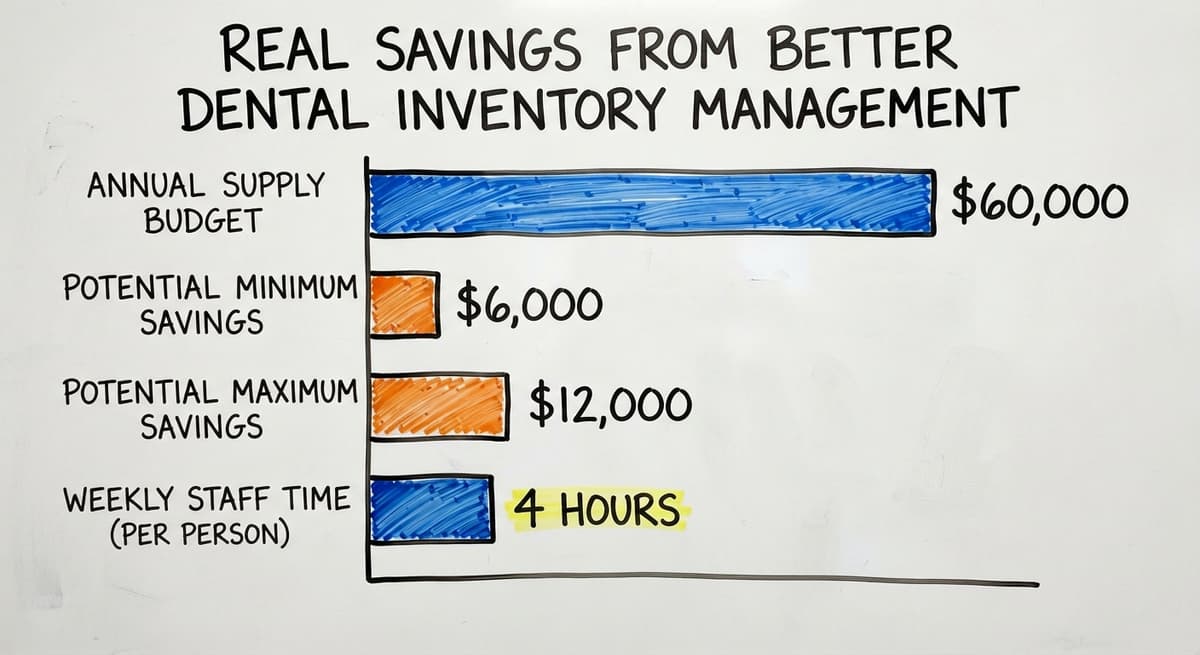
Practices that track inventory carefully usually cut supply spend by 10 to 20 percent. On a $60,000 annual supply budget, that is $6,000 to $12,000 back in the practice each year.
The savings come from several directions at once. Fewer emergency orders mean lower shipping costs. Better expiration tracking means less product thrown away unused. Accurate counts mean fewer duplicate buys.
Staff time is the less visible number. If 2 team members spend 4 hours each per week on manual inventory tasks at $19 per hour, that is $7,904 a year in labor. A system that cuts that time in half recovers nearly $4,000 annually, before any reduction in supply waste.
The financial case for better dental inventory management is not theoretical. It shows up in the numbers within the first few months of consistent tracking.
Next Steps to Improve Your Dental Inventory Management
Improving dental inventory management does not need a perfect system on day one. Start with an honest look at your current process. Where do stockouts happen? How long does a count take? What did you spend on supplies last month versus the month before?
From there, the path is straightforward:
- Set par levels for your top 20 highest-turnover items
- Organize the supply room with labeled shelves and a FIFO rotation
- Build or adopt a tracking tool that matches your current scale
- Train one team member to own the process
- Review and adjust every quarter
If manual processes are costing you more than a better tool would, explore how to replace manual processes with a custom system built around your actual workflow. The right software partner builds around how you already operate, rather than asking you to change everything at once.
One small improvement this week beats a perfect plan that never starts.
Frequently asked questions
What is dental inventory management and why does it matter?
Dental inventory management is the process of tracking, ordering, and organizing every supply a practice uses. It matters because running out of supplies mid-appointment costs revenue and frustrates patients, while over-ordering wastes cash on products that expire before they are used. A consistent system prevents both problems.
How do you set par levels for dental supplies?
Multiply your average weekly usage by your supplier's lead time in weeks, then add a small buffer. For example, if you use 4 boxes of gloves per week and delivery takes 1 week, set your par level at 5 boxes. When stock hits that number, place an order. Review par levels every quarter or whenever patient volume changes significantly.
What are the signs that a practice has outgrown manual inventory tracking?
Key signs include stockouts that happen even after a recent count, a second location with files that never match, staff turnover that erases institutional knowledge, and weekly counts that take more than 2 hours and still miss items. When the cost of those problems exceeds the cost of better software, it is time to switch.
How does inventory management connect to purchasing and accounting?
When a reorder alert fires, a connected system generates a draft buy order with the vendor, quantity, and price already filled in. Linking that to accounting software like QuickBooks removes double entry and gives the practice owner a live view of supply spend versus collections, without waiting for a monthly report.
What features should dental inventory management software have?
Look for barcode or QR code scanning, automated reorder triggers tied to par levels, expiration date alerts, multi-location support if needed, spend reporting, and integration with your practice management or accounting tools. Ease of use for non-technical staff matters as much as any feature, because a system the team avoids does not help.
How often should a dental office audit its inventory?
Run weekly spot checks on high-turnover disposables, monthly full counts for most categories, quarterly reviews of par levels and vendor pricing, and an annual audit for budget planning and compliance records. Building these into the calendar as scheduled events, rather than doing them reactively, is what makes the cadence stick.
What is the difference between off-the-shelf and custom dental inventory software?
Off-the-shelf tools are built for a broad audience and need the practice to adapt its workflow to the software. Custom solutions are built around how the practice already operates, so staff do not have to change their habits. Custom does not always cost more or take longer to implement, and it often fits better for practices with multiple locations or unique compliance needs.
How much money can better inventory management save a dental practice?
Practices that track inventory consistently usually reduce supply spend by 10 to 20 percent. On a $60,000 annual supply budget, that is $6,000 to $12,000 per year. Extra savings come from fewer rush orders, less expired product waste, and staff time recovered from manual counting tasks.
Start with a free first look
A 30 minute call, your operation mapped, and a clear picture of what we would build. No obligation and nothing to install.
Book a callRelated guides
The rest of this guide, for the parts of the job this page does not cover.
Guides
- Inventory Management for Multiple Locations
- Inventory Management System for Manufacturing
- Jewelry Inventory Management
- Qr Code for Inventory Management
- Hvac Inventory Management Software
- Warehouse Inventory Management Software
- Warehouse Inventory Management Systems
- Quickbooks Inventory Management Software
- Inventory and Warehouse Management Software
- Custom Inventory Management Software
- Warehouse Inventory Management System
- Retail Inventory Management
- Manufacturing Inventory Management Software
- Cost of Inventory Management Software
- Manufacturing Inventory Management
- Retail Inventory Management Systems
- Inventory Management Software Freeware
- Inventory Management Small Businesses
Common questions
- Why is Warehousing and Inventory Management Important
- How to Manage Inventory in a Warehouse
- What is the Best Warehouse Inventory Management System?
- What is the Difference Between Warehousing and Inventory Management
- What is B Type of Inventory in Warehouse Management
- What is Warehousing and Inventory Management