

Consumable Inventory
Consumable inventory is the supplies your team uses every day to run the warehouse but never sells. Think packing tape, gloves, and barcode labels. If you run out, orders stall. This article explains what consumable inventory is, why it slips through the cracks in QuickBooks, and how a small operation can get it under control without buying a full ERP.
Reviewed September 2026. Figures are worked from the assumptions stated beside them, so you can substitute your own and the arithmetic still holds.
Reviewed and updated: June 2025
Book a callWhat Is Consumable Inventory?
Consumable inventory means items your team uses up during daily operations. These are not products you sell. They are not machines you depreciate. They are the supplies that keep the work moving: stretch wrap, printer labels, cleaning spray, safety gloves, box tape.
The IRS draws a clear line here. IRS Publication 538 states: "To figure taxable income, you must value your inventory at the beginning and end of each tax year." Consumables on the shelf are an asset until your team uses them. The moment they are used, they become an expense. That shift matters for your books and for how you track them day to day.
The simplest test: if an item gets used up and thrown away, it is a consumable.
We build it for your operation, and the first look is free
If you would rather not compare products, describe how your operation already works and we build the system around it.
No build cost. You see it running on your own process first, and the monthly subscription starts only once it is live.
Book a callConsumable Inventory vs. Other Inventory Types
Not all inventory works the same way, and mixing up the categories causes tracking gaps.
| Type | What it is | Sold to customers? |
|---|---|---|
| Finished goods | Products ready to ship | Yes |
| Raw materials | Inputs that become finished goods | No, transformed |
| MRO inventory | Parts and supplies for equipment upkeep | No, maintenance use |
| Consumable inventory | Supplies used in daily operations | No, used up |
MRO inventory (maintenance, repair, and operations) is the closest cousin to consumables. The line blurs in a fulfillment center where the same gloves might protect a picker and also wipe down a conveyor belt. QuickBooks often lumps these together under a single expense account, which hides how much each category actually costs.
Knowing which category an item belongs to is the first step toward tracking it properly.
Why Consumable Items Rarely Carry Barcodes
GS1, the global standards body behind product barcodes, notes that "barcodes are the most widely used automatic spotting technology in the world," yet most consumable items in a small warehouse carry no barcode at all. No barcode means nothing to scan, and nothing to scan means no real-time count.
What Are Common Examples of Consumable Inventory in a Warehouse?
The most common consumable inventory items in a warehouse are the ones nobody thinks about until they run out. Bubble wrap, poly mailers, box tape, shrink wrap, ink cartridges, barcode labels, safety gloves, and hand sanitizer all qualify.
These items share 3 traits that make them easy to overlook:
- They cost little per unit, so no one watches them closely.
- They live in open supply areas where anyone can grab them.
- They disappear gradually, not all at once.
Small-dollar items at scale are a large-dollar problem without a system to watch them.
How Consumable Costs Add Up at Volume
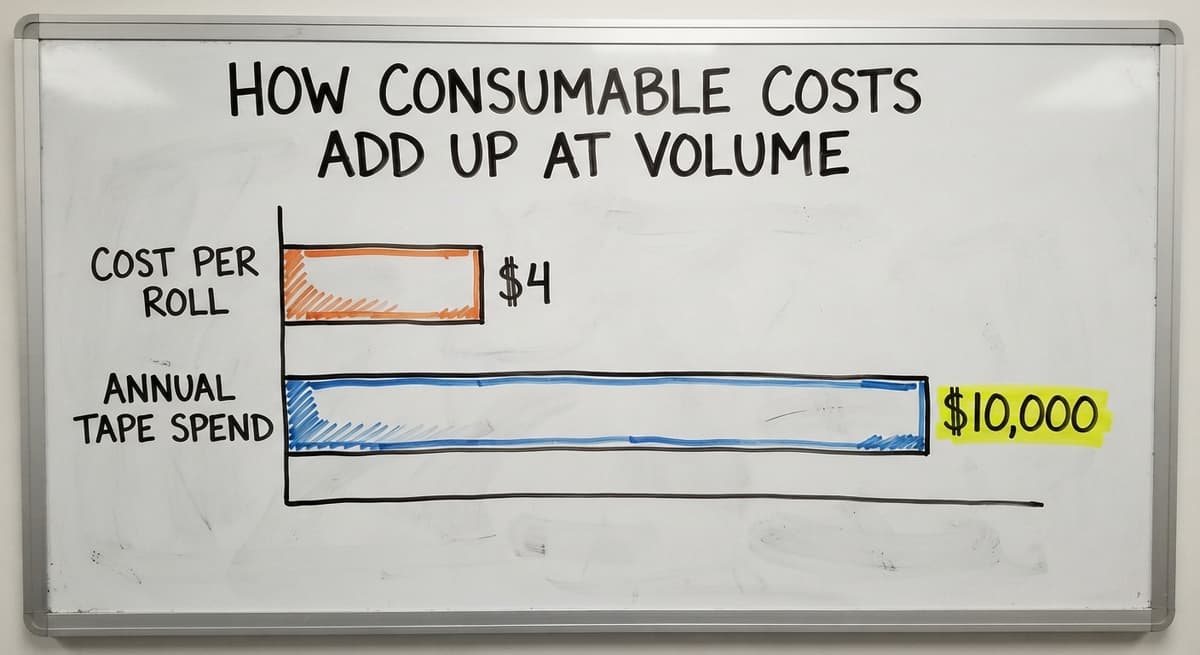
At a small scale, a missing roll of tape is a minor annoyance. At volume, the math changes fast. If a 10-person team each uses 1 roll of tape per shift at $4 a roll across 250 working days, that is $10,000 a year in tape alone. Multiply that across a dozen consumable items and the budget impact is real, even if each line item looks small.
Why Consumable Inventory Is Hard to Track
Consumable inventory tracking fails because the items were never built into the workflow in the first place.
Here is what usually happens:
- A team member grabs supplies from an open shelf with no checkout step.
- Multiple people access the same area across every shift.
- Items carry no SKU or barcode, so there is nothing to scan.
- QuickBooks captures the buy invoice after the fact, not the moment of use.
The result is a gap between what you bought and what you have. You only discover a shortage when someone goes to the shelf and finds it empty. By then, a rush order is already needed.
The gap is not a people problem. It is a process problem that a better system can close.
The comparison is easier when one option is built for you
Off-the-shelf means fitting your process to the software. We do it the other way round, and the first look costs nothing.
Book a call
The Labor Cost of Supply Shortages
The US Bureau of Labor Statistics reports that warehouse stock clerks earn a median wage near $20 per hour. Every hour a worker spends hunting for supplies or waiting on a rush delivery is a direct labor cost with no output attached.
The Hidden Cost of Poor Consumable Inventory Control
Running out of warehouse supplies costs more than the supplies themselves. The real damage shows up in 4 places.
Rush freight is the most visible hit. A same-day or next-day order for tape or labels often costs 3 to 5 times the standard unit price.
Overstocking is the overcorrection. Teams that have run out before tend to order too much next time. That cash sits on a shelf instead of working.
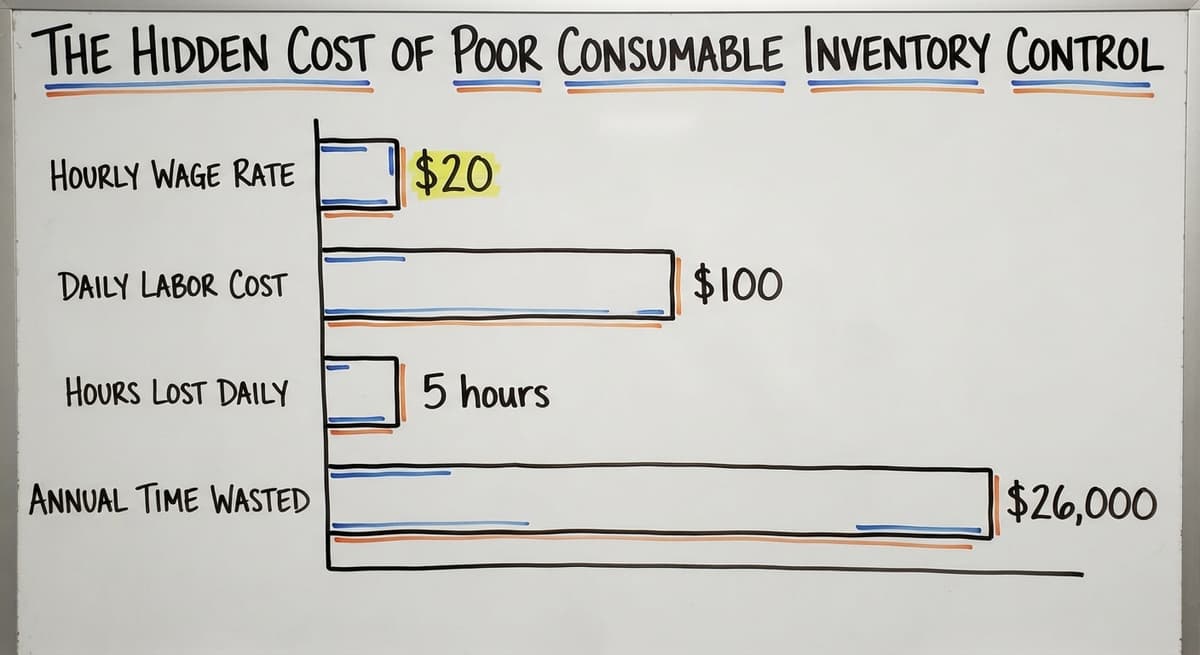
Staff time disappears into supply searches. Three people spending even 20 minutes a day looking for or waiting on supplies adds up to 5 hours of paid labor per day, or roughly $100 at $20 per hour. Over a year, that is $26,000 in time with nothing to show for it.
Every dollar lost to a supply shortage is a dollar that a basic reorder system would have kept.
How Untracked Consumables Distort Your Financial Picture
Budget overruns are the hardest to explain because the data is missing. When supply costs jump month to month, there is no usage record to point to. The US Census Bureau's Monthly Wholesale Trade data shows that inventory-to-sales ratios are a key signal of working health for wholesale firms. Consumables that are untracked distort that picture.

How Small Distributors Track Consumables Today, and Why It Breaks Down
Most small operations run on a patchwork: a sticky note on the shelf, a shared spreadsheet someone updates when they remember, or one person who just knows when to reorder. Reorder triggers are usually a visual check or a complaint from the floor.
This system worked fine when the operation was smaller. It is not a failure. It is a natural stage of growth.
The problem is that spreadsheets are not updated in real time. When 3 people share one file, version conflicts appear. There are no automatic reorder alerts, and the data lives outside the rest of the operation. QuickBooks captures the buy but not the daily usage, so the gap between spend and consumption stays invisible.
A system that worked at 5 people becomes a liability at 25.
Why Visibility Into Consumption Is the Real Gap
As the NIST Manufacturing Extension Partnership notes in its supply chain guidance, visibility into what is being consumed, not just what was ordered, is the foundation of a stable supply chain. A spreadsheet cannot provide that visibility once the operation grows past a handful of people.
Key Metrics for Consumable Inventory Control
Before you can fix a tracking problem, you need to know what to measure. Five numbers matter most for consumable stock.
- Consumption rate: how many units your team uses per day or per week for each item.
- Reorder point: the on-hand quantity that triggers a new buy order.
- Lead time: how many days it takes your supplier to deliver after you place an order.
- Days of supply on hand: current quantity divided by daily consumption rate.
- Cost per unit consumed: total spend on an item divided by units used in the same period.
None of these need expensive software to start. A simple log sheet can capture them. What matters is that someone owns each number and reviews it on a set schedule.
Measuring consumption turns a reactive supply system into a predictable one.
See it running on your own process first
No build cost. The subscription starts once it is live and doing the job, not before.
Book a call
How Do You Set a Reorder Point for Consumable Items?
A reorder point is the quantity that tells you to place a new order before you run out. The formula is: daily usage multiplied by lead time, plus safety stock.
Here is a real example with packing tape. Your team uses 4 rolls per day. Your supplier takes 3 days to deliver. You want 5 rolls as a buffer in case of a delay.
Reorder point = (4 rolls × 3 days) + 5 rolls = 17 rolls
When your shelf count hits 17, you order. Simple.
A reorder point you calculated yourself, even roughly, will prevent more stockouts than a policy that lives in someone's head.
Adjusting Reorder Points for Seasonal and Supplier Changes
Adjust the formula by season. If your volume doubles in Q4, double the daily usage number for that period. If your supplier slows down around holidays, add a day to your lead time estimate. The formula does not need to be perfect. A basic calculation reviewed once a quarter beats running on gut instinct every time.
Inventory management software for small distributors can store this number for every item and fire a reorder alert automatically when the count drops to that level. That removes the human memory step entirely.
Organizing Storage and Running a Consumable Inventory Audit
Set Up Storage That Supports Counting
Dedicated storage zones reduce informal grabbing and make counts faster. Label every shelf, even with a hand-written card. First-in, first-out matters for items with a shelf life: cleaning chemicals degrade, and barcode labels can fade. Limit the number of access points so you know who is taking what.
For a 5-to-100-staff warehouse, one designated supply room with a sign-out sheet is often enough to cut mystery losses by half.
How Do You Audit Your Current Consumable Inventory?
An audit starts with a list. Follow these 5 steps to get a clear picture of where you stand.
- List every consumable item your operation uses, from tape to toner to trash bags.
- Count current on-hand quantities for each item. A physical count, not a guess.
- Pull 90 days of buy history from QuickBooks to see what you have been spending.
- Estimate daily usage for each item based on your buy history and team size.
- Flag the items that have caused a stockout or that you consistently over-order.
That last step is the most valuable. The items that caused a stockout are the ones that need a formal reorder point first. The ones you over-order are tying up cash.
An audit takes a few hours and gives you the numbers every other fix depends on.
Why Consumable Inventory Accuracy Affects Order Fulfillment
The FTC's Mail and Telephone Order Rule needs businesses to ship when they say they will. Accurate consumable inventory is part of what keeps that promise: if you run out of labels or mailers, orders sit.
Not sure this is the right shape for your operation
Describe how the work runs today. We map it on a call and show you what it would look like built around that, before you spend anything.
Book a call
How Inventory Management Software Handles Consumables
Inventory management software for small distributors solves the tracking gap by giving every consumable item an internal code, even if it has no barcode. Staff log usage at the point of consumption, not after the fact. The system tracks running totals in real time.
When a count drops to the reorder point, an automatic reorder alert goes out. No one has to remember. Reports show consumption trends over weeks and months, so you can spot a spike before it becomes a shortage.
The right software does not replace QuickBooks. It fills the gap QuickBooks was never built to cover.
How Inventory Software Integrates With QuickBooks
Dedicated inventory software replaces the sticky note and the spreadsheet without requiring a full ERP migration. QuickBooks integration for warehouse operations keeps accounting clean: the working system tracks daily usage, and buy data flows into QuickBooks automatically when an order is placed. Staff log consumption in one place. The finance team sees clean numbers in the tool they already use.
Custom Inventory Software vs. Off-the-Shelf Tools
Off-the-shelf inventory tools are built for the average operation. If your workflow matches their assumptions, they work well. If it does not, you adapt your process to fit their software, which means retraining staff and working around screens that do not match how your team actually moves.
Custom working software for wholesale businesses maps to the way your team already works. The fields, the alerts, and the reports match your items and your process. Smaller teams benefit more from a system that fits than one that needs ongoing adaptation.
A system built around your workflow gets used. One that fights your workflow gets worked around.

What Custom Implementation Actually Looks Like
Custom does not mean slow or expensive. Rollout is measured in weeks, not quarters. A Columbus, Ohio-based team working directly with your operation means no offshore handoffs, no support ticket queues, and the same people who built the system are the ones who support it. Warehouse management without an ERP is possible when the system is sized for your actual operation rather than a hypothetical enterprise.
Signs Your Operation Is Ready for a Better System
The following warning signs are growth signals, not failures. If any of them sound familiar, a more structured approach to consumable inventory tracking will pay for itself quickly.
- You have run out of a consumable at least once in the past 90 days.
- Nobody on your team can say how much packing tape you used last month.
- Reorders happen because someone complained, not because a number triggered them.
- Supply costs vary month to month with no clear reason in the data.
If you checked 2 or more of those boxes, the informal system has reached its limit. The next step is not a massive software project. It starts with the audit described above, then a reorder point for your top 10 consumable items, then a simple log that captures daily usage.
How to replace Excel and spreadsheets in your warehouse is a question most small operations face at this stage. The answer is usually a focused tool that handles the working layer while QuickBooks handles the financial one.
Outgrowing a manual system is a sign the business is working. The fix is a system sized for where you are going, not where you started.
Frequently Asked Questions About Consumable Inventory
Is consumable inventory an asset or an expense? Consumable inventory is an asset while it sits on your shelf. It becomes an expense the moment your team uses it. The IRS needs you to value inventory at the start and end of each tax year, which includes consumables on hand.
Should I track consumables in QuickBooks? QuickBooks handles the buy side well. It does not track daily usage in real time. For accurate consumable inventory control, you need a separate working layer that feeds buy data into QuickBooks automatically.
What is a good reorder point formula for a small warehouse? Use: daily usage multiplied by lead time, plus safety stock. If you use 4 rolls of tape per day, your supplier takes 3 days to deliver, and you want a 5-roll buffer, your reorder point is 17 rolls.
How often should I count consumable inventory? A weekly spot-check on your fastest-moving items and a full count once a month works for most small warehouses. High-cost or high-risk items may need a daily glance.
Can I track consumable inventory without a barcode scanner? Yes. Assign an internal code to each item and log usage manually or through a simple app. A barcode scanner speeds the process up, but it is not required to get started.
When does a small warehouse need dedicated inventory management software for consumables? When stockouts happen more than once a quarter, when supply costs are unpredictable, or when no one can answer basic usage questions, a dedicated system will pay for itself inside a year.
Frequently asked questions
Is consumable inventory an asset or an expense?
Consumable inventory is an asset while it sits on your shelf. It becomes an expense the moment your team uses it. The IRS needs you to value inventory at the start and end of each tax year, which includes consumables on hand.
Should I track consumable inventory in QuickBooks?
QuickBooks handles the buy side well but does not track daily usage in real time. For accurate consumable inventory control, you need a separate working layer that feeds buy data into QuickBooks automatically so accounting stays clean.
What is a good reorder point formula for a small warehouse?
Use: daily usage multiplied by lead time, plus safety stock. If you use 4 rolls of tape per day, your supplier takes 3 days, and you want a 5-roll buffer, your reorder point is 17 rolls. Review the formula each quarter.
How often should I count consumable inventory?
A weekly spot-check on your fastest-moving items and a full count once a month works for most small warehouses. High-cost or high-risk consumable items may need a daily check to prevent surprise shortages.
Can I track consumable inventory without a barcode scanner?
Yes. Assign an internal code to each consumable item and log usage manually or through a simple app. A barcode scanner speeds the process up but is not required to get started with basic consumable inventory tracking.
When does a small warehouse need dedicated inventory management software for consumables?
When stockouts happen more than once a quarter, supply costs are unpredictable month to month, or no one can answer basic usage questions, a dedicated system will usually pay for itself inside a year.
What is the difference between consumable inventory and MRO inventory?
MRO inventory covers parts and supplies used to keep equipment. Consumable inventory covers supplies used in daily operations like packing and shipping. The line blurs in fulfillment centers, which is why tracking them separately matters for accurate cost data.
Start with a free first look
A 30 minute call, your operation mapped, and a clear picture of what we would build. No obligation and nothing to install.
Book a callRelated guides
The rest of this guide, for the parts of the job this page does not cover.
Guides
- Excess Inventory
- Closed for Inventory
- Multi Location Inventory Management Software
- Inventory Management for Multiple Locations
- Costing Inventory
- Is Inventory a Long-term Asset
- Inventory Management System for Manufacturing
- Inventory Fixed Assets
- Inventory Management Pics
- Excel Inventory Template
- Push and Pull Inventory
- B2b Inventory Management
- Jewelry Inventory Management
- Dental Inventory Management
- The Objective of Inventory Management is To
- Qr Code for Inventory Management
- Inventory Metrics
- Inventory Formulas
- Hvac Inventory Management Software
- Calculate Beginning Inventory
- Inventory Management Software for Schools
- Find Beginning Inventory