


Jewelry Inventory Management
Jewelry inventory management means tracking every piece you own, owe, or hold on behalf of a vendor, knowing exactly where each one is, and keeping that data accurate enough to make buying and selling decisions. It differs from general product inventory because one ring style can generate hundreds of SKUs, values are high, and memo or consignment goods add layers most software ignores. Getting it right protects your cash and your reputation.
Reviewed September 2026. Figures are worked from the assumptions stated beside them, so you can substitute your own and the arithmetic still holds.
Reviewed and updated: June 2025
Book a callWhat Is Jewelry Inventory Management
Jewelry inventory management is the process of recording, tracking, and counting every item in your stock, whether you own it outright, hold it on memo, or have it reserved on layaway. The IRS makes this a legal requirement, not a choice. As IRS Publication 538 states: "To figure taxable income, you must value your inventory at the beginning and end of each tax year." For jewelry businesses, that valuation is harder than most because a single product line can branch into dozens of variants, and a single mislabeled piece can mean a large dollar error on your books.
We build it for your operation, and the first look is free
If you would rather not compare products, describe how your operation already works and we build the system around it.
No build cost. You see it running on your own process first, and the monthly subscription starts only once it is live.
Book a callWhy Jewelry Inventory Is Harder Than Most Product Inventory
General retail software assumes a product is a product. Jewelry does not work that way. One ring style offered in 6 metals, 10 sizes, and 4 stone options creates 240 separate SKUs before you add finish variations. A single counting error on a $4,000 piece costs more than a full day of staff wages. Consignment and memo goods sit in your cases but do not belong to you yet, and most general software has no field for that distinction. Layaway adds another layer: the piece is spoken for but still on the shelf. Holiday demand spikes compress reorder windows to days rather than weeks.
Barcode standards help, and GS1 notes that its barcode system provides "a common language" that lets trading partners share accurate product data across the supply chain, which is exactly what jewelry SKU management needs at scale.
Common Problems That Signal a Broken System
What are the signs that your jewelry inventory system is broken? The clearest sign is overselling: a customer buys a piece online or by phone, and you discover it left the building last week. Other signals include staff spending 3 or more hours a week reconciling spreadsheets against QuickBooks, memo pieces going unrecovered because no one logged a return deadline, and an inability to answer which SKUs are moving without pulling 4 separate files. If your item list in QuickBooks has grown into an unnavigable mess, that is also a signal. Each of these problems has a dollar cost, and together they compound fast.
FAQ: How do I track memo and consignment pieces without losing them? Log every memo piece with its own record the moment it enters your store. Include the vendor name, piece description, agreed return date, and value. Set an automated reminder 5 days before the deadline. Keep memo stock in a separate report view so it never blends into owned inventory counts. A piece with no return date on record is a piece you will eventually lose track of.
How Most Small Jewelry Businesses Track Inventory Today
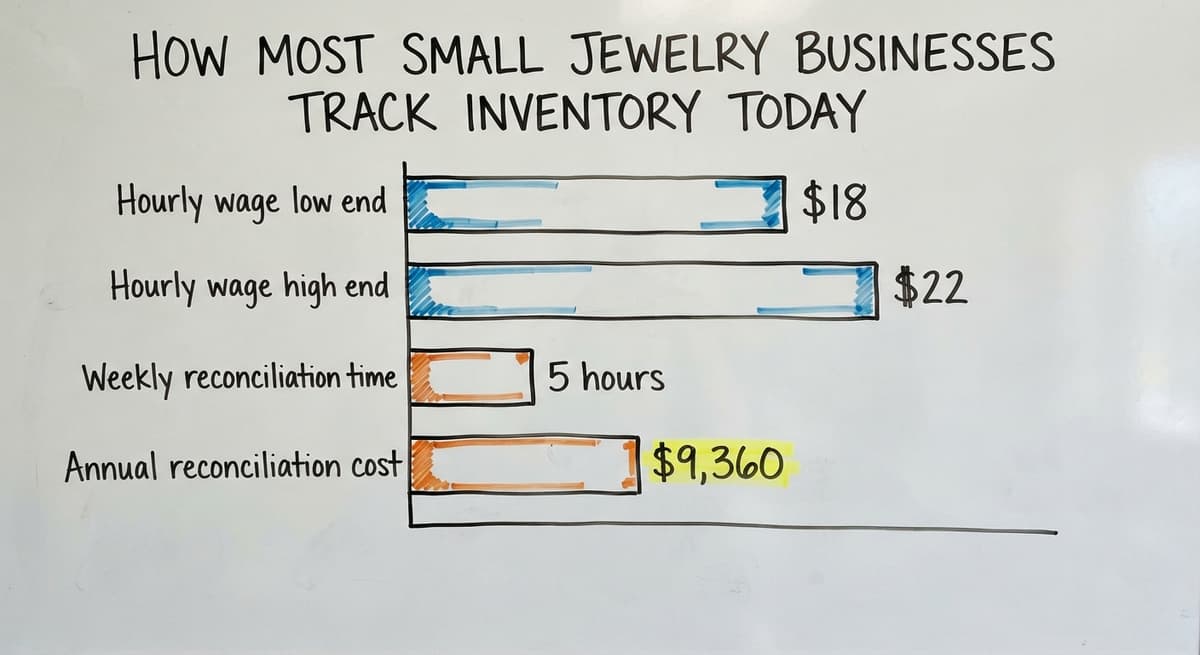
The typical setup is a mix of QuickBooks for accounting, an Excel sheet for item counts, handwritten tags on pieces, and email threads for memo agreements. This works at low volume. Once you pass roughly 500 active SKUs or add a second display case, the patchwork breaks. The hidden cost is staff time. According to the US Bureau of Labor Statistics, stock clerks and order fillers earn around $18 to $22 per hour. Two staff members spending 5 hours each week on manual matching costs between $9,360 and $11,440 per year, before you count the errors that slip through.
QuickBooks is not the problem, and it does not need to go. It handles your financials well. The gap is in jewelry-specific tracking, and that gap is what a dedicated layer fills.
The Core Components of a Solid Jewelry Inventory System
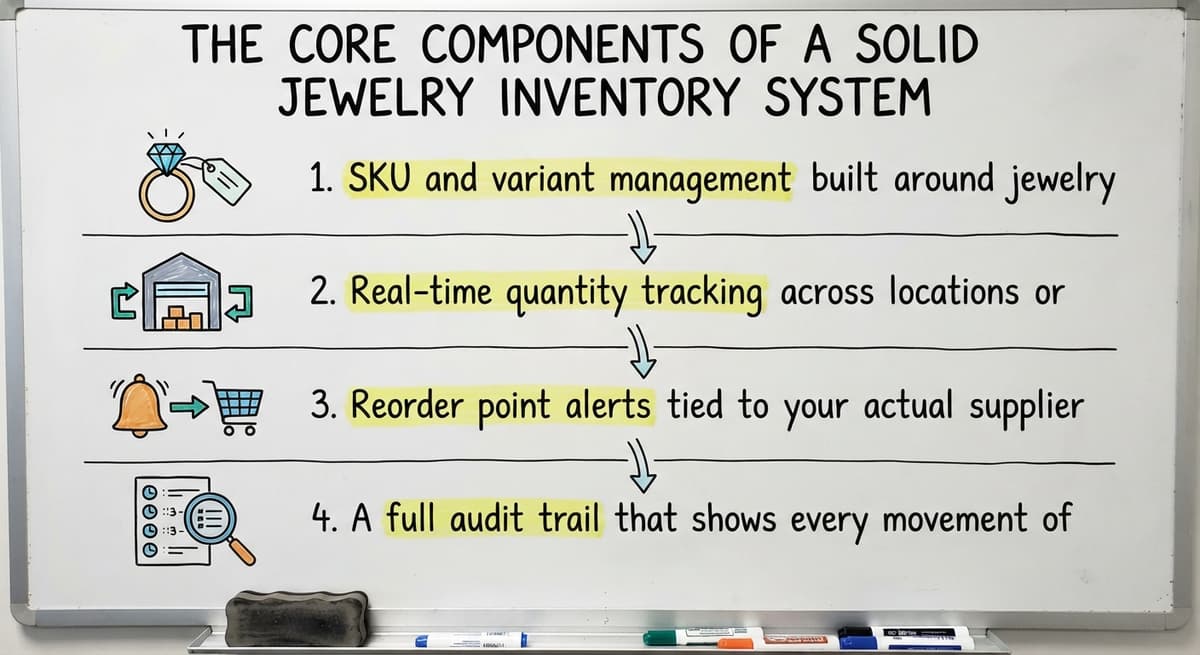
A system built for jewelry stock management needs more than a count field. The components that matter most are:
- SKU and variant management built around jewelry attributes: metal type, stone, size, and finish, so every combination has its own trackable record
- Real-time quantity tracking across locations or individual display cases, updated the moment a piece moves
- Reorder point alerts tied to your actual supplier lead times, not a generic default
- A full audit trail that shows every movement of every piece, who logged it, and when
Without an audit trail, shrinkage is invisible. Without variant management, your counts collapse into a single number that tells you nothing useful about what to reorder.
The comparison is easier when one option is built for you
Off-the-shelf means fitting your process to the software. We do it the other way round, and the first look costs nothing.
Book a callTracking Variants: Metal, Stone, Size, and Finish
How do you track the same style ring across multiple sizes, metals, and stones? You build a variant structure where the parent item is the style and each combination gets its own child SKU. One ring style across 6 metals, 10 sizes, and 4 stones produces 240 SKUs. A well-built system lets you search by any attribute, so finding "14K yellow gold, size 7, sapphire" takes one query rather than a scroll through a flat list. Jewelry variant tracking done this way keeps counts fast and searches accurate, even when your catalog runs into the thousands.
Managing Memo and Consignment Goods
Memo goods are pieces a vendor places in your store for you to sell, with unsold items returned by an agreed date. You do not own them yet, but they are physically in your possession. That creates real tracking risk: if memo pieces live in the same inventory pool as owned stock, your on-hand value is wrong and your insurance exposure may be wrong too.
The right approach logs each memo piece with its own record, flags it as vendor-owned, and stores the return deadline in the same record. Automated reminders fire before that date. Reports for consignment inventory run separately from owned inventory so your balance sheet stays clean. Vendors trust you more when you can produce an accurate memo matching on request, and that trust affects the terms they offer you.
FAQ: Can I keep using QuickBooks and still improve my inventory tracking? Yes. QuickBooks handles accounting well but was not built for complex jewelry variant tracking. The right move is to add a dedicated inventory layer that pushes cost-of-goods and buy data into QuickBooks automatically. You keep your chart of accounts, your existing reports, and your accountant's workflow. The inventory system handles what QuickBooks cannot.
Layaway and Hold Tracking Inside Your Inventory System
A piece on layaway is sold in the customer's mind but still sitting in your case. Manual counts treat it as available stock, which leads to double-selling. The fix is a status flag that marks the piece as held the moment a layaway agreement is created. The piece stays off your available count. The system links each payment to the record, so staff can see the balance due without opening a separate file. When the final payment clears, the system releases the piece to the sold column automatically. Layaway tracking built this way also gives you a clear picture of future cash coming in from existing agreements.

What Is a Reorder Point and How Do I Set One for Jewelry?
A reorder point is the stock level that triggers a buy order before you run out. Set it by multiplying your average daily sales for a SKU by your supplier's lead time in days, then add a small buffer for demand spikes. If you sell 2 units per day and your supplier takes 10 days to deliver, your reorder point is 20 units, plus whatever buffer your holiday history suggests. Seasonal demand around November and December can double normal sell rates, so jewelry reorder points need a seasonal adjustment built in, not just an annual review. A system that drafts a buy order automatically when stock hits the threshold removes the manual step most small teams forget under holiday pressure. Avoiding both stockouts and excess stock that ties up working capital is the whole point of getting this number right.
See it running on your own process first
No build cost. The subscription starts once it is live and doing the job, not before.
Book a callConnecting Jewelry Inventory Management to QuickBooks
QuickBooks integration for wholesale distributors works best as a one-way data push. Your inventory system owns the item records, quantities, and cost data. When a buy order closes or a sale posts, the inventory system sends the financial entry to QuickBooks. No one types the same number twice. No one reconciles two systems at month-end.
This approach keeps your accountant happy because QuickBooks stays the system of record for financials. It keeps your operations team happy because they work in a tool built for jewelry, not adapted from a general retail template. The two systems do different jobs, and the integration is the bridge, not the replacement.

Barcode and Tag Scanning for Jewelry
Small jewelry tags need label formats that general warehouse scanners often cannot read reliably. A dedicated jewelry label printer produces tags small enough for a ring shank but still scannable with a handheld or mobile device. Scanning a piece at receive, transfer, and sale removes the manual keying errors that cause most discrepancies on high-value items. According to GS1, standardized barcodes let any partner in the supply chain read the same data, which matters when you receive goods from multiple vendors. For larger collections, RFID tags allow a reader to count dozens of pieces at once without line-of-sight scanning, which cuts physical count time significantly.
Cycle Counts vs. Full Physical Inventory
What is the difference between a cycle count and a full physical inventory? A full physical count stops operations, pulls every piece from every case, and reconciles the whole catalog at once. Most small operations do this once a year. A cycle count checks a rotating subset of SKUs on a regular schedule, so the whole catalog gets counted across weeks or months without ever shutting down.
Schedule cycle counts by category: fine jewelry one week, fashion jewelry the next, loose stones after that. Shrinkage shows up faster when counts happen continuously rather than once annually, and a missing piece discovered in week 3 is easier to investigate than one discovered 11 months later.
FAQ: What is the best way to inventory jewelry? The best approach combines barcode or RFID scanning for receiving and sales, a system with native jewelry variant support for SKU management, and regular cycle counts by category rather than one annual physical count. No single method works in isolation. The combination of accurate data entry at the point of movement and frequent partial counts is what keeps your numbers reliable.

Reporting That Actually Helps You Make Decisions
Good jewelry inventory software produces reports you act on, not just reports you file. The 4 that matter most are:
- Sell-through rate by category and vendor: shows which lines are earning their shelf space and which are not
- Aging report: flags pieces that have sat longest so you can mark them down or return them before carrying costs compound
- Gross margin by SKU: finds your most profitable items so you can reorder them first and feature them prominently
- Open-to-buy calculation: tells you how much purchasing budget you have left in a period based on current stock value and projected sales
The US Census Bureau's Monthly Wholesale Trade data tracks inventory-to-sales ratios across wholesale sectors, which gives you a benchmark for whether your stock levels are in line with industry norms. A report that answers "what should I buy next month?" is worth more than a report that only confirms what you already sold.
Multi-Location and Display Case Tracking
Retailers with more than 1 store or multiple display cases need to know where each piece is physically located, not just whether it exists somewhere in the building. A transfer between cases should update counts the moment it is logged, not at end of day. Loss prevention depends on knowing the last logged location of any high-value piece. If a $6,000 bracelet is unaccounted for, the audit trail tells you which case it was in last and who moved it.
Wholesale distributors shipping to multiple retail accounts face the same challenge at a larger scale. Each retail account is well a location, and pieces sent on memo to those accounts need the same tracking discipline as pieces in your own cases.
Not sure this is the right shape for your operation
Describe how the work runs today. We map it on a call and show you what it would look like built around that, before you spend anything.
Book a call
What Should I Look for in Jewelry Inventory Management Software?
The right jewelry inventory software does these things without heavy customization. Look for:
- Native jewelry attribute support: metal, stone, size, and finish fields built in, not added via workarounds
- QuickBooks integration that preserves your existing accounting workflow rather than replacing it
- Memo and consignment tracking as a core feature, not an add-on module
- A real rollout team you can call, not just a help article and a chat widget
- Pricing that scales from 5 to 100 staff without jumping to enterprise tiers
Avoid tools built for general retail that need you to adapt your workflow to their data model. The NIST Manufacturing Extension Partnership recommends evaluating supply chain tools against your actual working process before committing, which is sound advice for any inventory software decision.
Custom Software vs. Off-the-Shelf Solutions
Off-the-shelf tools are built for the average business. If your operation runs on specific memo terms, unusual consignment splits, or a layaway structure that does not match a standard template, you spend months forcing your process into the software's shape. Custom inventory software for small businesses is built around how you already work. No forced migration. No retraining staff on a workflow that does not match their day.
A local rollout partner can adjust the system as your business changes, which matters more than it sounds. A SaaS vendor's roadmap does not bend for your edge cases. A partner who built your system can fix it in a phone call.

How Implementation Actually Works for a Small Operation
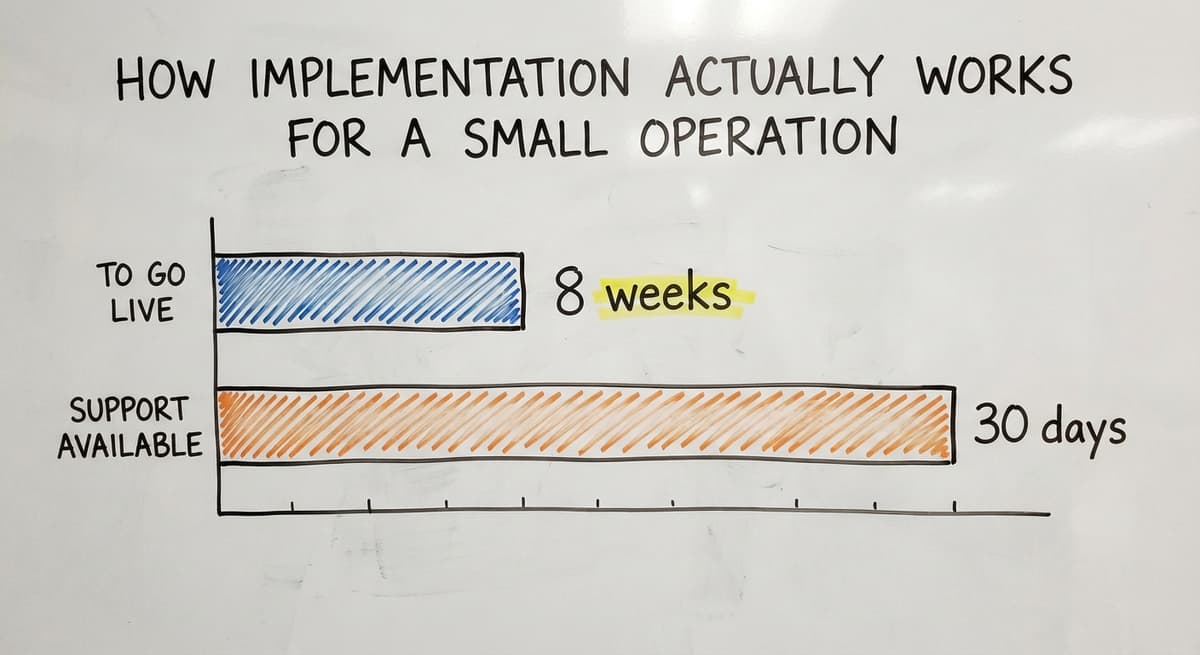
How long does it take to implement a jewelry inventory system? For a focused scope, expect 4 to 8 weeks from first conversation to go-live. The phases are:
- Discovery: map your current process, identify every manual step, and agree on what the system needs to do
- Build: configure or develop the system around your actual SKU structure and workflows
- Test: run parallel with your existing process using real data before cutting over
- Go-live: switch over, with support available for the first 30 days
Staff training is short because the system matches habits your team already has. Replacing Excel with a custom operations system does not mean rebuilding everything; it means automating the parts that cost the most time. Ongoing support means changes do not need starting a new project from scratch.
Signs You Have Outgrown Your Current Jewelry Inventory Setup
Four signals tell you the current setup has reached its limit:
- You spend more than 2 hours a week reconciling counts by hand
- You have lost track of memo pieces more than once in the past year
- Your QuickBooks item list has grown too large to navigate without a search
- You cannot answer "what is our current inventory value?" without opening multiple files
Any one of these is worth fixing. All four together mean the cost of staying put is higher than the cost of changing. The US Federal Trade Commission needs businesses to ship orders when promised, and an inaccurate count is the most common reason a business cannot meet that obligation.

Next Steps to Improve Your Jewelry Inventory Management
Start with an audit of your current process. Write down every manual step your team takes to count, reconcile, or track a piece from receive to sale. That list is your problem map.
From that map, pick the 3 pain points costing the most time or money. Memo pieces going missing, hours lost to matching, and an inability to report current stock value are the most common answers. Then talk to a software partner who understands small-scale operations and warehouse management for small operations, not one who leads with a demo built for a national chain.
Fix the biggest problem first, prove the system works, then expand. A focused start beats a full replacement that stalls before go-live.
Frequently asked questions
What is the best way to inventory jewelry?
The most reliable approach combines barcode or RFID scanning at every point of movement, a system with native jewelry variant support for SKU management, and regular cycle counts by category rather than one annual physical count. Scan pieces at receive, transfer, and sale to remove manual entry errors. Count a rotating subset of your catalog each week so discrepancies surface quickly rather than once a year.
How do I track memo and consignment pieces without losing them?
Log every memo piece with its own record the moment it enters your store. Include the vendor name, piece description, agreed return date, and value. Set an automated reminder 5 days before the deadline. Keep memo stock in a separate report view so it never blends into owned inventory counts. A piece with no return date on record is a piece you will eventually lose track of.
Can I keep using QuickBooks and still improve my inventory tracking?
Yes. QuickBooks handles accounting well but was not built for complex jewelry variant tracking. The right move is to add a dedicated inventory layer that pushes cost-of-goods and buy data into QuickBooks automatically. You keep your chart of accounts, your existing reports, and your accountant's workflow. The inventory system handles what QuickBooks cannot, and no one enters the same number twice.
What is the 80/20 rule in inventory?
The 80/20 rule in inventory means roughly 80 percent of your revenue comes from 20 percent of your SKUs. In practice, a small number of styles, metals, or stone combinations drive most of your sales. Identifying that 20 percent lets you rank reorders, protect against stockouts on your best movers, and make informed decisions about which slow items to mark down or discontinue.
What is the best CRM for a jewelry business?
There is no single best answer. The right CRM depends on whether you sell retail, wholesale, or both, and how your team tracks customer relationships today. Small retail jewelers often do well with a CRM connected to their point-of-sale system. Wholesalers and distributors need a CRM that links to their inventory and order management data. The most important criterion is whether the CRM connects to the rest of your operations without requiring manual data transfers.
How to keep jewellery stock in Excel?
Excel can work at low volume. Use one row per SKU, with columns for metal, stone, size, quantity on hand, reorder point, and vendor. A separate tab for memo goods with return dates helps keep those separate. The limits appear fast: Excel does not update in real time across users, has no barcode scanning, and cannot flag reorder points automatically. Once you pass a few hundred SKUs or add a second location, a dedicated system becomes more practical than expanding the spreadsheet.
What is a reorder point and how do I set one for jewelry?
A reorder point is the stock level that triggers a buy order before you sell out. Calculate it by multiplying your average daily sales for a SKU by your supplier's lead time in days, then add a buffer for demand spikes. If you sell 2 units per day and your supplier takes 10 days to ship, your reorder point is 20 units plus your buffer. Adjust the buffer upward for November and December when sell rates can double.
When does a small jewelry business need custom inventory software?
A small jewelry business needs custom inventory software when off-the-shelf tools need you to change your workflow to fit their data model rather than the other way around. If your memo terms, consignment splits, or layaway structure do not match a standard template, customization is cheaper than months of workarounds. A local rollout partner who can adjust the system as your business changes is often more valuable than a feature-rich SaaS product built for the average retailer.
Start with a free first look
A 30 minute call, your operation mapped, and a clear picture of what we would build. No obligation and nothing to install.
Book a callRelated guides
The rest of this guide, for the parts of the job this page does not cover.
Guides
- Inventory Management for Multiple Locations
- Inventory Management System for Manufacturing
- Dental Inventory Management
- Qr Code for Inventory Management
- Hvac Inventory Management Software
- Warehouse Inventory Management Software
- Warehouse Inventory Management Systems
- Quickbooks Inventory Management Software
- Inventory and Warehouse Management Software
- Custom Inventory Management Software
- Warehouse Inventory Management System
- Retail Inventory Management
- Manufacturing Inventory Management Software
- Cost of Inventory Management Software
- Manufacturing Inventory Management
- Retail Inventory Management Systems
- Inventory Management Software Freeware
- Inventory Management Small Businesses
Common questions
- Why is Warehousing and Inventory Management Important
- How to Manage Inventory in a Warehouse
- What is the Best Warehouse Inventory Management System?
- What is the Difference Between Warehousing and Inventory Management
- What is B Type of Inventory in Warehouse Management
- What is Warehousing and Inventory Management