


The Objective Of Inventory Management Is To
The objective of inventory management is to have the right product, in the right quantity, in the right place, at the right time. That single goal covers everything from preventing stockouts to keeping carrying costs low. This article breaks it into plain, practical objectives and shows how a small distributor or warehouse operator can actually hit them. Reviewed and updated June 2025.
Book a callWhat Inventory Management Means and Why the Objective Matters
Inventory management is the work of tracking, ordering, storing, and moving stock. It answers 3 basic questions: What do we have? Where is it? When do we need more? Done well, it keeps shelves stocked without burying cash in product that sits for months. Done poorly, it creates stockouts, surprise overstock, and fulfillment errors that cost real money. The objective is not an abstract goal. It is a daily operating target that every pick, count, and buy order either hits or misses.
Reviewed September 2026. Figures are worked from the assumptions stated beside them, so you can substitute your own and the arithmetic still holds.
The IRS makes the stakes concrete. IRS Publication 538 states: "To figure taxable income, you must value your inventory at the beginning and end of each tax year." Counting stock is not optional. The question is whether your count is accurate enough to run the business, not just satisfy the tax return.
We build it for your operation, and the first look is free
If you would rather not compare products, describe how your operation already works and we build the system around it.
No build cost. You see it running on your own process first, and the monthly subscription starts only once it is live.
Book a callThe Core Inventory Management Objectives, Explained Simply
The primary objective branches into 7 supporting goals. Each one protects a different part of the business.
GS1, the body that sets the barcode standards behind every scan-based count, explains that accurate item spotting is the foundation of any reliable stock system. Read more at GS1's barcode standards page. Without a clean, scannable identifier on every SKU, counts drift and errors compound.
The 7 objectives are:
- Prevent stockouts before they cost you a sale
- Avoid excess inventory that ties up cash
- Keep carrying costs as low as the operation allows
- Ship the right item in the right quantity every time
- Protect cash flow through smarter purchasing
- See stock levels in real time, not yesterday's spreadsheet
- Fill and ship orders faster than the competition
Each objective is a practical problem you are probably already living with.
What Is a Stockout, and Why Does It Hurt More Than One Sale?
A stockout happens when a customer wants a product and you have none to sell. The immediate loss is that sale. The longer-term loss is the relationship. A buyer who calls 3 times and finds you out of stock each time will find a supplier who is not. Rush orders placed to cover a stockout often cost more than a planned replenishment order, eating into the margin on any sale you do recover.
Reorder points and safety stock are the tools that prevent this. A reorder point is the stock level that triggers a new buy order. Safety stock is the buffer kept on hand to absorb demand spikes or supplier delays. Setting both correctly means you reorder before the shelf goes empty, not after. The US FTC's Mail, Internet, or Telephone Order Merchandise Rule makes clear that sellers must ship when promised. An accurate stock count is what makes that promise keepable.
Avoiding Excess Inventory While Preventing Stockouts
Holding too much stock costs money in 3 direct ways: storage space, insurance, and spoilage or obsolescence. Dead stock, product that does not move, ties up cash that could fund payroll, a new product line, or a piece of equipment.
The balance point sits between too little and too much. Inventory turnover, the number of times stock sells through in a year, is the clearest signal of where you stand. A low turnover rate means capital is sitting on shelves. A high rate with frequent stockouts means reorder points are set too low. Neither extreme serves the business. The goal is a turnover rate that keeps shelves stocked without funding a warehouse full of product nobody ordered.
The US Census Bureau tracks monthly wholesale trade data, including the inventories-to-sales ratio for wholesale firms nationally. That ratio is a useful benchmark for checking whether your own stock levels are in line with the industry.

Carrying Costs and Order Accuracy: Two Objectives That Share a Root Cause
Keeping Carrying Costs Low
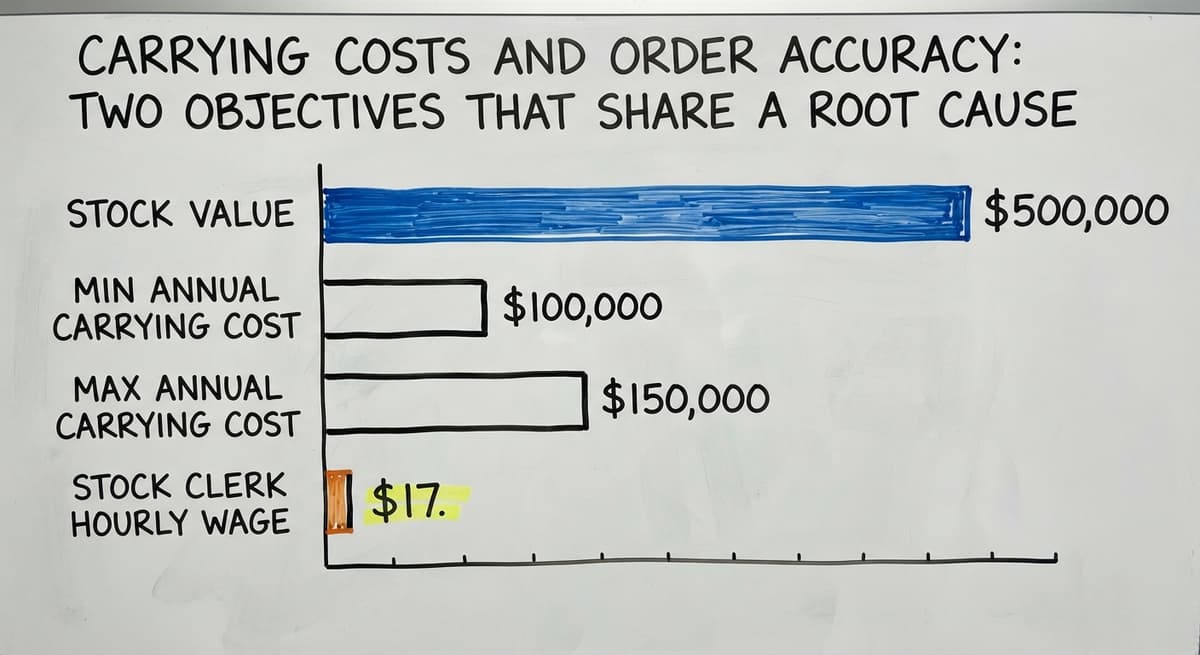
Carrying costs cover warehousing space, labor, shrinkage (theft and damage), and the financing cost of cash tied up in stock. Together they can run 20 to 30 percent of inventory value per year. For a distributor holding $500,000 in stock, that is $100,000 to $150,000 a year just to keep product on the shelf.
Accurate counts are the first step to cutting those costs. You cannot reduce what you cannot measure. When stock records are wrong, buyers order more than needed as a buffer, which pushes carrying costs higher. A reliable count breaks that cycle.
The Bureau of Labor Statistics reports that stock clerks and order fillers earn a median hourly wage of around $17. Three people spending 6 hours a week on manual counts cost roughly $15,912 a year in labor alone, before errors are factored in.
The comparison is easier when one option is built for you
Off-the-shelf means fitting your process to the software. We do it the other way round, and the first look costs nothing.
Book a callShipping the Right Item Every Time
Order accuracy means the customer receives the correct product in the correct quantity. A wrong shipment triggers a return, a replacement order, and a frustrated buyer. The cost of fixing a picking error runs 2 to 3 times the cost of getting it right the first time, once you count return freight, restocking labor, and the replacement shipment.
Accurate inventory data drives accurate picking. When the system shows the right bin location and the right quantity on hand, the picker has no reason to guess. Fulfillment accuracy is not a warehouse problem. It is a data problem, and it starts with the stock record.
How Inventory Levels Affect Cash Flow for a Small Distributor
Every dollar sitting in unsold stock is a dollar not available for payroll, marketing, or equipment. For a small wholesale distributor, inventory is often the largest single asset on the balance sheet. Smarter purchasing decisions free that cash up.
Practical levers include tightening reorder quantities on slow movers, negotiating shorter lead times with key suppliers, and running down safety stock on items with reliable supply. None of those decisions are possible without reliable data on what is selling and how fast. Working capital improves when purchasing matches actual demand, not gut feel or last year's habit.
NIST's Manufacturing Extension Partnership offers vendor-neutral guidance on supply chain and inventory process that is worth reviewing before making purchasing policy changes.

Does Real-Time Inventory Visibility Actually Change How You Operate?
Real-time inventory visibility means every team member sees the same stock count at the same moment, whether they are in the warehouse, at a desk, or on a sales call. The alternative is a spreadsheet updated once a day, or a printed sheet from last Tuesday's count. By the time a decision gets made on stale data, the situation has already changed.
When visibility is live, a sales rep can confirm availability before quoting a lead time. A buyer can see that a fast-moving SKU is approaching its reorder point before the shelf goes empty. A warehouse manager can spot a discrepancy between the system count and the physical count before it becomes a fulfillment error. Real-time tracking turns inventory data from a record of the past into a tool for the present.
How Does Inventory Visibility Speed Up Fulfillment?
Faster fulfillment starts with knowing exactly where every item is. When a picker does not have to search for a product or verify a bin location, pick times drop. When the system confirms available quantity before an order is released to the floor, there are no mid-pick surprises.
Customers expect quick, accurate delivery. For a small distributor competing against larger operations, fulfillment speed is a real competitive advantage. A reliable 24-hour ship time beats a 48-hour ship time with frequent errors every time. That speed comes from clean data, not from hiring more people.
See it running on your own process first
No build cost. The subscription starts once it is live and doing the job, not before.
Book a call
Why Manual Processes Work Against Every Inventory Objective
Many small distributors run on a combination of QuickBooks for accounting, Excel for stock tracking, and email for buy orders. That setup works until it does not. Data lives in 3 separate places, and none of them talk to each other in real time.
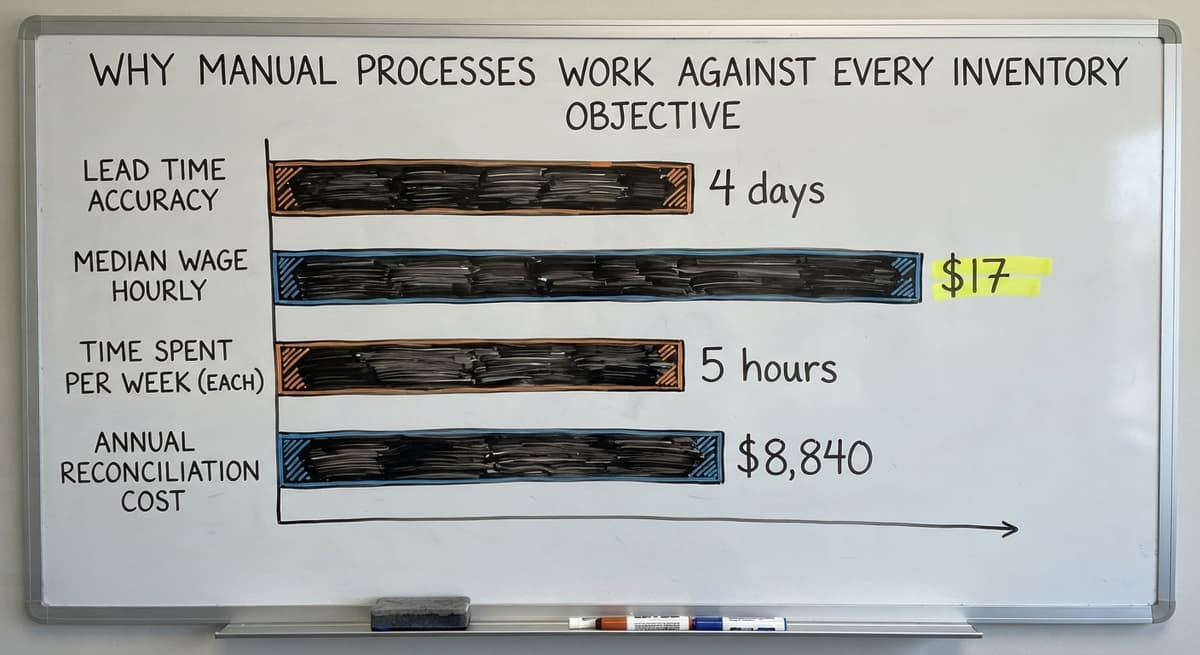
Here is what a typical day looks like when the process breaks down. A buyer places a buy order by email. The receiving team logs it in a spreadsheet when the shipment arrives. QuickBooks gets updated at the end of the week. A sales rep quotes a lead time based on the spreadsheet, which is 4 days old. The order ships late because the item was actually out of stock. The customer calls.
A missed reorder point in that chain hits multiple objectives at once: stockout prevention fails, fulfillment accuracy fails, and cash flow takes a hit from the rush order needed to recover. The problem is not the people. It is a system that needs manual handoffs at every step, and each handoff is a place where data can drift.
Measured against what warehouse staff actually cost, the labor spent on manual matching adds up fast. At a median wage of around $17 an hour, 2 people spending 5 hours a week each on count matching runs to $8,840 a year before any error costs are added.
What Inventory Management Software Does to Fix This
Inventory management software centralizes stock data so every team member sees the same numbers. A receiving scan updates the count at once. A picked order reduces it in the same moment. No spreadsheet to update, no end-of-week matching to run.
Key features that directly support the objectives covered above:
- Automated reorder alerts trigger a buy order when stock hits the reorder point, removing the manual check that gets skipped on a busy day
- Real-time counts give every team member the same current picture, cutting the lag between a stock change and the record reflecting it
- Order tracking from buy to shipment closes the loop between what was ordered, what arrived, and what went out
- Bin location management tells pickers exactly where to go, which cuts pick time and reduces errors
The right software fits the way the business already works. A system that forces a new workflow on an existing team creates resistance and errors during the transition. The better approach is software built around the operation.

Keeping QuickBooks and Adding Warehouse Inventory Control
The fear of replacing an entire system stops many small distributors from improving their inventory process. That fear is understandable, and it is also unnecessary.
Good inventory software works alongside QuickBooks, not instead of it. The financial side stays in QuickBooks: accounts payable, accounts receivable, general ledger. The inventory side moves to a dedicated system that tracks stock in real time. The 2 systems share data through a sync, so buy costs flow into QuickBooks without double entry.
QuickBooks inventory management tools are built for accounting, not for warehouse operations. They track cost and quantity at a high level. They do not manage bin locations, handle real-time picking, or alert a buyer when a reorder point is hit. A dedicated inventory system fills that gap without touching the accounting setup the team already knows.
Custom Inventory Software vs. Off-the-Shelf Solutions
Off-the-shelf inventory platforms are built for a broad market. They cover common workflows and charge for features a 20-person distributor will never use. More importantly, they assume a workflow that may not match how the operation actually runs. The result is a team forced to adapt to the software rather than software that fits the team.
Custom-built software starts from the operation. The reorder logic, the bin structure, the receiving process, the reports: all of it is built around what the business actually does. There is no unused module to navigate around and no workaround needed for a process the platform does not support.
For a small distributor with specific product categories, specific supplier relationships, and a specific fulfillment process, a custom system built by a local partner who understands the operation will outperform a generic platform from day one. The rollout is faster because there is less to configure, and the team adopts it faster because it already looks like the job.

Is Your Current Inventory Process Falling Short?
Several clear signals show that the current system is working against the core objectives. If more than 2 of these are familiar, the process needs attention.
- Frequent stockouts on fast-moving SKUs even when buy orders are being placed regularly
- Surprise overstock on items that were ordered without checking current levels first
- Cycle counts that take a full day because the system count never matches the physical count
- Fulfillment errors discovered after shipment, not before, because there was no check step
- Buyers and sales reps working from different stock numbers because each team has its own spreadsheet
- Rush orders placed monthly to cover gaps that a reorder point would have caught
These are not signs of a bad team. They are signs that the system is not giving the team what it needs to do the job well.
Not sure this is the right shape for your operation
Describe how the work runs today. We map it on a call and show you what it would look like built around that, before you spend anything.
Book a callMetrics That Show Whether You Are Hitting Your Inventory Objectives
Tracking a few simple numbers makes it clear whether the objectives are being met. Each metric points to a specific gap.
| Metric | What It Measures | A Sign of Trouble |
|---|---|---|
| Inventory turnover rate | How many times stock sells through per year | Low rate means too much capital in slow-moving stock |
| Stockout rate | How often an item is unavailable when ordered | Any rate above 2 to 3% signals a reorder point problem |
| Order accuracy rate | Percentage of orders shipped correctly | Below 98% means picking or data errors are costing money |
| Carrying cost as % of inventory value | Annual cost to hold stock relative to its value | Above 25% suggests overstock or inefficient storage |
Reliable data from a solid system is what makes these numbers trackable. A business running on spreadsheets can estimate them. A business running on real-time inventory software can track them weekly and act on them before small gaps become expensive problems.
Getting Started Without a Long, Expensive Implementation
The word "rollout" puts many small operators off. It calls to mind a 6-month ERP rollout, a team of consultants, and a bill that runs into six figures. That is not the only option.
Smaller, focused systems built around a specific operation can be up and running in weeks. The key is working with a partner who knows small operations and builds software around the workflow rather than the other way around. A local team that has seen the same problems across similar businesses will move faster and cost less than an enterprise vendor selling a platform designed for a company 10 times the size.
The goal is not the most powerful system. It is the right system, running from day one, used by the whole team. That outcome is more likely when the software was built for the operation rather than retrofitted to it.
Frequently Asked Questions About Inventory Management Objectives
What is the main objective of inventory management? To have the right stock available at the right time without wasting money on excess. Every other objective, from stockout prevention to carrying cost reduction, supports that single goal.
Why is it important to prevent stockouts and excess inventory at the same time? Because both cost money in different ways. A stockout loses a sale and damages a customer relationship. Excess inventory ties up cash and runs up storage costs. The objective is a balance, not a preference for one over the other.
Can a small warehouse or distributor use inventory management software without replacing QuickBooks? Yes. The right software syncs with QuickBooks so accounting stays where it is. Inventory tracking moves to a dedicated system, and the two share data without double entry.
What is the difference between off-the-shelf inventory software and a custom-built solution? Off-the-shelf software is built for a broad market and assumes a generic workflow. Custom software is built around the specific operation, which means less setup, faster adoption, and no workarounds for processes the platform does not support.
How do I know if my current inventory process is failing? Frequent stockouts, surprise overstock, cycle counts that never match, and fulfillment errors found after shipment are the clearest signs. If the team is working from different stock numbers, the process is already failing.
How long does it take to set up inventory management software for a small operation? It depends on the system. A large ERP can take 6 months or more. A focused, custom-built solution designed around the existing workflow can be running in weeks, especially when the rollout partner already understands the operation.
Next Steps for Wholesale Distributors and Warehouse Operators
The objective of inventory management is to have the right product, in the right quantity, in the right place, at the right time. That goal breaks into 7 practical targets: prevent stockouts, avoid excess stock, keep carrying costs low, ship correctly, protect cash flow, see stock in real time, and fulfill orders fast.
Start by checking your current process against those 7 targets. Where does it hold up? Where does it break down? The gaps you find are the places a better system pays for itself.
If the audit turns up more than 2 or 3 gaps, it is worth talking to a team that builds software around how the operation already works. That conversation costs nothing and usually surfaces a clearer picture of what the fix actually looks like.
Frequently asked questions
What is the main objective of inventory management?
The main objective of inventory management is to have the right stock available at the right time without wasting money on excess. Every supporting goal, from stockout prevention to carrying cost reduction, serves that single target.
Why is it important to prevent stockouts and excess inventory at the same time?
Both cost money in different ways. A stockout loses a sale and damages a customer relationship. Excess inventory ties up cash and drives up storage and insurance costs. The objective is a balance between the two, not a preference for one extreme.
How does inventory management affect cash flow for a small distributor?
Every dollar in unsold stock is a dollar unavailable for payroll, equipment, or growth. Smarter reorder quantities and tighter safety stock levels free up working capital without creating stockouts. The improvement shows up directly on the balance sheet.
Can a small warehouse or distributor use inventory management software without replacing QuickBooks?
Yes. The right inventory software syncs with QuickBooks so accounting stays where it is. Inventory tracking moves to a dedicated system, and the two share data without requiring double entry from the team.
What is the difference between off-the-shelf inventory software and a custom-built solution?
Off-the-shelf software is built for a broad market and assumes a generic workflow. Custom software is built around a specific operation, which means faster adoption, fewer workarounds, and no paying for features the business will never use.
How do I know if my current inventory process is failing?
Frequent stockouts, surprise overstock, cycle counts that never match the system, and fulfillment errors found after shipment are the clearest signs. If different team members are working from different stock numbers, the process is already failing.
What metrics should I track to know if I am meeting my inventory management objectives?
Track inventory turnover rate, stockout rate, order accuracy rate, and carrying cost as a percentage of inventory value. Each metric points to a specific gap. You need reliable, real-time data to track them consistently.
How long does it take to implement inventory management software for a small operation?
A large ERP rollout can take 6 months or more. A focused, custom-built solution designed around an existing workflow can be running in weeks, particularly when the rollout partner already understands the operation and its specific requirements.
Start with a free first look
A 30 minute call, your operation mapped, and a clear picture of what we would build. No obligation and nothing to install.
Book a callRelated guides
The rest of this guide, for the parts of the job this page does not cover.
Guides
- Multi Location Inventory Management Software
- Inventory Management for Multiple Locations
- Inventory Management System for Manufacturing
- Inventory Management Pics
- B2b Inventory Management
- Jewelry Inventory Management
- Dental Inventory Management
- Qr Code for Inventory Management
- Hvac Inventory Management Software
- Inventory Management Software for Schools
- Nonprofit Inventory Management
- Manual Inventory Management
- Inventory Management Photos
- Inventory Management Software Costs
- Hvac Inventory Management
- Warehouse Inventory Management Software
- Warehouse Inventory Management Systems
- Quickbooks Inventory Management Software
- Inventory and Warehouse Management Software
- Custom Inventory Management Software
- Warehouse Inventory Management System
- Retail Inventory Management