

Lpn Barcodes
LPN barcodes let you scan a single label on a pallet or carton and instantly know what is inside, where it came from, and where it belongs. LPN stands for License Plate Number. It is a unique ID assigned to a physical container. One scan replaces manual lookups, paper logs, and memory. This guide covers what LPN barcodes are, where they fit in your warehouse, and how to start using them.
Reviewed September 2026. Each figure comes from the assumptions stated beside it, so you can substitute your own and the arithmetic still holds.
Published 16 July 2026. Reviewed and updated 15 September 2026.
Book a callWhat Is an LPN Barcode and How Does It Work?
An LPN, or License Plate Number, is a unique ID tied to a physical container such as a pallet, tote, carton, or bin. The barcode is the scannable version of that ID.
Think of it the way you think of a car's license plate. You do not need to open the hood to know who owns the vehicle. You scan the plate and the system tells you everything.
The barcode itself is just a number. The warehouse software behind it holds the real data.
Linked to each LPN you might find item SKUs, quantities, lot numbers, expiration dates, supplier name, receipt date, and bin location. One scan pulls all of it in under a second.
As GS1, the global standards body for barcodes, explains on its barcode standards page, identifiers like these are designed so that a single scan tells structured data across any system that speaks the same standard.
Would you rather have it built around your operation?
The first look is free. If you would rather not compare products, describe how your operation already works and we build the system around it.
No build cost. You see it running on your own process first, and the monthly subscription starts only once it is live.
Book a callWhich Barcode Format Should an LPN Use?
Common barcode formats for LPNs include Code 128, GS1-128, and QR codes. GS1-128 is the most widely used in distribution because it can encode multiple data fields in one barcode.
Most modern handheld scanners read all three formats. Your choice depends on your scanner hardware and your software.
How Is an LPN Barcode Different from a Product Barcode?
A product barcode such as a UPC or EAN identifies a product type. Every box of the same item carries the same barcode. An LPN barcode identifies a specific physical unit at a specific moment in time.
Two pallets of identical product get 2 different LPNs. That distinction matters the moment you need to know which pallet holds a recalled lot, which one arrived first, or which one a customer claims never arrived.
Item barcodes answer the question: what is this product? LPN barcodes answer the question: which exact unit is this, and where has it been?
Where Are LPN Barcodes Used Across the Warehouse?
LPN barcodes follow a container from the moment it enters your building to the moment it leaves. Each step writes a record.
At receiving, the system generates a unique LPN when a shipment arrives. A label prints and goes on the pallet or carton.
The LPN links to the buy order and item details right then. From that point forward, one scan identifies everything about that unit.
During putaway, the worker scans the LPN and then scans the destination bin or rack. The system records the link between the two. No paper putaway sheets. If the item moves later, another scan updates the location.
At picking, the system directs the picker to a location and specifies which LPN to pull. Scanning it confirms the right unit was grabbed. This matters most when similar products sit near each other or when lot control is required.
At shipping, a final scan confirms what left the building and when. That record is your proof of shipment if a customer disputes a delivery.
Is the comparison easier when one option is built for you?
Yes. Off-the-shelf means fitting your process to the software, and custom is the other way round. The first look costs nothing.
Book a callHow Do LPN Barcodes Help with Lot Tracking and Expiration Dates?
Each LPN ties to a specific lot or batch number at receiving. If a recall or quality issue surfaces, you can trace exactly which LPN holds the affected lot.
Without LPN barcodes, lot tracking depends on manual records that are easy to lose or mix up.
Expiration dates work the same way. Store the date against the LPN at receiving, and the system can flag or rank units using FEFO (First Expired, First Out).
The worker scans the LPN and the system confirms it is the right unit to pick. This reduces waste and lowers compliance risk for food, pharma, and health products.
Nested LPNs: Pallets That Contain Cartons
A pallet LPN can hold multiple carton LPNs, each with their own contents. Scan the pallet LPN and you see everything inside it.
Scan a single carton LPN and you see just that carton. Distributors who receive full pallets but pick individual cartons find this especially useful.

Can a Small Warehouse Use LPN Barcodes?
LPN tracking is not only for large distribution centers. A 5-person team makes more errors relying on memory and handwriting than a 50-person team using scan-first habits. A single mislabeled pallet can cost hours of searching and recounting.
LPN barcodes give a small operation the same location accuracy as a large one.
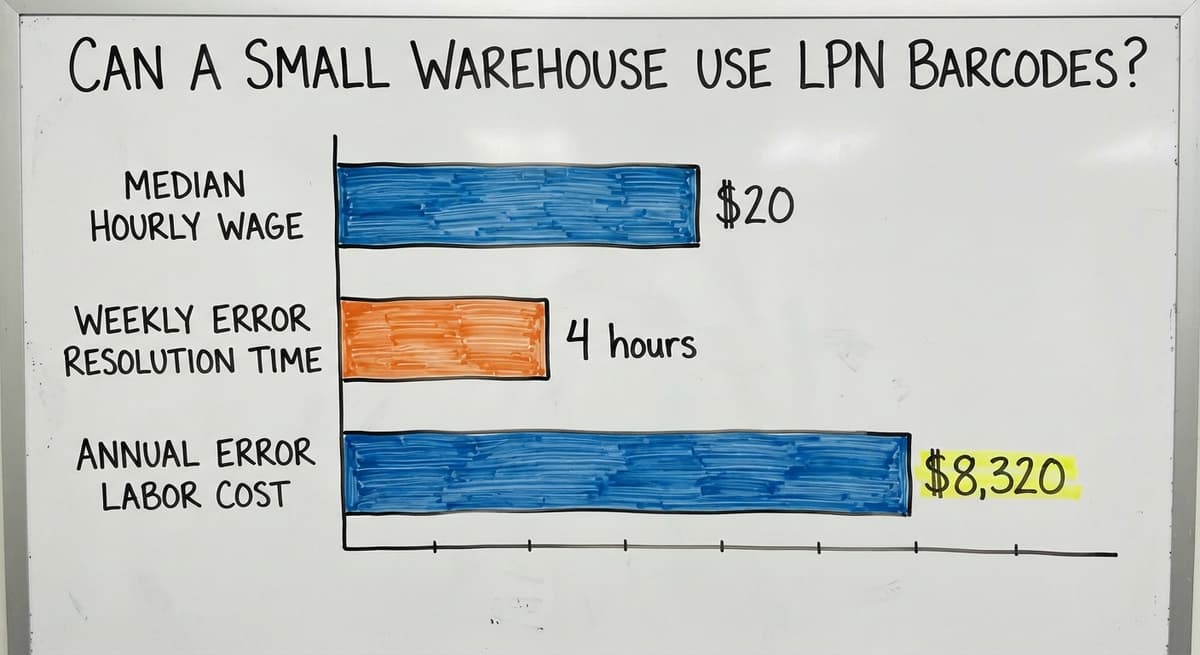
Consider the labor cost alone. The US Bureau of Labor Statistics reports that warehouse stock clerks earn a median wage around $20 per hour.
If 2 workers each spend 4 hours a week resolving location errors, that is $8,320 a year in labor before you count the cost of a wrong shipment or a missed delivery window.
The IRS adds another reason to care. IRS Publication 538 states: "To figure taxable income, you must value your inventory at the beginning and end of each tax year." Accurate inventory records are not optional.
LPN barcodes make those records faster to build and easier to defend.
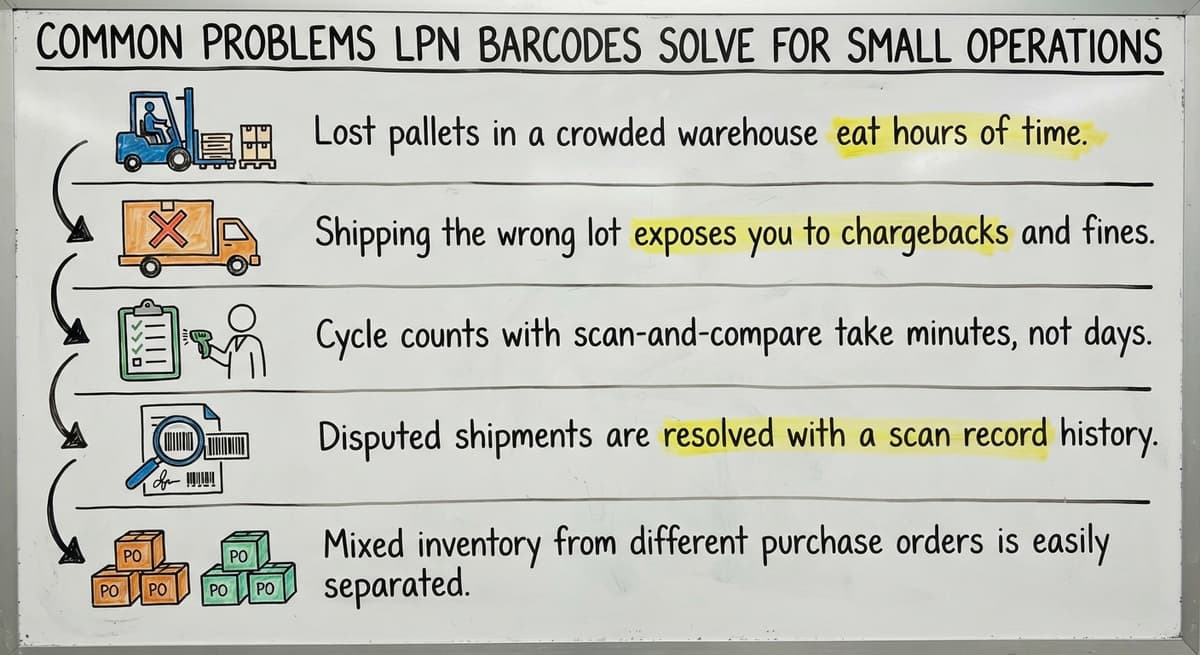
Common Problems LPN Barcodes Solve for Small Operations
Small warehouses face the same categories of error as large ones, just with fewer people to absorb the cost:
- Lost pallets in a crowded warehouse eat hours of search time per week
- Shipping the wrong lot exposes you to chargebacks and customer complaints
- Cycle counts with scan-and-compare take minutes instead of hours
- Disputed shipments are resolved with a scan record rather than a phone call
- Mixed inventory from different buy orders stays separated by LPN

Does QuickBooks Work with LPN Barcodes?
QuickBooks does not natively support LPN-level tracking. Many small distributors manage accounting in QuickBooks and then lose visibility at the pallet or carton level because the software was not built for that purpose.
Custom warehouse software can handle LPN tracking and sync totals back to QuickBooks. This keeps QuickBooks in place for accounting without forcing your warehouse team to work around its limits.
The warehouse system owns the scan data. QuickBooks owns the financial records. Each tool does what it was built for.
If you are outgrowing spreadsheets but not ready for a full enterprise WMS, a purpose-built integration is the right middle step.
What does it look like running on your own process?
The first thing you see is it running on your own process, at no build cost. The subscription starts once it is live and doing the job, not before.
Book a callWhat Hardware Do You Need to Use LPN Barcodes?
The hardware list is shorter than most people expect:
- A barcode scanner or mobile device with scanning ability handles the scan events
- A thermal label printer produces durable labels fast and at low cost per label
- Labels rated for your environment matter more than most buyers expect: cold storage needs labels that stay adhesive below freezing, while ambient warehouses can use standard stock
- A Wi-Fi or cellular connection so each scan writes to the system in real time rather than batching at end of shift
Label placement matters too. Apply the LPN label to a visible corner of the pallet or carton. Keep it clear of shrink wrap. Replace any damaged label before the unit moves again.

What Makes a Good LPN Numbering System?
A strong LPN numbering system follows a few simple rules. Never reuse an LPN. Once a number has been assigned, it stays in the record forever even after the physical unit is gone. Sequential numbers work well.
Adding a date prefix gives context without adding length. Keep numbers short enough to scan cleanly and display on a small label. Let the system generate numbers automatically so duplicates cannot happen through human error.
How Do You Roll Out LPN Barcodes Without Disrupting Operations?
Getting started does not need a full rollout on day one:
- Start at receiving and label everything that comes through the door
- Map your storage locations so the system knows where each LPN can live
- Train staff on scan-first habits before expanding to picking and shipping
- Run cycle counts by scanning LPNs in each location and letting the system flag discrepancies
- Add lot and expiration tracking once the basic scan habit is solid
A phased approach reduces disruption and builds team confidence before the next layer goes in.
LPN Barcodes and the Software Behind Them
The barcode is just a number. The software is what makes it useful. Every scan writes a record: what was scanned, where, when, and by whom. The system uses those records to show current stock, location, and movement history.
Off-the-shelf WMS tools need your team to change how they work to fit the software.
Custom software maps LPN logic to the way your operation already runs. That means fewer workarounds, faster adoption, and a system that reflects your actual workflow rather than a generic one.
What the manual process costs, in numbers
The arithmetic is worth doing before the software conversation. 3 people spending 6 hours a week between them chasing the same questions, at 22 dollars an hour, is 936 hours a year of paid time spent confirming what a system would already know. Over 3 years that is 2,808 hours.
Frequently asked questions
What does LPN mean on an Amazon label?
On an Amazon label, LPN stands for License Plate Number. Amazon uses LPN barcodes internally to track pallets, cartons, and totes as they move through its fulfillment centers.
The LPN on a label is Amazon's unique ID for that specific physical unit, not a product identifier.
Can I look up an Amazon LPN number?
Amazon's LPN numbers are internal identifiers used inside Amazon's own warehouse management system. They are not publicly searchable. If you are a seller, you can sometimes find LPN references in your Seller Central shipment reports, but the number itself only means something inside Amazon's systems.
Does an LPN sticker mean Amazon return?
Not necessarily. Amazon applies LPN labels to incoming inventory as part of its standard receiving process, not only to returns. A product with an LPN sticker may be new stock that Amazon labeled on arrival.
However, Amazon also re-labels returned items with new LPNs before restocking them, so the sticker alone does not confirm a return.
What does LPN mean in inventory?
In inventory management, LPN stands for License Plate Number. It is a unique identifier assigned to a physical container such as a pallet, carton, tote, or bin.
Scanning the LPN barcode retrieves all data linked to that container, including item SKUs, quantities, lot numbers, and location.
What barcode format should I use for LPN barcodes?
GS1-128 is the most common choice for LPN barcodes in distribution because it encodes multiple data fields in a single barcode. Code 128 works well for simpler setups.
QR codes are an option if your scanners support them. The right format depends on your scanner hardware and what your warehouse software can read.
How do LPN barcodes work with QuickBooks?
QuickBooks does not natively support LPN-level tracking. A separate warehouse system handles the LPN scanning and location data, then syncs inventory totals back to QuickBooks for accounting. This keeps your financial records in QuickBooks while giving your warehouse team real scan-based visibility.
How do I get started with LPN barcodes in my warehouse?
Start at receiving. Label every pallet or carton that comes through the door with a system-generated LPN. Map your storage locations next.
Train staff to scan before they move anything. Once that habit is solid, extend scanning to picking and shipping. A phased rollout is faster to adopt than a full cutover.
What is the difference between an LPN and an FNSKU?
An LPN identifies a container, a pallet or tote, inside your own warehouse. An FNSKU identifies one product unit inside a marketplace's fulfilment network. A pallet with one LPN can hold hundreds of units each carrying an FNSKU.
How can I scan an LPN barcode?
With any 1D or 2D scanner. Scanning the LPN pulls up the container record, and the system shows everything inside it, so a whole pallet moves with one scan instead of a scan per case. That is the point of LPN barcodes.
How do I create LPN labels for my warehouse?
Let the warehouse system assign the next number from its own counter, print a Code 128 label on a thermal printer, and apply it to the pallet at receiving. Never reuse a number, and print the digits under the bars for the rare manual lookup.
What barcode format is best for LPN labels?
Code 128 for internal pallets and totes. Pallets that ship to retail customers carry a GS1-128 label with an SSCC, the format carriers and retailers expect.
What is in a free first look?
A 30 minute call, your operation mapped, and a clear picture of what we would build. No obligation and nothing to install.
Book a callRelated guides
The rest of this guide, for the parts of the job this page does not cover.
Guides
- Barcode Abbreviation
- Barcode Scan Machine
- Tracking Number Barcode
- Barcode Reader Machine
- Barcode Scanner App Ios
- 2d Barcode Readers
- Barcode Producer
- Barcode Systems for Warehouse
- Barcode Reader Description
- Barcodes and Labels
- Alphanumeric Barcode
- Barcode Scanner Inventory System
- Imager Barcode Scanner
- Barcode System for Inventory Free
- Inventory Management Software Barcode Scanner
- Make Barcode
- 2d Wireless Barcode Scanner