

When Was Barcode Scanner Invented
The barcode scanner was invented in 1952. Norman Woodland and Bernard Silver received US Patent 2,612,994 on October 7, 1952. Commercial use did not begin until the early 1970s. The first retail scan happened on June 26, 1974. That single moment changed how stores and warehouses track goods forever.
Reviewed August 2026. Each figure comes from the assumptions stated beside it, so you can substitute your own and the arithmetic still holds.
Published 26 August 2026. Reviewed and updated 15 September 2026.
Book a callWhen Was the Barcode Scanner Invented?
The short answer is 1952. That is when the US Patent Office granted the first barcode patent. But the idea started even earlier. Bernard Silver overheard a grocery store manager at Drexel University in 1948.
The manager wanted a faster way to ring up products. Silver brought the problem to his friend Norman Woodland. The two worked on it for years before filing their patent in 1949.
According to GS1, the global standards body for barcodes, barcode symbols and the scanning devices that read them form the backbone of modern supply chains. Their standard is what makes a label printed in one country readable in a store on another continent.
The 1952 patent covered both the printed symbol and the device used to read it. That was the full system, not just one piece of it.
Would you rather have it built around your operation?
The first look is free. If you would rather not compare products, describe how your operation already works and we build the system around it.
No build cost. You see it running on your own process first, and the monthly subscription starts only once it is live.
Book a callWho Invented the Barcode Scanner?
Norman Woodland and Bernard Silver invented the barcode scanner. Silver heard the problem first.
A Drexel University food chain manager asked a dean whether the school could research a way to read product data at checkout. Silver overheard the conversation and told Woodland about it.
Woodland was the one who cracked the design. He was sitting on a Florida beach in 1949 and drew lines in the sand. He had been studying Morse code, which uses dots and dashes to carry information. He stretched those dots and dashes into thick and thin lines. The barcode was born in the sand.
The two men were young engineers with a real problem to solve. Their story is not a lab accident. It was deliberate work on a practical need.

How Did Woodland and Silver Come Up With the Idea?
Woodland drew the first barcode concept in the sand on a Florida beach, inspired by Morse code. That is the direct answer. The lines he drew were not the straight vertical bars you see today.
The original design used concentric circles, like a bull's-eye target. The idea was that a scanner could read the symbol from any angle.
The bull's-eye design had problems in practice. It was hard to print cleanly and easy to smudge. The vertical bar design we know today came later, when printing and scanning technology caught up.
The jump from sand drawing to working patent took about a year. Woodland and Silver filed in 1949 and received US Patent 2,612,994 in 1952.
When Was the Patent Filed and Granted?
Woodland and Silver filed their patent application in 1949. The US Patent Office granted it on October 7, 1952, as US Patent 2,612,994. The patent was broad. It covered the printed symbol and the scanner together as one system.
RCA, a large electronics company, later bought the patent. RCA tried to build a working system but could not make it cheap enough for stores to adopt.
The patent eventually expired before barcode scanning became common. Woodland and Silver never made much money from their invention.
That is a common story in technology. The people who solve the hard problem do not profit from it. The people who make it cheap and practical do.
When Did Barcodes First Appear in Stores?
The grocery industry adopted the Universal Product Code (UPC) standard in 1973. The UPC is the numbering system that tells a scanner what product it is reading. Without a shared standard, every store would need its own system and nothing would work across brands.
The first real retail barcode scan happened on June 26, 1974, at a Marsh supermarket in Troy, Ohio. The product was a 10-pack of Wrigley's Juicy Fruit gum.
A cashier named Sharon Buchanan ran it across the scanner. That pack of gum is now in the Smithsonian Institution.
The moment mattered because it proved the system worked in a live store with real customers. Within a few years, large grocery chains began installing scanners at every checkout lane.
Is the comparison easier when one option is built for you?
Yes. Off-the-shelf means fitting your process to the software, and custom is the other way round. The first look costs nothing.
Book a callHow Did Barcode Technology Spread to Warehouses?
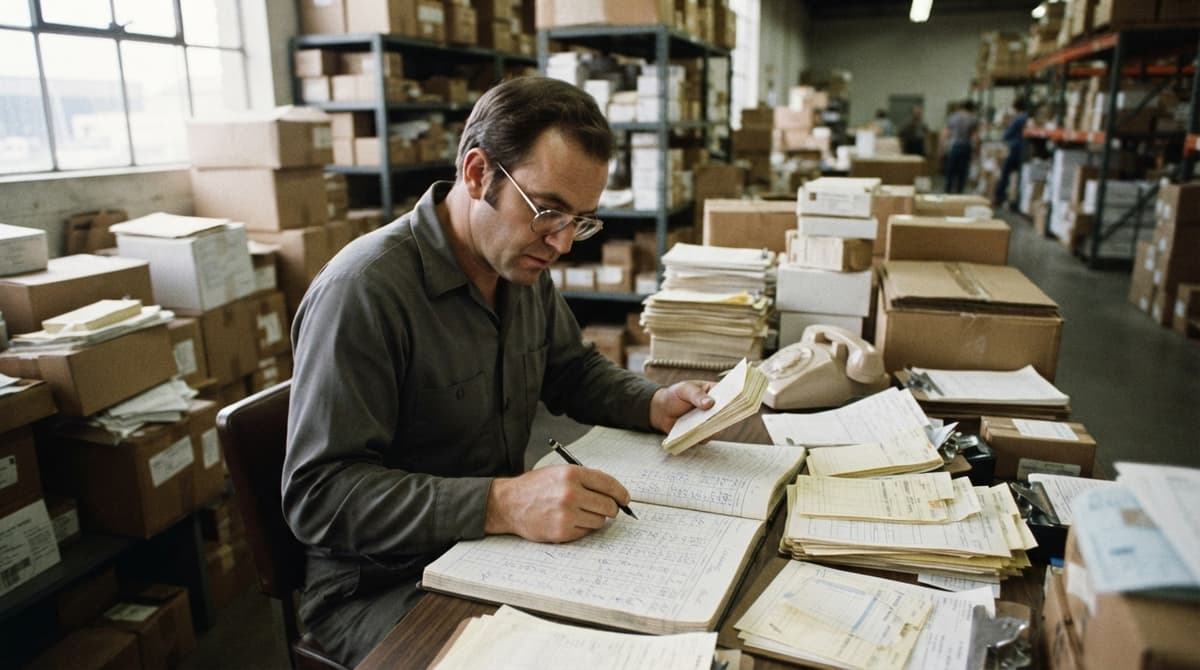
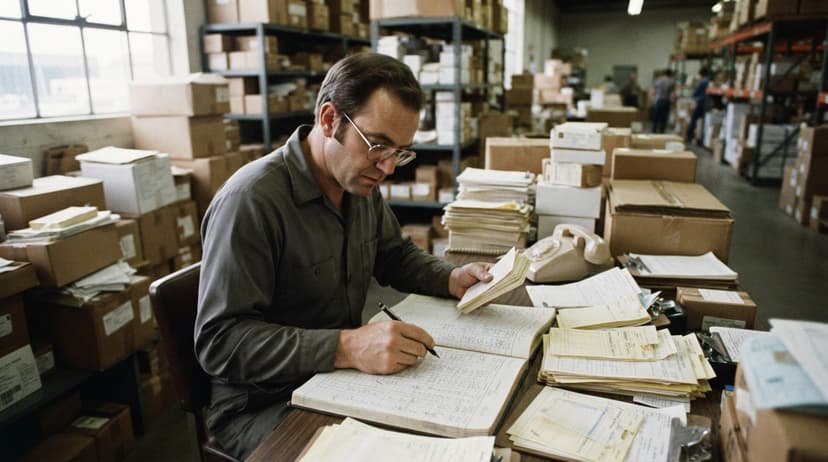
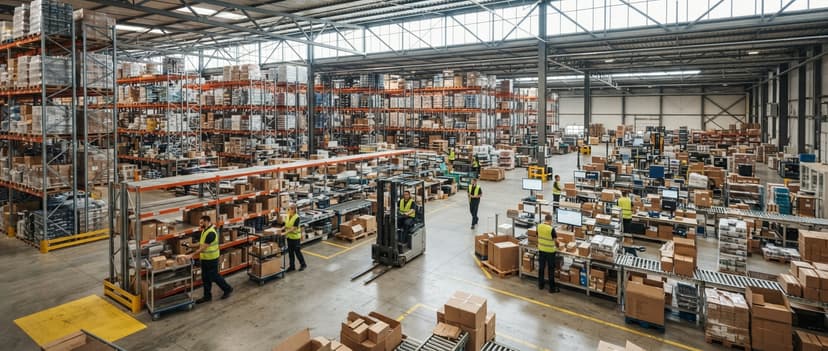
Retail adoption came first. Warehouses followed through the late 1970s and into the 1980s. The reasons were practical. A warehouse holds far more items than a checkout lane sees in a day. Tracking pallets, bins, and individual cases by hand took time and created errors.
Handheld barcode scanners made warehouse use possible. A worker could walk to a shelf, scan a label, and the system recorded the location and quantity. No paper log. No second step to enter data later.
Wholesale distributors and fulfillment centers saw the gains right away. Receiving a truck went from a multi-hour paper process to a scan-and-confirm workflow. Shipping accuracy improved because workers scanned each item before it left the dock.

Why Was the Warehouse Barcode Investment Easy to Justify?
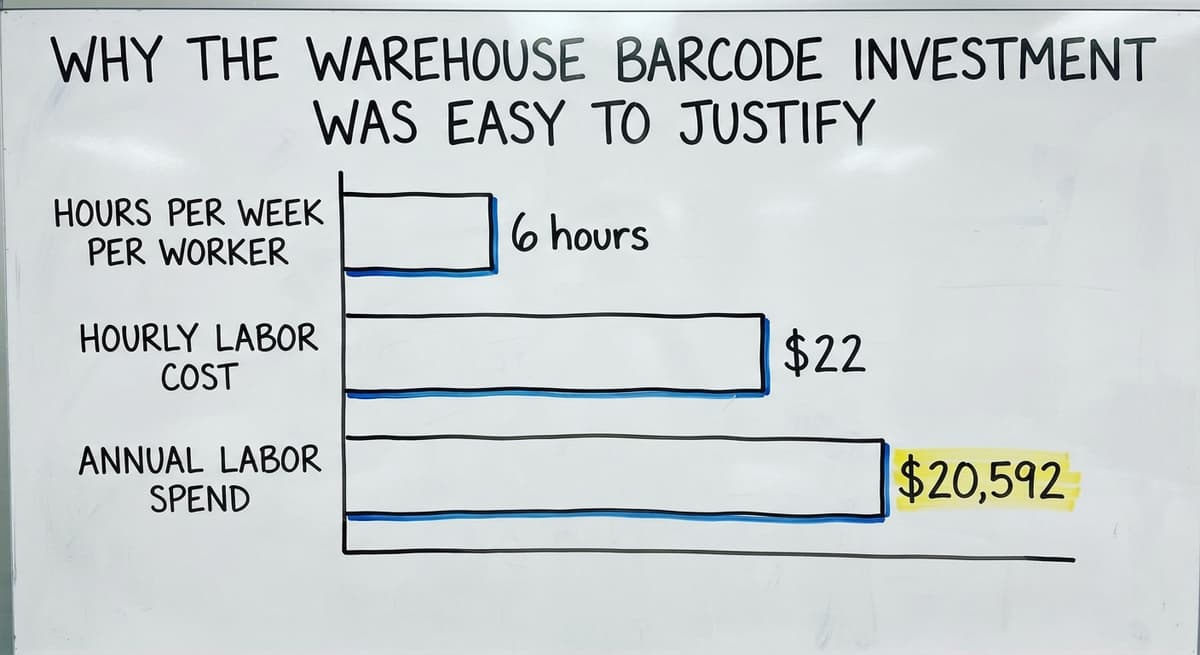
For a small distributor with 3 workers spending 6 hours a week each on manual counts at $22 an hour, that is $20,592 a year in labor on a task a scanner and basic software can cut by more than half. The math made the investment easy to justify.
What Did Early Barcode Scanners Look Like?
The first commercial scanners were large and fixed. They sat under the checkout counter and shone a laser upward through a glass window. The cashier dragged a product across the glass. If the label faced the right way, the scanner read it.
Next came wand scanners. A worker held a small pen-shaped device and dragged it across the label in a single stroke. Wand scanners were cheap and portable but required careful technique. A shaky hand or a bad angle meant a failed read.
How Laser Scanners Improved on the Wand
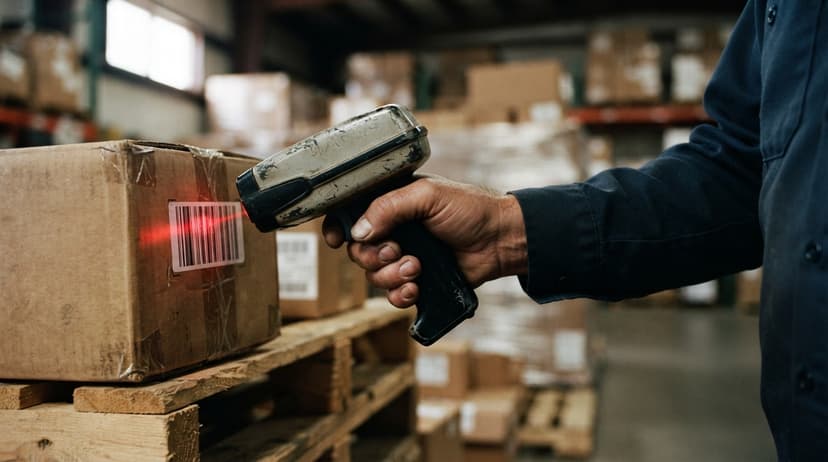
Laser scanners arrived in the 1980s and changed the experience. A laser beam swept back and forth across the label many times per second. The worker just had to point the scanner in the right direction. Read rates went up. Training time went down.
Modern warehouse scanners add a bright aiming dot, a wide scan field, and the ability to read damaged or partially torn labels. The core idea is still Woodland's lines in the sand.
What does it look like running on your own process?
The first thing you see is it running on your own process, at no build cost. The subscription starts once it is live and doing the job, not before.
Book a callThe Jump From 1D to 2D Barcodes
A traditional barcode stores data in one direction. The scanner reads across the bars from left to right. That is a 1D barcode. It can hold a product number, maybe 20 characters of data.
2D barcodes store data in two directions, across and up and down. A QR code is the most common example. A Data Matrix code is another. Engineers developed 2D codes in the early 1990s to carry more information in a smaller space.
Comparing 1D and 2D Barcodes
Here is a plain comparison:
| Feature | 1D Barcode | 2D Barcode (QR/Data Matrix) |
|---|---|---|
| Data direction | Left to right only | Across and up/down |
| Data capacity | Up to ~20 characters | Up to ~3,000 characters |
| Common use | Retail products, shipping labels | Parts tracking, lot numbers, URLs |
| Scanner needed | Standard laser scanner | Imager or camera-based scanner |
| Damage tolerance | Low | Higher |
Modern warehouse scanners read both types. That gives operations more options. A small part can carry a full batch number, expiry date, and supplier code in one tiny 2D symbol.
Why Did the Barcode Scanner Change Inventory Management?
Before barcode scanners, inventory was counted and written down by hand. That is the direct answer. Workers walked the floor with clipboards. They wrote numbers. Someone else typed those numbers into a ledger or, later, a spreadsheet. Every step added a chance for error.
Scanning replaced the clipboard. A scan event records the item, the quantity, the time, and the location in one action. No second step.
The IRS requires businesses to value inventory at the start and end of each tax year: "To figure taxable income, you must value your inventory at the beginning and end of each tax year." A barcode inventory management system makes that count faster and more accurate.

What Happens When a Scan Is Missed
Small distributors and fulfillment centers still feel this every day. A missed scan at receiving means a product that exists on the shelf but not in the system. That leads to a lost sale, a wrong shipment, or a customer complaint.
The barcode did not just speed things up. It made the data trustworthy.
A barcode inventory management system overview will show how these scan events connect to purchase orders, stock levels, and reorder triggers in a modern setup.
What is in a free first look?
A 30 minute call, your operation mapped, and a clear picture of what we would build. No obligation and nothing to install.
Book a callHow Modern Warehouse Software Builds on the Barcode Scanner
A scanner alone does not manage inventory. It reads a label and sends a signal. Something has to catch that signal, record it, and connect it to the rest of the business.
That is where software comes in. Modern systems link each scan to a specific purchase order, a bin location, a stock level, and a shipment record. The scan is the input. The software is what turns it into useful information.
Many small distributors already own scanners. The gap is the software layer. Their current setup might log a scan into a spreadsheet that someone checks once a day. That is not real-time. It is just a faster clipboard.
Connecting Scanners to the accounting software and Existing Tools
How warehouse management software works with the accounting software is a common question for small operations.
The answer is that a well-built system passes scan data directly into the accounting software records without manual entry. No double keying. No end-of-day reconciliation. The books reflect what is actually on the shelf.
Replacing manual inventory tracking with a custom system does not have to mean buying a full ERP platform. A targeted build that connects your scanners to your existing tools can close the gap at a fraction of the cost and time.
Inventory receiving and shipping workflows for small distributors are the first two areas where that connection pays off fastest.
The NIST Manufacturing Extension Partnership offers vendor-neutral guidance on supply chain process for smaller operations. Their resources are a useful starting point for any distributor mapping out where manual work is costing the most.
What This Means for Your Operation Today
Barcode scanning is not new technology. It is proven, affordable, and widely understood. Most small distributors already use scanners at some point in their day.
The real question is whether those scans connect to anything useful. If a worker scans a pallet at receiving and someone still has to type that data somewhere else, the scanner is only doing half the job.
The gap is the software, not the hardware. A system built around your actual workflow, connected to the tools you already use, can turn a scan into a complete transaction without any extra steps.
How to Close the Gap Without a Full ERP Rollout
If your operation runs on scanners but still relies on manual workarounds to keep the books and the floor in sync, that is a solvable problem. It does not require replacing the accounting software or committing to a year-long ERP rollout. It requires a practical build by someone who understands both the warehouse floor and the accounting side.
That is exactly the kind of work The Software Society does. If you want to talk through what a connected system would look like for your operation, reach out. No pitch deck. Just a straight conversation about what you have and what would actually help.
Frequently asked questions
What the manual process costs, in numbers
The arithmetic is worth doing before the software conversation. 3 people spending 6 hours a week between them chasing the same questions, at 22 dollars an hour, is 936 hours a year of paid time spent confirming what a system would already know. Over 3 years that is 2,808 hours.
Frequently asked questions
When did the US start using barcodes?
The US grocery industry adopted the Universal Product Code (UPC) standard in 1973. The first live retail scan happened on June 26, 1974, at a Marsh supermarket in Troy, Ohio. Warehouses and distributors began adopting barcode scanning through the late 1970s and 1980s.
Did barcodes exist in the 1970s?
Yes. The UPC standard launched in 1973 and the first retail barcode scan took place in 1974. By the late 1970s, major grocery chains were installing scanners across their stores. Warehouse use of barcodes also began in this decade.
Was the QR Code invented in 1994?
Yes. Denso Wave, a Japanese company, developed the QR code in 1994 to track car parts during manufacturing.
QR codes are a type of 2D barcode and can hold far more data than a standard 1D barcode. They became widely used in warehouses and consumer apps in later decades.
Did barcodes exist in 1980?
Yes. Barcodes were in active use by 1980. The UPC standard launched in 1973, the first retail scan was in 1974, and through the late 1970s grocery chains expanded scanner use. By 1980, barcodes were also moving into warehouse and distribution center operations.
Who invented the barcode scanner?
Norman Woodland and Bernard Silver invented the barcode scanner. They filed their patent in 1949 and received US Patent 2,612,994 on October 7, 1952.
Silver identified the problem after overhearing a grocery store manager. Woodland designed the symbol after drawing lines in the sand on a Florida beach.
What was the first product ever scanned with a barcode?
A 10-pack of Wrigley's Juicy Fruit gum was the first product scanned with a barcode in a retail store. The scan happened on June 26, 1974, at a Marsh supermarket in Troy, Ohio. That pack of gum is now on display at the Smithsonian Institution.
What is the difference between a 1D barcode and a 2D barcode?
A 1D barcode stores data in one direction, left to right, and holds about 20 characters. A 2D barcode such as a QR code stores data across and up and down, holding up to around 3,000 characters. Modern warehouse scanners read both types.
Are barcode scanners still relevant for small warehouses and distributors today?
Yes. Barcode scanning is the standard method for tracking inventory in warehouses of all sizes. The hardware is affordable and proven. The common gap for small distributors is software: scans need to connect to stock levels, orders, and accounting tools to deliver full value.
When was the UPC barcode created?
The Universal Product Code was adopted in 1973 by a grocery industry committee, and the first UPC scan at a checkout was a pack of chewing gum on June 26, 1974, in Troy, Ohio.
When was the QR code invented?
In 1994, by Denso Wave in Japan, to track car parts through assembly. It holds far more data than a 1D barcode and reads from any angle, which is why it spread from factories to phones.
When did barcode scanners become common in stores?
Through the late 1970s and 1980s. Fewer than 1 percent of grocery stores had scanners in 1975; by the mid-1980s most large chains ran them, and by the 1990s a checkout without one was the exception.
How do barcode scanners work?
The scanner lights the code, reads the pattern of reflected light from the bars and spaces, and decodes the widths into digits. Software then looks the digits up: a price at a checkout, a stock record in a warehouse.
Not sure this is the right shape for your operation?
The call is free. Describe how the work runs today. We map it on a call and show you what it would look like built around that, before you spend anything.
Book a callRelated guides
The rest of this guide, for the parts of the job this page does not cover.
Guides
- Barcode Scanner App Ios
- Barcode Scanner Inventory System
- Imager Barcode Scanner
- Inventory Management Software Barcode Scanner
- 2d Wireless Barcode Scanner
- 2d Imaging Barcode Scanners
- 2d Imager Barcode Scanner
- 2d Usb Barcode Scanner
- Free Inventory Management Software with Barcode Scanner
- Barcode Scanner Description
- 2d Image Barcode Scanner
- Upc Scanner Gun
- Quickbooks Inventory Scanner
- Scanner Manuals
- Aml Scanners
- Warehouse Scanner System
- Scanner Inventory Software
- Barcode Abbreviation
- Barcode Scan Machine