

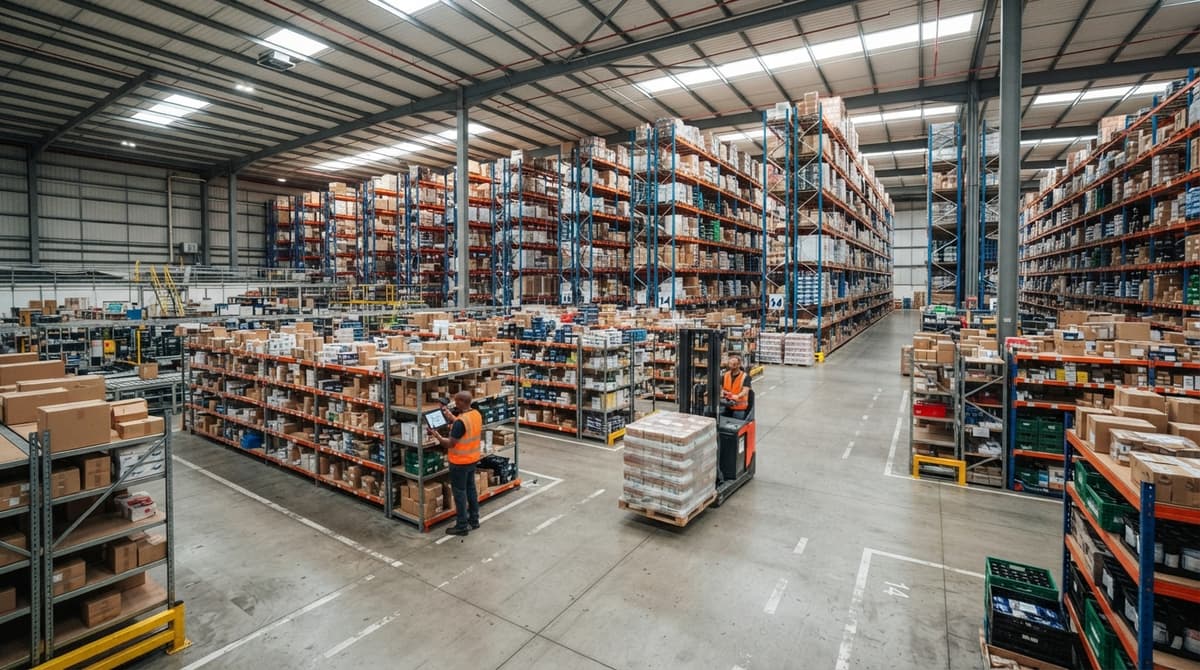
Barcode Abbreviation
Reviewed and updated: June 2025
Reviewed September 2026. Figures are worked from the assumptions stated beside them, so you can substitute your own and the arithmetic still holds.
Every warehouse label carries abbreviations. They appear on scanner screens, pick tickets, pallet tags, and receiving reports. Miss one, and a picker grabs the wrong item. Misread another, and a pallet ships to the wrong address. This guide explains the barcode abbreviations that show up most in wholesale and fulfillment work, what each one means, and what task it connects to on the warehouse floor.
Book a callWhat Is a Barcode Abbreviation?
A barcode abbreviation is a short code that names a barcode standard, a data field, or an identifier type. These labels appear on scanner screens and shipping documents. They are not the barcode itself. They tell you what kind of data the barcode holds and where that data goes once the scanner reads it. GS1, the global body that sets barcode standards, describes its specifications as the shared language of business at gs1.org/standards/barcodes. Knowing the abbreviation tells you what the scanner will do with the data it reads.
We build it for your operation, and the first look is free
If you would rather not compare products, describe how your operation already works and we build the system around it.
No build cost. You see it running on your own process first, and the monthly subscription starts only once it is live.
Book a callBarcode Abbreviations for Product Identification: UPC, EAN, and GTIN
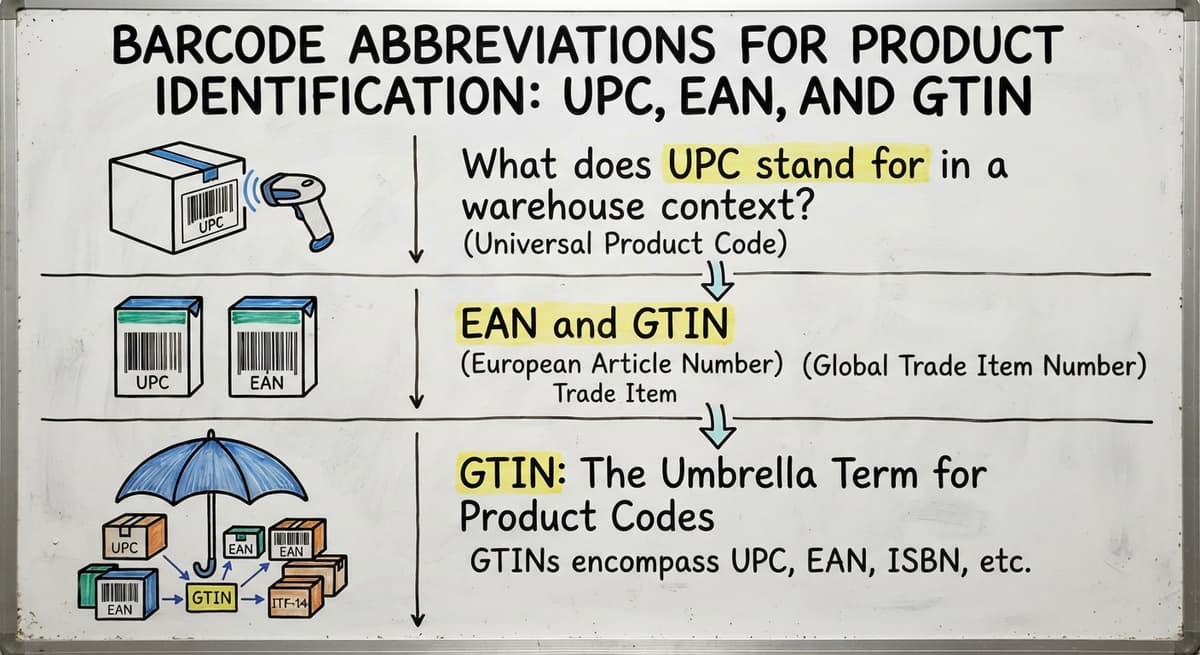
UPC, EAN, and GTIN are the 3 abbreviations that identify what a product is. They appear on item labels, inbound cartons, and supplier documents.
What does UPC stand for in a warehouse context?
UPC stands for Universal Product Code, the most common barcode on retail and wholesale products in North America. A UPC-A has 12 digits. A UPC-E is a compressed 6-digit version for small packaging. In a warehouse, the UPC tells the system what the product is, not where it lives. Scanning a UPC during receiving matches the item to a buy order line. It does not tell the system which bin to put it in.
EAN and GTIN
EAN stands for European Article Number, though it is used worldwide. EAN-13 is the 13-digit global version of UPC-A. Distributors receiving international goods will see EAN on inbound labels. Most modern scanners read both UPC and EAN without any setting change, so the practical difference is the digit count.
GTIN: The Umbrella Term for Product Codes
GTIN stands for Global Trade Item Number. It is an umbrella term that covers UPC, EAN, and several other formats. A GTIN can be 8, 12, 13, or 14 digits depending on the standard used. Large retail buyers often need suppliers to provide a GTIN for each product they sell. The key difference between a UPC and a GTIN is scope: a UPC is one specific format, while a GTIN is the category that includes all of them.
Inline FAQ: What is the difference between a UPC and a GTIN? A UPC is a 12-digit product code used mainly in North America. A GTIN is the broader term that includes UPC, EAN, and other formats. Every UPC is a GTIN, but not every GTIN is a UPC.

SKU, LOT, and SN: Internal Tracking Abbreviations
SKU, LOT, and SN are abbreviations that come from inside the business, not from a standards body. They track variants, batches, and individual units.
SKU stands for Stock Keeping Unit. A SKU is created by the business itself. It lets a distributor track variants like size, color, or pack count as separate items. SKU numbers are often encoded into barcodes on bin labels and pick tickets. A SKU is different from a barcode: the SKU is the identifier, and the barcode is the printed symbol that carries it.
LOT and SN: Batch and Unit Tracking
LOT refers to a lot number, which groups items made or received in the same batch. SN or S/N stands for serial number, a unique code for a single unit. Food, pharmaceutical, and electronics distributors rely on LOT and SN tracking for recalls and warranty claims. Both are often encoded in a barcode alongside the product GTIN on the same label, so 1 scan captures the product identity and the batch or unit identity at once.
Inline FAQ: What does SKU stand for and how is it different from a barcode? SKU stands for Stock Keeping Unit. A SKU is an internal code your business creates to track a specific product variant. A barcode is the printed symbol that carries the SKU, so the scanner can read it without manual typing.
The comparison is easier when one option is built for you
Off-the-shelf means fitting your process to the software. We do it the other way round, and the first look costs nothing.
Book a call
Barcode Symbologies: Code 39, Code 128, ITF-14, and QR
A barcode symbology is the format, or the visual language, a barcode uses. When software asks which symbology to print, it is asking which format to use.
Code 39 encodes letters and numbers. It is common on internal warehouse labels because it is simple and widely supported. Code 128 encodes more data in less space. It is the standard for shipping labels and GS1-128 applications, which encode multiple data fields in a single barcode. If a scanner fails to read a label, a mismatch between the printed symbology and the scanner's expected format is often the cause.
ITF-14 stands for Interleaved Two of Five, a 14-digit barcode format used on cases and pallets rather than individual items. It encodes a GTIN-14 and is built to stay readable on rough corrugated packaging. Wholesale distributors see ITF-14 on master cartons arriving from suppliers.
What is a QR code used for in a warehouse?
QR stands for Quick Response, and a QR code is a two-dimensional barcode that holds far more data than a standard linear barcode. In warehousing, QR codes appear on bin labels, work orders, and equipment tags. A QR code can store a URL, so scanning one can open a receiving checklist or product page directly on a mobile device. That makes them useful for tasks where a worker needs more than just an identifier.
Inline FAQ: What is the difference between Code 39 and Code 128? Code 39 encodes letters and numbers in a simple format common on internal labels. Code 128 holds more data in less space and is the standard for shipping and GS1 labels. Use Code 128 for any label that needs to leave your building.

GS1, SSCC, and ASN: Shipping and Compliance Abbreviations
GS1, SSCC, and ASN are abbreviations that connect your warehouse to your trading partners. They appear on pallet labels, shipping documents, and vendor compliance requirements.
GS1 is the global organization that sets barcode and data standards. Many abbreviations in this guide, including GTIN and SSCC, come from GS1 specifications. GS1-128 is a barcode standard used on shipping labels that encodes multiple data fields at once, such as GTIN, lot number, and expiry date in a single scan. Understanding that GS1 is a standards body, not a product or a vendor, explains why so many abbreviations trace back to it.
SSCC and ASN: Pallet Identity and Pre-Shipment Notice
SSCC stands for Serial Shipping Container Code. It is an 18-digit number that uniquely identifies a pallet or shipping container. SSCC barcodes appear on pallet labels. Fulfillment centers scan SSCC codes during receiving to match a pallet to an incoming shipment record without counting every item by hand.
ASN stands for Advanced Shipping Notice, an electronic document sent before a shipment arrives. An ASN lists what is on each pallet and includes the SSCC barcodes for each one. The warehouse scans the SSCC on arrival and the system fills in the rest. Many large retail buyers need an ASN as part of their vendor compliance rules. Skipping the ASN means the buyer's receiving dock does manual entry, and they often charge back the cost.
Inline FAQ: What is an SSCC barcode and when is it used? SSCC stands for Serial Shipping Container Code. It is an 18-digit number printed as a barcode on a pallet label. The receiving warehouse scans it to pull up the full contents of that pallet from the ASN, removing the need to count and key in every item.

BIN, PO, and SO: Location and Order Abbreviations
What does a BIN code on a warehouse label mean?
BIN is short for bin location, the physical address of a storage slot in a warehouse. Bin codes are printed as barcodes on shelf labels. A typical bin code encodes aisle, bay, level, and slot in a short alphanumeric string. Scanning a bin barcode instead of typing a location removes the manual entry step that causes most mis-picks. A picker who scans both the item barcode and the bin barcode gives the system 2 confirmation points before the pick is logged.
PO stands for Buy Order. SO stands for Sales Order. Both are printed as barcodes on receiving documents and pick tickets. Scanning a PO barcode during receiving links each item scan to the correct buy order automatically. That keeps records accurate in your inventory or accounting system without rekeying data at the end of the shift.
See it running on your own process first
No build cost. The subscription starts once it is live and doing the job, not before.
Book a call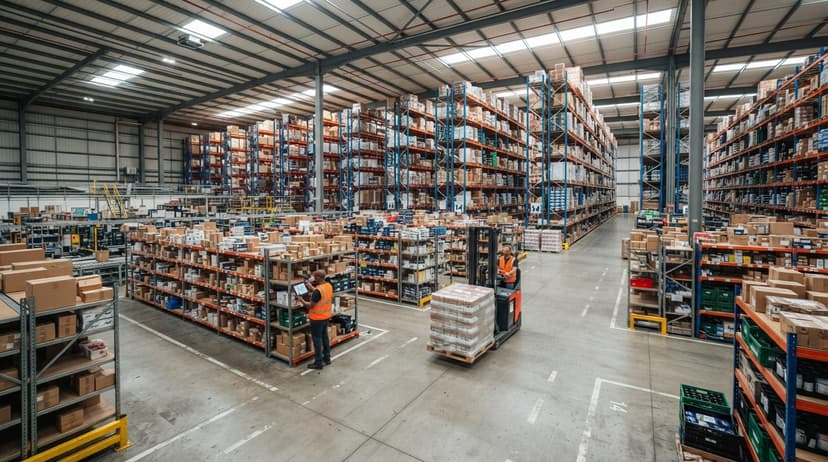
WMS and IMS: The Software That Reads Every Scan
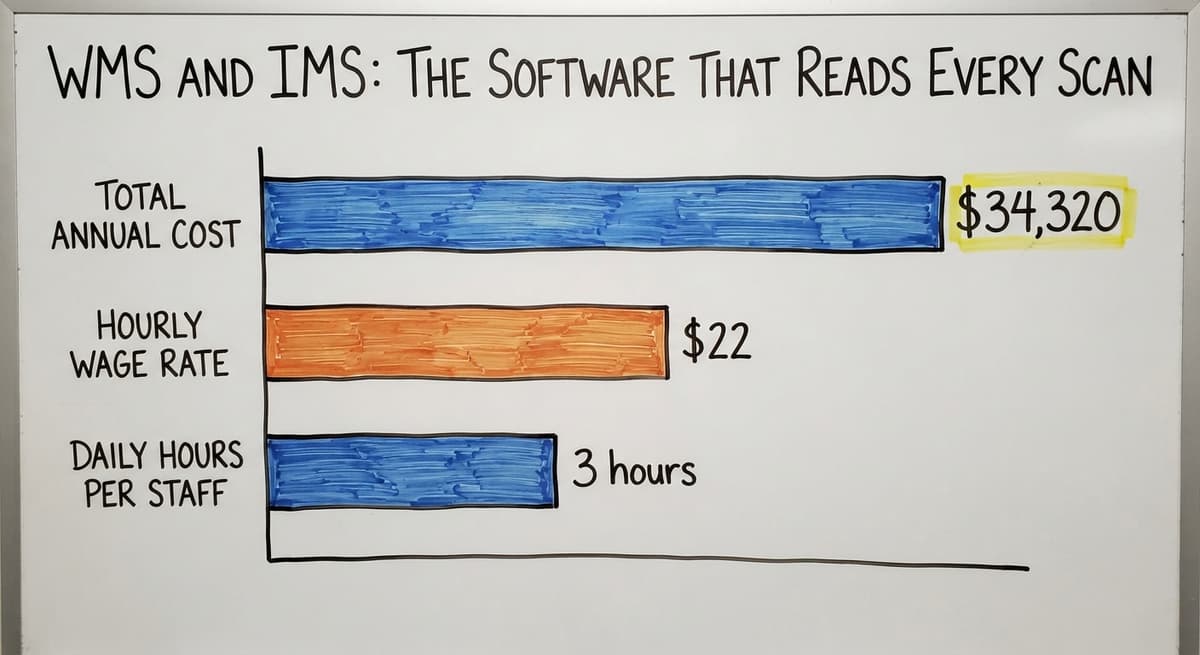
WMS stands for Warehouse Management System. IMS stands for Inventory Management System. These are the platforms that receive barcode scans and update stock records. A WMS manages location and movement inside a warehouse. An IMS tracks quantities across locations, often including multiple sites or sales channels. Smaller distributors often use an IMS that connects to QuickBooks rather than a full WMS, which keeps costs down while still automating the scan-to-record step.
The Cost Case for Barcode Scanning Software
Consider the labor cost before deciding a WMS is unnecessary. 2 warehouse staff spending 3 hours a day on manual data entry at $22 an hour, the median wage for stock clerks according to the US Bureau of Labor Statistics, adds up to $34,320 a year. A barcode scanning system that cuts that time in half pays for itself quickly. The IRS also needs businesses to value inventory at the start and end of each tax year: "To figure taxable income, you must value your inventory at the beginning and end of each tax year," per IRS Publication 538. Accurate scanning makes that count faster and more reliable.
How Barcode Abbreviations Work Together on One Label
A single warehouse label can carry GTIN, LOT, SN, and BIN barcodes side by side. Each barcode encodes a different piece of data. The scanner reads them in sequence. The inventory system maps each scan to the right field automatically.
Common Label Mistakes and How to Prevent Them
Common mistakes in small warehouses follow a pattern:
- Confusing SKU with UPC creates duplicate items in the inventory system because the system treats them as different identifiers for the same product.
- Printing Code 39 when the scanner expects Code 128 causes read failures that slow receiving to a crawl.
- Using a retail UPC as an internal bin label creates scanning conflicts when the system cannot tell whether a scan is a product or a location.
- Mixing up GTIN-12 and GTIN-14 triggers supplier compliance rejections that delay payment.
A clear label naming convention, one that states the abbreviation type next to each barcode, prevents most of these errors before they reach the scanner.
Building a Barcode System That Uses These Abbreviations Correctly
Start by listing which barcode abbreviations your suppliers, customers, and carriers need. Map each one to a field in your inventory software. Choose Code 128 as your default symbology: it covers most warehouse use cases and is readable by every modern scanner.
The NIST Manufacturing Extension Partnership recommends aligning your labeling process to the standards your trading partners already use, which reduces compliance friction without requiring a full system overhaul. A custom-built inventory system can be designed around the label formats and abbreviations your operation already uses, including your existing QuickBooks setup, rather than forcing your team to change how they work to fit a new platform.
Closing the Knowledge Gap on the Warehouse Floor
If your scanner screens show abbreviations your team cannot explain, that gap is a risk. Every abbreviation in this guide connects to a real task: receiving, picking, shipping, or counting. When staff know what each one means, they catch label errors before those errors become wrong shipments or inventory discrepancies.
A barcode inventory management system overview can help you see how all these pieces connect in a single workflow. If you want to explore how barcode scanning integrates with QuickBooks, or need a warehouse bin location labeling guide built around your current setup, the right starting point is a review of the abbreviations and label formats your operation already uses, and then building from there.
Frequently asked questions
What does UPC stand for in a warehouse context?
UPC stands for Universal Product Code. In a warehouse, it identifies what the product is. Scanning a UPC during receiving matches the item to a buy order line, but it does not tell the system where to store the item. That job belongs to the bin location barcode.
What is the difference between a UPC and a GTIN?
A UPC is a 12-digit product code used mainly in North America. A GTIN, which stands for Global Trade Item Number, is the broader category that includes UPC, EAN, and other formats. Every UPC is a GTIN, but a GTIN can also be 8, 13, or 14 digits depending on the standard used.
What does SKU stand for and how is it different from a barcode?
SKU stands for Stock Keeping Unit. A SKU is an internal code your business creates to track a specific product variant such as size or color. A barcode is the printed symbol that carries the SKU so a scanner can read it. The SKU is the identifier; the barcode is the delivery method.
What is the difference between Code 39 and Code 128?
Code 39 encodes letters and numbers in a simple format suited to internal warehouse labels. Code 128 holds more data in less space and is the standard for shipping labels and GS1 applications. If a label needs to leave your building or meet a trading partner's requirements, Code 128 is the right choice.
What does EAN mean on a product label?
EAN stands for European Article Number. Despite the name, it is used worldwide. EAN-13 is a 13-digit barcode that is the global equivalent of the 12-digit UPC-A. Distributors receiving international products will see EAN on inbound labels, and most modern scanners read both formats without any setting change.
What does LOT mean on a barcode label?
LOT refers to a lot number that groups items produced or received in the same batch. It is encoded in a barcode alongside the product GTIN so a single scan captures both the product identity and the batch it came from. Food, pharmaceutical, and electronics distributors use LOT tracking to manage recalls and expiry dates.
What is ITF-14 used for in wholesale distribution?
ITF-14 stands for Interleaved Two of Five. It is a 14-digit barcode printed on cases and pallets rather than individual items. It encodes a GTIN-14 and is designed to stay readable on rough corrugated packaging. Wholesale distributors see ITF-14 on master cartons arriving from suppliers.
How do barcode abbreviations connect to inventory management software?
Each barcode abbreviation maps to a specific data field in a warehouse management system or inventory management system. When a scanner reads a GTIN, the system looks up the product. When it reads a BIN code, it logs the location. When it reads a LOT, it records the batch. The software does the mapping automatically once it is set up correctly.
Start with a free first look
A 30 minute call, your operation mapped, and a clear picture of what we would build. No obligation and nothing to install.
Book a callRelated guides
The rest of this guide, for the parts of the job this page does not cover.
Guides
- 2d Barcode Readers
- Barcode Systems for Warehouse
- Barcode Reader Description
- Barcodes and Labels
- Alphanumeric Barcode
- Barcode Scanner Inventory System
- Lpn Barcodes
- Imager Barcode Scanner
- Barcode System for Inventory Free
- Inventory Management Software Barcode Scanner
- 2d Wireless Barcode Scanner
- System Id Barcode Solutions
- 2d Imaging Barcode Scanners
- Inventory Management Software with Barcode
- Quickbooks Barcode Reader
- Excel Barcode
- 2d Imager Barcode Scanner
- 2d Usb Barcode Scanner
- Free Inventory Management Software with Barcode Scanner
- Barcode Effect
- Barcode for Id Card