


What Is Inventory Management And Its Types
Inventory management is the process of ordering, storing, tracking, and selling goods. It tells you what you have, where it is, and when to reorder. Good inventory control keeps shelves stocked without tying up cash in product that sits. This article was reviewed in October 2026 and covers every major method in plain terms.
Book a callWhat Is Inventory Management
Inventory management is how a business keeps track of the goods it buys, stores, and sells. Every time stock moves, a good system records it. That record tells you what is on hand, what is running low, and what is costing you money by sitting too long. For a wholesale distributor, a fulfillment center, or a warehouse, this process runs every single day. Get it right and orders ship on time. Get it wrong and customers wait, shelves overflow, or cash disappears into product no one is buying.
We build it for your operation, and the first look is free
If you would rather not compare products, describe how your operation already works and we build the system around it.
No build cost. You see it running on your own process first, and the monthly subscription starts only once it is live.
Book a callWhy Inventory Management Matters for Small Operations
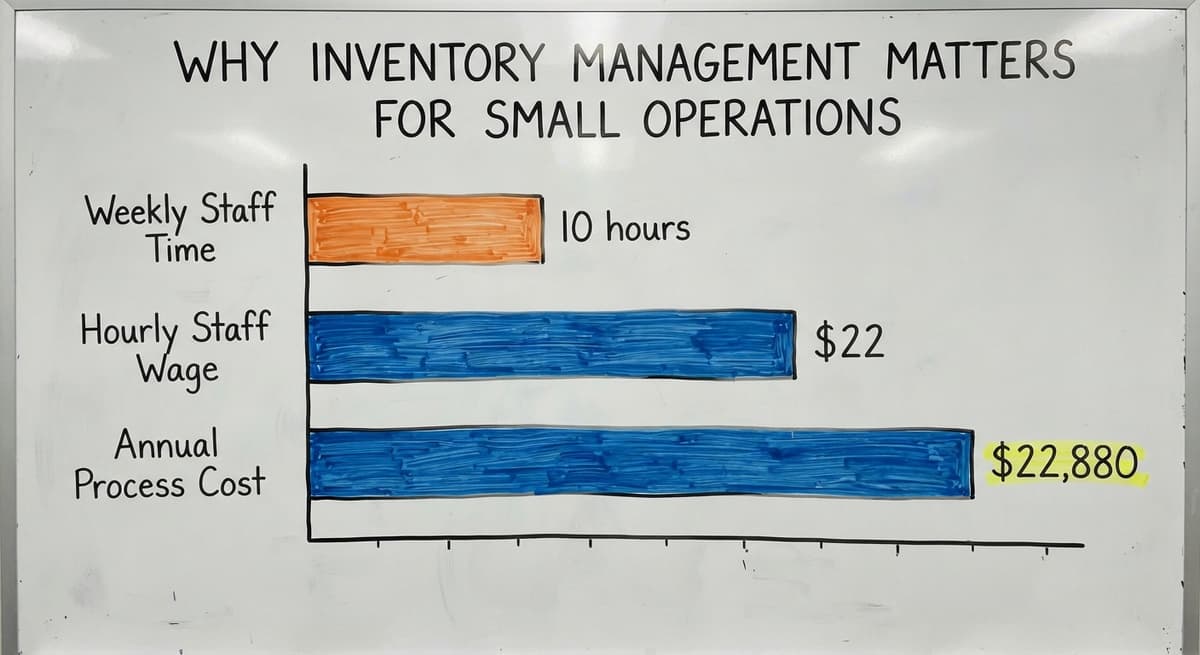
Poor inventory control has a direct dollar cost. If 2 staff members spend 10 hours each week reconciling stock counts at $22 an hour, that is $22,880 a year spent on a process that still produces errors. Overselling burns customer trust. Stockouts mean lost sales. Excess stock ties up cash and raises storage costs.
Many small operations run on an accounting package plus spreadsheets and printed pick sheets. That setup works until it doesn't. The good news is that you do not need a large enterprise resource planning system to fix it.
Accurate counts also carry a legal dimension. The IRS states in Publication 538: "To figure taxable income, you must value your inventory at the beginning and end of each tax year." Beyond taxes, the US Federal Trade Commission needs sellers to ship when promised, which depends on knowing what stock is actually available. GS1, the global standards body, notes that "barcodes are the most widely used automatic spotting technology in the world," and links that claim directly to its barcode standards page, because scan-based counts are what make those legal obligations achievable at scale.

What Are the Main Types of Inventory a Business Holds?
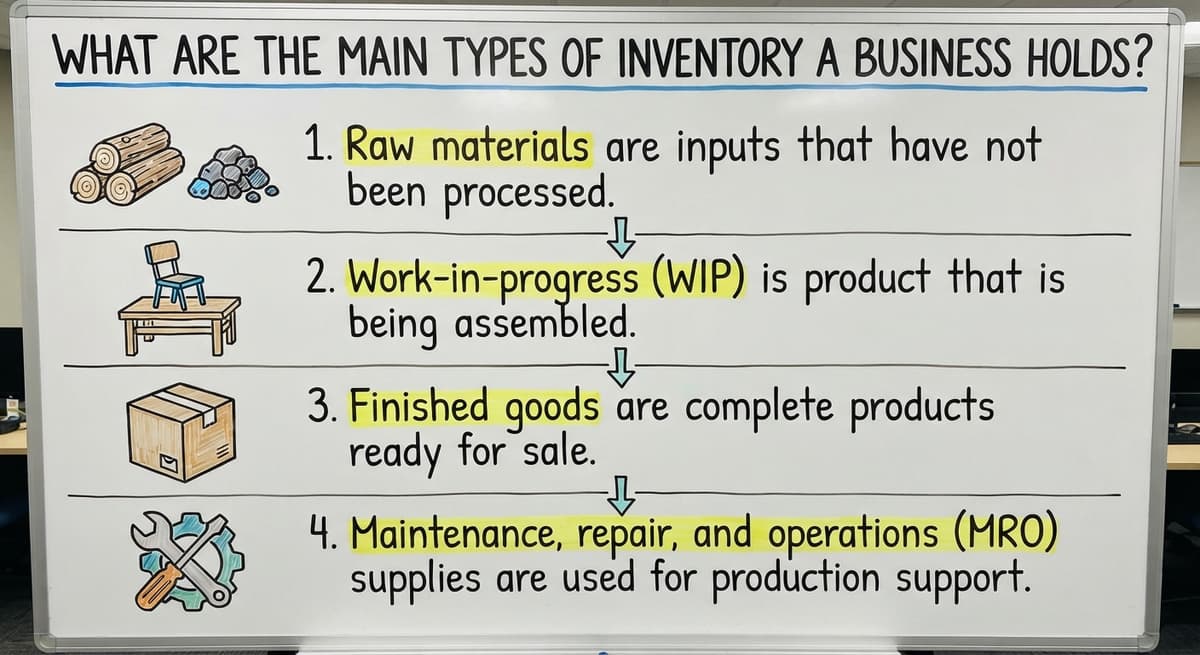
Knowing which type of inventory you hold shapes which management method fits best. Most businesses carry one or more of these 4 categories.
- Raw materials are inputs that have not been processed yet. A beverage distributor holding bulk concentrate is holding raw materials.
- Work-in-progress (WIP) is product that is being assembled or prepared but is not ready to ship. A kit-packing operation with half-built gift sets carries WIP.
- Finished goods are complete products ready for sale or shipment. Most wholesale distributors deal almost entirely in finished goods.
- Maintenance, repair, and operations (MRO) inventory covers supplies that keep the warehouse running: tape, forklift parts, cleaning supplies. MRO is easy to overlook and easy to overstock.
Once you know which category dominates your operation, the right tracking method becomes much clearer.
Types of Inventory Management Methods
Method refers to how you control stock, which is a separate question from what type of stock you hold. The sections below each cover one method. Scan to the one that matches how your operation runs today, then read what a shift to that method would actually change.

Just-in-Time (JIT) Inventory Management
Just-in-time inventory means stock arrives only when it is needed for an order or production run. The goal is to hold as little on-hand stock as possible, which cuts storage costs and reduces the risk of obsolete product.
The trade-off is real. JIT works well only when supplier lead times are short and reliable. A distributor of fast-moving consumer goods with 3 or 4 dependable vendors can run lean and reorder daily. A business with long overseas lead times or unpredictable suppliers will face stockouts the moment one shipment is late.
JIT rewards discipline. It is not a fit for every warehouse, but for the right operation it frees up large cash.
The comparison is easier when one option is built for you
Off-the-shelf means fitting your process to the software. We do it the other way round, and the first look costs nothing.
Book a callABC Analysis
ABC analysis ranks every SKU by value and sales speed. "A" items are your top sellers or highest-margin products. They need close attention and frequent counts. "B" items are mid-range. "C" items move slowly or carry low value and need less day-to-day focus.
This method works even before any software is in place. A spreadsheet with sales totals and unit costs is enough to sort your catalog into three buckets. For a small team managing hundreds of SKUs, ABC analysis tells you where to spend your time. Counting and reviewing your top 20 A items weekly is more valuable than counting 200 C items monthly. The result is better control with fewer staff hours.
FIFO and LIFO
FIFO (first in, first out) means the oldest stock ships first. If a case of product arrived in March and another arrived in April, the March case ships first. This is the standard approach for most distributors, especially those handling date-sensitive or perishable goods.
LIFO (last in, first out) means the newest stock ships first. LIFO is uncommon in distribution and is not permitted under international accounting rules. It also has US tax implications worth a conversation with your bookkeeper before you adopt it.
For most warehouse operations, FIFO is the practical default because it keeps product fresh and reduces write-offs from expired or outdated stock.
Perpetual vs. Periodic Inventory Tracking
These two approaches describe when your stock records get updated, not how you count.

Perpetual inventory tracking updates stock levels in real time with every transaction. A sale, a receipt, a transfer: each one adjusts the count at once. This needs dedicated software, but it means you always know what is on hand without waiting for a count.
Periodic inventory tracking updates stock on a set schedule: weekly, monthly, or quarterly. The team counts what is physically present, then updates the records. Many small operations start here because it fits a spreadsheet workflow.
The US Census Bureau's Monthly Wholesale Trade data shows that wholesale inventories-to-sales ratios shift regularly, which means businesses relying on stale periodic counts can be making reorder decisions on numbers that are already weeks out of date.
Most operations move from periodic to perpetual as order volume grows, because the cost of a wrong count rises with every extra order. Periodic is a fine starting point. Perpetual is where accuracy becomes consistent.
Which Inventory Management Method Is Right for Your Operation?
The right method is the one that fits how your business already runs, not the one that needs the biggest process change. Start by answering 3 questions: How many SKUs do you carry? How often do orders ship? How reliable are your suppliers?

- Fewer than 200 SKUs and weekly shipments: periodic tracking with ABC analysis is a strong starting point.
- More than 200 SKUs or daily shipments: perpetual tracking pays for itself quickly in avoided errors.
- Fast-moving stock with reliable vendors: JIT reduces carrying costs without adding risk.
- Date-sensitive or perishable goods: FIFO is non-negotiable.
The NIST Manufacturing Extension Partnership offers vendor-neutral guidance on supply chain process that reinforces the same principle: match the system to the operation, not the other way around.
Custom-built software can connect directly to your accounting software and replace only the manual parts of your current workflow. That means no forced migration and no retraining staff on a system built for a different kind of business. The right inventory management approach is the one your team will actually use. If you want to talk through what that looks like for your specific operation, a local rollout team that builds around your workflow is the right place to start.
Frequently asked questions
What are the four main types of inventory management?
The 4 main types refer to the categories of stock a business holds: raw materials, work-in-progress (WIP), finished goods, and MRO (maintenance, repair, and operations) inventory. Each type calls for a different tracking approach. Finished goods dominate most wholesale and distribution operations, while MRO is often tracked separately because it supports the warehouse rather than the product sold.
What is the 80/20 rule in inventory?
The 80/20 rule in inventory is the idea that roughly 80% of your revenue comes from 20% of your SKUs. It is the foundation of ABC analysis. Identifying that top 20% lets a small team focus counting, reordering, and storage attention where it drives the most value. You do not need software to apply it: a sorted spreadsheet of sales by SKU is enough to see the pattern.
What are the top 5 inventory management software?
There is no single right answer because the best fit depends on your order volume, number of SKUs, accounting package, and how your team works. The main categories are: a basic spreadsheet for very small operations, a standalone inventory app for growing teams, a cloud inventory platform that connects to your accounting package, a warehouse management system for higher volume, and a custom-built platform for operations with workflows that off-the-shelf tools do not cover. The deciding factor is whether the tool fits your process or forces you to change it.
What are the 5 stages of the inventory management process?
The 5 stages most operations follow are: (1) purchasing or receiving stock, (2) storing and organizing it in the warehouse, (3) tracking what is on hand and where, (4) fulfilling orders by picking and shipping, and (5) counting and reconciling to keep records accurate. Each stage is a point where errors can enter the system, which is why tracking method and software choice matter at every step, not just at the count.
What is the difference between FIFO and LIFO?
FIFO ships the oldest stock first. LIFO ships the newest stock first. FIFO is the standard for most distributors because it keeps product fresh and reduces write-offs. LIFO is rarely used in distribution, is not permitted under international accounting rules, and carries US tax implications worth discussing with a bookkeeper before adoption.
What is ABC analysis and how does it work?
ABC analysis ranks every item in your inventory by sales volume and value. A items are your top performers and need frequent attention. B items are mid-range. C items move slowly and need less oversight. The method helps small teams focus time and resources where they matter most. A sorted spreadsheet is enough to get started.
Do I need a large ERP system to manage inventory properly?
No. Many small wholesale distributors and warehouses manage inventory well with a combination of periodic counts, ABC analysis, and a tool that connects to their existing accounting package. A large ERP system adds cost and complexity that most small operations do not need. Custom-built software can fill the gaps in a current workflow without replacing everything at once.
What is just-in-time inventory management?
Just-in-time inventory means ordering stock only when it is needed, not before. It cuts storage costs and reduces the risk of holding product that does not sell. It works best when supplier lead times are short and reliable. Operations with long or unpredictable lead times carry more risk with JIT and may need a small safety stock buffer to avoid stockouts.
Start with a free first look
A 30 minute call, your operation mapped, and a clear picture of what we would build. No obligation and nothing to install.
Book a callRelated guides
The rest of this guide, for the parts of the job this page does not cover.
Guides
- Types of Inventory Control
- 7 Types of Inventory
- Types of Stock Control Systems
- Warehouse Management System Types
- Multi Location Inventory Management Software
- Inventory Management for Multiple Locations
- Inventory Management System for Manufacturing
- Inventory Management Pics
- B2b Inventory Management
- Jewelry Inventory Management
Common questions
- What is B Type of Inventory in Warehouse Management
- What is the Main Purpose of Inventory Management
- What is Information Technology Inventory Management
- What is Risk Pooling in Inventory Management
- What is Stock Taking in Inventory Management
- What is Bin Number in Inventory Management
- What is Inventory Listing
- What is Inventory
- What Are the 7 Types of Warehouses?
- What is the Best Warehouse Inventory Management System?
- What is the Difference Between Warehousing and Inventory Management
- What is Warehousing and Inventory Management
- What is the Best Inventory Management Software for Small Business
- What is the Best Inventory Management System for Small Businesses?