


What Is Information Technology Inventory Management
Information technology inventory management means using software and digital tools to track, record, and control stock levels across your business in real time. Updated October 2026.
It replaces paper logs, spreadsheets, and memory with a live digital record that updates every time goods move in or out. Your team always sees the same numbers, from the warehouse floor to the front office.
Book a callWhat Is Information Technology Inventory Management, Really?
At its simplest, an inventory management system is a database that knows where every item is, how many you have, and what is coming or going next. Staff enter data by scanning a barcode, typing a quantity, or completing a transaction in a connected system. The record updates instantly.
The IRS makes the stakes clear. IRS Publication 538 states: "To figure taxable income, you must value your inventory at the beginning and end of each tax year." That obligation alone means a reliable count is not optional. A real-time inventory tracking system makes that count accurate without a manual year-end scramble.
We build it for your operation, and the first look is free
If you would rather not compare products, describe how your operation already works and we build the system around it.
No build cost. You see it running on your own process first, and the monthly subscription starts only once it is live.
Book a callWhat Does an IT Inventory Management System Actually Track?
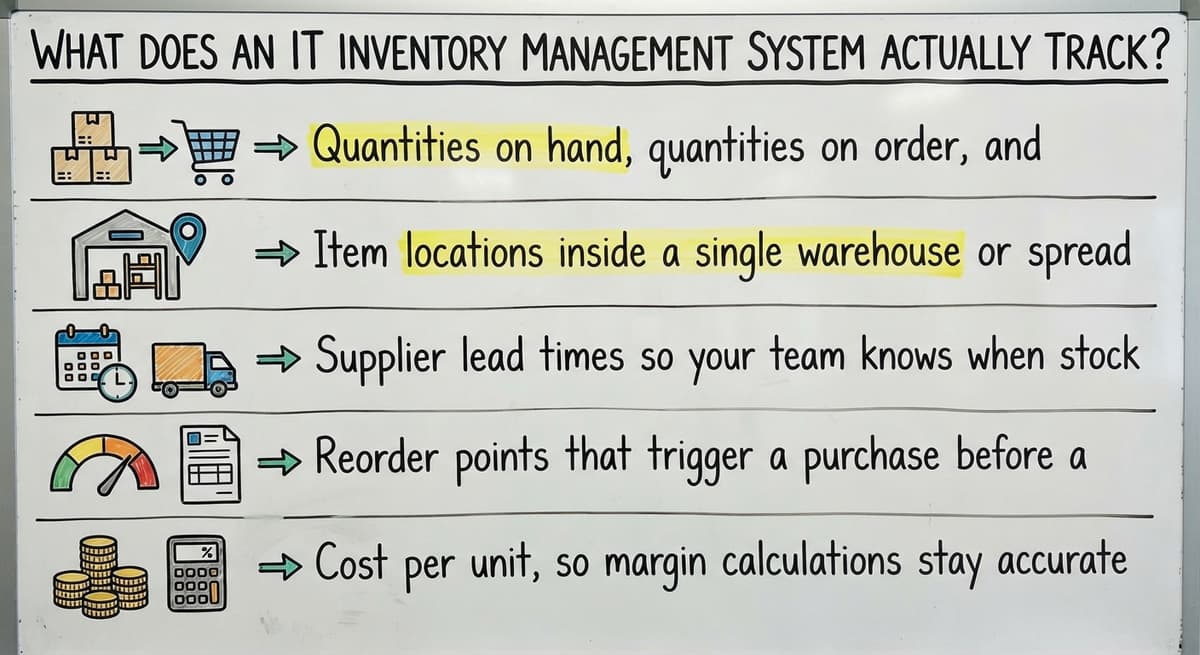
A solid stock control system captures more than a simple count. Here is what it watches at any given moment.
- Quantities on hand, quantities on order, and quantities committed to open customer orders
- Item locations inside a single warehouse or spread across multiple sites
- Supplier lead times so your team knows when stock will actually arrive
- Reorder points that trigger a buy before a shelf runs empty
- Cost per unit, so margin calculations stay accurate
How Barcode Scanning Powers Warehouse Inventory Tracking
Barcode scanning sits at the heart of most warehouse inventory tracking setups. As GS1 explains, barcodes are "the most widely used automatic spotting technology in the world," and their standards make it possible for any scanner to read any label without custom setup.
For a wholesale distributor, that means a receiver can scan a pallet on arrival and the system at once knows what came in, from which supplier, and at what cost.
How Does Inventory Management Software Work at a Basic Level?
A central database stores every item record and updates the moment a transaction occurs. That is the whole mechanism, and everything else builds on it.
Barcodes, handheld scanners, or manual entry feed data into the system. When a picker pulls 12 units of an item, the on-hand count drops by 12. When a buy order is received, the count rises. The system connects to your purchasing module, your sales order process, and your accounting package so every side of the business reads the same live number.

Why Integration Is the Key to Supply Chain Visibility
The NIST Manufacturing Extension Partnership describes this kind of integration as needed to supply chain visibility: knowing what you have, where it is, and what it costs, without chasing down a colleague to find out.
No single transaction needs a phone call or a manual update to a second spreadsheet. The data flows once and lands everywhere it needs to be.
The comparison is easier when one option is built for you
Off-the-shelf means fitting your process to the software. We do it the other way round, and the first look costs nothing.
Book a callWhy Spreadsheets and Manual Methods Break Down as a Business Grows
Spreadsheets work fine for one person tracking a small catalog. The trouble starts the moment a second person opens the same file.
Two people editing at once can overwrite each other's work. A wrong formula in one cell cascades through every count that depends on it. A forgotten save means the warehouse is working from yesterday's numbers. Email chains carrying pick lists add delay at every step, and a printed sheet is out of date before it reaches the floor.

Why Counting Errors Create Real Financial Exposure
None of this is a failure of the people using the tools. It is a natural growth pain. The US Census Bureau's Monthly Wholesale Trade data shows that wholesale inventories run into the hundreds of billions of dollars nationally. At that scale, even a small operation carries enough stock that a 2% counting error creates real financial exposure.
The spreadsheet was never built to be a stock control system. It was built to do math, and at some point the math outgrows it.
The Difference Between a Generic System and a Custom One
Off-the-shelf inventory platforms are built around an average workflow. That means most businesses must change how they work to fit the software, not the other way around.
A custom inventory software build starts from the operation that already exists. Your receiving steps stay the same. Your order flow stays the same. The terminology your team uses every day stays the same. Staff learn a screen that mirrors what they already do, rather than learning a new process and new software at the same time.

Why Custom Does Not Mean Slow or Expensive
Custom does not mean slow or expensive to start. It means the software does not force you to migrate habits that already work. A focused build targets only the manual steps causing the most pain, goes live faster than a full ERP rollout, and grows as your needs grow.
For a 10-to-50-person wholesale distributor, that distinction matters. A purpose-built layer handles the warehouse and operations side without replacing the accounting tools your team already trusts.
Can Inventory Management Software Work Alongside Your Accounting Software Instead of Replacing It?
Yes, and for most small distributors, that is exactly the right approach. Many operations already use dedicated accounting software and have no reason to replace it.
An inventory management system can sit alongside your accounting software, handling the warehouse and operations side while your accounting software keeps the books. How custom working software works alongside your existing accounting software is straightforward: only the manual parts move into the new system.
- Pick lists move out of email and into a live screen
- Stock counts update in real time instead of at month end
- Buy order tracking shows what is open, what is received, and what is still outstanding
Your accounting software continues to handle invoicing, payments, and your chart of accounts. The 2 systems share the data they need to share and stay out of each other's way everywhere else.
See it running on your own process first
No build cost. The subscription starts once it is live and doing the job, not before.
Book a call
What the Labor Cost of Manual Stock Work Actually Adds Up To
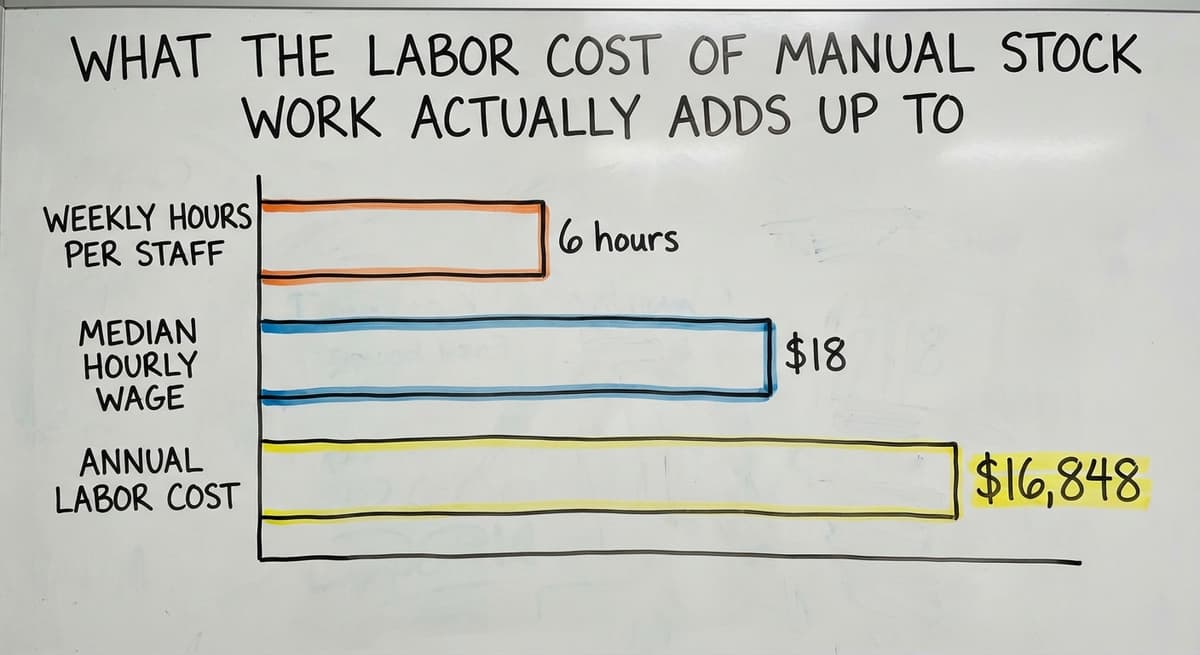
Consider the labor cost of the current manual process. If 3 staff members each spend 6 hours a week reconciling stock counts, pick lists, and buy orders, and the Bureau of Labor Statistics puts the median wage for stock clerks and order fillers near $18 an hour, that is roughly $16,848 a year in paid time spent on work a connected system handles automatically.
Key Benefits for Wholesale Distributors and Warehouses
Real-world benefits show up in daily operations, not just on a dashboard. Warehouse management software for small and mid-size operations delivers gains that are concrete and measurable.
- Accurate stock counts reduce over-ordering and prevent the stockouts that cause late shipments
- Staff spend less time hunting for information and more time fulfilling orders
- Managers see what is on hand, what is inbound, and what is promised, all from one screen
- Errors from re-keying data between systems drop sharply when the data flows automatically
- Buy order tracking closes the gap between what was ordered and what actually arrived
The FTC's guidance on order fulfillment makes clear that sellers must ship when they say they will or notify customers of delays. An accurate real-time inventory tracking system is the working foundation that makes that promise keepable.
When your count is right, your commitments are right.
Signs Your Operation Is Ready for IT Inventory Management
Some patterns show up in almost every operation that has outgrown its current setup. These are signals worth recognizing, not criticisms.

- Stock counts do not match what your accounting package or spreadsheet shows
- Orders ship late because no one knew a product was out of stock until a customer called
- A new team member takes weeks to learn where everything lives and how to record it correctly
- The team has grown past 5 to 10 people and the informal systems that once worked are now creating daily friction
- Receiving, picking, and buy order tracking each live in a different place, and reconciling them takes hours
If 3 or more of those sound familiar, the operation has likely reached the point where replacing Excel and Access databases with purpose-built software pays for itself quickly. The question is not whether to make the change, but where to start.
How Do You Get Started Without a Long Implementation?
A focused build that targets only the manual pain points can go live faster than a full ERP rollout, and that speed is the point.
Starting with one area, such as receiving, picking, or buy order tracking, lets your team learn the system without disrupting the whole operation at once. Inventory management software for fulfillment centers and wholesale operations is most effective when it is introduced in stages, so staff build confidence before the next module goes live.
Why Local Support Makes the Difference
Local support changes the experience. When the same people who built the system answer your questions, the answers are specific to your setup, not a generic help article.
If your operation is running on accounting software and spreadsheets and the friction is growing, the right first step is a conversation about where the manual work is actually costing you the most. Custom inventory software for wholesale distributors does not have to mean a months-long project or a six-figure budget. It means building the right layer for the work you already do.
Reach out and describe your operation. That is where a practical plan starts.
Frequently asked questions
What is inventory management in IT?
Inventory management in IT means using software and digital tools to track stock quantities, locations, costs, and order status in real time. Instead of relying on paper logs or spreadsheets, a digital system updates automatically when goods move in or out, giving every part of the business the same accurate count at the same moment.
What is the best software for IT inventory management?
There is no single best answer. The right choice depends on the size of your operation, how many locations you manage, whether you need to connect to an existing accounting package, and how much your workflow differs from a generic process. A spreadsheet works for a very small catalog. A cloud-based inventory app suits a growing team. A custom-built system fits an operation with specific receiving, picking, or order flows that off-the-shelf platforms cannot match without forcing process changes.
What is an IT asset inventory?
An IT asset inventory is a record of the technology hardware and software a business owns or licenses, such as computers, servers, and subscriptions. It is different from product inventory management, which tracks physical goods for sale. Both use similar database logic, but an asset inventory focuses on what the business uses internally rather than what it sells or ships.
What are the three types of inventory management?
The three common types are periodic, perpetual, and just-in-time. Periodic inventory means counting stock at set intervals, such as monthly or quarterly. Perpetual inventory means the system updates counts continuously as each transaction happens. Just-in-time inventory means ordering stock only when it is needed, keeping on-hand quantities low. Most small wholesale distributors benefit most from a perpetual system because it gives an accurate count at any moment without a manual count cycle.
Can an inventory management system connect to your accounting software without replacing it?
Yes. A purpose-built inventory system can sit alongside your accounting software, handling warehouse operations like receiving, picking, and buy order tracking while your accounting software continues to manage invoicing, payments, and accounting. Only the manual warehouse steps move into the new system. The two platforms share the data they need and stay independent everywhere else.
How long does it take to implement an inventory management system?
A focused build that targets one or two manual pain points, such as receiving or pick list management, can go live in weeks rather than months. A full ERP rollout takes longer because it touches every part of the business at once. Starting with the area causing the most daily friction and expanding from there keeps the team functional during the transition.
Why does real-time inventory tracking matter for order fulfillment?
When your stock count is accurate at every moment, your team knows at once if a product is available before committing to a ship date. The FTC needs sellers to ship when they say they will or notify customers of delays. An accurate live count is the working foundation that makes on-time fulfillment possible and keeps your business compliant with that obligation.
Start with a free first look
A 30 minute call, your operation mapped, and a clear picture of what we would build. No obligation and nothing to install.
Book a callRelated guides
The rest of this guide, for the parts of the job this page does not cover.
Guides
- Multi Location Inventory Management Software
- Inventory Management for Multiple Locations
- Inventory Management System for Manufacturing
- Inventory Management Pics
- B2b Inventory Management
- Jewelry Inventory Management
- Dental Inventory Management
- The Objective of Inventory Management is To
- Qr Code for Inventory Management
- Hvac Inventory Management Software
- Inventory Management Software for Schools
Common questions
- What is Inventory Management and Its Types
- What is the Main Purpose of Inventory Management
- What is Risk Pooling in Inventory Management
- What is Stock Taking in Inventory Management
- What is Bin Number in Inventory Management
- What is Inventory Listing
- What is Inventory
- What is the Best Warehouse Inventory Management System?
- What is the Difference Between Warehousing and Inventory Management
- What is B Type of Inventory in Warehouse Management
- What is Warehousing and Inventory Management
- What is the Best Inventory Management Software for Small Business
- What is the Best Inventory Management System for Small Businesses?