

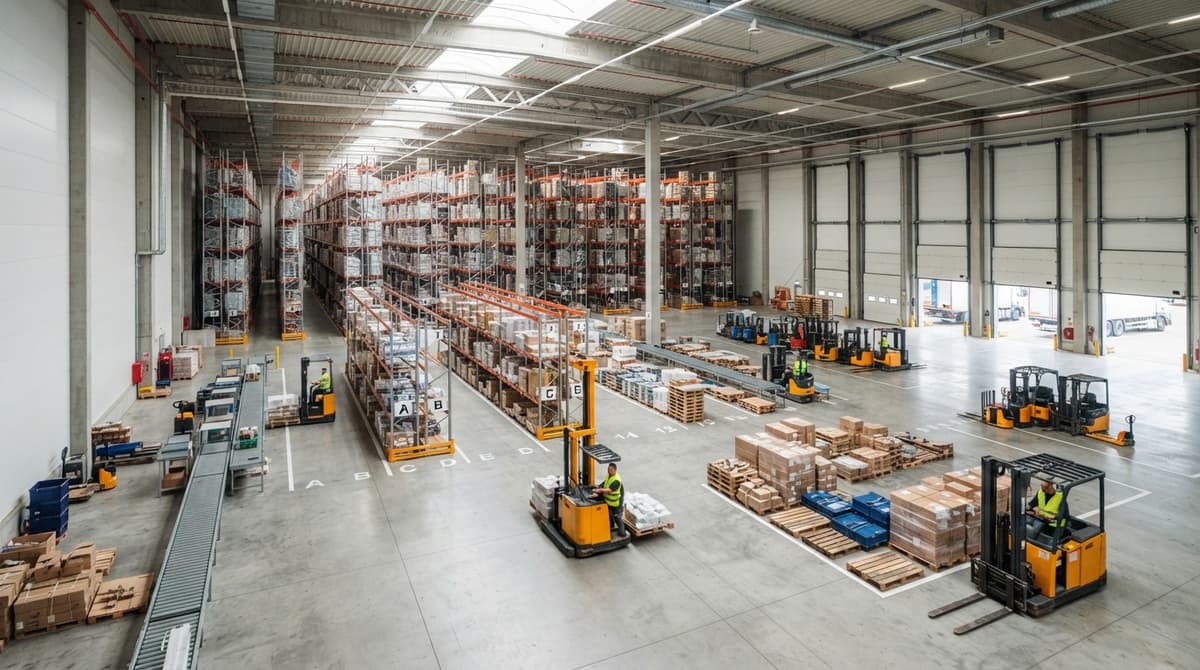
What Are The 7 Types Of Warehouses?
The 7 types of warehouses are the private, public, bonded, climate-controlled, distribution, fulfillment, and smart kinds. Each type stores different goods for a different reason, and each puts a different demand on the people and the software running it. A private warehouse holds one company's stock; a public one rents space to many. A bonded warehouse holds imports before duty is paid, a climate-controlled one holds anything that spoils, and distribution and fulfillment centers move goods through in days or hours. This guide, reviewed in September 2026, explains all 7 and the type that needs inventory software first.
Published 20 August 2026. Reviewed and updated 15 September 2026.
Reviewed August 2026. Each figure comes from the assumptions stated beside it, so you can substitute your own and the arithmetic still holds.
Book a callWhy Does Knowing Your Warehouse Type Matter?
The type of warehouse you run is the biggest single influence on every staffing and inventory decision you make. Get it wrong and you end up with the wrong software, the wrong process, and wasted money.
Operations managers who know their warehouse type can build systems that actually fit their work. Those who do not often patch problems with spreadsheets until things break.
Here is a quick look at the 7 types before we go deeper:
- Private warehouse: owned and run by the business that uses it
- Public warehouse: rented space shared by multiple businesses
- Bonded warehouse: licensed to hold imported goods before customs duties are paid
- Climate-controlled warehouse: keeps temperature and humidity at set levels
- Distribution center: built for fast movement, not long storage
- Fulfillment center: picks, packs, and ships individual customer orders
- Smart warehouse: uses software and automation to cut manual steps
Would you rather have it built around your operation?
The first look is free. If you would rather not compare products, describe how your operation already works and we build the system around it.
No build cost. You see it running on your own process first, and the monthly subscription starts only once it is live.
Book a call1. Private Warehouse
A private warehouse is owned and run by the business that uses it. No landlord. No shared space. Full control over layout, process, and hours.
Mid-size wholesalers and distributors go this route. The upfront cost is higher, but there is no lease to renew and no operator telling you how to run your floor.
Inventory systems in a private warehouse must be built around the company's own SKUs and workflows. Off-the-shelf software fits poorly because every private warehouse runs differently.
As OSHA notes, "The warehousing and storage industry includes establishments operating facilities for general merchandise, refrigerated goods, and other products." That range means no two private warehouses look the same, and your inventory system should reflect your actual operation, not a generic template.
What Does a Private Warehouse Cost to Run?
Costs vary by size and location, but the real expense is labor. The US Bureau of Labor Statistics tracks wages for stock clerks and order fillers.
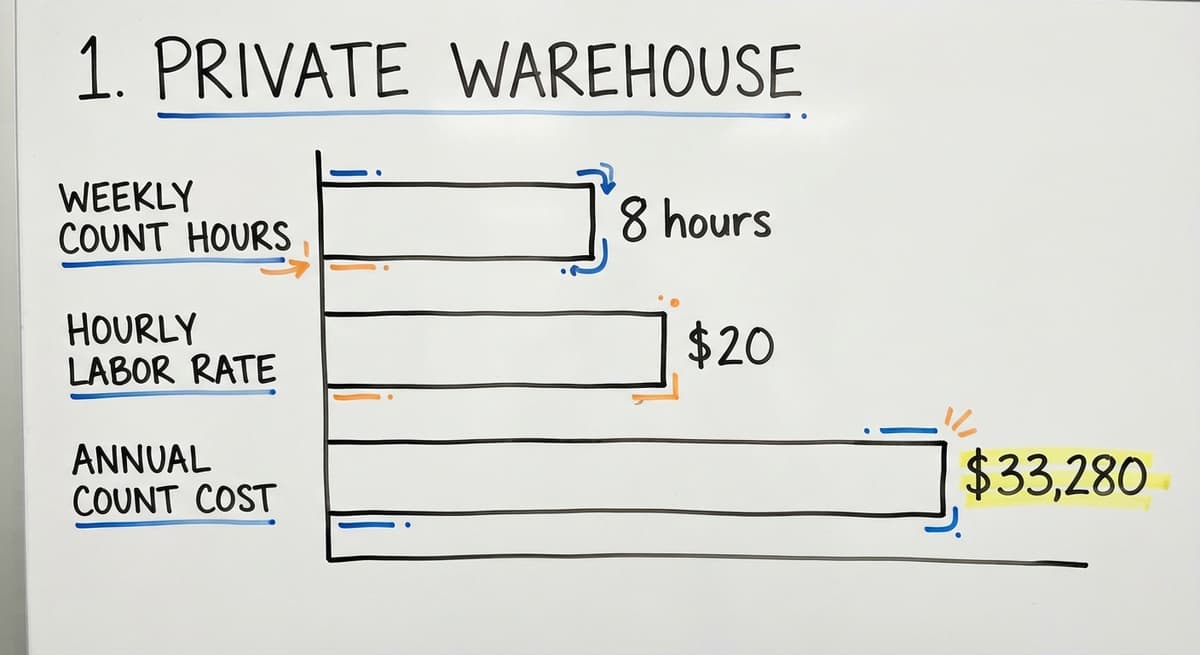
If 4 staff members spend 8 hours a week on manual stock counts at $20 an hour, that is $33,280 a year in labor just for counting. A system that cuts that in half pays for itself fast.
2. What Is a Public Warehouse and Who Should Use One?
A public warehouse is space rented out to multiple businesses by a third-party operator. You pay for what you use. The operator handles the building, the staff, and the shared infrastructure.
Public warehouses work well for companies with seasonal or variable storage needs. A business that doubles its stock every November does not need to own a building for that peak.
The trade-off is control. You do not set the layout. You do not always set the process. Tracking inventory across a shared facility requires clean data handoffs at every step, or stock counts drift fast.
Businesses using public warehouse space need stronger data discipline than those running their own building, precisely because they rely on someone else's systems.
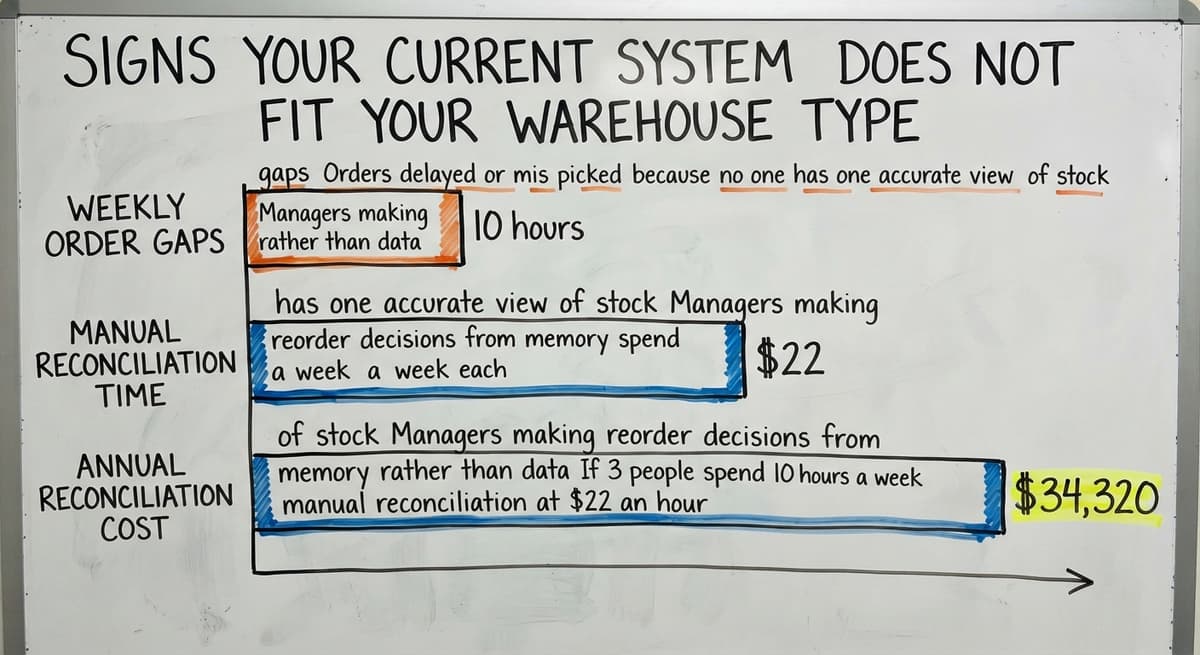
3. Bonded Warehouse
A bonded warehouse is licensed by the government to store imported goods before customs duties are paid. Importers use bonded warehouses when they need time before committing to duty costs on a large shipment.
The rules are strict. Documentation must be exact. Inventory records must be audit-ready at all times, not just at year end.
The IRS states in Publication 538: "To figure taxable income, you must value your inventory at the beginning and end of each tax year." In a bonded facility, that standard applies continuously, not just once a year. A manual system cannot reliably meet that bar.
Who Uses a Bonded Warehouse?
Importers who bring in large volumes of goods, such as electronics, apparel, or food products, use bonded warehouses to manage cash flow. They store the goods, pay duties only when they release stock for sale, and keep the rest in a compliant hold. Compliance logs are not optional here. They are the product.
Is the comparison easier when one option is built for you?
Yes. Off-the-shelf means fitting your process to the software, and custom is the other way round. The first look costs nothing.
Book a call
4. Climate-Controlled Warehouse
A climate-controlled warehouse is one that keeps temperature and humidity at specific levels. Food, pharmaceuticals, electronics, and specialty products all require controlled storage conditions.
Operating costs run higher than a standard warehouse. Heating, cooling, and humidity systems run around the clock. Energy bills reflect that.
Inventory management in a climate-controlled facility carries an extra layer. Stock levels matter, but so do expiration dates, lot numbers, and storage condition logs. A system that tracks only quantity misses half the job.
For businesses in food or pharma, a missed expiration date is not just a loss. It is a compliance failure. The record-keeping burden alone makes manual tracking a poor fit.
5. Distribution Center
A distribution center is built for speed, not storage. Goods come in, get sorted, and go back out, the same day or the next.
Wholesale distributors and fulfillment operations run distribution centers. The goal is throughput, not stockpiling.
The Warehousing Education and Research Council publishes standard benchmarks for distribution center performance. Speed and accuracy are the two measures that matter most, and both depend on how well inventory data flows through the facility.
A distribution center where staff are reconciling paper pick sheets hours after a shipment leaves is a distribution center losing time and orders.
How a Distribution Center Differs From a Warehouse
A standard warehouse holds stock for weeks or months. A distribution center holds stock for hours or days. The inventory system must match that pace. Real-time visibility is not a nice feature in a distribution center. It is the baseline requirement.

6. Fulfillment Center
A fulfillment center is built for picking, packing, and shipping individual customer orders. E-commerce sellers and businesses handling direct-to-consumer shipments run this type of facility.
The difference from a distribution center is order size and frequency. A distribution center ships pallets to retailers. A fulfillment center ships single boxes to customers, hundreds or thousands of times a day.
Manual tracking with spreadsheets and printed sheets breaks down fast at this volume. An error rate of 1% sounds small. At 500 orders a day, that is 5 wrong shipments every day, 150 a month, and hundreds of unhappy customers a year.
Pick-and-pack accuracy is the core metric in a fulfillment center. Every tool and process should point at that number.
Warehouse inventory management software built for this environment tracks each pick in real time, flags mismatches before the box is sealed, and feeds shipping data back to the order record automatically.
7. Smart Warehouse
A smart warehouse uses automation, barcode scanning, and software to manage inventory with minimal manual steps. This does not mean robots and conveyor belts. It means real-time data, automated reorder triggers, and a single view of stock across the facility.
Small and mid-size operations can adopt smart practices without buying a large enterprise system. Barcode scanning at receiving, automatic low-stock alerts, and a live dashboard are practical starting points.
GS1 maintains the global barcode standards that make a label printed in one facility scannable in another. Adopting those standards early means your data works with every supplier and carrier you deal with.
Most growing warehouses are moving in this direction regardless of their base type. The question is not whether to go smart. It is how fast and in what order.

Can Real Warehouses Overlap More Than One Type?
Yes, and most do. A private distribution center might have a climate-controlled zone for one product line. A fulfillment center might hold bonded stock for an import client. Real operations rarely fit a single textbook label.
Operations managers inherit a hybrid setup. The building was built for one purpose and then adapted over years as the business changed.
Understanding the dominant type helps you decide which process to fix first, even when the facility does not fit neatly into one category.
What does it look like running on your own process?
The first thing you see is it running on your own process, at no build cost. The subscription starts once it is live and doing the job, not before.
Book a callHow Do You Choose Software When Your Warehouse Spans Multiple Types?
The NIST Manufacturing Extension Partnership offers vendor-neutral guidance on supply chain process design. Their core advice applies here: match your systems to your actual flow, not to an ideal you do not run.
Software that fits what you have, rather than a textbook ideal, is what makes the difference in a hybrid facility. That is why warehouse inventory management software built around existing workflows tends to outperform generic platforms in real operations.

Which Warehouse Type Needs Inventory Software Most Urgently?
Fulfillment centers and distribution centers feel inventory pain fastest. Order volume exposes every gap in real time.
Private warehouses outgrowing their accounting software and spreadsheets hit a different kind of wall. The tools were never built for operational inventory at scale.
Accounting software handles accounting well. It was not designed to track live stock movements, manage pick lists, or flag low stock automatically.
Why Can Compliance-Driven Warehouses Not Afford Manual Records?
Climate-controlled and bonded warehouses are the 2 types that need compliance-grade record keeping. Manual systems cannot reliably provide that. One missed lot number or one unlogged temperature excursion can trigger a regulatory problem.
The US Census Bureau's Monthly Wholesale Trade data tracks the inventories-to-sales ratio for wholesale firms nationally. When that ratio rises, it means stock is sitting longer. A business holding more inventory for longer has more to lose from a tracking error.
The right software fits the warehouse type. A system designed for retail point-of-sale does not serve a bonded importer. A system built for a distribution center may not handle expiration date tracking for a cold storage operation.
Signs Your Current System Does Not Fit Your Warehouse Type
Mismatched tools and operations produce recognizable warning signs, and none of them are minor inconveniences. They are signals that your tools and your operation have grown apart:
- Stock counts done on printed sheets and reconciled hours later
- Accounting software used for inventory it was not built to handle at this scale
- Staff keeping parallel records in spreadsheets or small desktop databases to fill the gaps
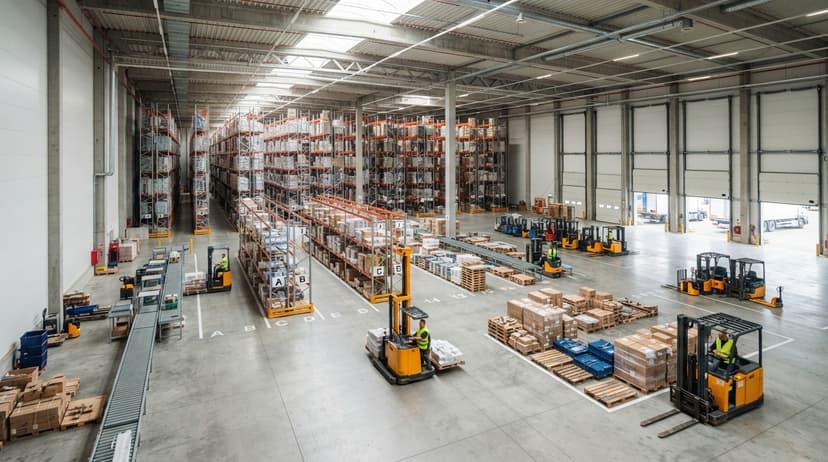
- Orders delayed or mis-picked because no one has one accurate view of stock
- Managers making reorder decisions from memory rather than data
If 3 people spend 10 hours a week each on manual reconciliation at $22 an hour, that is $34,320 a year in labor doing work a system should handle. The cost of the right software is almost always lower than the cost of the workaround.
How to replace spreadsheets with a custom inventory system is a practical question, not a theoretical one. The answer starts with knowing which warehouse type you run and what that type demands from a tracking system.
Custom software for wholesale distributors starts exactly here: a private warehouse or distribution center that has outgrown its tools and needs a system built around its actual SKUs, workflows, and compliance requirements, without a full ERP migration.
Frequently Asked Questions About Warehouse Types
What is the most common type of warehouse for small distributors? Small distributors most often run a private warehouse or a small distribution center.
Private warehouses give full control without shared space. As order volume grows, the distribution center model becomes more relevant because speed matters more than storage.
Is a fulfillment center the same as a warehouse? No. A fulfillment center focuses on picking, packing, and shipping individual orders, hundreds per day. A warehouse stores bulk stock for longer periods. The processes, staffing, and software needs are different.
Do I need different software for different warehouse types? Yes. The features that matter vary by type. Pick-and-pack tools matter most for fulfillment centers.
Compliance logs and lot tracking matter most for bonded and climate-controlled facilities. A system built for one type fits poorly in another.
Can a small warehouse operate like a smart warehouse without a large ERP? Yes. Incremental steps work well: start with barcode scanning at receiving, add automated reorder alerts, then build toward a live stock dashboard.
None of those steps require a full ERP. They require software built around your existing workflow, not the other way around.
Frequently asked questions
Frequently asked questions
What are the 10 types of warehouses?
The most commonly cited list runs to 7 types: private, public, bonded, climate-controlled, distribution center, fulfillment center, and smart warehouse.
Some sources extend this to 10 by adding cooperative warehouses (shared by a group of businesses), government warehouses (owned and operated by a public authority), and on-site or in-plant warehouses (attached directly to a manufacturing facility). The core 7 cover the vast majority of real-world operations.
What are the 7S of warehousing?
The 7S of warehousing is a framework used in warehouse planning. The 7 elements are: storage, space, staff, systems, safety, sustainability, and service. It is a planning tool, not a type classification. It helps managers audit whether a facility is set up well across all the dimensions that affect performance.
What are the 7 storage techniques?
The 7 common storage techniques used in warehouses are: bulk storage (floor stacking), pallet racking, shelving, mezzanine floors, mobile racking, drive-in racking, and automated storage and retrieval systems (AS/RS). The right technique depends on product size, turnover rate, and the space available in the facility.
What are the two main types of warehouses?
The two main types are private warehouses and public warehouses. A private warehouse is owned and run by the business that uses it.
A public warehouse is operated by a third party and rented out to multiple businesses. All other warehouse types, such as bonded, climate-controlled, and fulfillment centers, are variations built on top of this basic split.
What is a bonded warehouse and who uses it?
A bonded warehouse is a facility licensed by the government to store imported goods before customs duties are paid.
Importers use bonded warehouses to manage cash flow. They store goods, pay duties only when releasing stock for sale, and keep the rest in a compliant hold. Strict documentation and audit-ready inventory records are required at all times.
How is a fulfillment center different from a distribution center?
A distribution center ships bulk orders to retailers or other businesses, by the pallet. A fulfillment center ships individual orders directly to customers, hundreds or thousands per day.
The order size is smaller, the frequency is higher, and the accuracy demands are greater. Software built for a distribution center does not handle the pick-and-pack workflow a fulfillment center needs.
Which warehouse type needs inventory management software the most?
Fulfillment centers and distribution centers feel the pain fastest because order volume exposes every gap in real time. Bonded and climate-controlled warehouses need compliance-grade record keeping that manual systems cannot reliably provide.
Private warehouses outgrowing their accounting software also reach a breaking point quickly. In each case, the right software fits the warehouse type rather than forcing the operation to adapt to a generic tool.
What happens when your software does not match your warehouse type?
Staff start keeping parallel records in spreadsheets to fill the gaps. Stock counts get done on paper and reconciled hours later.
Orders get mis-picked because no one has a single accurate view of stock. These are not minor friction points. They are symptoms of a system mismatch, and they get more expensive as order volume grows.
What is the difference between a warehouse and a distribution center?
A warehouse stores goods, for weeks or months, and its work is measured in how well stock is kept and counted.
A distribution center moves goods through quickly, receiving in bulk and shipping out in smaller lots, and its work is measured in speed and order accuracy.
Many buildings do both, but the software each needs is different: storage control for one, throughput and routing for the other.
What are the main functions of a warehouse?
Receiving goods and checking them against the purchase order, putting them away to a recorded location, storing and counting them, picking them for orders, packing and shipping them, and handling returns.
Whatever the type of warehouse, from private to bonded to a fulfillment center, those functions are the same; the type changes which one is hardest and which rules apply.
What is a bonded warehouse used for?
Storing imported goods that have not yet cleared customs duty. Goods can sit in a bonded warehouse, be repackaged or re-exported, and duty is paid only when they are released into the domestic market, which helps cash flow and lets importers hold stock close to customers before the sale.
Because customs authorities audit them, bonded warehouses need exact, timestamped records of every movement.
Which type of warehouse is best for small businesses?
Most small businesses start in a private warehouse of their own, a single building or a unit they lease, because it gives them control over process and stock.
Businesses that ship mainly online use a third-party fulfillment center instead, paying per order rather than carrying a lease and staff.
The right choice depends on order volume, how much control the process needs, and whether the business wants to run a warehouse or just have one.
What is in a free first look?
A 30 minute call, your operation mapped, and a clear picture of what we would build. No obligation and nothing to install.
Book a callRelated guides
The rest of this guide, for the parts of the job this page does not cover.
Guides
Common questions
- What is B Type of Inventory in Warehouse Management
- What is Inventory Management and Its Types
- What is the Most Important Part of Warehouse Organization
- What Are the Benefits of Warehouse Management System
- What is the Point of Warehouse Management System
- What Are the 7s Rules in a Warehouse?
- What is Picking and Packing in a Warehouse?
- What Are the Top 5 Warehouse Management Systems?
- What is Asn in Warehouse Management System
- What is a Warehouse Management System
- What is the Best Warehouse Inventory Management System?
- What is a Warehouse Management System Used For
- What is the Difference Between Warehousing and Inventory Management
- What Does Receiving Mean in a Warehouse?
- What is the Most Popular Warehouse Management System?
- What Are the 5 Main Activities in a Warehouse?
- What is Warehousing Operations
- What is the Purpose of a Warehouse Management System
- What is a Warehouse Management System Pdf
- What is Warehouse Operation
- What Does Lpn Stand for in Warehousing
- What is a Simple Warehouse Management System?