

What Is a Bin Number in Inventory Management?
A bin number is a unique code assigned to a specific storage location inside a warehouse or distribution center. Think of it as a street address for a shelf slot. It tells your team exactly where a product lives, so they can find it without guessing. Bin numbers are the foundation of location-based inventory tracking, and every operation that picks more than a handful of orders each day benefits from using them.
We build it for your operation, and the first look is free
If you would rather not compare products, describe how your operation already works and we build the system around it.
No build cost. You see it running on your own process first, and the monthly subscription starts only once it is live.
Book a callWhat a Bin Actually Is
A bin is any defined storage slot. It can be a shelf section, a pallet position, a drawer, a cubby, or a marked zone on the floor. The bin number is the code your system uses to identify that slot. Bins are not always physical containers. A strip of tape on a shelf with a label is a bin. A painted square on the floor is a bin. What matters is that the location is defined, labeled, and recorded in your system. As GS1 notes in its barcode standards, consistent location codes are what make scan-based tracking reliable across a facility.
The bin is a location concept, not a box.
How Should a Bin Number Be Formatted?
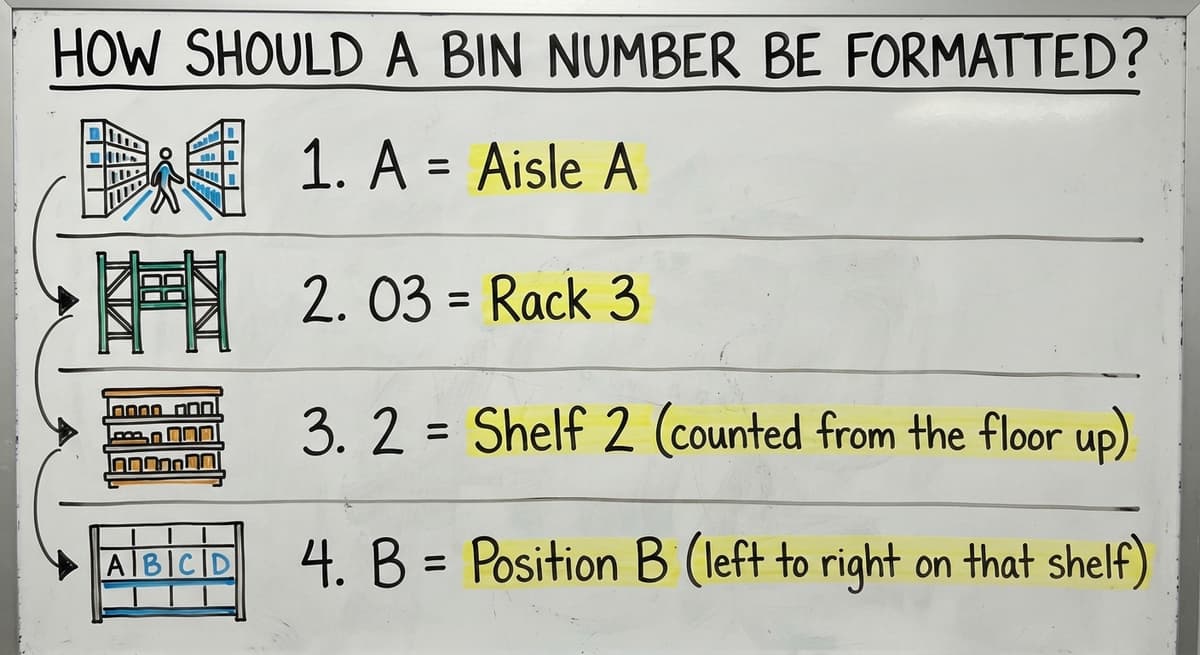
Most bin numbers combine aisle, rack, shelf, and position into a short code. A typical example: A-03-2-B means Aisle A, Rack 3, Shelf 2, Position B. Each segment narrows the location step by step. A picker reads left to right and walks straight to the spot.
Some operations add a zone prefix for buildings with multiple rooms or temperature areas. A cold-storage zone might start with C, making the full code C-A-03-2-B.
Here is a simple breakdown:
- A = Aisle A
- 03 = Rack 3
- 2 = Shelf 2 (counted from the floor up)
- B = Position B (left to right on that shelf)
The goal is a code short enough to read at a glance but specific enough to remove all guesswork. If your pickers have to think about what a code means, the format needs work.
Why Bin Numbers Matter for Inventory Accuracy
Without bin numbers, staff rely on memory or informal maps. That works for 2 people managing 50 products. It breaks down fast when the team grows or the product mix expands.
Bin numbers give the system location-level data, not just building-level data. That distinction is large. Knowing you have 40 units in the building is not the same as knowing 25 are in A-03-2-B and 15 are in overflow slot D-07-1-A.
The comparison is easier when one option is built for you
Off-the-shelf means fitting your process to the software. We do it the other way round, and the first look costs nothing.
Book a call
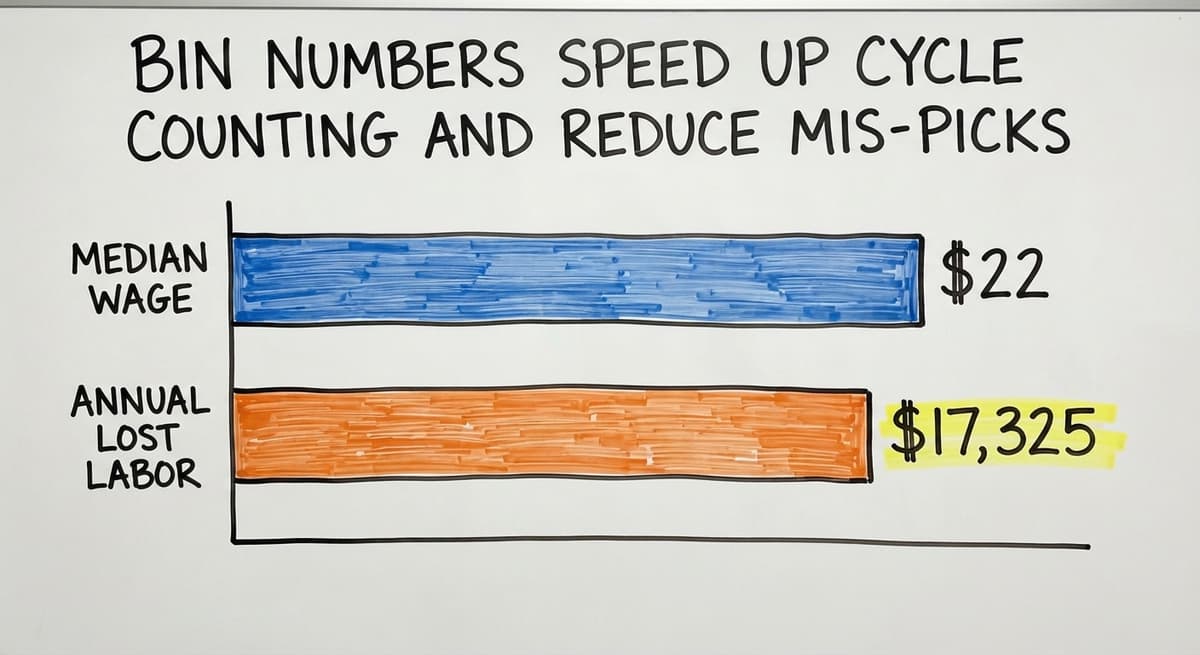
Bin Numbers Speed Up Cycle Counting and Reduce Mis-Picks
Accurate bin data speeds up cycle counting. A cycle count is a scheduled check of a specific subset of inventory rather than a full physical count. When bins are labeled and tracked, a counter checks one bin at a time rather than scanning the whole floor. The IRS is direct about why counts matter: IRS Publication 538 states, "To figure taxable income, you must value your inventory at the beginning and end of each tax year." Location data makes that valuation faster and more accurate.
Mis-picks drop when pickers follow a bin address instead of searching by memory. Fewer mis-picks mean fewer returns, fewer reships, and lower labor cost per order.
The Real Cost of Poor Location Tracking
Consider a small operation with 3 pickers each spending 45 minutes a day searching for product because bin data is missing or wrong. At a median warehouse worker wage of around $22 an hour, that is roughly $17,325 a year in lost labor on search time alone, before counting the cost of mis-picks and reships. The US Bureau of Labor Statistics publishes current wage data for stock clerks and order fillers if you want to run this with your actual pay rate.
Bin numbers turn location from a memory problem into a data problem, and data problems are solvable.
Bin Numbers vs. SKU Numbers
Bin numbers and SKU numbers are a common point of confusion. A SKU (stock keeping unit) identifies what a product is. A bin number identifies where it is stored. They are different dimensions of the same item record.
One SKU can live in multiple bins. A fast-moving product might have a forward-pick slot near the dock and an overflow slot deeper in the warehouse. Both bin numbers link to the same SKU in the system.
One bin can hold multiple SKUs, though this adds complexity. Mixed bins need careful scanning at pick time to make sure the right item leaves the right slot.
Both pieces of data must be linked in the inventory system for location tracking to work. A SKU record with no bin assignment is an item the system cannot find. A bin with no SKU assignment is dead space.
| Data Point | Answers | Example |
|---|---|---|
| SKU | What is it? | Widget-Blue-Large |
| Bin number | Where is it? | A-03-2-B |
| Quantity on hand | How many? | 25 units |
SKU and bin number work together. Neither replaces the other.

How Bin Numbers Work in Day-to-Day Operations
Bin numbers touch every step of the receive-store-pick-replenish cycle.
- Receiving: A shipment arrives. Staff scan the product and assign it a bin number in the system. The physical item goes to that bin.
- Putaway: The system confirms the bin assignment. If the bin is already full, the system flags an alternate location.
- Picking: An order drops. The system sends the picker a list that shows the bin number first, then the SKU and quantity. The picker goes straight to A-03-2-B without searching.
How Bin Numbers Support Replenishment and Cycle Counting
Replenishment and cycle counting both depend on current bin data.
- Replenishment: When a forward-pick bin runs low, the system triggers a replenishment task. A worker pulls stock from the overflow bin and updates the quantity in both locations.
- Cycle counting: A supervisor schedules a count of Aisle A. Staff count each bin in sequence and confirm quantities against the system record.
At every step, the bin number is the link between the physical item and the digital record. Remove it, and the chain breaks.
Pick accuracy and replenishment speed both depend on that link staying current.
See it running on your own process first
No build cost. The subscription starts once it is live and doing the job, not before.
Book a call
Setting Up a Bin Numbering System That Scales
Planning the format before you label anything is the most important step. Changing codes after labels are printed and staff are trained is disruptive and expensive.
Here is a practical setup checklist:
- Fix the segment order before day one. Aisle, rack, shelf, position is the most common sequence because it matches how people walk.
- Use a consistent character count per segment. Two digits for rack numbers (01, 02, not 1, 2) means codes sort correctly in any system.
- Leave gaps in the sequence. Number racks 02, 04, 06 instead of 01, 02, 03. When you add a rack between existing ones, it gets 03 without renaming anything downstream.
Mapping SKUs to Bin Locations for Pick Efficiency
Where a SKU lives inside the bin structure is as important as the structure itself.
- Map high-velocity SKUs to bins near the shipping dock. A picker who travels 20 fewer feet per pick saves real time across hundreds of daily picks.
- Use the same format across all zones. A cold zone and a dry zone should follow the same code structure with only the zone prefix changing.
The NIST Manufacturing Extension Partnership offers vendor-neutral guidance on supply chain process design, including location planning, for small and mid-size operations.
A bin numbering format that is consistent and gapped will serve the operation for years without a rebuild.
When Spreadsheets and Basic Accounting Software Are No Longer Enough
An accounting package tracks what you have and what it cost. It does not track where the item sits inside the building. That is not a criticism; financial software is built for financial records.
Spreadsheets can hold a bin map. Many operations start there. The problem is that a spreadsheet is a snapshot. The moment a worker moves stock without updating the file, the map is wrong. In a busy warehouse, that happens dozens of times a day.
Three Failure Points That Signal Manual Bin Tracking Has Broken Down
Operations that grow past a handful of SKUs or staff hit 3 specific failure points with manual bin tracking:
- Stale location data causes pickers to visit empty bins, then search for the stock that moved.
- No pick sequence logic means pickers criss-cross the floor instead of walking a straight path.
- No cycle count support means full physical counts, which take the operation offline for hours or days.
The US FTC's mail and internet order rule needs sellers to ship when promised or notify the customer. Accurate bin data is what lets you confirm stock is actually available before you commit to a ship date.
The spreadsheet does not break all at once. It degrades slowly until the errors cost more than the fix.
Not sure this is the right shape for your operation
Describe how the work runs today. We map it on a call and show you what it would look like built around that, before you spend anything.
Book a call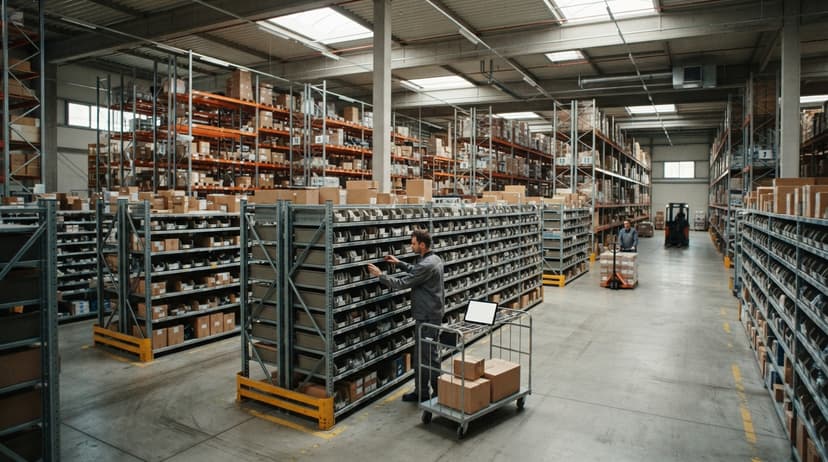
How Does Inventory Software Handle Bin Numbers in Daily Operations?
A purpose-built warehouse module enforces bin assignments at every step rather than relying on staff to update a file. That is the core difference. When a receiver scans a product, the system prompts for a bin before the record closes. When a picker gets a task, the bin number appears first on the screen or label. The system will not mark the pick complete until the correct bin is confirmed.
Such a system can sit alongside an accounting package rather than replacing it. The accounting package keeps the financials. The warehouse module owns the location data. The two sync on quantities and costs. That split avoids the cost and complexity of a full ERP while giving the operation real bin-level control.
Why a Custom Warehouse System Outperforms Generic Tools for Small Distributors
For distributors and fulfillment operations in the 5-to-100-staff range, a custom-built system aligned to the actual physical layout outperforms a generic off-the-shelf tool. Generic tools are built for an average warehouse. A system built around your aisle layout, your zone structure, and your pick sequence removes the workarounds that generic tools need.
Inventory management software for small distributors in this range should enforce bin assignments, guide picks in physical sequence, flag empty or overfull bins, and support cycle counting in a small warehouse without shutting down daily operations. How warehouse management works with your accounting software is a practical question worth asking before any buy, because the integration work out whether financial and location data stay in sync automatically or need manual matching.
The right system makes bin numbers work without adding a data-entry burden to every transaction.
Conclusion
A bin number is a location address. It tells your team, your system, and your pick list exactly where a product lives. Without it, you are managing inventory by memory, and memory fails as the operation grows.
The format matters. The planning matters. And the tool that records and enforces bin assignments matters most of all. If your current setup cannot track where stock is at the bin level, the errors you are seeing are not a training problem. They are a systems problem.
Is a Custom Warehouse System Right for Your Operation?
If you are weighing whether a custom warehouse system makes sense for your operation, start with a review of your current pick accuracy and the time your team spends searching for stock. Those two numbers will tell you what the gap costs. A connected growth platform that aligns your warehouse workflow to your actual layout can close that gap without the complexity of a full ERP replacement.
Frequently asked questions
What is a bin number in inventory management?
A bin number is a unique code that identifies a specific storage location inside a warehouse or distribution center. It works like a street address for a shelf slot, telling staff exactly where a product is stored so they can find it without searching.
What does a bin number look like and how is it formatted?
Most bin numbers combine aisle, rack, shelf, and position into a short code. For example, A-03-2-B means Aisle A, Rack 3, Shelf 2, Position B. Each segment narrows the location step by step. Operations with multiple zones often add a zone prefix at the start.
What is the difference between a bin number and a SKU number?
A SKU identifies what a product is. A bin number identifies where it is stored. One SKU can live in multiple bins, such as a forward-pick slot and an overflow slot. Both pieces of data must be linked in the inventory system for location tracking to work.
Why do warehouses use bin numbers instead of just knowing where things are?
Memory works for very small operations but fails as the team or product mix grows. Bin numbers give the system location-level data so any staff member can find any product without relying on a colleague who remembers where it was put last week.
How do bin numbers improve picking accuracy and speed?
When a pick list shows a bin number, the picker goes straight to the right slot without searching. Mis-picks drop because the picker is following a precise address rather than guessing. Pick sequence logic also lets the system route pickers through the warehouse in a straight path rather than back and forth.
How should a small warehouse set up a bin numbering system?
Decide on the segment order before printing any labels, use a consistent character count per segment so codes sort correctly, and leave gaps in the numbering sequence so you can add new bins without renaming existing ones. Place high-velocity SKUs in bins closest to the shipping dock to cut travel time.
When does managing bin numbers in a spreadsheet stop working?
Spreadsheets go stale the moment someone moves stock without updating the file. As the operation grows, stale location data causes pickers to visit empty bins, and there is no pick sequence logic or cycle count support. Most operations hit these limits well before they reach 10 staff or 200 active SKUs.
How does inventory software use bin numbers in daily warehouse operations?
A purpose-built warehouse module enforces bin assignments at receiving, displays the bin number first on every pick task, and will not mark a pick complete until the correct bin is confirmed. It can sync with an accounting package so financial and location data stay current without manual matching.
Start with a free first look
A 30 minute call, your operation mapped, and a clear picture of what we would build. No obligation and nothing to install.
Book a callRelated guides
The rest of this guide, for the parts of the job this page does not cover.
Guides
- Inventory Bin System
- Multi Location Inventory Management Software
- Inventory Management for Multiple Locations
- Inventory Management System for Manufacturing
- Inventory Management Pics
- B2b Inventory Management
- Jewelry Inventory Management
Common questions
- What is Inventory Management and Its Types
- What is the Main Purpose of Inventory Management
- What is Information Technology Inventory Management
- What is Risk Pooling in Inventory Management
- What is Stock Taking in Inventory Management
- What is Inventory Listing
- What is Inventory
- What Are Serial Numbers
- What is a Serial Number on a Product
- What Are the Numbers on a Barcode
- What Are Serial Numbers Used For
- What is the Best Warehouse Inventory Management System?
- What is the Difference Between Warehousing and Inventory Management
- What is B Type of Inventory in Warehouse Management
- What is Warehousing and Inventory Management
- What is the Best Inventory Management Software for Small Business
- What is the Best Inventory Management System for Small Businesses?