


Types Of Inventory Control
The main types of inventory control are periodic, perpetual, ABC analysis, just-in-time, safety stock with reorder points, FIFO, lot tracking, min-max, consignment, and cycle counting. Most small and mid-size distributors use a mix of several. This guide explains each method, shows how they fit together, and helps you pick the right combination for your operation.
Reviewed and updated: October 2026
Book a callWhat Inventory Control Actually Means
Inventory control is the day-to-day process of tracking what stock you have, where it sits, and when to order more. It is not the same as inventory management, which covers broader decisions like supplier strategy and demand planning. Control is the ground-level work: counts, records, and triggers. Get it wrong and you pay for it in overstock that ties up cash, stockouts that lose sales, and picking errors that damage customer trust. Every method in this guide is a way to get that ground-level work right.
We build it for your operation, and the first look is free
If you would rather not compare products, describe how your operation already works and we build the system around it.
No build cost. You see it running on your own process first, and the monthly subscription starts only once it is live.
Book a callWhy the Type of Control You Choose Matters
No 2 warehouses are the same. A 10-SKU operation shipping 50 orders a week has different needs than a 2,000-SKU distributor shipping 500. The wrong method creates more manual work, not less. Many small and mid-size distributors run a patchwork of methods without realizing it: a spreadsheet here, a QuickBooks report there, a whiteboard count in the corner. Choosing a method on purpose reduces errors and saves staff hours. GS1, the global standards body behind supply chain barcodes, notes that "barcodes are the most widely used technology for identifying products" in its barcode standards records, which points to why scan-based systems outperform manual logs at almost any volume.
Periodic Inventory Control
What Is Periodic Inventory Control, and Is It Right for Your Operation?
Periodic inventory control means stock counts happen at set intervals, such as weekly, monthly, or quarterly, rather than after every transaction. Between counts, you are working from the last known number. That is fine when SKU counts are low and order volume is manageable. Many small operations start here using spreadsheets or a simple log.
The cost to start is low. No scanning hardware, no software license. The tradeoff is blind spots. If a pallet of product walks out the door between counts, you will not know until the next scheduled tally. Those blind spots cause stockouts that surprise the team and overstock that quietly eats cash. Periodic control works best as a starting point, not a permanent solution.
Perpetual Inventory Control
Perpetual inventory control updates stock levels in real time with every transaction: every receipt, pick, shipment, and return. The system knows what you have right now, not what you had last Tuesday.
This approach needs barcode scanning, RFID readers, or software that connects to your order and receiving workflows. The upfront cost is higher than a spreadsheet. The payoff is that a manager can check any SKU at any moment without a physical count. For operations with high order volume or hundreds of SKUs, that real-time picture is not a luxury. It is the only way to keep fulfillment accurate.
How Perpetual Tracking Meets IRS Inventory Valuation Requirements
The IRS requires that inventory be valued at the start and end of each tax year, as stated in IRS Publication 538: "To figure taxable income, you must value your inventory at the beginning and end of each tax year." Perpetual tracking makes that obligation easier to meet without a scramble. Because every transaction posts in real time, the numbers needed for valuation are already current rather than reconstructed from memory or a rushed physical count.
Periodic vs. Perpetual: A Quick Comparison
Choosing between these 2 methods comes down to volume, SKU count, and how much a mistake costs you.
| Factor | Periodic | Perpetual |
|---|---|---|
| Cost to start | Low | Moderate to high |
| Accuracy between counts | Low | High |
| Staff effort | High at count time | Spread across daily workflow |
| Technology needed | Spreadsheet or log | Scanning hardware and software |
| Best fit | Low SKU count, low volume | High volume, many SKUs |
Many small distributors start periodic and outgrow it without noticing the switch is needed. The signal is usually a run of stockout surprises or a reconciliation that takes the team 2 full days. When counts start costing more in staff time than the software would, perpetual tracking pays for itself.
ABC Analysis Inventory Control
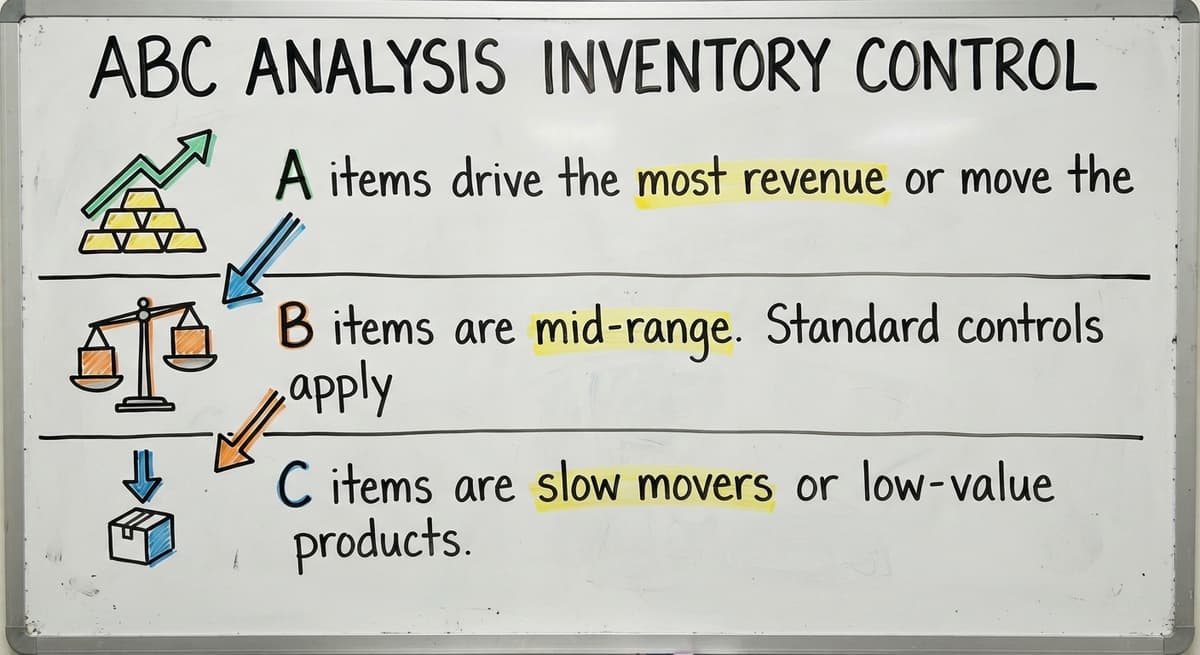
ABC analysis is a ranking method, not a tracking system. It sorts your SKUs into 3 tiers based on value or sales velocity.
- A items drive the most revenue or move the fastest. They get tight control: frequent counts, prime storage locations, close watch on reorder points.
- B items are mid-range. Standard controls apply.
- C items are slow movers or low-value products. Looser control is acceptable because the cost of a mistake is smaller.
ABC analysis works alongside either periodic or perpetual tracking. It tells you where to spend staff attention, not how to track. A warehouse running 1,500 SKUs cannot give every product equal focus. Sorting by ABC lets the team protect what matters most. Pair it with cycle counting (covered below) and you get a system where your highest-value stock gets verified most often. The goal is proportional effort: more control where the stakes are higher.
The comparison is easier when one option is built for you
Off-the-shelf means fitting your process to the software. We do it the other way round, and the first look costs nothing.
Book a callJust-in-Time Inventory Control
Just-in-time, or JIT, means stock arrives close to when it is needed rather than sitting in the warehouse for weeks. The appeal is real: lower carrying costs and more usable floor space.
JIT needs 2 things your operation must already have before it makes sense: reliable suppliers who hit delivery windows consistently, and demand forecasting accurate enough to know what you will need and when. Miss either one and a supplier delay leaves you with nothing to ship. For distributors who carry a wide mix of SKUs from multiple vendors, JIT works well on fast-moving, predictable items and poorly on anything with an unreliable lead time. Use JIT selectively, not as a blanket policy, and always keep a backup plan for your highest-risk SKUs.
Safety Stock and Reorder Point Control
Safety stock is the buffer you keep on hand to absorb demand spikes or supplier delays. It is not dead inventory. It is insurance. A reorder point is the stock level at which your system triggers a buy order automatically, before you hit zero.
These 2 rules work together inside a perpetual tracking system. The reorder point sits above zero by the amount of safety stock you need. To set a reorder point, multiply your average daily usage by your supplier lead time in days, then add your safety stock.

How to Calculate a Reorder Point and Why It Protects Shipping Commitments
For example: if you sell 20 units a day, your supplier takes 5 days to deliver, and you want 50 units of buffer, your reorder point is (20 × 5) + 50 = 150 units. When stock hits 150, the system flags a buy order. Staff do not have to watch the number manually. Built into software, this combination prevents stockouts without the overstock that comes from ordering by gut feel.
The US Federal Trade Commission's Mail, Internet, or Telephone Order Merchandise Rule needs sellers to ship within the time promised. Accurate reorder points are one of the clearest ways to protect that commitment.
FIFO and LIFO: Which Method Should You Use in a Warehouse?
FIFO, first in first out, means the first product received is the first picked and shipped. The oldest stock moves first. FIFO is the right choice for nearly every wholesale and fulfillment operation because it prevents product from aging on the shelf and reduces spoilage or expiration risk.
LIFO, last in first out, means the most recently received product ships first. It is rarely used in physical distribution because it leaves older stock sitting indefinitely. LIFO has some accounting uses, but it creates real warehouse problems when products have shelf lives or when customers expect consistent lot quality.
Connecting FIFO and LIFO to Your Accounting and Picking Workflow
Both methods affect your accounting as well as your warehouse process. IRS Publication 538 covers inventory valuation requirements that apply to both. QuickBooks supports both FIFO and LIFO for cost accounting, but enforcing the physical pick sequence on the warehouse floor needs a system that connects the software to the picking workflow. Without that connection, staff may pick whatever is closest regardless of what the books say.
Batch and Lot Tracking Control
Batch or lot tracking groups inventory by production run, supplier batch, or expiration date. Every unit received gets tagged with a lot number. That number follows the product through receiving, storage, picking, and shipping.

This method is required in food distribution, pharmaceuticals, and any regulated product category. When a quality issue or recall hits, lot tracking lets you pull every affected unit without touching unrelated stock. Without it, a recall means pulling everything and hoping.
Lot tracking needs software that can attach lot data to every transaction record. A spreadsheet cannot do this reliably at any real volume. The NIST Manufacturing Extension Partnership provides vendor-neutral guidance on supply chain traceability, including the role lot data plays in protecting both the business and the end customer. If your products carry expiration dates or come from regulated supply chains, lot tracking is not optional.
See it running on your own process first
No build cost. The subscription starts once it is live and doing the job, not before.
Book a callMin-Max Inventory Control
Min-max sets a floor and a ceiling for each SKU. When stock drops to the minimum, the system triggers a reorder. The order brings stock back up to the maximum. Simple to explain, simple to run.
This method works best for stable SKUs with predictable demand and consistent lead times. If a product sells erratically or your supplier lead time varies widely, the min and max levels become hard to set correctly and will need frequent adjustment.
Min-max can live in a basic spreadsheet for a handful of SKUs. It can also be automated in custom software so reorder triggers fire without anyone checking a cell. The value of automating here is that the rule runs even when the person who set it is on vacation. For small distributors with lean teams, that reliability matters more than the sophistication of the method.
Consignment Inventory Control
Consignment means the supplier retains ownership of the goods until you sell or use them. You hold the stock, but it does not appear on your books as an asset until the sale happens. The appeal is cash flow: you are not tying up money in product you have not moved yet.
The tradeoff is tracking complexity. You need clear records of what arrived, what sold, and what is still supplier-owned at any point in time. Without those records, matching disputes with suppliers become expensive and time-consuming. Consignment is common in certain wholesale niches, including some medical supply and specialty distribution channels. If you run consignment stock alongside owned inventory, your system must keep the 2 pools separate or the accounting breaks down quickly.

Cycle Counting as a Control Method
Cycle counting means counting a rotating subset of SKUs on a regular schedule rather than shutting the warehouse down for a full physical count. A team might count 50 SKUs on Monday, a different 50 on Wednesday, and so on through the year.
This approach spreads the counting workload evenly and catches errors faster than an annual count. Pair it with ABC analysis and the A items get counted most often, perhaps weekly, while C items rotate in less frequently.
The US Census Bureau's Monthly Wholesale Trade data tracks inventory-to-sales ratios across wholesale sectors, and operations with tighter ratios tend to run more frequent cycle counts rather than relying on annual matching. Cycle counting keeps accuracy high without the disruption of a full shutdown, which is why it has largely replaced the annual physical count in well-run distribution operations.
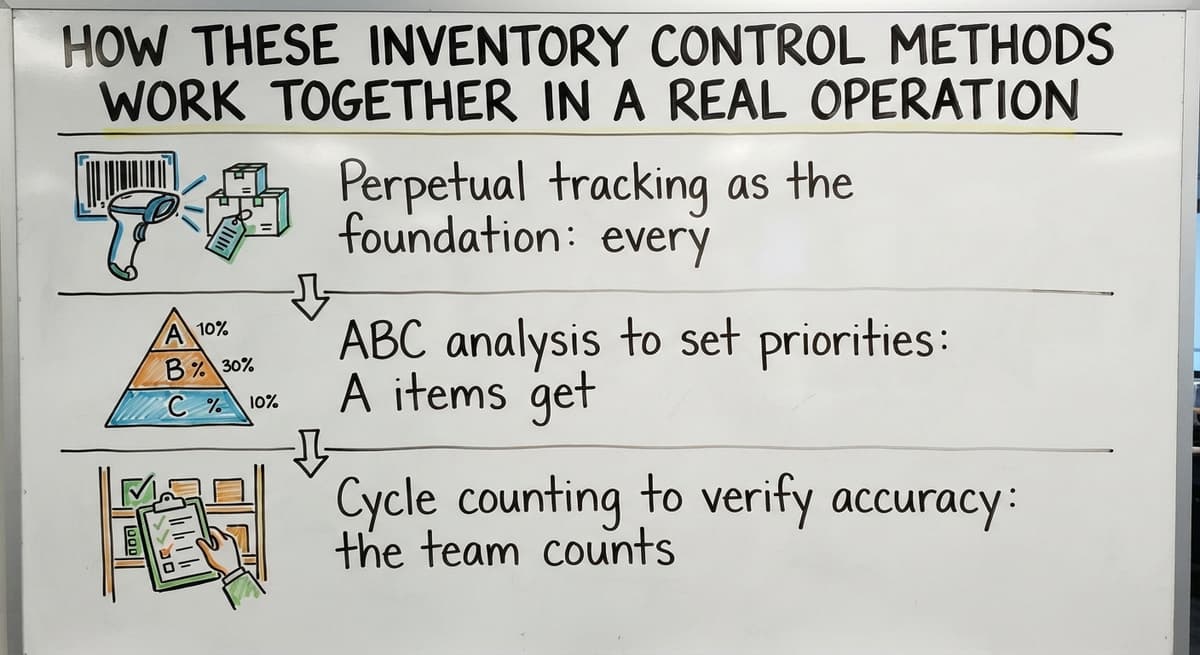
How These Inventory Control Methods Work Together in a Real Operation
No single method covers everything. The operations that run cleanly use a combination, and the combination is usually built around 1 backbone system with supporting rules layered on top.
A practical example for a mid-size wholesale distributor might look like this:
- Perpetual tracking as the foundation: every receipt, pick, and shipment updates stock in real time.
- ABC analysis to set priorities: A items get tighter reorder points and more frequent cycle counts.
- Cycle counting to verify accuracy: the team counts a rotating set of SKUs each week without stopping operations.
Completing the Stack: Reorder Points, FIFO, and Lot Tracking
- Reorder points and safety stock to automate purchasing: the system flags a buy order when stock hits the trigger level.
- FIFO pick sequence enforced at the shelf level so the oldest stock always moves first.
- Lot tracking applied to any SKU with an expiration date or a regulated supply chain.
The goal is a system where the right data is available without extra manual steps. Custom software can enforce whichever combination fits your operation, connecting the warehouse floor to your accounting records without forcing a process overhaul. The combination that works is the one your team will actually use every day.

Why Does QuickBooks Alone Fall Short for Warehouse Inventory Control?
QuickBooks handles accounting well, but it was not built for real-time warehouse tracking, and that gap costs money. The problem is not QuickBooks itself. The problem is asking it to do a job it was not designed for.
QuickBooks records what was invoiced and what was received on a bill. It does not track where a pallet is in the warehouse, which lot number is in bin 14, or whether the picker grabbed the right SKU. As SKU counts grow and order volume rises, the distance between what QuickBooks shows and what the warehouse floor holds gets wider.
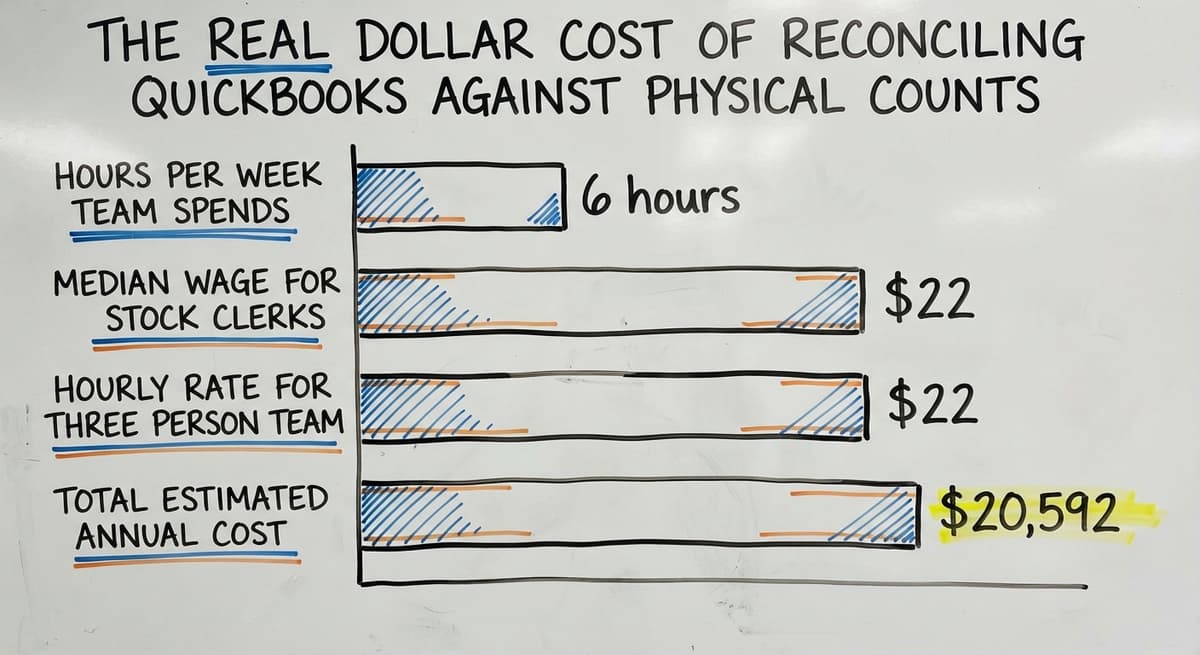
The Real Dollar Cost of Reconciling QuickBooks Against Physical Counts
Consider a lean team of 3 people spending 6 hours a week reconciling QuickBooks records against physical counts. At the median wage for stock clerks and order fillers, around $22 an hour according to Bureau of Labor Statistics occupational data, that is 3 × 6 × 52 × $22 = $20,592 a year in labor spent closing a gap that better software would remove. Signs you have outgrown Excel for inventory tracking often show up at the same time as QuickBooks matching problems.
Not sure this is the right shape for your operation
Describe how the work runs today. We map it on a call and show you what it would look like built around that, before you spend anything.
Book a callSigns Your Current Inventory Control Method Is Breaking Down
Operations rarely fail all at once. The breakdown shows up in small, repeated friction before it becomes a crisis. Watch for these patterns:
- Stockouts that surprise the team: a product runs out before anyone expected it to, and the answer is always "we thought we had more."
- Reconciliation that eats staff hours: comparing QuickBooks records to a physical count takes a day or more, and the numbers still do not match cleanly.

More Warning Signs That You Have Outgrown Your Inventory Method
- Shipping errors from bad pick data: pickers pull from stock that the system says exists but the shelf says does not.
- No fast answer to a basic question: if someone asks how much of SKU X you have right now and the honest answer is "let me go check," the system is not doing its job.
When any 2 of these show up together, the current method has been outgrown. The fix is not working harder inside the broken system. It is choosing a method that matches the current scale of the operation.
Choosing the Right Type of Inventory Control for Your Operation
Matching the method to your operation is more useful than chasing the most sophisticated option. Four factors drive the decision:
- SKU count: under 100 SKUs, periodic or min-max may be enough. Over 500, perpetual tracking becomes necessary.
- Order volume: high daily order counts demand real-time data. Low volume gives you more tolerance for periodic gaps.
- Product type: perishables, regulated goods, or high-value items need lot tracking and tighter cycle counts.
- Staff capacity: a 3-person team cannot run the same system as a 30-person warehouse. The method has to fit the people available.
How to Start Improving Inventory Control Without Overbuilding
Start with the method that solves the most painful current problem. If stockouts are the issue, set reorder points and safety stock first. If matching is eating hours, move toward perpetual tracking. Avoid building a system so complex that the team routes around it.
Inventory management software for small distributors ranges from add-on QuickBooks modules to full custom builds. The right tool is the one shaped around the workflow already in place, not the one that forces the team to change how they work to fit the software.

How Custom Software Supports Any Inventory Control Method
Custom software does not replace what already works. It fills the gaps that off-the-shelf tools leave open.
For most small and mid-size distributors, that means keeping QuickBooks in place for accounting while replacing the manual steps between the warehouse floor and the books. QuickBooks integration for warehouse operations can be built so that picks, receipts, and adjustments post automatically, without a staff member re-entering data in 2 systems.
What a Well-Built Custom Warehouse System Actually Does
Custom warehouse software built around your workflow can enforce FIFO pick sequences, trigger reorder points, attach lot numbers at receiving, and run cycle count schedules without a separate app for each function. How wholesale distributors automate reorder points is one of the most common questions small teams ask, and the answer is almost always a connected system rather than a new manual process.
No large ERP is required. No 18-month rollout. A team that understands your operation builds the tool to match it, so the learning curve is short and the adoption rate is high. The measure of a good custom build is that the team uses it without being reminded to.
Next Steps for Improving Inventory Control
Start with an honest audit of what you have now. Ask 3 questions:
- Which parts of the current process work without problems?
- Where do errors happen most often, and what causes them?
- Which tasks are purely manual and could be handled by a rule or a trigger?
Identify the 1 or 2 biggest pain points and solve those first. A phased approach keeps the business running while the new system is built and tested. You do not have to switch everything at once.
Talk to a team that builds around existing operations rather than selling a platform that needs you to adapt to it. The right starting point is a conversation about your actual workflow, not a software demo.
Frequently asked questions
What are the main types of inventory control?
The main types are periodic, perpetual, ABC analysis, just-in-time, safety stock with reorder points, FIFO, lot tracking, min-max, consignment, and cycle counting. Most operations use a combination rather than a single method.
When should a small distributor switch from periodic to perpetual inventory tracking?
Switch when stockouts start surprising the team, when matching takes more than a few hours, or when shipping errors from bad pick data become a pattern. If staff are spending more time on manual counts than a software system would cost, perpetual tracking pays for itself.
What is cycle counting and why is it better than an annual physical count?
Cycle counting means counting a rotating subset of SKUs on a regular schedule throughout the year instead of stopping operations for one full count. It catches errors faster, spreads the workload evenly, and avoids the disruption of a full warehouse shutdown.
What is safety stock and how is a reorder point calculated?
Safety stock is the buffer kept on hand to absorb demand spikes or supplier delays. A reorder point is calculated by multiplying average daily usage by supplier lead time in days, then adding the safety stock amount. For example, 20 units per day times a 5-day lead time plus 50 units of safety stock equals a reorder point of 150 units.
What is the difference between periodic and perpetual inventory control?
Periodic control counts stock at set intervals, so accuracy is only guaranteed right after a count. Perpetual control updates stock levels in real time with every transaction, giving an accurate picture at any moment. Periodic is lower cost to start; perpetual is more accurate and scales better with volume.
What is lot tracking and which operations need it?
Lot tracking groups inventory by production run, supplier batch, or expiration date and follows that group through every step from receiving to shipping. It is required for food distribution, pharmaceuticals, and any regulated product category where a recall or quality issue must be traced to a specific batch without pulling all stock.
Can custom software support my existing inventory control process without replacing QuickBooks?
Yes. Custom software can be built to handle real-time warehouse tracking, lot numbers, reorder triggers, and pick sequences while keeping QuickBooks in place for accounting. Transactions post automatically so staff do not re-enter data in 2 systems, and the accounting records stay accurate without manual matching.
How do I know which inventory control method is right for my operation?
Match the method to your SKU count, daily order volume, product type, and team size. Start by solving the most painful current problem: if stockouts are the issue, set reorder points first; if matching is eating hours, move toward perpetual tracking. Avoid building a system more complex than the team can operate consistently.
Start with a free first look
A 30 minute call, your operation mapped, and a clear picture of what we would build. No obligation and nothing to install.
Book a callRelated guides
The rest of this guide, for the parts of the job this page does not cover.
Guides
- Types of Stock Control Systems
- 7 Types of Inventory
- Inventory Control Software for Small Business
- Inventory Control with Excel
- Inventory Control for Small Business
- Warehouse Management System Types
- Classification of Inventory
- Excess Inventory
- Closed for Inventory
- Multi Location Inventory Management Software
- Ms Excel Inventory Template
- Inventory Management for Multiple Locations
- Costing Inventory
- Is Inventory a Long-term Asset
- Inventory Management System for Manufacturing
- Inventory Fixed Assets
- Inventory Management Pics
- Inventory Monitoring
- Excel Inventory Template
- Push and Pull Inventory