

Automotive Inventory Management Systems
Automotive inventory management systems track parts, bins and orders. Learn the features, QuickBooks fit, and when custom beats packaged for 5 to 100 staff.
Book a callWhat Are Automotive Inventory Management Systems?
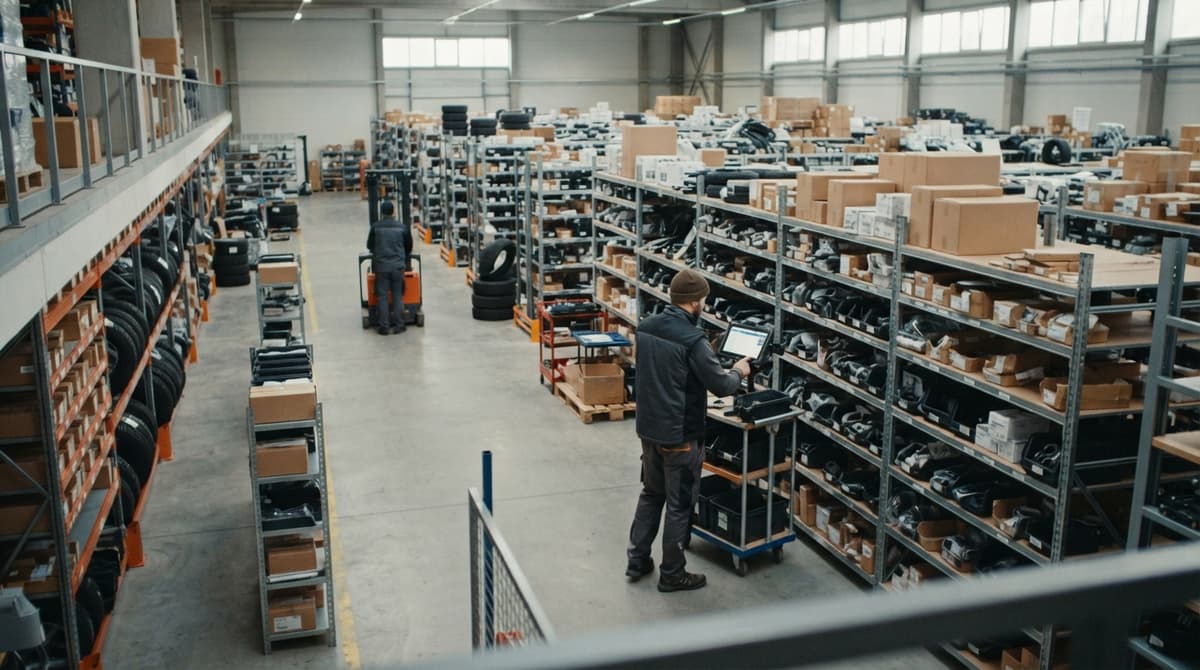
Automotive inventory management systems are software that tracks car and truck parts, tires, fluids and accessories. They record each item as it comes in, sits on a shelf and goes out. Reviewed November 2026. Owners who run on Excel, QuickBooks and paper will find the plainest path here.
We build it for your operation, and the first look is free
If you would rather not compare products, describe how your operation already works and we build the system around it.
No build cost. You see it running on your own process first, and the monthly subscription starts only once it is live.
Book a callWhy Automotive Inventory Is Harder to Track Than Most
Auto parts inventory is hard because of volume and look-alikes. A single shop can stock thousands of SKUs. A SKU is one unique item code. Many are small and look the same. One part comes in many brands and grades. One part can also fit dozens of vehicles. GS1 sets the barcode "standards" that let a scan mean the same thing everywhere, as shown at GS1 barcodes. Clean item data is the base for every count that follows.
What Does an Automotive Inventory System Need to Track?
A good system needs to track five core records: part numbers, quantities, locations, costs and suppliers. Keep the list short. Each record must link to the others. The two groups below show where distributors lose the most time.
Part Numbers, Cross-References and Vehicle Fitment
One part can carry an OEM number, an aftermarket number and a supplier number. OEM means the maker of the original part. A cross-reference table links all of them to one record. That stops duplicate records. Staff can then find a part by any number they know.
Fitment is the make, model, year and engine a part fits. Good vehicle fitment data sits on the part record as a list of vehicles. Wrong fitment drives returns. A buyer who gets a brake pad for the wrong trim sends it back, and you pay the freight twice.
Bin Locations, Counts, Cores and Returns
Bin locations are shelf and bin labels such as A-04-2. They cut pick time. A wrong label creates phantom stock, which is stock the system shows but the shelf lacks. Cycle counting fixes this. Staff count a few items each week instead of shutting down for a full count.
A core charge is a fee added to a sale until the buyer returns the old part. Returns and warranty claims need a trail back to the first sale. Spreadsheets lose that link. A system keeps the core, the return and the claim on one order record.
Core Features of Automotive Inventory Management Software
The right automotive inventory management software has a short list of must-haves. Each one should work from day one.
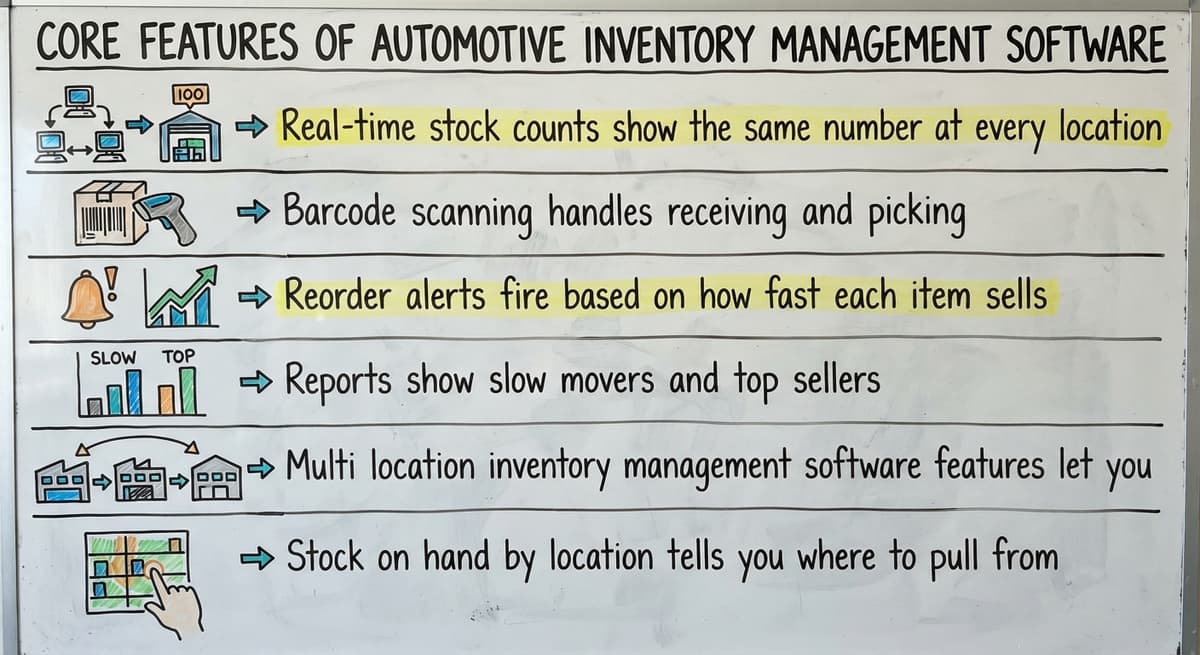
- Real-time stock counts show the same number at every location.
- Barcode scanning handles receiving and picking.
- Reorder alerts fire based on how fast each item sells.
- Reports show slow movers and top sellers.
- Multi location inventory management software features let you move stock between sites with a full record.
Reports matter only when an owner acts on them:
- Stock on hand by location tells you where to pull from.
- Inventory value tells you what cash sits on shelves. The IRS says in Publication 538 that "To figure taxable income, you must value your inventory at the beginning and end of each tax year."
- A slow-mover list tells you what to discount.
- Supplier delivery reports tell you who to drop.
Not sure this is the right shape for your operation
Describe how the work runs today. We map it on a call and show you what it would look like built around that, before you spend anything.
Book a callHow Does Barcode Scanning Cut Errors?
Barcode scanning inventory tools cut errors because a scan replaces a hand-typed part number. A person can mistype a 10-digit code. A scanner cannot. Staff pick the right part more often. Wrong shipments drop. Handheld scanners work well on the floor. Rugged phones work too, and cost less to buy. The takeaway: scan every item at every step.
How Reorder Points Prevent Stockouts and Overstock
A reorder point is the stock level that triggers a new order. Set it from daily sales and supplier lead time. If you sell 6 filters a day and the supplier takes 5 days, order when 30 remain. Add a buffer for slow suppliers.
Seasons move the number. Batteries sell fast in winter. Tires sell fast in spring. Update points before each swing. Parts that rarely sell tie up cash. Lower their points so they stop refilling.

How Do Receiving, Picking and Shipping Work in a Good System?
Picking improves next. Staff get digital pick lists sorted by bin location. They scan each item before it is packed. Shipping details flow back to the order record. The customer and your office both see the status without a phone call.
A good system matches each shipment to a buy order at the dock. Staff scan items and assign bins on the spot. The system flags shortages and damage right away, so you can claim them from the supplier the same day.
Signs Your Spreadsheets Have Hit Their Limit
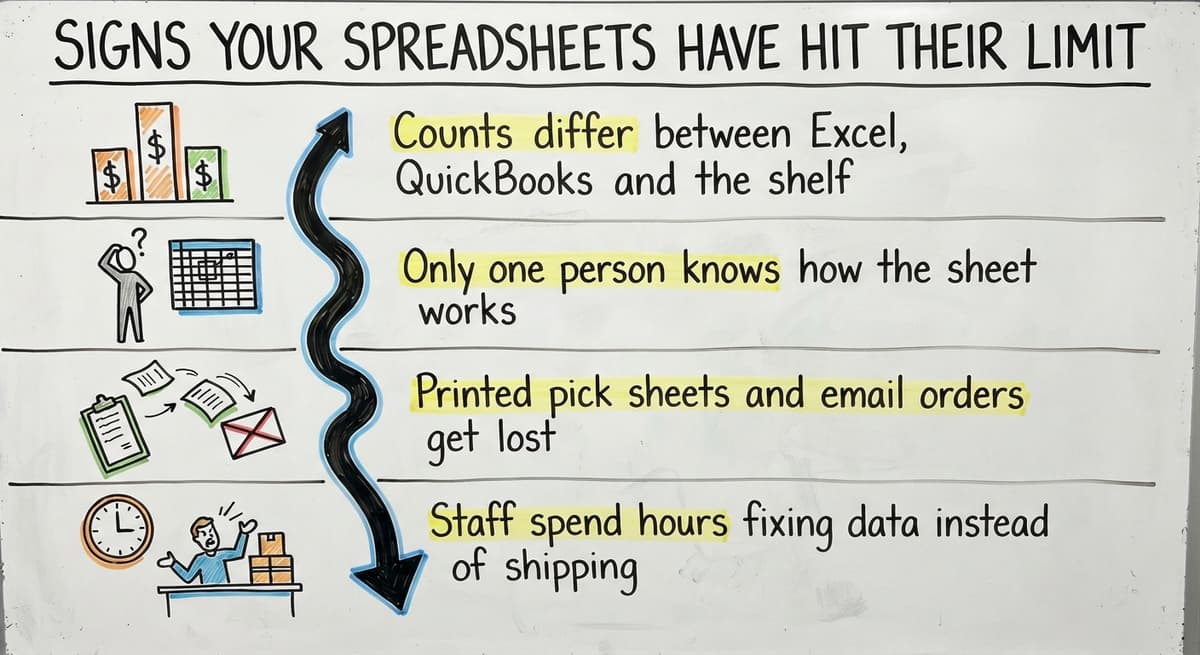
Spreadsheets fail when the work outgrows one person. Check your shop against this list:
- Counts differ between Excel, QuickBooks and the shelf.
- Only one person knows how the sheet works.
- Printed pick sheets and email orders get lost.
- Staff spend hours fixing data instead of shipping.
Put a price on it. Say 3 people spend 6 hours a week at $22 an hour on fixes. That is $20,592 a year. The Bureau of Labor Statistics tracks pay for this work. Two or more checks means it is time to move.
Off-the-Shelf, Custom or Big ERP?
Packaged tools start fast. You sign up and load data. The cost is that you change how you work to fit the tool. Custom inventory management software is built around your current process. It takes longer to start. It fits when your workflow is unusual, such as odd core rules or special bin schemes. Packaged fits when your process is standard and your needs are simple.
Most 5 to 100 person operations do not need a big ERP, which is a large suite that runs every part of a company. Big systems mean long, costly setups. A smaller warehouse inventory management system can replace only the manual parts. The takeaway: buy the smallest tool that solves your real pain.
The comparison is easier when one option is built for you
Off-the-shelf means fitting your process to the software. We do it the other way round, and the first look costs nothing.
Book a call
Keeping QuickBooks in the Picture
QuickBooks stays for accounting, where it works well. The inventory system handles stock, locations and orders. Data syncs between the two, so staff stop entering things twice. That is QuickBooks inventory integration in plain terms. Some owners search for quickbooks inventory management software to do it all. QuickBooks alone has no bin tracking. You replace only the manual parts and keep the rest.
What a Custom Build Looks Like Step by Step
A custom build follows four plain steps, and none needs a fixed deadline or price up front.
- Walk through how your team does the work today.
- Pick the most painful manual task, such as receiving.
- Build that piece and test it with your staff.
- Add the next piece once the first one works.
Staff see each change early. Problems show up while they are small. The takeaway: small steps beat one big launch.
Questions to Ask Before You Choose and Mistakes to Avoid
Ask these questions of any vendor:
- Will it fit how we already work?
- Does it connect to QuickBooks?
- Can staff use it with little training?
- Who supports it after launch?
Four mistakes show up again and again. Teams move all data at once with no cleanup. They skip staff input. They buy features nobody will use. They expect a tool to fix a broken process. Clean the data and fix the process first. Then pick the tool.

Can a Parts Distributor Move Off Spreadsheets?
Yes. Here is a hypothetical example, not a client result. A 20-person distributor tracks stock in Excel and orders by email. First, it cleans its part list and adds cross-references. Next, it labels bins and starts scanning at the dock. Then it syncs orders to QuickBooks. Staff stop retyping orders. Counts match the shelf more often. The shop changes one step at a time.
Next Steps for Your Warehouse
Start with a list of your pain points. Pick one process to fix first, such as receiving or picking. The Columbus, Ohio team at The Software Society builds software, your website and your search presence as one team. Talk with us about your warehouse and what to replace first. A short chat costs nothing and shows whether we fit.
Frequently asked questions
What are automotive inventory management systems?
Automotive inventory management systems are software that tracks car and truck parts, tires, fluids and accessories. They record items as they arrive, sit on shelves and ship out. Distributors use them to keep counts right and orders on time.
Why is auto parts inventory harder to manage than other stock?
Auto parts come in huge SKU counts with many look-alike items. Each part has many brands and grades. One part can fit dozens of vehicles. Fitment errors and duplicate part numbers make tracking harder than most stock.
How does barcode scanning reduce errors?
Scanning replaces hand-typed part numbers. A scanner reads the code the same way every time. Staff pick the right part more often, and wrong shipments drop. Handheld scanners and rugged phones both work.
How do you handle core charges and returns?
Record the core charge on the original sale. When the old part comes back, link the return to that order and credit the core. A system keeps warranty claims on the same record, so staff can trace each one.
Can an inventory system work with QuickBooks?
Yes. The system handles stock, bins and orders. It syncs sales, costs and values to QuickBooks. Staff stop entering data twice, and QuickBooks stays in charge of accounting.
Do small distributors need a full ERP?
No. Most operations with 5 to 100 staff do not. Large systems mean long, costly setups. A smaller system can replace only the manual parts, such as receiving, picking and stock counts.
When is custom software a better fit than packaged software?
Custom software fits when your process is unusual, such as special core rules or bin schemes. Packaged software fits when your process is standard. Custom builds around how you work now. Packaged tools ask you to change.
What does automotive inventory software cost?
Cost depends on staff count, locations, SKU count and how many tools must connect. A short business review can scope the work and give a clear range for your shop.
Start with a free first look
A 30 minute call, your operation mapped, and a clear picture of what we would build. No obligation and nothing to install.
Book a callRelated guides
More on the same work.
Guides
- Inventory Management System for Manufacturing
- Automated Inventory Management System
- Web Based Inventory Management System
- Best Inventory Management System
- Cloud Based Inventory Management Systems
- Hospital Stock Management System
- Medical Stock Management System
- Inventory Bin System
- Manual Inventory System
- System Inventory
- Perpetual Inventory System
- Periodic Inventory Systems
- Best Inventory Tracking Systems
- Cloud Inventory System
- Multi Location Inventory Management Software
- Inventory Management for Multiple Locations
Common questions
- What is Kanban System of Inventory Management
- What is Online Inventory Management System
- What is Sales and Inventory Management System
- What is Rol in Inventory Management System
- What is Inventory Management System Project
- What is the Use of Inventory Management System
- What is the Difference Between Aggregate and Item Inventory Management
- What is Jit Inventory Management