

What Is Rol In Inventory Management System
Reviewed: October 2026
ROL stands for Reorder Level, also called Reorder Point. It is the stock quantity at which you place a new buy order. When on-hand inventory drops to the ROL, the system triggers a replenishment action before you run out. That single trigger is what keeps shelves stocked without tying up extra cash in excess inventory.
Book a callWhat ROL Means in an Inventory Management System
The reorder level is the minimum stock quantity that signals it is time to buy more. Think of it as a line drawn on the shelf. When stock falls to that line, the buy order goes out. The goal is to have new stock arrive before the shelf empties, but not so early that you are storing product you do not yet need.
ROL sits at the center of any stock replenishment plan. It replaces gut feel with a number the whole team can act on, and it gives your inventory management system a clear trigger point to work from.
Setting ROL correctly is the first step toward automating your reorder process.
We build it for your operation, and the first look is free
If you would rather not compare products, describe how your operation already works and we build the system around it.
No build cost. You see it running on your own process first, and the monthly subscription starts only once it is live.
Book a callWhy ROL Matters for Wholesale and Distribution Operations
Stockouts delay shipments and damage customer trust. The US Federal Trade Commission notes that sellers must ship on time or notify the customer, under the Mail, Internet, or Telephone Order Merchandise Rule. An accurate reorder level is one of the simplest ways to protect that obligation.
Overstocking creates a different problem. Carrying costs, warehouse space, and tied-up cash all climb when inventory sits too long. The US Census Bureau tracks the inventories-to-sales ratio for wholesale firms, and that ratio rises quickly when reorder points are set too high.
For a lean distribution team, a missed reorder can cascade into missed orders and lost accounts. ROL is the balance point between those 2 risks, and getting it right costs nothing but a little math.
How Do You Calculate the Reorder Level for an Inventory Item?
The baseline inventory reorder formula is: ROL = Average Daily Usage × Lead Time (in days). Average daily usage is how many units you sell or ship each day. Lead time is how many days your supplier takes to deliver after you place the order.

Here is a simple example. You sell 20 units a day. Your supplier takes 5 days to deliver. Your ROL is 20 × 5 = 100 units. When stock hits 100, you order more.
That baseline formula works when demand and delivery are steady. Most operations are not that predictable, which is why safety stock gets added on top.
Adding Safety Stock to Your Reorder Level
Safety stock is a buffer for demand spikes or late supplier deliveries. The full formula is: ROL = (Average Daily Usage × Lead Time) + Safety Stock.
A practical way to estimate safety stock: subtract your average daily usage from your maximum daily usage, then multiply by lead time. If you average 20 units a day but sometimes ship 30, the difference is 10. Multiply 10 by a 5-day lead time and you get 50 units of safety stock.
Full ROL in that case: (20 × 5) + 50 = 150 units. Enter 150 into your system as the buy order trigger for that item. You now have a number that accounts for real-world variability, not just the average day.
The comparison is easier when one option is built for you
Off-the-shelf means fitting your process to the software. We do it the other way round, and the first look costs nothing.
Book a call
How Inventory Management Software Uses ROL to Automate Replenishment
A properly set up system monitors stock levels continuously against each item's ROL. When stock hits the trigger point, the system flags the item, drafts a buy order, or sends an alert to the buyer. No one has to remember to check.
This replaces the spreadsheet checks and sticky-note reminders that small operations rely on. GS1, the global standards body behind barcode and supply chain data, notes that scan-based counting depends on consistent item spotting: "barcodes are the most widely used automatic spotting technology in the world," per GS1's barcode standards page. When every item scans correctly at receiving and at pick, the system's on-hand count stays accurate and the ROL trigger fires at the right moment.

Why Automated ROL Tracking Keeps Working When Your Team Cannot
Automating also means the reorder fires even when the person who normally watches inventory is out sick or on vacation. The system does not forget. For teams already using an accounting package, the right inventory add-on keeps that tool in place and layers automated ROL tracking on top, so nothing has to be rebuilt from scratch. That is the practical case for inventory management software for wholesale distributors who are not ready for a full ERP migration.
What Happens When ROL Is Set Too High or Too Low
Setting a reorder level incorrectly in either direction costs money. Setting ROL too high means you order before you need to. Excess inventory builds up, carrying costs rise, and warehouse space fills with product that is not moving. The IRS needs businesses to value inventory at the start and end of each tax year: "To figure taxable income, you must value your inventory at the beginning and end of each tax year," per IRS Publication 538. Bloated stock inflates that figure and can distort your tax position.
Setting ROL too low means you run out before the next shipment arrives. Rushed orders, premium freight charges, and unhappy customers follow.
How Often to Review and Adjust Your Reorder Levels
Neither problem is permanent. ROL is not a set-and-forget number. Seasonal demand and supplier reliability should prompt a review of each item's reorder level on a regular schedule, at minimum when a key supplier changes terms or when a product's sales velocity shifts.
See it running on your own process first
No build cost. The subscription starts once it is live and doing the job, not before.
Book a callROL vs. Reorder Quantity: What Is the Difference?
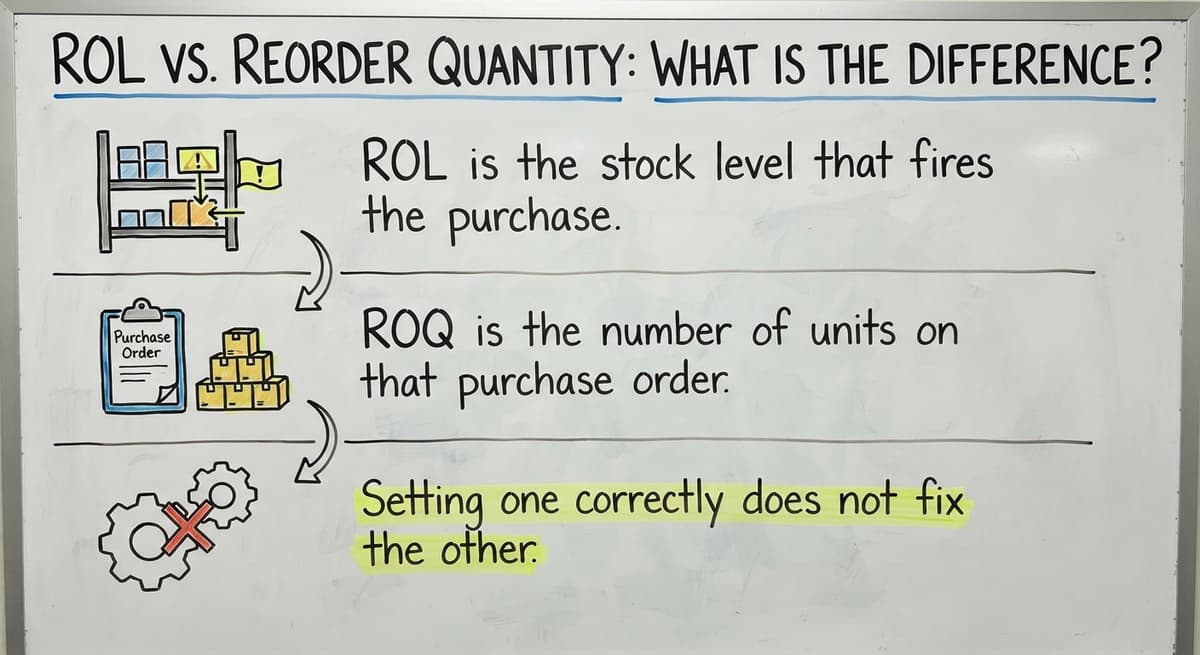
ROL answers one question: when do I order? Reorder quantity (ROQ) answers a separate question: how much do I order? These are 2 distinct settings in most inventory systems.
A reader who mixes them up may set the right trigger point but still over-order or under-order every time. Here is the distinction in plain terms:
- ROL is the stock level that fires the buy order trigger.
- ROQ is the number of units on that buy order.
- Setting one correctly does not fix the other.
Review both when you set up a new item in your system. A correct ROL with a wrong ROQ still produces the wrong result at the end of every replenishment cycle.
Can a Small Wholesale Distributor Use ROL Without a Large ERP System?
Yes, and most do not need one. A system built around how the operation already runs will serve a lean team better than a large platform that forces the business to adapt to the tool.
For teams already running on an accounting package, the right solution adds automated ROL tracking only where the manual process breaks down, without replacing the tools the team already knows. Connecting an existing accounting package to a warehouse inventory platform is one common example: the financial records stay where they are, and the inventory layer handles the reorder triggers.
Local rollout support matters here. The people configuring the system should understand the actual workflow, not just the software. NIST's Manufacturing Extension Partnership offers vendor-neutral guidance on supply chain process that applies directly to small and mid-size distributors evaluating their options.
The Cost of Staying on Manual Reorder Checks
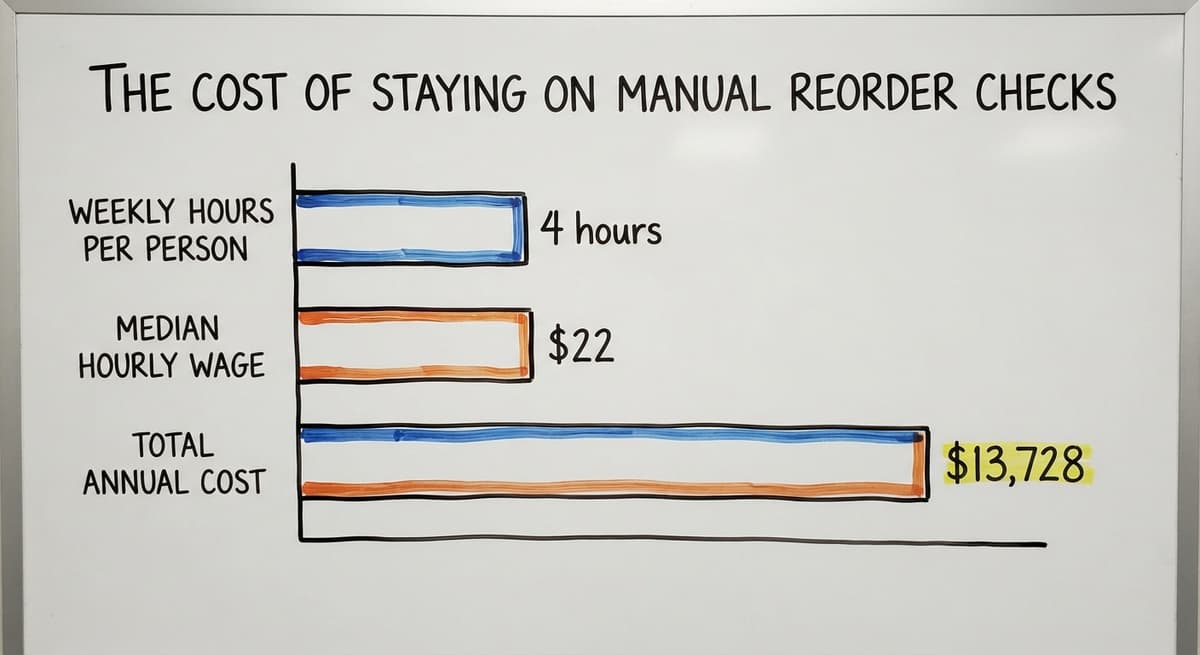
Consider the cost of doing nothing. 3 people each spending 4 hours a week on manual reorder checks, at the median stock clerk wage of roughly $22 an hour per the Bureau of Labor Statistics, adds up to about $13,728 a year in labor alone, before a single stockout or missed order. A system that automates those checks pays for itself quickly.
If your team is still managing reorder levels with spreadsheets or gut feel, the right next step is a conversation about replacing that process with a system built around your existing workflow. How to replace Excel-based inventory tracking with custom software is a practical starting point for operations that are ready to make that move.
Frequently asked questions
What are the functions of an inventory management system?
An inventory management system tracks stock levels, records incoming and outgoing goods, triggers buy orders when stock hits the reorder level, and generates reports on usage and carrying costs. More advanced systems also manage supplier lead times, flag slow-moving items, and sync with an accounting package so financial records stay current without manual entry.
What does ROP stand for in inventory?
ROP stands for Reorder Point. It means the same thing as ROL (Reorder Level): the stock quantity at which a new buy order should be placed. Some systems and textbooks use ROP, others use ROL. The formula and the logic behind both terms are identical.
How does safety stock factor into the reorder level formula?
Safety stock is added on top of the baseline reorder level to cover demand spikes and late deliveries. The full formula is: ROL = (Average Daily Usage × Lead Time) + Safety Stock. A simple way to estimate safety stock is to subtract your average daily usage from your maximum daily usage, then multiply that difference by your supplier lead time in days.
What is rolling inventory?
Rolling inventory, sometimes called cycle counting, is a method of counting a portion of stock on a rotating schedule rather than shutting down operations for a full physical count. Each section of the warehouse is counted in turn so the full inventory is verified over a set period, usually a month or a quarter, without a single disruptive count day.
What are the three phases in the inventory process?
The three phases are receiving, storage, and fulfillment. Receiving covers inspecting and recording incoming goods. Storage covers organizing and tracking stock in the warehouse. Fulfillment covers picking, packing, and shipping orders. Reorder level monitoring fits inside the storage phase: the system watches on-hand quantities and fires a buy order trigger before stock runs out.
What happens when the reorder level is set too high or too low?
A reorder level set too high causes excess inventory, higher carrying costs, and wasted warehouse space. A reorder level set too low causes stockouts, rushed orders, premium freight charges, and unhappy customers. Both errors cost money. The fix is to review each item's reorder level whenever demand patterns shift or a supplier changes their lead time.
How often should a business review and update its reorder levels?
There is no single right schedule, but a practical rule is to review an item's reorder level whenever a key supplier changes terms, when a product's sales velocity shifts noticeably, or at the start of a seasonal peak. At minimum, a full review of all items once or twice a year prevents the problem of reorder levels that were set years ago and never updated.
What is the difference between ROL and reorder quantity?
ROL (Reorder Level) answers the question of when to order: it is the stock quantity that triggers a buy order. Reorder quantity answers the question of how much to order: it is the number of units on that buy order. These are 2 separate settings. Getting the trigger point right does not automatically produce the right order size, so both figures need to be reviewed together.
Start with a free first look
A 30 minute call, your operation mapped, and a clear picture of what we would build. No obligation and nothing to install.
Book a callRelated guides
The rest of this guide, for the parts of the job this page does not cover.
Guides
Common questions
- What is the Role of Inventory Management
- What is Kanban System of Inventory Management
- What is Online Inventory Management System
- What is Sales and Inventory Management System
- What is Inventory Management System Project
- What is the Use of Inventory Management System
- What is the Difference Between Aggregate and Item Inventory Management
- What is Jit Inventory Management
- What is the Definition of Inventory Management
- What is an Important Factor in Inventory Management
- What is Abc Classification in Inventory Management
- What is Inventory Management in Working Capital
- What is Poor Inventory Management
- What is Inventory Management and Its Types
- What is the Main Purpose of Inventory Management
- What is Inventory Management in Pharmacy
- What is Effective Inventory Management
- What is Information Technology Inventory Management
- What is Inventory Management in Tally
- What is Risk Pooling in Inventory Management
- What is Inventory Management Mary Kay
- What is Stock Taking in Inventory Management