

Order Entry and Status Tracking
The system records each order as it comes in and shows its current status: placed, picked, packed, or shipped. Anyone on your team can check without calling the warehouse.

A sales and inventory management system is software that tracks what you sell and what you have in stock at the same time. When you record a sale, the stock count drops automatically. When you receive a shipment, it goes back up. Both sides stay accurate without anyone entering the same number twice. This article was reviewed in October 2026.
Book a callA sales and inventory management system links your order data to your stock data inside one tool. A sale reduces your available units. A receipt adds them back. You always see a single, current number instead of 2 separate records that drift apart over time. No spreadsheet, no manual sync, no guessing.
The system works as a feedback loop. Every transaction updates the count. Every count reflects the latest transaction. That connection is what makes it useful.
If you would rather not compare products, describe how your operation already works and we build the system around it.
No build cost. You see it running on your own process first, and the monthly subscription starts only once it is live.
Book a callA sales and inventory management system holds specific, concrete data. Knowing what it stores helps you decide whether it fits your operation.
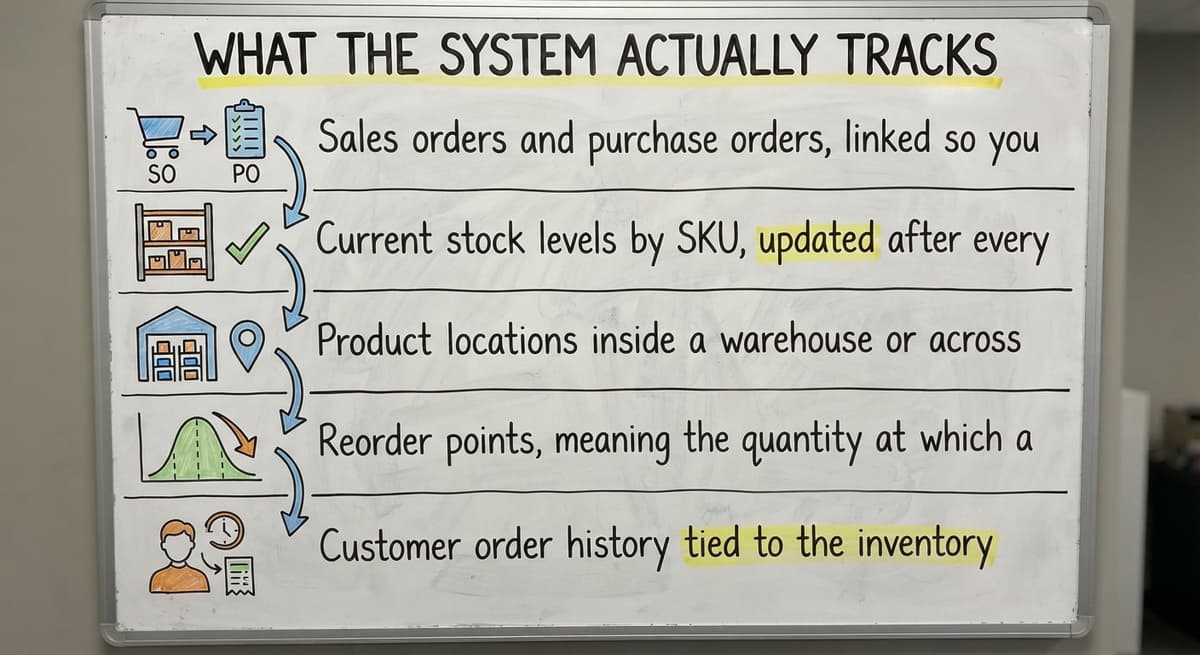
Here is what a well-built system keeps on record:
Barcode scanning drives most of this. As GS1, the global body behind supply chain standards, explains on its barcode standards page, barcodes give every product a unique identity that systems can read and record without manual input. That scan is what keeps counts accurate at speed.
Accurate counts carry a legal dimension that goes beyond working convenience. The IRS states in Publication 538: "To figure taxable income, you must value your inventory at the beginning and end of each tax year." Tracking stock is not optional. A system that keeps counts current gives you the data you need to meet that obligation without a separate end-of-year matching effort.
Sales and inventory connect through a real-time feedback loop: every confirmed sale pulls units from available stock, and every received shipment pushes units back in.
Without a connected system, those 2 updates happen in separate places. A wholesale distributor might record a sale in an accounting package and then update a spreadsheet by hand. By Thursday, the spreadsheet is 3 days behind. A rep sells 40 cases of a product that actually has 12 left. The oversell is discovered when someone walks to the shelf.
Off-the-shelf means fitting your process to the software. We do it the other way round, and the first look costs nothing.
Book a call
A connected system removes the lag between a sale and a count update. The moment the order is confirmed, the count drops. The moment the receiving dock scans a pallet, the count rises. No one has to reconcile 2 files at the end of the week. For a wholesale distributor moving dozens of SKUs across 2 or 3 locations, that real-time inventory link is the difference between reliable order fulfillment and constant firefighting.
Not every system is built the same, but a solid sales and inventory management system should do these things without requiring workarounds.
The system records each order as it comes in and shows its current status: placed, picked, packed, or shipped. Anyone on your team can check without calling the warehouse.
Stock levels update the moment a transaction is recorded. You see what is actually available, not what was available yesterday.
You set a minimum quantity for each SKU. When stock drops to that number, the system flags it. Some systems can generate a draft buy order automatically so your buyer does not have to catch it manually.
When a shipment arrives, the system compares what came in against the buy order. Discrepancies show up at once rather than surfacing weeks later during a count.
The system tells you what sold, what is left, and what needs to be ordered. That is the reporting most distributors actually use day to day. Anything beyond that is useful only if your team will look at it.

Wholesale distributors, fulfillment centers, and warehouse operators are the core users of a sales and inventory management system. These are businesses that buy product in bulk, store it, and sell it to other businesses.
The US Census Bureau's Monthly Wholesale Trade data tracks the inventories-to-sales ratio across wholesale firms nationally, which shows just how much capital wholesale operations tie up in stock. Keeping that stock count accurate is not a convenience; it is a financial control.
Small and mid-size operations use these systems just as much as large ones. A distributor with 5 to 30 employees moving product through a single warehouse has the same core problem as a large fulfillment center: sales data and inventory data need to stay in sync. The scale is smaller, but the gap is just as damaging. If your operation buys in bulk, stores product, and ships to business customers, a connected system fits your workflow.
No build cost. The subscription starts once it is live and doing the job, not before.
Book a call
Some pain points are easy to dismiss as normal. They are not. Each one below points to the same root cause: your sales data and your inventory data live in different places.
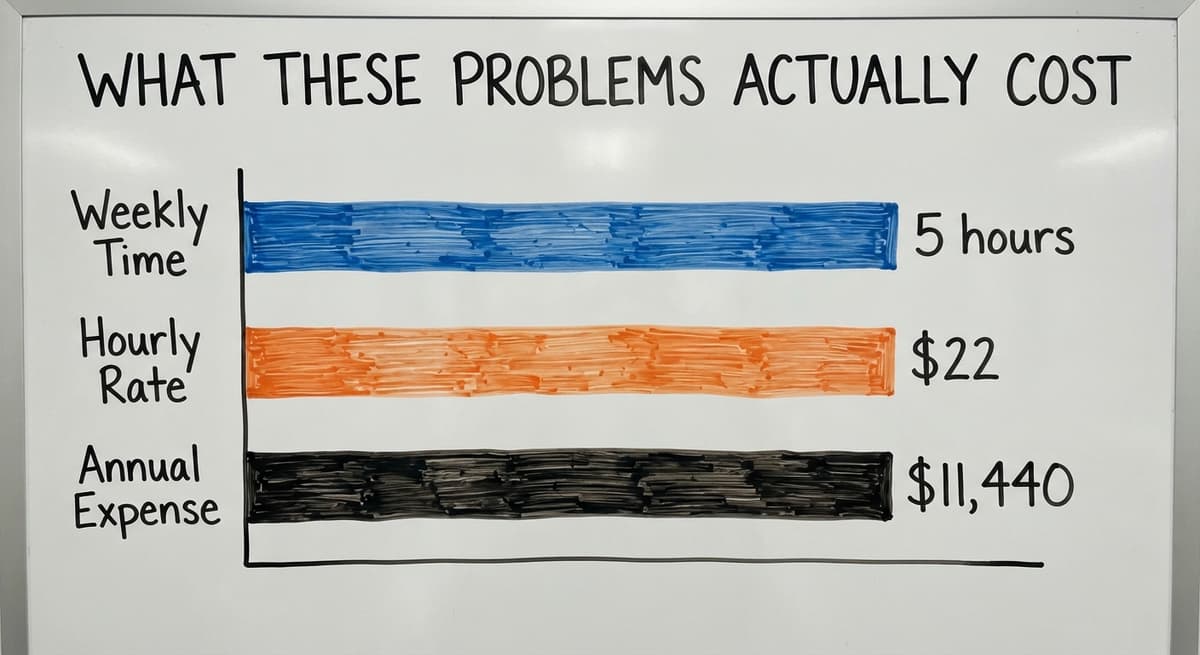
Consider the labor cost alone. If 2 people each spend 5 hours a week reconciling order and inventory records, and the Bureau of Labor Statistics reports that stock clerks and order fillers earn around $22 an hour, that is $11,440 a year spent on a problem a connected system solves at the source. There is also a compliance dimension: the US Federal Trade Commission's Mail and Telephone Order Rule needs sellers to ship within the time they promise or notify the customer. Overselling because your count is wrong puts you on the wrong side of that obligation.

Yes. A well-built system keeps your accounting software handling your financials while a separate working layer manages inventory tracking and order management.
Many small distributors already use dedicated accounting software for their books. Replacing it is not the goal and not necessary. Accounting software integration for distributors is a standard ability in purpose-built inventory systems. Invoices, payments, and cost of goods flow into your accounting software automatically. Your books stay accurate without anyone entering the same number in 2 places.
The concern most operators raise is disruption. A connected system that feeds your accounting software rather than replacing it keeps your accounting team working exactly as they do now. The change happens on the working side, where orders are entered, inventory is tracked, and receiving is recorded. Those updates then push the financial data across. For a small distributor, this setup means you get real-time inventory without a full accounting overhaul. The 2 tools each do what they are built for, and data moves between them without manual transfer.
Describe how the work runs today. We map it on a call and show you what it would look like built around that, before you spend anything.
Book a call
Off-the-shelf systems are designed for a generic operation. They cover common workflows well. If your operation matches those workflows, setup is fast and cost is lower upfront.
The problem is that most wholesale distributors do not run generic operations. You may have specific receiving steps, unusual product categories, or a pricing structure that does not map to a standard template. An off-the-shelf system forces your team to work around those gaps, and workarounds become the new spreadsheet problem.
Custom inventory software is built around how your operation already works. Your receiving process, your order flow, your customer pricing rules: the system reflects them from day one. That cuts training time and speeds adoption because staff are not learning a new way to do their job. Custom does not mean a long, expensive ERP rollout. A scoped custom build can target only the manual parts that are breaking down: order entry, inventory sync, and low-stock alerts. The NIST Manufacturing Extension Partnership offers vendor-neutral guidance on supply chain process, and the consistent finding is that smaller operations benefit most from targeted fixes rather than broad platform replacements. For a distributor with a specific workflow, a targeted custom build usually costs less in total than a year of staff time spent managing workarounds inside an off-the-shelf tool.
Start by mapping where your sales data and inventory data currently live. For most small distributors, the answer is dedicated accounting software, one or more spreadsheets, and email threads.
Once you have that map, identify the single breakdown that costs you the most. Is it overselling because counts are wrong? Lost orders because status lives in someone's inbox? Slow receiving because the dock and the system are not connected? Naming the specific problem tells you what to fix first.
From there, talk to a builder who works at your scale. Enterprise vendors will propose a platform built for operations 10 times your size. What you need is order management software for small distributors and a system scoped to your actual workflow, not a roadmap for a warehouse you do not run yet. If you want to know what a connected system would look like for your operation specifically, describe how your orders and inventory are managed today. That conversation takes 20 minutes and gives you a clear picture of where the gaps are and what closing them would need.
A sales and inventory system is software that records your sales and updates your stock counts at the same time. When a sale is confirmed, available units drop. When a shipment is received, they go back up. The result is one accurate number instead of separate records that drift apart.
The four types are periodic, perpetual, just-in-time, and consignment. Periodic systems count stock at set intervals, such as monthly. Perpetual systems update counts after every transaction in real time. Just-in-time systems order stock only when needed to reduce holding costs. Consignment systems track goods owned by a supplier but stored at your location. Most wholesale distributors benefit most from a perpetual system because it keeps counts current without manual cycle counts.
The core skills are attention to detail, comfort with data entry, and the ability to read basic reports. In a warehouse setting, knowing how to operate a barcode scanner and match a buy order to a receipt matters more than any software certification. A connected system reduces the skill burden by automating the count updates, so staff spend less time reconciling and more time on physical operations.
There is no single answer that fits every operation. The right tool depends on your scale, your existing accounting setup, and how your warehouse actually runs. Options range from spreadsheets at the simplest end, to inventory apps that connect to your accounting package, to cloud platforms built for mid-size distributors, to fully custom systems built around your specific workflow. For a small wholesale distributor already using dedicated accounting software, the deciding factor is usually how well the system integrates with your accounting data and whether it can be set up without a long rollout.
No. Enterprise-grade planning systems are built for large, complex operations and carry costs and timelines that do not fit a small distributor. The core features you need, real-time stock counts, order tracking, low-stock alerts, and accounting software integration, can be delivered in a scoped build or a purpose-built inventory tool designed for smaller operations. The goal is to fix the specific breakdown in your workflow, not to adopt a platform built for a company ten times your size.
Every confirmed order should reduce your available stock count before the item leaves the shelf. That reservation prevents a second order from selling the same units. When the order ships, the system marks those units as fulfilled. When a return comes back, the count adjusts again. Without that connection, fulfillment runs on guesswork and oversells become routine.
A 30 minute call, your operation mapped, and a clear picture of what we would build. No obligation and nothing to install.
Book a callThe rest of this guide, for the parts of the job this page does not cover.