


Perpetual Inventory System
A perpetual inventory system updates stock records each time an item is received, moved, picked, or sold.
Book a callWhat Is a Perpetual Inventory System?
A perpetual inventory system is a method, not one product. The count stays current at all times. It does not wait for a physical count. Your records change as stock moves. A warehouse can run one with a spreadsheet, an add-on, or custom software.
Reviewed November 2026.
How Does a Perpetual Inventory System Work?
The cycle has 5 steps: receive, put away, pick, ship, and adjust. Each step changes the record right away. Staff then check the records against the shelves from time to time. The GS1 barcode standards are the shared rules behind most scans. Scans are how steps get recorded. The parts below show each step in turn.
We build it for your operation, and the first look is free
If you would rather not compare products, describe how your operation already works and we build the system around it.
No build cost. You see it running on your own process first, and the monthly subscription starts only once it is live.
Book a callWhat Are the Basic Parts of a Perpetual Inventory System?
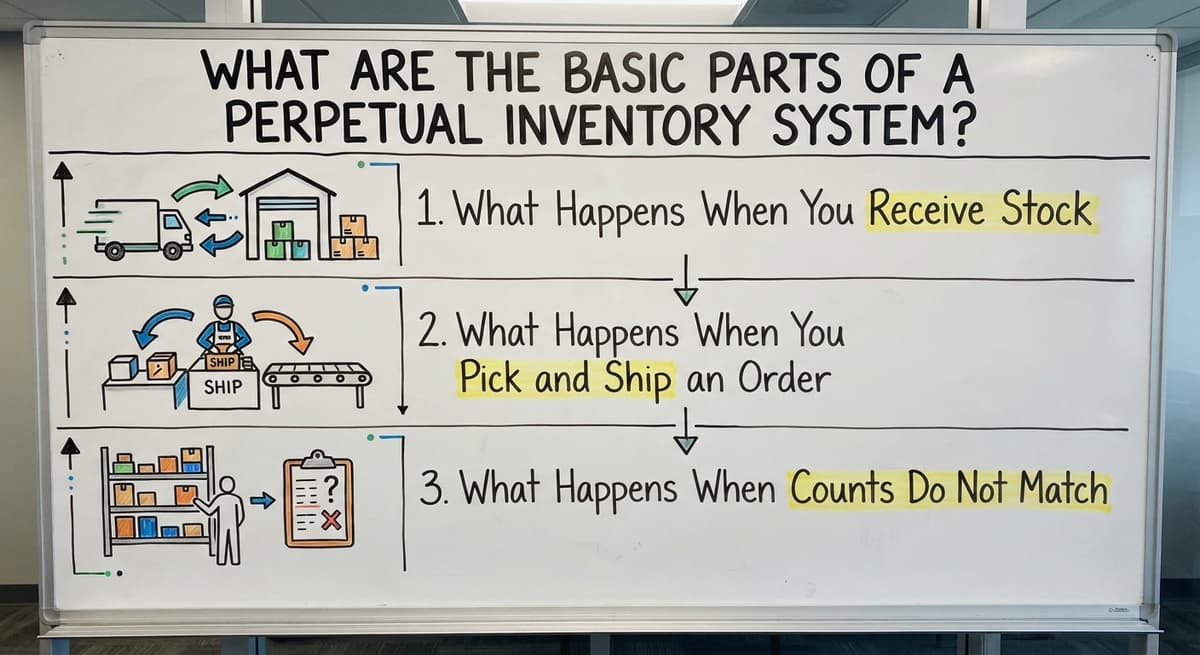
A perpetual inventory system has 4 basic parts. Each one must be in place before the count can stay true.
- Item records list each SKU, a stock keeping unit, with its unit of measure such as each, case, or pallet.
- Locations name every bin, shelf, and zone in the building.
- A capture step records each move by scan or by entry on a screen.
- One shared database holds the numbers so all staff see the same count.
Group items by classification of inventory, such as finished goods and supplies. Miss one part and the count drifts.
What Happens When You Receive Stock
Receiving is where good data starts. Staff match the delivery to the buy order. They add quantity and cost to the record at once. Then they assign a bin location. Short or damaged items get a flag on the spot. A pallet that is not logged at the dock is a pallet the system cannot sell.
What Happens When You Pick and Ship an Order
The count drops when a pick is confirmed or the order ships. The system also splits allocated stock from available stock. Allocated stock is held for an order but still on the shelf. This split stops you from selling what is not there. The FTC publishes a rule on shipping when you said you would. A true count helps you keep that promise.
What Happens When Counts Do Not Match
A mismatch needs an adjustment, and every adjustment needs a reason. Inventory adjustments are changes that fix the record to match the shelf. Common causes of drift are:
- Staff miskey a quantity.
- Stock gets damaged and nobody logs it.
- A box sits in the wrong bin.
- A customer return never reaches the record.
Fix the cause, not just the number.
Perpetual vs. Periodic Inventory
A periodic inventory system counts stock at set times, such as month end. A perpetual system keeps a running count. Neither one removes the need to look at the shelves. Compare perpetual inventory vs physical inventory this way: one is a record, the other is a check.
| Method | When the count is current |
|---|---|
| Periodic | Only right after a physical count |
| Perpetual | After every move, all day |
The running count shows problems sooner.
Not sure this is the right shape for your operation
Describe how the work runs today. We map it on a call and show you what it would look like built around that, before you spend anything.
Book a callWhy Do Wholesalers and Warehouses Use Perpetual Inventory?
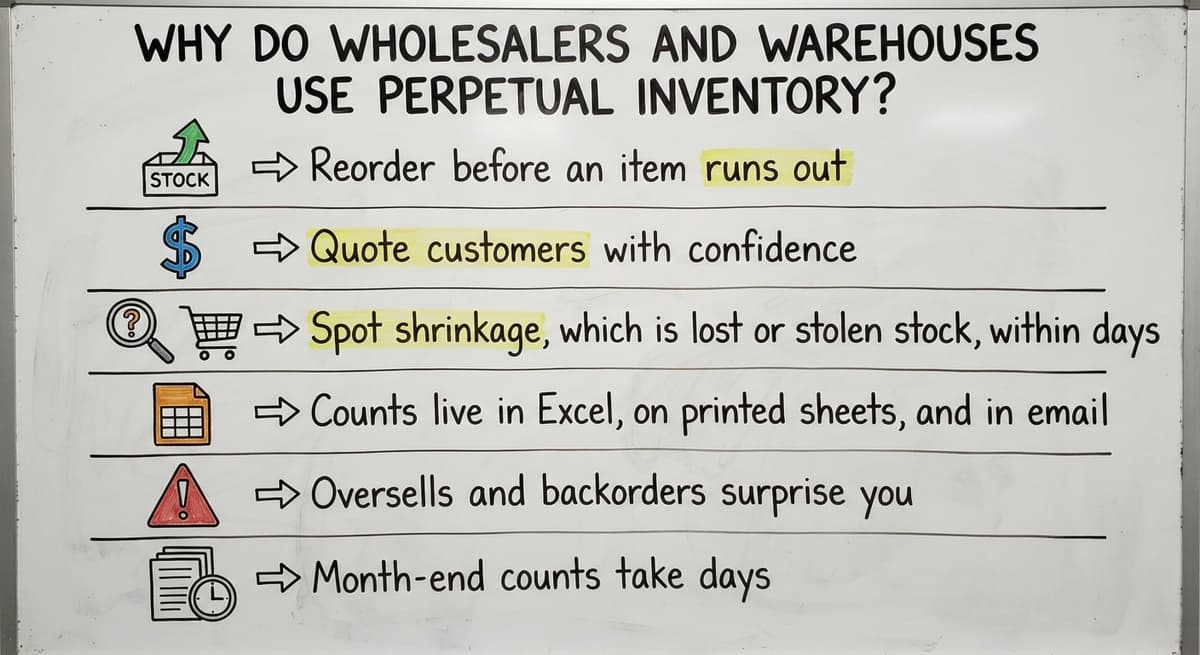
Wholesalers use perpetual inventory because stock levels are visible without a walk of the floor. The Census Bureau tracks wholesale inventories and sales each month. Your own shelves matter more to you. A live count lets you:
- Reorder before an item runs out.
- Quote customers with confidence.
- Spot shrinkage, which is lost or stolen stock, within days.
Good wholesale inventory data turns guesses into answers.
Is Your Current Method Holding You Back?
Your method holds you back if staff ask each other what is in stock. Watch for 4 more signs:
- Counts live in Excel, on printed sheets, and in email.
- Oversells and backorders surprise you.
- Month-end counts take days.
- Only one person knows how the sheet works.
Two or more signs mean the manual method has run its course.
What Does a Perpetual System Not Fix on Its Own?
A perpetual inventory system does not fix bad habits at the dock. Bad entries make bad data. The system needs steady scanning or entry. It needs clear rules on who may adjust stock. It takes discipline, not just software. Staff who skip a scan today create a count error next week.

Why Does Cycle Counting Keep the Numbers Honest?
Cycle counting is a habit of counting a few items or bins each day or week. Start with fast movers and high-value items. Cycle counting replaces one big shutdown count. Track how many counts match the record over time. A small daily count finds errors while the cause is still fresh.
How Do You Tell If Your Data Is Accurate?
Inventory accuracy, also called inventory record accuracy, is the share of items where the system count matches the shelf. Track it weekly from cycle counts. Review adjustments by cause, such as damage or miskeys. Set a simple target for your own team. Do not borrow a benchmark you cannot check. A rising match rate shows the habits are working.

How Does Costing Fit Into a Perpetual Inventory System?
Cost of goods sold is the cost of items you sold. A perpetual system updates it on each sale. FIFO means first in, first out: the oldest cost leaves first. Average cost spreads total cost over all units. Say you buy 10 units at $5, then 10 at $6, and sell 12. FIFO gives $62. Average cost gives $66.
The IRS states in Publication 538: "To figure taxable income, you must value your inventory at the beginning and end of each tax year." Pick your method with your accountant.

Do You Need a Big ERP?
No. A small operation can run perpetual inventory without a large system. Match the tool to how work already flows. Avoid long, costly rollouts. NIST offers vendor-neutral supply chain guidance for small makers and distributors.
An accounting package that tracks quantities, such as inventory management features in popular small business accounting software, works for a time. Many warehouses outgrow it for bins, picks, and receiving. Keep it for accounting. Send summary totals there and keep the detail elsewhere. Check your plan before you count on a feature.
The comparison is easier when one option is built for you
Off-the-shelf means fitting your process to the software. We do it the other way round, and the first look costs nothing.
Book a call
What Are the Ways to Run a Perpetual Inventory System?
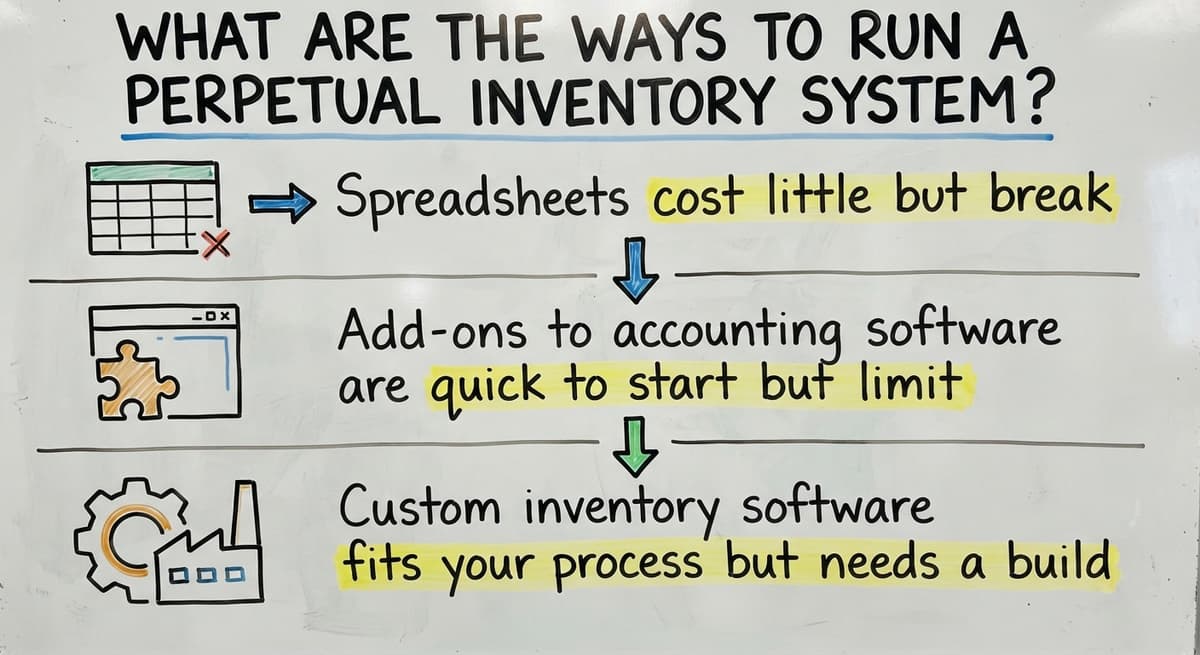
There are 3 main ways to run a perpetual inventory system. Each has a trade-off.
- Spreadsheets cost little but break when one person leaves or one cell is wrong.
- Add-ons to accounting software are quick to start but limit bins and picking.
- Custom inventory software fits your process but needs a build partner.
There is no single best inventory software. Your process and staff size decide. Warehouse inventory management software and warehouse inventory tracking software cover this range.
What Can Custom Software Do for Your Operation?
Custom software is built around how your team already works. It replaces only the manual parts. Your accounting software stays where it is useful for accounting. It works at small scale. The Software Society builds the software, the website, and the search presence as one team. That means one partner, not 3.
Which Tools Help: Scanners and Labels?
Barcode scanning cuts keying errors. Labels and handheld scanners are the core tools. Start with receiving and picking. Phones or tablets work for small teams. A scanner takes a second. Typing a SKU takes longer and invites mistakes. Cheap labels on every bin pay off fast.

How Do You Set Up a Perpetual Inventory System?
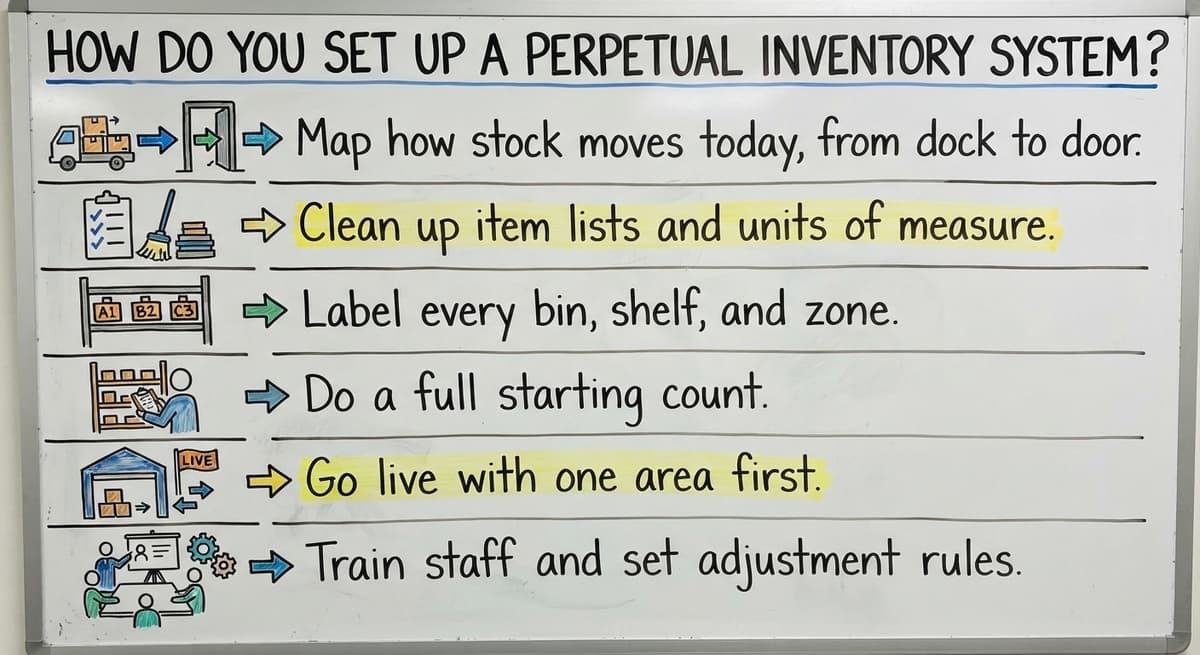
You set up a perpetual inventory system in 6 steps. Warehouse inventory management systems follow the same order:
- Map how stock moves today, from dock to door.
- Clean up item lists and units of measure.
- Label every bin, shelf, and zone.
- Do a full starting count.
- Go live with one area first.
- Train staff and set adjustment rules.
A spreadsheet that costs 3 people 6 hours a week at $22 an hour is $20,592 a year. The Bureau of Labor Statistics publishes pay for stock clerks, so use your own wage.
What Mistakes Should You Avoid?
Four mistakes sink new systems:
- Skipping the starting count.
- Letting anyone adjust stock.
- Tracking too much detail at first.
- Forcing staff into a process that does not fit.
Start small and keep rules plain.

What Does a Project Look Like with a Local Partner?
A project starts with a walk-through of your operation. In Columbus, Ohio, we visit the floor. For other places, we start with a call. We build the smallest useful piece first. Then we grow step by step. You see a working piece before you pay for the next one. Warehouse inventory systems built this way fit your crew, not the other way around.
See it running on your own process first
No build cost. The subscription starts once it is live and doing the job, not before.
Book a call
Next Steps
A perpetual inventory system gives you current counts, fewer surprises, and better choices. Describe how stock moves in your building today. Tell us where the sheets break. The Software Society can talk through a small first step with you.




Frequently asked questions
How to calculate FIFO perpetual inventory system?
List each buy batch with its date, units, and unit cost. When you sell, take units from the oldest batch first. Multiply those units by that batch cost. Move to the next batch when the first runs out. Add the parts to get cost of goods sold. Update after every sale.
What do you mean by perpetual inventory system in cost accounting?
In cost accounting, a perpetual inventory system records the cost of each buy and each sale as it happens. The inventory account and cost of goods sold stay current all period. You do not wait for a period-end count to learn what you sold. Counts only confirm the books.
What is a perpetual inventory system in pharmacy?
In a pharmacy, the same method applies. Each drug received or dispensed updates the count. Many pharmacies also track lot numbers and expiry dates. Rules for controlled drugs come from state and federal law. Confirm what you must keep with your pharmacist in charge or a compliance adviser.
Do I still need physical counts?
Yes. The record can drift from the shelf through damage, misplaced stock, or missed scans. Physical checks find that drift. With a perpetual system you count small groups often through cycle counting instead of closing the building once a year.
Is perpetual inventory only for big companies?
No. A small warehouse or distributor with 5 staff can run one. You need item records, labeled locations, a way to log each move, and a shared place for the numbers. A spreadsheet can start the job. Custom software grows with you.
Can I keep my accounting package?
Yes. Keep your accounting software or a similar package for the books. Send summary totals there. Keep bin, pick, and receiving detail in a system built for it. That split keeps accounting simple and warehouse data clean. Check your own plan before you rely on a feature.
How accurate is a perpetual inventory system?
Accuracy depends on your habits, not the software. Each missed scan or unlogged return adds error. Measure the share of items where system and shelf match, using cycle counts each week. Set your own target and watch the trend.
Start with a free first look
A 30 minute call, your operation mapped, and a clear picture of what we would build. No obligation and nothing to install.
Book a callRelated guides
More on the same work.
Guides
- Perpetual Stock System
- Inventory Management System for Manufacturing
- Inventory Bin System
- Manual Inventory System
- Automated Inventory Management System
- Web Based Inventory Management System
- Best Inventory Management System
- Cloud Based Inventory Management Systems
- Periodic Inventory Systems
- Hospital Stock Management System
- Top 10 WMS Systems
- Types of Stock Control Systems
- Best Inventory Software
- Classification of Inventory
- Excess Inventory
- Closed for Inventory
Common questions
- Perpetual Inventory vs Physical Inventory
- What is Kanban System of Inventory Management
- What is Online Inventory Management System
- What is Sales and Inventory Management System
- What is Rol in Inventory Management System
- What is Inventory Management System Project
- What is the Use of Inventory Management System
- How to Keep Track of Inventory