


What Is Jit Inventory Management
JIT inventory management means ordering goods only when a customer needs them, not before. JIT stands for just-in-time. Instead of filling shelves with stock you may not sell for weeks, you order smaller amounts more often. The goal is to keep less cash sitting on shelves and more cash available to run your business.
Reviewed and updated: October 2026
Book a callJIT Inventory Management in Plain Terms
Traditional stocking works like a pantry. You buy in bulk, fill the shelves, and wait for demand to arrive. JIT flips that. You order what you need right before you need it.
Think of a warehouse with 500 shelf slots. Traditional logic says fill them all. JIT logic says leave most of them empty and only pull product in when an order triggers a buy. The shelf stays lean. The cash stays in your account.
JIT does not mean running with zero stock. It means matching what you hold to what you actually sell, as closely as your supplier relationships allow.
We build it for your operation, and the first look is free
If you would rather not compare products, describe how your operation already works and we build the system around it.
No build cost. You see it running on your own process first, and the monthly subscription starts only once it is live.
Book a callThe Core Goal: Cut Inventory You Do Not Need
The primary aim of JIT is to cut carrying costs, which are the expenses of holding stock you have not sold yet. Those costs include storage space, insurance, spoilage, and cash that cannot be spent elsewhere.
For small distributors, every square foot of warehouse space costs money. Every dollar sitting on a shelf is a dollar that cannot pay a supplier early or fund a new product line.
GS1, the global standards body behind barcode and supply chain data, notes that accurate item spotting is the foundation of any reliable count, stating that "barcodes are the most widely used automatic spotting technology in the world" (GS1). Without that accuracy, you cannot know what you truly hold, and you cannot run JIT safely.
The real goal is freeing working capital without creating stockouts.

How Does Just-in-Time Inventory Management Work in Practice?
JIT follows a tight cycle: a customer order arrives, the system sends a buy order to the supplier, the supplier delivers quickly, and the goods ship. That cycle works when timing is exact and demand signals are live.
Here is the basic sequence:
- A customer places an order.
- The system reads current stock levels and triggers a buy order automatically.
- The supplier ships a small quantity fast.
- Goods arrive, get checked in, and go straight out the door.
Real-time inventory data replaces gut-feel reordering. You are not guessing based on last month's spreadsheet. You are acting on what the system shows right now.
Manual processes break this cycle. When inventory counts live in a spreadsheet and buy orders go out by email, the lag between trigger and action kills the timing advantage that makes JIT work.
The comparison is easier when one option is built for you
Off-the-shelf means fitting your process to the software. We do it the other way round, and the first look costs nothing.
Book a call
What JIT Requires to Work
JIT is not a strategy you bolt onto a broken process. It needs 4 things in place before it delivers any benefit.
- Reliable suppliers who can deliver small quantities quickly and consistently, because one late shipment stalls every order behind it.
- Accurate, real-time stock visibility so the system knows what is actually on hand, not what was counted last Tuesday.
- Current demand data, not a quarterly report, but live order flow that shows what is selling right now.
- A connected system that links orders, stock levels, and purchasing without anyone re-entering data by hand.
Running JIT on disconnected tools, separate spreadsheets, email chains, and a standalone accounting package, is like driving with a fogged windshield. The destination is right, but you cannot see what is ahead. The data quality has to come first.

Benefits of JIT for Wholesale and Distribution Operations
When the right conditions are in place, JIT delivers real, measurable gains for wholesale and distribution businesses.
- Lower carrying costs because you hold less stock for shorter periods.
- Less cash tied up in slow-moving or dead stock that occupies shelf space and generates no revenue.
- Faster inventory turns, which means the same dollar cycles through your business more times per year and improves cash flow.
- Reduced spoilage and obsolescence risk, especially relevant for products with expiration dates or short trend cycles.
- Smaller warehouse footprint, which matters directly when you pay rent by the square foot.
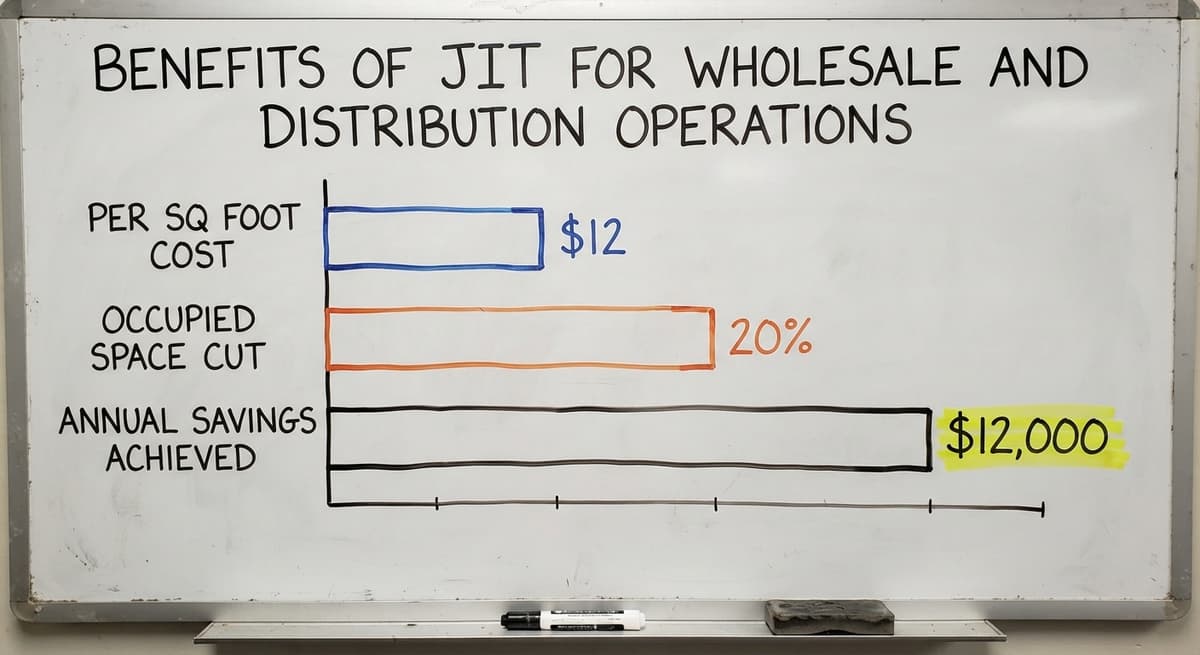
For a small distributor renting 5,000 square feet at $12 per square foot per year, cutting occupied space by 20% saves $12,000 annually before touching a single carrying cost line.
Risks and Trade-Offs to Know Before You Start
JIT trades buffer stock for efficiency, and that trade has a real downside. Understanding the risks is as important as understanding the benefits.
Supply chain disruptions hit harder when you carry little safety stock. A port delay, a supplier quality hold, or a weather event can leave you with nothing to ship.
Supplier reliability becomes a critical dependency. One vendor who misses a delivery window can stall your entire fulfillment operation for that product line.
Not every product category suits JIT. High-volume staples that move every day may still need a safety stock buffer. JIT logic works best on slower or more predictable SKUs.
The system is only as good as the data feeding it. Inaccurate stock counts create stockouts even when the purchasing logic is sound. The IRS needs accurate inventory valuation: "To figure taxable income, you must value your inventory at the beginning and end of each tax year" (IRS Publication 538). That same discipline protects your JIT triggers from firing on bad numbers.
Weigh the efficiency gains against your specific risk exposure before committing.
See it running on your own process first
No build cost. The subscription starts once it is live and doing the job, not before.
Book a call
JIT vs. Traditional Inventory: A Quick Comparison
The 2 approaches solve different problems, and most operations end up using both.
| Factor | Traditional Stocking | JIT | |
|---|---|---|---|
| Order size | Large, infrequent | Small, frequent | |
| Stock on hand | High | Low | |
| Carrying cost | Higher | Lower | |
| Supply disruption risk | Lower | Higher | |
| Data requirement | Basic | Real-time | |
| Cash tied up in stock | More | Less |
Traditional stocking protects against supply gaps but costs more to keep. JIT cuts holding costs but demands better data and tighter supplier relationships.
Most small distributors land somewhere between the two. They keep safety stock on fast-moving SKUs and apply JIT logic to slower items where the carrying cost is hardest to justify. A reorder point set on real demand data, rather than a fixed calendar schedule, is often the practical middle ground.
Where Manual Systems Break Down in a JIT Environment
JIT depends on instant, accurate information. Spreadsheets and printed pick sheets cannot deliver that.
When inventory counts live in a file on someone's desktop, that file is already out of date the moment a shipment arrives or a pick goes out. A buy order sent by email has no live link to the stock level that triggered it. By the time the supplier confirms and ships, the demand picture has changed.
An accounting package tracks financials well but was not built to manage real-time warehouse movements or fire reorder triggers based on live stock levels. It records what happened. JIT needs a system that acts on what is happening now.
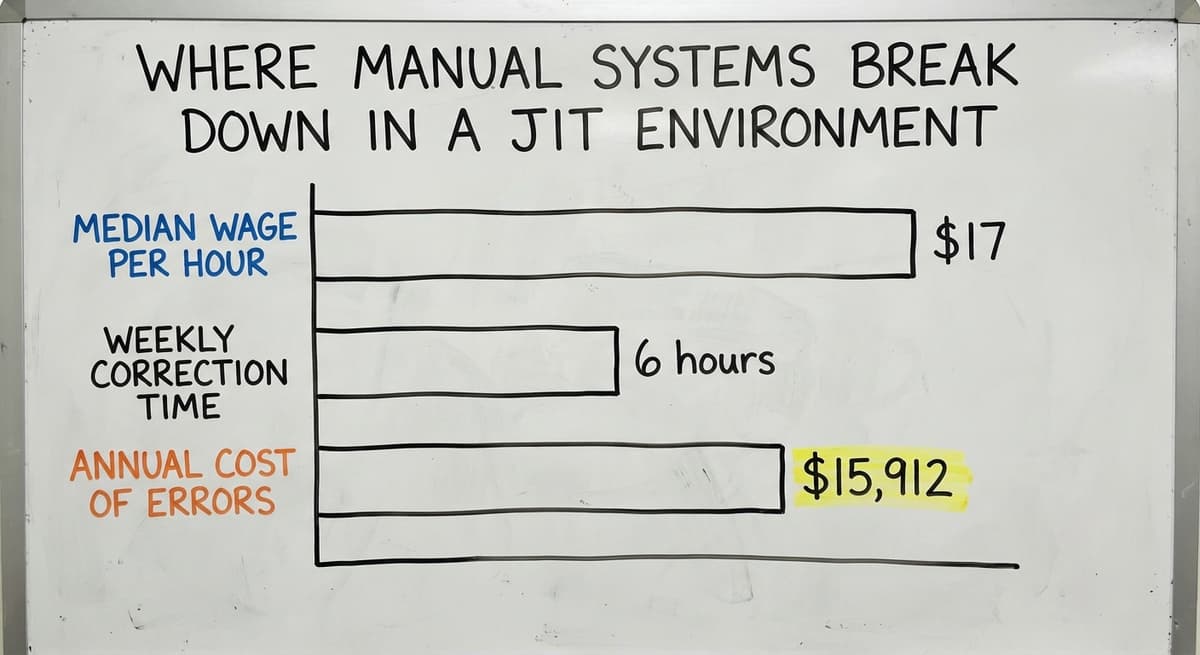
The US Bureau of Labor Statistics reports that stock clerks and order fillers earn a median wage of around $17 per hour (BLS). Three staff spending 6 hours a week correcting manual entry errors costs roughly $15,912 a year, and that figure does not count the stockouts those errors cause.
A connected working system, one that links orders, stock levels, and purchasing in a single source of truth, removes that lag. It does not have to replace your accounting package or force a full platform migration. It sits between your order flow and your purchasing, and it makes the timing that JIT needs actually possible.
Inventory management software for small distributors built around this model connects the moving parts without adding complexity that a lean team cannot manage.
Is JIT Inventory Management Right for Your Operation?
JIT fits best when your suppliers are reliable, your demand is reasonably predictable, and storage space is a real constraint. Those 3 conditions together make the trade-off worthwhile.
The fit gets harder when lead times are long, demand swings sharply by season, or you depend on a single source for a key product. In those cases, carrying some buffer stock is not inefficiency. It is risk management.
Ask yourself 3 questions before deciding:
- Can your main suppliers deliver small quantities within a window that matches your order cycle?
- Do you have live, accurate stock counts, or are you working from a count that is days or weeks old?
- Does your current system connect orders, inventory, and purchasing, or do those live in separate places?
If the answer to any of those is no, the starting point is not JIT. The starting point is fixing the data and the connections that JIT depends on. Custom warehouse management systems built around your actual workflow can close those gaps without forcing a tool change across the whole business.
The right inventory approach depends on your product mix, your supplier network, and the quality of the data you have right now. JIT is a method, not a mandate. Start with an honest read of your own operation.
Frequently asked questions
What does JIT stand for in inventory management?
JIT stands for just-in-time. It describes a method of ordering and receiving goods only when they are needed to fill a customer order, rather than stocking large quantities in advance.
What are the main benefits of JIT inventory for a small distributor?
The main benefits are lower carrying costs, less cash tied up in unsold stock, faster inventory turns, and a smaller warehouse footprint. For operations paying rent by the square foot, those savings are direct and measurable.
What does a business need in place before JIT can work?
Four things: reliable suppliers who can deliver quickly, accurate real-time stock counts, current demand data, and a system that connects orders, inventory, and purchasing without manual re-entry. Missing any one of these makes JIT unreliable.
What is JIT with example?
A wholesale food distributor using JIT does not stock 500 cases of a product on the shelf. Instead, when a retailer places an order, the distributor's system triggers a buy order to the supplier for exactly that quantity. The supplier delivers within 24 to 48 hours, and the cases ship directly. The distributor never holds more than a day or two of stock at any time.
What are the disadvantages of JIT?
The main disadvantages are vulnerability to supply chain disruptions, dependence on supplier reliability, and the need for high-quality real-time data. If a supplier is late or a stock count is wrong, JIT creates stockouts faster than a traditional buffer-stock model would. It also needs more frequent ordering, which can increase transaction costs if not managed through an automated system.
What is the difference between EOQ and JIT?
EOQ, or economic order quantity, calculates the ideal order size to balance ordering costs against carrying costs. It still results in holding stock, just in a mathematically optimized amount. JIT takes a different approach: it aims to remove holding costs by ordering only when demand actually arrives. EOQ is a formula applied to traditional stocking. JIT is a philosophy that challenges the assumption of holding stock at all.
What companies use the JIT system?
There is no single answer. JIT originated in large-scale manufacturing and is used across industries from automotive assembly to grocery distribution. For small and mid-size distributors, the relevant question is not which large brands use it but whether your supplier relationships and data quality can support it. The method scales down, but only when the underlying conditions scale with it.
Why do spreadsheets and manual processes make JIT difficult to execute?
JIT needs the purchasing trigger to fire the moment stock drops to a set level. A spreadsheet updated once a day, or once a week, cannot do that. The lag between the real stock level and the recorded one means orders go out late, suppliers ship late, and customers wait. Reorder point automating for small warehouses solves this by connecting the trigger directly to live inventory data rather than a manually updated file.
Start with a free first look
A 30 minute call, your operation mapped, and a clear picture of what we would build. No obligation and nothing to install.
Book a callRelated guides
The rest of this guide, for the parts of the job this page does not cover.
- What is the Difference Between Aggregate and Item Inventory Management
- What is an Important Factor in Inventory Management
- What is Abc Classification in Inventory Management
- What is Inventory Management in Working Capital
- What is Inventory Management and Its Types
- What is the Main Purpose of Inventory Management
- What is Effective Inventory Management
- What is Information Technology Inventory Management
- What is Risk Pooling in Inventory Management
- What is Inventory Management Mary Kay
- What is Stock Taking in Inventory Management
- What is Bin Number in Inventory Management
- What is the Goal of Inventory Management Quizlet
- What is the Implication of Proper Inventory Management
- What is Omni-channel Inventory Management
- What is Inventory Management and Its Importance
- What is the Importance of Eoq in Inventory Management
- What is the Importance of Quality Inventory Management
- What is Inventory Management Explain Techniques of Inventory Management
- What is Mean by Inventory Management
- What is Inventory Management Meaning in Hindi
- What is Inventory Management and Why is It Important
- What is the Rationale for Inventory Management Quizlet
- What is the Purpose of Inventory in Operations Management